

Here's the number that reframed how I think about this whole market.
As of May 2026, 19.8% of US businesses were using AI in their operations. That's from the Census Bureau's Business Trends and Outlook Survey — the largest ongoing survey of American firms, not a vendor poll.
One in five. In 2026. After three years of the loudest technology cycle of my lifetime.
But that's not the interesting part. The interesting part is buried in the same release: between December 2025 and May 2026, AI use increased among firms with at least 20 employees and didn't change significantly among firms with fewer than 20 employees.
The AI adoption gap isn't closing. It's widening. And it's widening along a line that runs straight through the customer base of every agency, consultancy, and freelancer reading this.
I've spent the last stretch looking at the research on this — the government data, the McKinsey and MIT studies, the SMB surveys — and comparing it against what I actually see people building. What stood out is how badly the popular story about the gap misdescribes it.
The gap is not a technology problem. It's not even really a budget problem. It's a translation problem, and translation is a service you can sell.
This guide covers what the AI adoption gap actually is, what the honest numbers say, why it persists, and — the part I care most about — a concrete framework for closing it for a client and getting paid properly to do it.
What the AI adoption gap actually is
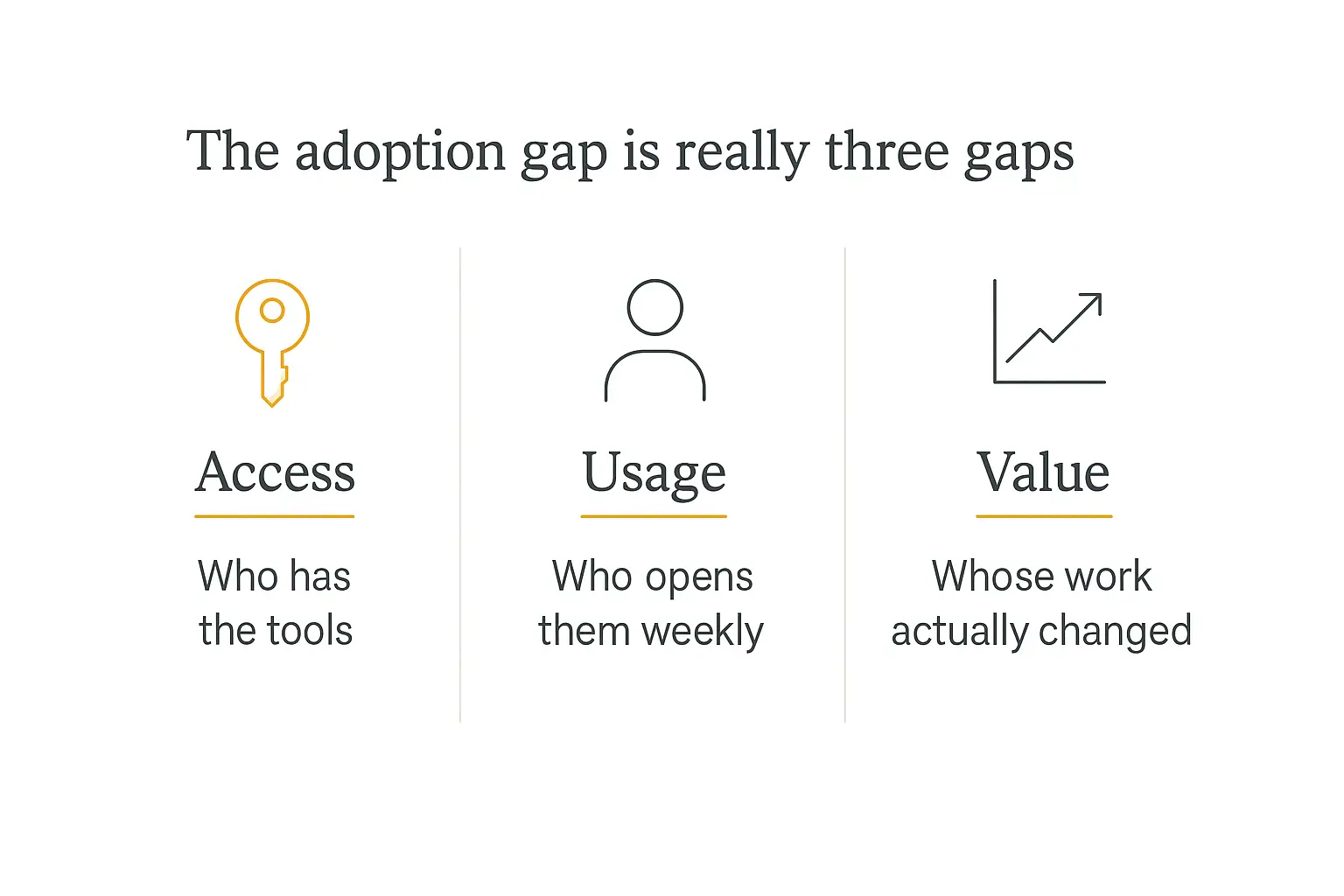
The AI adoption gap is the distance between an organization's access to AI and its realized value from AI.
That definition sounds academic until you see how large the distance is in practice.
Most people use the phrase to mean one of three very different things, and conflating them is why so much commentary on this topic is useless:
- The access gap — big companies have AI tools, small companies don't. This is the classic firm-size divide.
- The usage gap — the tools are bought and deployed, but employees don't actually use them.
- The value gap — the tools are used, but nothing measurable changed. No hours saved, no revenue moved, no line on the P&L.
These are not stages of the same problem. They have different causes and completely different fixes.
Handing someone a license closes the access gap and does nothing for the other two. Running a training session might close the usage gap and still leave the value gap wide open, because people can use a tool enthusiastically for work that never mattered.
The value gap is where the money is, both in terms of what's being wasted and what you can charge to fix it.
The numbers: how wide is the AI adoption gap in 2026
Let me lay out the data, because the AI adoption gap is one of those topics where everyone has a vibe and almost nobody has a source.
The access gap is real and it tracks company size
The Census Bureau's May 2026 analysis is the cleanest picture we have, because BTOS surveys hundreds of thousands of firms rather than a self-selecting panel of executives.
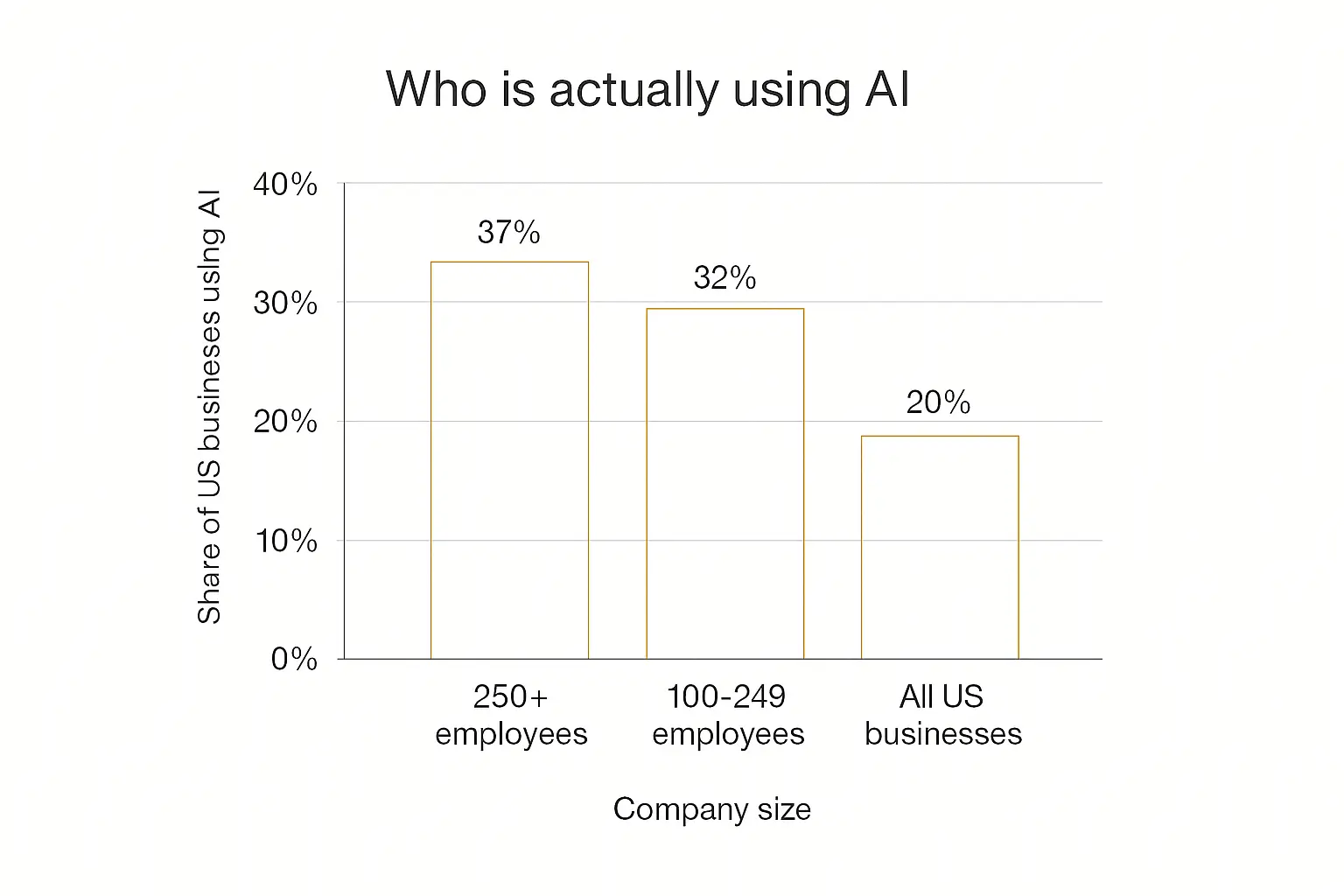
The breakdown:
- 37% of businesses with 250+ employees use AI
- 32% of businesses with 100–249 employees
- 19.8% across all US businesses
- Under 20% for firms with fewer than 20 employees — and flat over the last six months
Sector variation is just as sharp. AI use hit 39.7% in Information and 33.9% in Finance and Insurance, against roughly 14% in Retail Trade.
The Federal Reserve has been tracking the same trend, and the picture is consistent: adoption is concentrated in large firms and information-heavy sectors.
So if your clients are 5-to-50-person professional services businesses — the bread and butter of most agencies — you are selling into the exact segment where adoption has stalled.
The usage gap is bigger than the access gap
Here's where it gets uncomfortable for the "just buy everyone a license" crowd.
IBM's 2026 Global CEO Study found that 85% of employees have access to at least one AI tool at work, but only about 25% use it regularly. That's a 60-point gap between capability and behavior.
Sit with that. In the companies that already won the access race, three out of four employees with an AI tool on their desk aren't meaningfully using it.
Buying the software was the easy part, and it turned out to be the part that didn't matter.
The value gap is the expensive one
MIT's NANDA initiative published a study titled "The GenAI Divide: State of AI in Business," and one statistic from it went genuinely viral: 95% of generative AI pilots delivered no measurable P&L return.
The study drew on roughly 150 leader interviews, 350 employee surveys, and 300 public implementations. Forbes covered the findings in detail.
Two honest caveats, because I'd rather you cite this accurately than get caught out by a skeptical client: the report was not peer-reviewed, and it leans on self-reported outcomes. Treat 95% as a directional signal, not a physical constant.
The mechanism MIT identified matters more than the headline number anyway. They called it the learning gap — most deployed AI systems don't retain feedback, don't adapt to context, and don't improve with use. They're static tools dropped into dynamic workflows, so they stall.
McKinsey's State of AI research lands in the same place from a different angle. Roughly 88% of organizations report using AI in at least one function, but only 39% report any enterprise-level EBIT impact — and most of those say AI accounts for under 5% of EBIT.
Nearly two-thirds haven't started scaling beyond pilots at all.
McKinsey's most useful finding, for our purposes, is what separates the winners: the strongest correlation with EBIT impact is fundamental workflow redesign. Not model choice. Not budget. Redesigning how the work happens.
Small businesses are more optimistic than the enterprise data suggests
The SMB picture is genuinely different, and more hopeful.
Upwork's Research Institute surveyed 750 US business leaders in Q1 2026 and found 62% were very or extremely confident handing high-stakes tasks to AI agents, with 79% planning to increase AI spending.
But the gains were incremental — mostly under 25% productivity improvement — and data privacy topped the barrier list at 49%.
The read I take from this: SMB leaders are willing. They're not resistant, they're not scared, they're not waiting for the technology to mature. They just don't know what to build or how to make it stick.
That's a services gap wearing a technology costume.
Why the AI adoption gap exists (it isn't the technology)
Every serious study of this lands on organizational causes, not technical ones. Here are the five that actually explain the data.
1. Tools are bought at the org level and used at the task level
A CTO buys a hundred seats. The seats get provisioned. A launch email goes out.
Nobody ever mapped a single one of those seats to a specific recurring task that a specific person hates doing. So the tool sits there, general-purpose and unattached to anyone's actual Tuesday.
The Forbes Business Council put this sharply: adoption metrics, when tracked at all, are usually session counts and tokens used — neither of which tells you whether anyone's work actually changed.
The organization rewarded the announcement, not the outcome.
2. Generic tools require the user to do the hard part
A blank chat box is a magnificent piece of technology and a terrible piece of workflow design.
It hands the user the entire burden: figure out what to ask, how to phrase it, what context to paste in, how to check the output, and where to put the result. That's real cognitive work, and most people have jobs already.
This is precisely why prompt engineering for agents matters more than prompt engineering for chat. A well-built agent has the instructions, the context, and the output format baked in. The user just brings the input.
3. Employees are hiding their AI use
This one is my favorite because it's so counterintuitive and so well documented.
Ethan Mollick at Wharton coined the term "secret cyborgs" for employees quietly using AI to do their jobs faster without telling anyone.
He described the dynamic on X: companies write elaborate AI policies focused on negative use cases, so employees become too scared to discuss how they use AI or to touch the corporate LLM. They just use their own and don't share what they learn.
In another post he noted that after talks, people routinely come up to confess they've automated part of their job and don't want anyone to know.
The incentive is obvious. If revealing a 40% productivity gain gets you 40% more work — or makes you look 40% more replaceable — you keep quiet.
So the org's measured adoption reads near zero while actual adoption is substantial, invisible, ungoverned, and running through personal accounts on company data. That last part should worry anyone thinking about AI agent security risks.
4. Nobody redesigned the workflow
Most AI deployments bolt a tool onto a process designed for humans doing every step manually.
The report still gets assembled the same way, just with a drafting step that's slightly faster. The approval chain is unchanged. The handoffs are unchanged. So the end-to-end cycle time barely moves, and cycle time is what the client actually feels.
Remember McKinsey's finding: workflow redesign is the single strongest predictor of EBIT impact. Almost nobody does it, because it's uncomfortable and political and doesn't fit in a two-week pilot.
5. There's no feedback loop
MIT's learning gap again. A deployed agent that never gets corrected, never gets its knowledge base updated, and never gets its instructions tuned degrades against a business that keeps changing.
It was accurate in March. It's subtly wrong in September. One bad answer in front of a client and the whole thing gets quietly abandoned.
This is an operational problem, which means it's a retainer, which is very good news if you're selling services.
Which clients have the widest gap (and the best odds)
Not every business with low AI adoption is a good client. Some are stalled for reasons you can fix in a month; others are stalled for reasons you can't fix at all.
The data gives you a decent targeting filter. Look for the intersection of low current adoption and high document-and-decision density — businesses that run on text, rules, and repetition rather than physical work.
The profile I'd prioritize:
- 10–100 employees. Below 10, there's often no budget and no process to redesign. Above 250, you're competing with an internal IT function and a procurement cycle.
- Professional services, finance-adjacent, or heavily regulated. High document volume, repetitive written output, and real cost attached to slow response.
- Already paying for software they underuse. A client with a CRM nobody updates has a workflow problem you can solve, and a budget line that already exists.
- One visible bottleneck the owner complains about unprompted. If they name the pain in the first meeting without you fishing for it, the engagement will close and the agent will get used.
- A named internal champion. Not necessarily technical. Just someone who wants this to work and has enough standing to change how a team operates.
The clients I'd be cautious about: businesses where the owner wants "AI" as a marketing claim rather than an operational change, and businesses with no measurable process at all. You can't prove you closed a gap in an organization that's never measured anything.
Sector data helps here too. Retail Trade sits near 14% adoption while Information is at 39.7% — but low adoption alone isn't opportunity. A retail client with a high-volume customer-question problem is a great fit; one that mostly needs shelves stocked isn't.
The agency opportunity: gap-closing is the best services business of 2026
Put the pieces together and the shape of the opportunity is hard to miss.
Clients are willing to spend — 79% plan to increase AI investment. They have low adoption. They have no internal capability. The barrier they cite most is skills, not budget. And roughly half of small firms using AI report zero investment in implementation: no training, no change management, no dedicated time.
That's a market where demand is high, supply of competence is low, and the failure rate of DIY attempts is brutal. Forbes made the case that small business AI failure is fundamentally a leadership and implementation problem.
Managed services data backs this up: AI services within managed services are growing around 59% annually versus roughly 13% for traditional managed services.
Here's the strategic point I want to make, though, and it's the thing most agencies get wrong.
Do not sell "AI implementation." Sell a closed gap.
"We'll help you adopt AI" is a proposal that invites a procurement process and a comparison to four other vendors. "Your intake process takes eleven days and we'll make it two" is a proposal that invites a start date.
The first sells a technology. The second sells the outcome the technology is incidental to. Clients buy the second one, and they pay more for it.
If you're building this into a business rather than a side project, our guide on how to start an AI agent agency covers the positioning and delivery model in more depth, and selling AI agents to local businesses covers the $300–$1,500/month end of the market specifically.
A five-step framework to close the gap for a client
This is the part I'd actually hand to someone starting an engagement tomorrow.
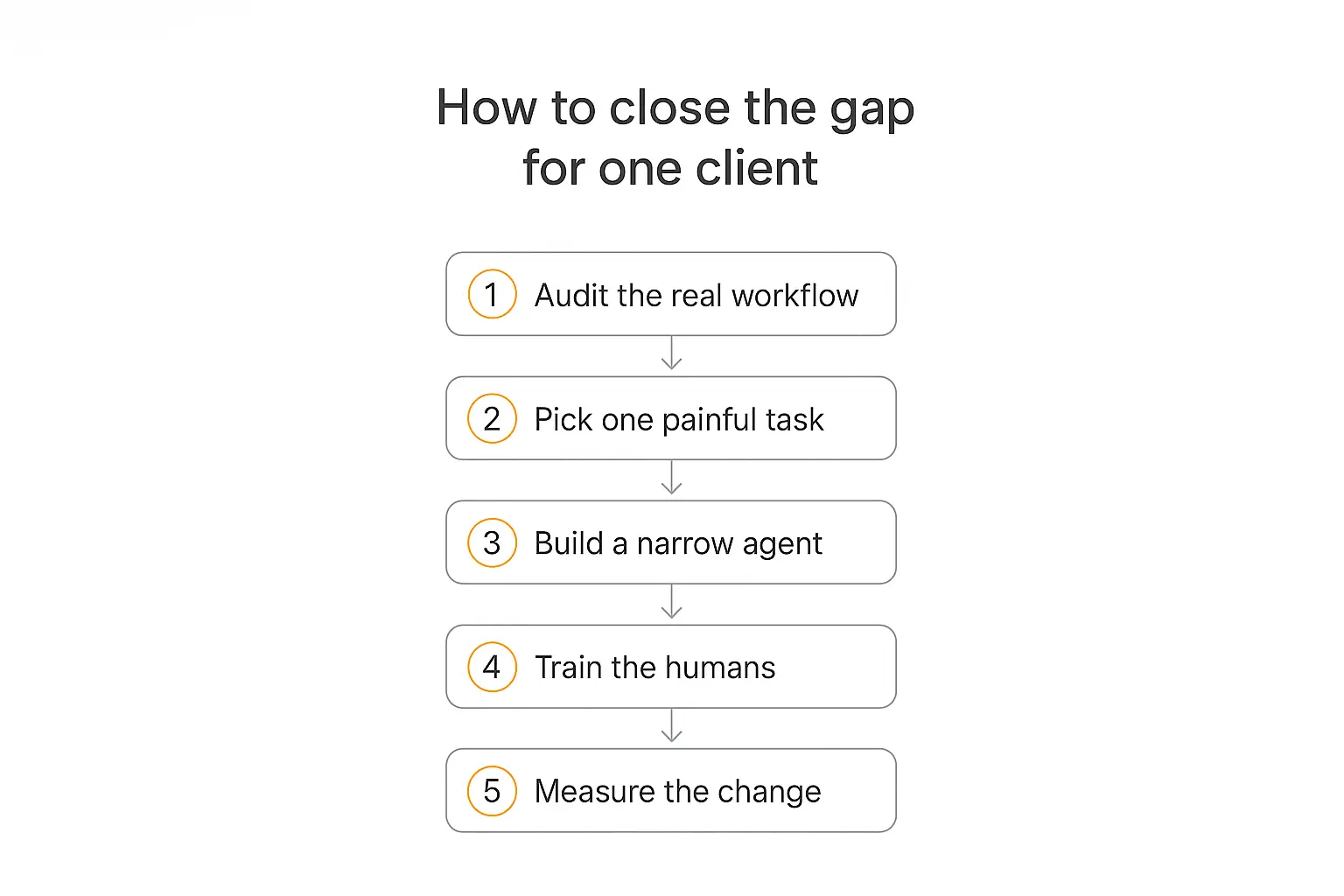
Step 1 — Audit the real workflow, not the documented one
Every business has two versions of every process: the one in the SOP and the one that actually happens.
You need the second one. Sit with three people who do the work and ask them to narrate a real recent instance, start to finish, including the parts they're slightly embarrassed by.
What you're listening for:
- Tasks done more than weekly — frequency is what makes automation compound
- Tasks with a stable input and a stable output format — these are the automatable ones
- Waiting time — where does work sit in a queue? That's usually the real cycle-time killer, not the doing
- The workarounds — the spreadsheet someone maintains on the side is a map of exactly where the official system fails
- Existing secret cyborgs — ask directly, non-judgmentally, who's already using ChatGPT for this. Promise no consequences. You'll find them, and they're your internal champions
Our AI workflow audit checklist is a good structured starting point if you want something to work through with a client.
One rule I'd hold to: audit before you scope. Fixed-fee audits that convert to build engagements are the cleanest way to sell this, because the audit itself is valuable even if they never buy the build.
Step 2 — Pick one painful task, not one impressive one
The instinct is to pick the flashiest possible first project. Resist it.
Score every candidate task on four axes:
| Criterion | What you want | Why |
|---|---|---|
| Frequency | Daily or weekly | Value compounds; monthly tasks take a year to prove ROI |
| Pain | Someone visibly dislikes it | Pain creates a willing adopter instead of a reluctant one |
| Tolerance for error | Reviewable output | First projects should never be irreversible or client-facing |
| Measurability | A number that exists today | You cannot prove you closed a gap you never measured |
The winner is usually boring. Drafting the same category of email. Summarizing intake forms. Turning meeting notes into a structured CRM entry. Answering the forty questions clients ask over and over.
Boring is good. Boring is frequent, low-risk, and measurable.
If you want a menu of proven starting points, what AI agents actually are and the choosing your first agents guide both lay out patterns that reliably work on a first engagement.
Build the agent before the proposal is signed.
A working demo of the client's own workflow closes better than any deck.
Step 3 — Build a narrow agent, not a general assistant
This is the step where the adoption gap is actually won or lost.
A general assistant puts the burden back on the user. A narrow agent carries it for them.
Concretely, a narrow agent has:
- A single job, described in one sentence the client would recognize
- The context pre-loaded — the client's tone, policies, product details, and past examples live in the agent's knowledge base, not in the user's head
- A fixed output format, so results drop straight into the next step of the process
- A constrained input — ideally a short form, not an open chat box
- The connections it needs to read and write where the work already lives
That last point is where most DIY attempts die. An agent that produces a great answer the user then has to copy-paste into three systems hasn't removed the work, it's relocated it.
This is most of what we built Pickaxe around. You describe the agent's job, attach the client's documents as a knowledge base so answers stay grounded in their material, and wire up Actions so the agent can actually read from and write to the tools the client already uses — Gmail, Sheets, Notion, a CRM, whatever's in the stack.
Then you deploy it where the work happens. A branded portal, an embed on their site, Slack, WhatsApp, email, or the API. Same agent, whichever channel the team already lives in.
The reason the deployment surface matters so much: every context switch you introduce is a place adoption leaks. An agent that lives in Slack where the team already is will out-adopt a better agent that lives behind a separate login, every time.
On model choice — I'd default to a mid-tier model for most client work and only reach for a frontier model where the task genuinely needs the reasoning. You can compare what's available on the models page, and mixing models across a workflow is worth understanding once you're running several agents.
Step 4 — Train the humans (this is half the engagement)
Remember: 85% access, 25% usage. If you build a perfect agent and hand it over with a Loom video, you have built a very expensive access gap.
What actually works:
- Train in the workflow, not in a conference room. Walk through three real live cases with the actual people who'll use it, on a normal working day.
- Name an owner. One person internally who is responsible for this agent. Diffuse ownership means no ownership.
- Set the norm explicitly. Leadership has to say out loud that using this is expected, and that finding a faster way to work is rewarded rather than punished. This is the direct antidote to secret cyborgs — and it costs nothing.
- Publish what good looks like. Three example inputs and outputs, visible to everyone, beats twenty pages of documentation.
- Give it two weeks of hand-holding. Be in the channel. Answer the "is it supposed to do this?" questions fast. Weeks one and two decide whether this becomes habit or shelfware.
The Axios framing — that the adoption gap is becoming a communications problem — is right, and it's an underrated part of what you're being paid for.
Step 5 — Measure the change against a real baseline
You cannot prove you closed the gap without a before number, and the before number has to be captured before you build. This is the single most common miss.
Capture, at minimum:
- Time per instance — how long the task takes today, measured, not estimated
- Volume — how many times per week it happens
- Cycle time — request to completion, including waiting
- Quality proxy — error rate, revision count, or complaint volume
- The business metric it feeds — response time, conversion, retention, whatever it actually rolls up to
Then re-measure at 30 and 90 days. Our guide on measuring AI agent ROI has the formulas, and AI agent analytics covers what to instrument on an ongoing basis.
Track adoption itself as a first-class metric too: weekly active users as a share of intended users. If that's under 40% at day 30, you have a usage gap and no amount of model quality will fix it.
What to build first: the highest-ROI agent patterns
Across the engagements I've seen work, a handful of patterns come up again and again. These are the ones I'd reach for on a first project.
The internal knowledge agent
Connect the client's documentation, policies, and past work to an agent that answers employee questions.
Low risk, immediately useful, and it produces a beautiful side effect: the questions people ask it are a live map of where the client's documentation is broken.
Best measured by: time spent answering repeat internal questions, and new-hire ramp time.
The intake and qualification agent
Inbound lead or request comes in. The agent structures it, enriches it, scores it against the client's criteria, and routes it.
This one is easy to prove because response time is already tracked in most CRMs and it's a metric owners care about viscerally. See building an AI lead qualification agent for the full build.
The client-facing FAQ agent
Deflects the repetitive questions that eat a support inbox. Deploy on the site or in whatever channel clients already use.
Higher risk than internal agents because it's customer-visible, so it needs tighter guardrails and a clean escalation path to a human. Worth it, because the savings are obvious on a support ticket report.
The recurring report agent
Runs on a schedule, pulls from the client's data sources, and delivers a written summary to an inbox or a channel.
The magic here is that it requires zero adoption behavior. Nobody has to remember to use it. It just shows up. For clients with a genuine usage-gap problem, scheduled agents are the highest-completion-rate thing you can ship.
The document generation agent
Proposals, contracts, briefs, summaries — anything where the client produces the same document shape repeatedly with different content.
Measurable, frequent, and the output is reviewable before it goes anywhere, which makes it safe as a first build.
How to price gap-closing work
The pricing mistake I see most often: charging for the build as a one-off and walking away.
That's leaving the majority of the value on the table, and it also guarantees the agent decays — which eventually becomes a story about how your work didn't stick.
The structure that works:
| Phase | Model | Typical range | What it buys |
|---|---|---|---|
| Audit | Fixed fee | $1,500 – $5,000 | Workflow map, opportunity scoring, baseline metrics, recommendation |
| Build | Fixed fee per agent | $3,000 – $15,000 | One agent, integrated, deployed, with training delivered |
| Manage | Monthly retainer | $500 – $3,000/mo | Monitoring, tuning, knowledge updates, reporting, new use cases |
The retainer is the actual business. It's recurring, it's high-margin once the agent is stable, and it's genuinely necessary — MIT's learning gap is a real phenomenon and somebody has to be the feedback loop.
Frame it that way to the client, too. Not "ongoing support" but "the thing that keeps this from becoming one of the 95%."
Two notes on the economics. First, charge for the outcome, not the hours — if you save a client 30 hours a month, the value is the 30 hours, not your build time. Our guides on pricing AI services and AI agent pricing models go deep on this.
Second, know your delivery cost. Model usage is a real line item, and the difference between a well-scoped agent and a sloppy one can be several multiples on token spend. The real cost of AI agents breaks down where that money goes and how to control it.
If you're delivering under your own brand, white-label options let you put the client's or your own branding on the portal rather than shipping them to a third-party product they'll eventually wonder why they're paying you for.
How to prove you actually closed the gap
Clients don't renew retainers because the technology is impressive. They renew because a number they care about moved.
Report on three layers, in this order:
Layer 1 — Adoption
Weekly active users as a percentage of intended users. Sessions per user per week. Share of eligible work going through the agent.
This is the layer that tells you whether anything else is even possible. It's also the leading indicator — adoption falls before value falls.
Layer 2 — Operational
Time per task versus baseline. Cycle time versus baseline. Volume handled. Error and revision rate. Escalation rate for client-facing agents.
This is where you show the mechanism. "Intake used to take 40 minutes and now takes 6" is a sentence the client can repeat to their own board.
Layer 3 — Business
Hours reclaimed converted to cost. Revenue affected. Retention or response-time changes. Headcount avoided, where that's the honest framing.
Be conservative here, deliberately. Under-claiming at layer 3 and letting the layer 2 numbers speak builds far more trust than an aggressive ROI model the client's CFO can poke holes in.
One thing worth doing that almost nobody does: report the failures too. Which use cases didn't work, what you turned off, what you'd do differently. It costs you nothing and it makes every positive number you report credible.
Five mistakes that keep the adoption gap open
1. Starting with the technology instead of the workflow
Choosing the model, the framework, and the architecture before you've watched anyone do the actual job. The technology decisions are mostly interchangeable; the workflow decisions aren't.
2. Building one agent that does everything
Scope creep in agent form. The client asks for "an assistant for the sales team" and you build something that does six jobs badly instead of one job excellently.
Ship one narrow agent. Add the second after the first is adopted. If you eventually need several working together, multi-agent systems are a real pattern — but earn your way there.
3. Skipping the baseline
Building first and trying to reconstruct the "before" number later. You will never get an honest one, and without it your renewal conversation is a vibes conversation.
4. Treating training as a deliverable instead of a phase
A handover document is not training. Two weeks of being present while people build the habit is training. Price it in.
5. Ignoring governance until something goes wrong
Where does client data go? Who can access which agent? What's logged? What happens when the agent is confidently wrong in front of a customer?
Sort this out at build time. It's a fraction of the work then, and it's the thing that ends engagements when it's discovered late. Our AI agent compliance checklist covers the GDPR, HIPAA, and EU AI Act angles.
Frequently asked questions about the AI adoption gap
What is the AI adoption gap in simple terms?
It's the distance between having AI and getting value from AI. In 2026 that shows up three ways: large firms adopt at roughly 37% while all US businesses sit near 20%; 85% of employees have AI access but only about 25% use it regularly; and while 88% of organizations use AI somewhere, only 39% see any enterprise-level EBIT impact.
Is the AI adoption gap closing?
Not at the small end. Census data shows AI use rising among firms with 20+ employees between December 2025 and May 2026 while staying flat for firms under 20 employees. The access gap by company size is widening, not narrowing.
Why do most AI pilots fail?
MIT's research points to the learning gap — systems that don't retain feedback or adapt to context stall once they hit real workflows. McKinsey's data points the same direction from the other side: the strongest predictor of EBIT impact is fundamental workflow redesign, which is exactly what most pilots skip.
What's the biggest barrier for small businesses?
Skills and implementation capacity, not budget or willingness. Roughly half of small firms using AI report no investment in training or change management, and the OECD's cross-country SMB research puts the skills gap at the top of the barrier list — especially for firms with no in-house tech function.
How long does it take to close the gap for one client?
For a single narrow agent on a well-chosen workflow: two to four weeks to build and deploy, then 30 days of adoption support before the numbers mean anything. Expect 90 days before you have a defensible ROI story.
Do I need to be technical to sell this?
No, and that's much of the point. The scarce skills here are workflow diagnosis, change management, and measurement. No-code platforms handle the build — see no-code AI agent builders for the landscape — and build vs buy vs wait is a useful frame for deciding what to assemble yourself versus what to source.
The bottom line
The AI adoption gap is the most misdiagnosed problem in business technology right now.
It gets described as a technology gap, so people respond by buying more technology. It's actually a translation gap — the distance between a general-purpose capability and a specific business's specific work.
Translation is not something you can buy a license for. It's a service. Someone has to sit with the people doing the work, find the task worth automating, build something narrow enough to be genuinely useful, get humans to change a habit, and prove with numbers that it mattered.
That's five distinct competencies, and almost no small or mid-sized business has all five in-house. The ones that do are pulling away — that's the whole story the Census data is telling.
Which is a good position to be in if you're the person selling those five competencies.
Start with one client and one workflow. Measure it before you touch it. Build one narrow agent, not a platform. Be in the room for the first two weeks. Report the number at 30 days.
Do that once, credibly, and you'll have a case study that sells the next five engagements — and a retainer that pays for itself while it keeps the gap closed.
If you want to build the first one, you can start building on Pickaxe — agents, knowledge bases, Actions, and client-ready deployment in one place. The pricing page has the plan details if you're working out delivery costs for a client engagement.