

Here's the number that made me rethink how I budget for AI: in early 2026, Uber reportedly burned through its entire annual AI coding budget by April. Not because anyone did anything wrong — the agents just quietly did their job, token by token, until the bill arrived.
That story isn't unusual anymore. It's the new normal.
The uncomfortable truth about AI agent cost and token economics is that agents are wildly more expensive to run than the chatbots most people mentally compare them to. And the cost is hard to see coming, because it hides inside a mechanism most builders never look at: the token.
I've spent a lot of time this year helping people build agents on Pickaxe and watching where their spend actually goes. This guide is everything I wish someone had explained to me before I shipped my first autonomous agent — what a token really costs, why agents eat so many of them, and the specific levers that bring a runaway bill back under control.
Let's start with the mechanism, because if you understand the token, everything else follows.
What Is a Token, and Why It's the Only Unit That Matters
A token is the atomic unit of text a language model reads and writes. Roughly, one token is about four characters of English — so "cost" is one token, "token economics" is about four or five.
Every model on the market bills by the token. Not by the request, not by the minute — by the token. And it bills in two directions:
- Input tokens — everything you send into the model: your prompt, the system instructions, the conversation history, retrieved documents, tool definitions.
- Output tokens — everything the model writes back.
Output tokens are almost always more expensive than input tokens, because generating text is more compute-intensive than reading it. But here's the twist that surprises most people: for AI agents, the input side is usually the bigger bill.
That inversion is the whole story of agent cost. To see why, you have to understand what makes an agent different from a chatbot.
Why AI Agents Cost So Much More Than Chatbots
A chatbot is a single round trip. You ask, it answers, done. One input, one output, one bill.
An agent is a loop. It reads a task, decides on an action, takes it, reads the result, decides on the next action, and repeats — sometimes dozens of times — until the job is done.
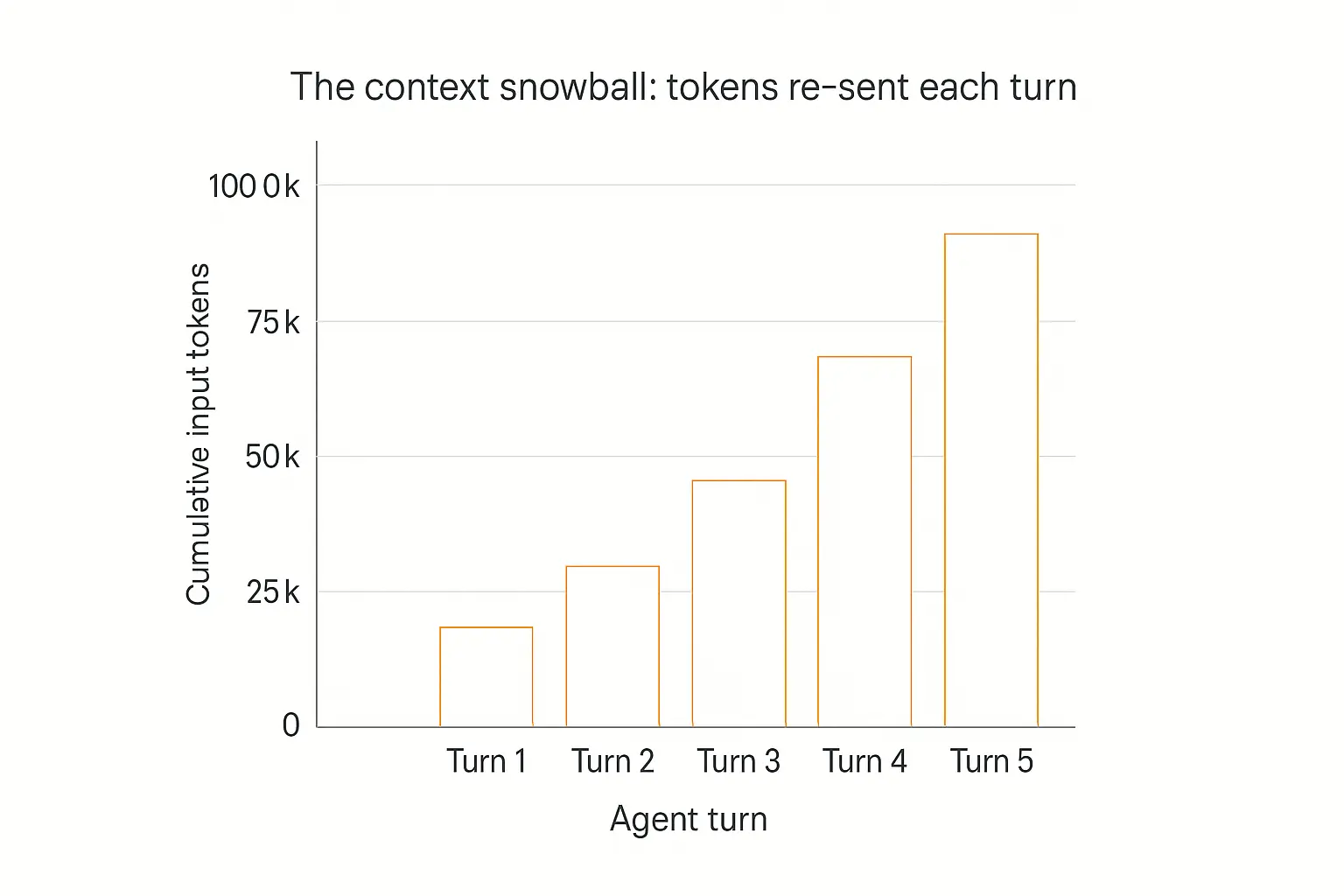
The problem is what happens to the context on each pass. The model has no memory between calls, so the agent has to re-send the entire accumulated history every single step: the original task, plus every action, plus every tool result so far. Then it does it again on the next step, with even more history.
Researchers at the Stanford Digital Economy Lab call this "one big pricey context snowball" — and they found that agentic tasks can consume roughly 1,000x more tokens than a comparable chat or code-reasoning task.
Read that again. Not 10x. Not 50x. Up to a thousand times more tokens for the same underlying question, because the context gets re-billed on every turn.
A separate analysis from the team at LeanOps put a more conservative floor on it: agents burn around 50x more tokens than chats in typical workloads. Either way, the direction is the same — agents are a different order of magnitude.
And it gets worse, because the cost is unpredictable. Stanford found up to 30x variation in cost for the same agent running the same task, depending on the path it happened to take. As researcher Jiaxin Pei put it, "Agents are not capable of predicting their own token costs." When your own tool can't estimate its bill, budgeting gets hard fast.
What Agents Actually Cost: The Real Numbers
Let's put dollar figures on this. Token prices are quoted per million tokens, split into input and output. Here are representative published API prices for the major frontier and budget models as of mid-2026:
| Model | Input / 1M tokens | Output / 1M tokens | Tier |
|---|---|---|---|
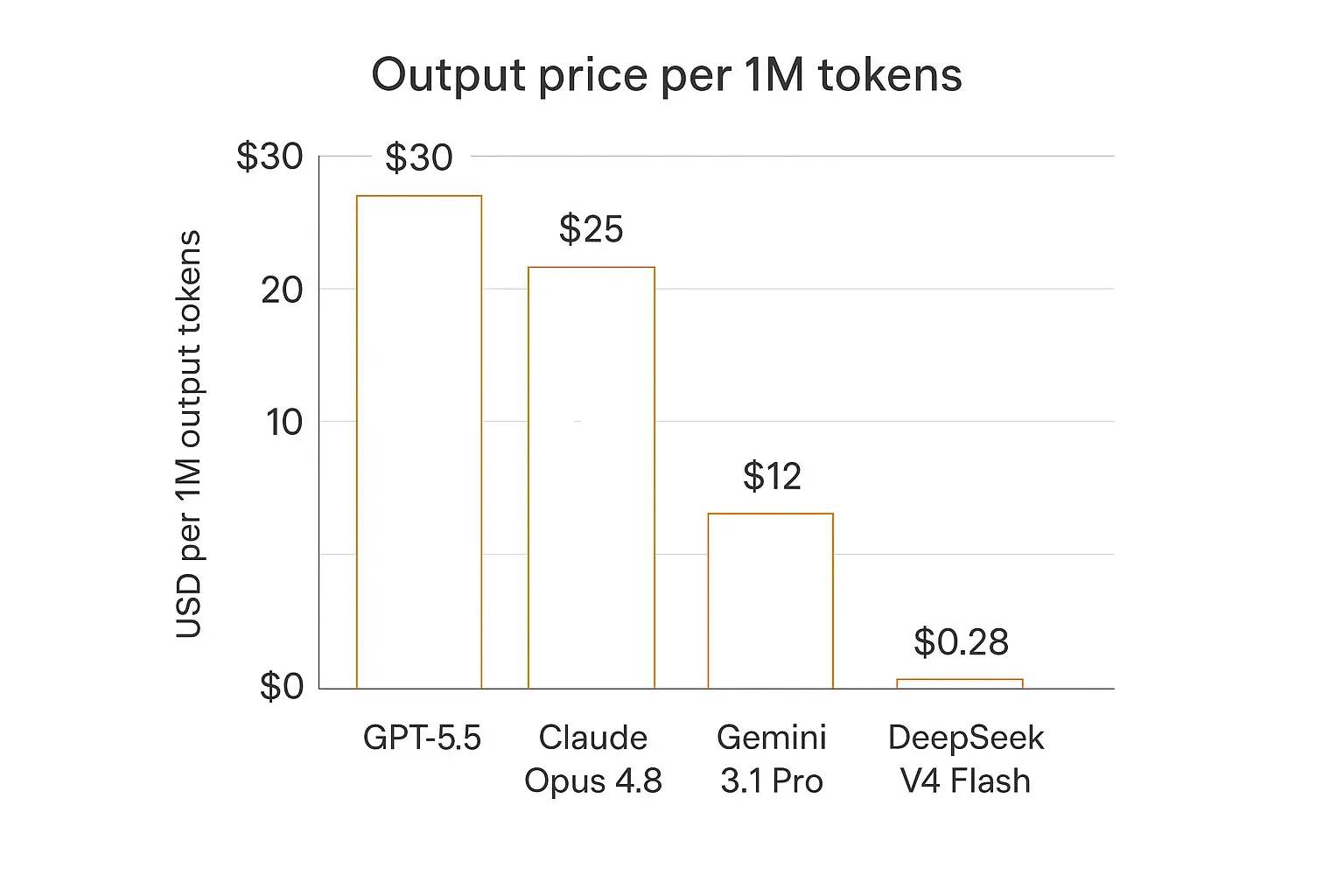
| Claude Opus 4.8 | $5.00 | $25.00 | Frontier |
| GPT-5.5 | $5.00 | $30.00 | Frontier |
| Gemini 3.1 Pro | $2.00 | $12.00 | Frontier |
| Claude Sonnet 4.5 | $3.00 | $15.00 | Mid |
| Claude Haiku 4.5 | ~$1.00 | ~$5.00 | Budget |
| DeepSeek V4 Flash | $0.14 | $0.28 | Budget |
The spread is enormous. Running a task on a frontier model versus a budget model can be a 35x difference in price per token — and that's before you multiply by the agent's token appetite.
The good news: prices are falling fast. Across the industry, published token prices dropped roughly 80% from 2025 to 2026, according to pricing trackers. The bad news: agent token consumption is rising even faster, so most teams' bills are going up, not down.
A quick worked example
Say you build a research agent. A single run reads a 5,000-token brief, makes 8 tool calls (each re-sending the growing context), and writes a 2,000-token report. Because of the snowball, that "one task" might touch 150,000 input tokens and 6,000 output tokens by the time it finishes.
On Claude Opus 4.8, that's roughly (0.15M × $5) + (0.006M × $25) = $0.90 per run. Feels cheap. But run it 5,000 times a month for your clients and you're at $4,500/month — from a single agent. Now imagine ten agents. Most of those runs never needed Opus in the first place, which is the case we make in Claude Opus vs Sonnet vs Haiku.
This is exactly how the average agentic developer ends up spending $400 to $1,500 per month, with heavy users blowing past $4,000 in a matter of days. The per-run cost looks trivial. The aggregate is what wrecks the budget.
Want your token costs itemized, not surprising?
Pickaxe meters usage as credits — $1 credit = $1 of AI cost — so you always see where spend goes.
How Bad Has It Gotten? The 2026 Token Bill Reality
It's worth pausing on just how fast this crept up on people, because the shape of the problem is the reason it's so easy to miss.
The core issue is a rate-of-change problem. According to reporting in TechCrunch, per-developer token consumption rose roughly 18.6x in just nine months as teams moved from asking models questions to letting agents do work autonomously. Your headcount stayed flat; your token usage went vertical.
That's why the horror stories cluster around agentic coding tools first — they were the earliest mainstream autonomous agents. But the same curve is coming for every category: support agents, research agents, sales agents, back-office automation. Anywhere an agent runs a loop instead of answering a single question, the snowball applies.
Analysts have started treating this as a genuine budgeting category rather than a line-item afterthought. Firms like Optimum and platforms like elvex now publish enterprise playbooks specifically for keeping token bills from wrecking the quarter — the same way cloud-cost management became its own discipline a decade ago.
The lesson isn't "don't build agents." Agents are worth it. The lesson is that the old mental model — "an API call costs a fraction of a cent, so who cares" — is exactly what breaks the budget. At agent scale, fractions of a cent compound into five-figure invoices.
The Hidden Cost Multipliers Nobody Warns You About
The base math above assumes a clean run. In reality, several multipliers quietly stack on top. These are the line items that turn a $0.90 run into a $4 run.
Retries and loops. When an agent hits an error or gets a bad tool result, it often retries — re-sending the full context again. A single stuck loop can 5x a run's cost before any guardrail catches it.
Tool call overhead. Every tool and function definition you attach to the agent is sent as input tokens on every single call, whether the tool is used or not. Ten verbose tool schemas can add thousands of tokens to every turn.
Long context. This is the quietest driver of all. The bigger your system prompt, knowledge base, and conversation history, the more you pay on every step. Long context is convenient — and it's the reason bills creep up over a session even when nothing looks wrong.
Reasoning tokens. Modern models "think" before answering, and those internal reasoning tokens are billed as output. A model that reasons deeply is more capable — and materially more expensive per response.
Multi-agent fan-out. If you run a multi-agent system where a coordinator spawns sub-agents, each sub-agent carries its own context snowball. Elegant architecture, multiplied bill.
The Three Types of Token Spend (And Why It Matters)
Not all token spend is the same, and treating it as one undifferentiated "AI bill" is how teams lose control. Deloitte's framework for token economics splits spend into three buckets, and I've found it genuinely useful for deciding what to optimize.
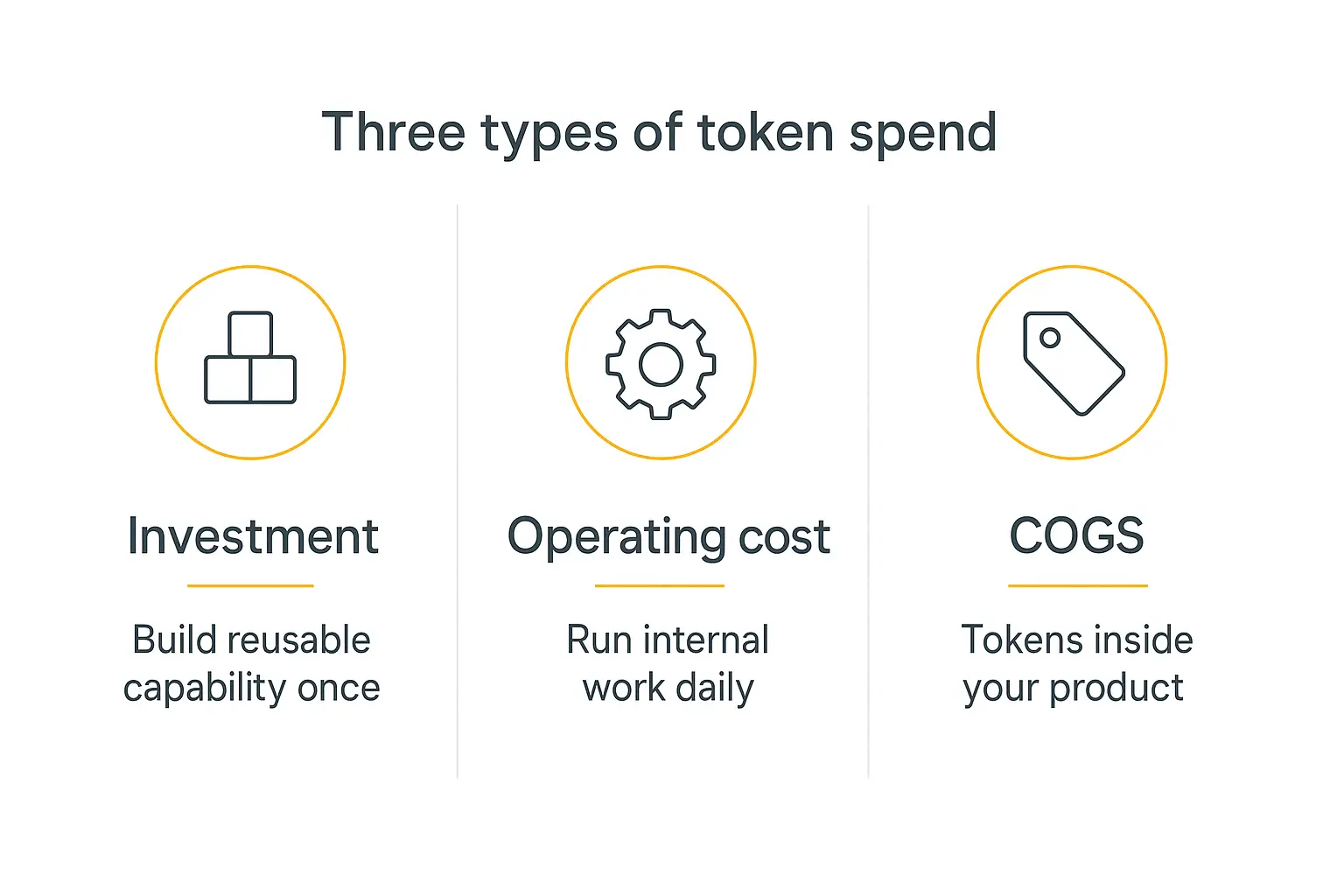
Investment (capex-like). Tokens spent building something reusable — designing a prompt, generating a knowledge base, one-time data processing. You pay once, you benefit repeatedly. Optimize these the least; they compound.
Operating expense (opex). Tokens spent running internal work — an agent summarizing your team's tickets, drafting internal reports. Steady, recurring, worth trimming but not existential.
Cost of goods sold (COGS). Tokens spent inside a product your customers use. This is the dangerous one, because it scales directly with usage. If each customer interaction costs you $0.40 in tokens and you charge a flat $20/month, a heavy user can turn your best customer into your least profitable one.
This framing matters for pricing. If your agent's tokens are COGS, your pricing model has to account for variable cost — which is exactly why usage-based and outcome-based pricing have taken over from flat per-seat plans in the agent economy.
How to Control Your Spend: Six Levers That Actually Work
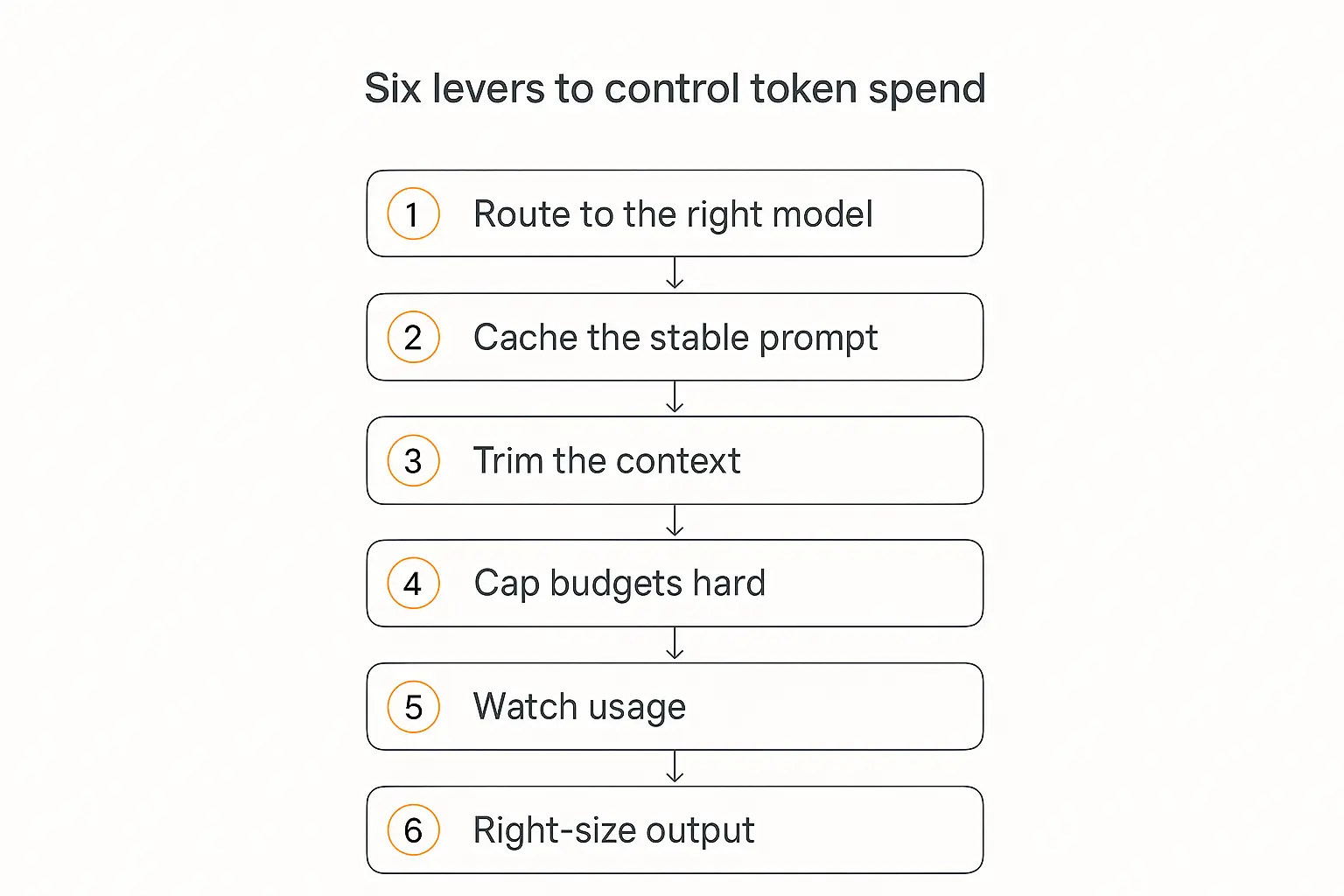
Now the useful part. Here are the six controls that consistently move the needle, roughly in order of impact-to-effort. You don't need all six — start at the top.
1. Model routing — send each task to the right model
This is the single highest-leverage move. Most tasks an agent performs — classifying, extracting, formatting, simple lookups — do not need a frontier model. They run just fine on a budget tier at a fraction of the cost.
The pattern is called model routing: use a cheap model for the easy 80% of calls and reserve the expensive model for the hard 20% that genuinely needs deep reasoning. BCG reports that enterprises using intelligent routing typically cut costs 60–80% with no hit to user experience. We walk through how to actually implement that in AI model routing.
If you're building on a platform, pick one that lets you assign different models to different agents and steps. Pickaxe is model-agnostic — you can put Haiku on the cheap steps and Opus on the hard ones — which is the whole point of routing. (For a deeper look, see our guide on multi-model AI agents.)
2. Prompt caching — stop paying for the same tokens twice
Most of your input on every turn is identical — the same system prompt, the same tool definitions, the same instructions. Prompt caching stores the processed form of that stable prefix so the model doesn't recompute it on the next call.
Every major provider now supports it — OpenAI, Anthropic, and Google all have published guidance — and cached input tokens are typically billed at a fraction (often 10%) of the normal rate. For an agent that re-sends a big stable system prompt every turn, caching alone can cut input costs dramatically.
3. Context management — trim the snowball
Since the snowball is the cost, managing context is managing your bill. A few concrete tactics:
- Summarize old turns. Instead of re-sending the full history, compress older exchanges into a short summary once they're no longer directly relevant.
- Prune tool schemas. Only attach the tools an agent actually needs for its job. Every unused schema is dead weight on every call.
- Retrieve, don't stuff. Instead of dumping your entire knowledge base into context, use retrieval to pull only the relevant chunks. This is the core idea behind agent memory systems.
- Cap the history window. Set a hard limit on how many past turns get re-sent.
4. Budget controls and hard caps
Optimization reduces cost; caps prevent disasters. You need spending limits that fire automatically, before a stuck loop drains the account.
Good practice, per cost-control guidance from Portal26, is layered budgets: set limits by team, by application, by environment, and by individual agent. That way one runaway workflow can't take down the whole budget. On Pickaxe, you can allocate a token budget per agent so an end user can't run a single agent past its ceiling — a simple guardrail that has saved builders from nasty surprises.
5. Observability — you can't cut what you can't see
The teams that control spend are the ones that watch it. You want per-agent, per-user, and per-model visibility into token consumption, so you can spot the one workflow eating 60% of the bill.
This is the same discipline that FinOps brought to cloud spend a decade ago — and it's arriving for tokens now. In early 2026 the Linux Foundation even announced plans for a Tokenomics Foundation to build open standards for measuring token efficiency. Track your usage the way you'd track any other COGS. Our guide on AI agent analytics covers what to instrument.
6. Right-size the output
Output tokens are the pricey ones. If you don't need a 2,000-word answer, don't ask for one. Set max_tokens sensibly, prompt for concise responses, and use structured output (JSON) where you'd otherwise get rambling prose. Small change, real savings at scale.
Build agents with cost controls baked in
Choose your model per agent, cap token budgets, and watch usage — all without touching an API.
A Simple Formula for Estimating Agent Cost
Before you ship an agent, run this back-of-the-envelope estimate. It won't be exact — remember Stanford's 30x variance warning — but it gets you within the right order of magnitude, which is what you need for pricing.
Cost per run ≈ (avg input tokens × input price) + (avg output tokens × output price)
Then: Monthly cost ≈ cost per run × runs per month × a safety multiplier of 1.5–3x to cover retries, loops, and variance.
The safety multiplier is the part most people skip, and it's why their real bill always beats their estimate. Agents are stochastic. Budget for the bad path, not the happy path.
Once you have a cost-per-run number, you can set pricing that protects your margin. This ties directly into measuring AI agent ROI — if you don't know your per-run cost, you can't know your return.
How Pickaxe Handles Token Costs
I'll be direct about how this works on Pickaxe, because cost transparency is the whole reason people move off raw API scripting.
Usage is metered as credits, where $1 in credits equals $1 of underlying AI cost. There's no markup game hidden inside a per-message fee — you see the actual token economics.
You stay model-agnostic: pick OpenAI, Anthropic, Gemini, or others per agent, which means you can route cheap tasks to cheap models without rewiring anything. You can allocate a token budget per agent so no single agent or end user can run away with your balance. And because knowledge, memory, and end-user documents share a defined allocation, you're not accidentally stuffing the entire context window on every call.
The point isn't that Pickaxe makes tokens free — nobody can. It's that the cost is visible and bounded, which is exactly what the runaway-bill horror stories are missing. If you want the deeper strategic picture, our build vs. buy guide walks through when a managed platform beats rolling your own.
What Cloud FinOps Teaches Us About Token Spend
If all of this feels familiar, it should. We've lived through this movie before — it was called cloud computing.
In the early 2010s, elastic cloud infrastructure did to server budgets exactly what agents are now doing to AI budgets: it made a resource so easy to consume that spend detached from any human decision. The answer wasn't to abandon the cloud. It was FinOps — a discipline of visibility, accountability, and optimization that made variable spend predictable.
Tokens are following the same arc, and the tooling is catching up. Security and ops teams at firms like Fluid Attacks now write about token economics with the same rigor they'd apply to cloud cost, and platforms like TrueFoundry publish full cost-optimization frameworks for AI workloads.
The playbook that worked for cloud maps almost one-to-one onto tokens:
- Visibility first. Tag and attribute every token to a team, agent, and use case — just as cloud FinOps tags every instance to a cost center.
- Accountability next. Give the people who spend the tokens the bill for them. Ownership changes behavior faster than any optimization.
- Optimization last. Only once you can see and attribute spend does routing, caching, and right-sizing pay off — because now you know where to point them.
If you take one organizational idea from this guide, take that order. Most teams jump straight to optimization and wonder why nothing sticks. Visibility and ownership are what make the technical levers actually hold.
Frequently Asked Questions
Why are AI agents so much more expensive than chatbots?
Because agents run in a loop and re-send their entire accumulated context on every step. A chatbot bills you once per exchange; an agent bills you for a growing pile of context on every turn of its reasoning loop — up to 1,000x more tokens for the same underlying task, per Stanford research.
Are input or output tokens more expensive?
Per token, output is more expensive — usually 2–6x the input price. But for agents, the sheer volume of input tokens (the re-sent context snowball) usually makes input the larger share of the total bill.
What's the single best way to cut agent token costs?
Model routing. Send the easy majority of calls to a budget-tier model and reserve frontier models for genuinely hard reasoning. Enterprises doing this cut costs 60–80% with no quality loss, according to BCG.
How do I estimate my monthly agent bill?
Estimate average input and output tokens per run, multiply by the model's per-token prices, multiply by expected runs per month, then apply a 1.5–3x safety multiplier for retries and variance. Track actuals against the estimate and adjust.
Does prompt caching really save money?
Yes, meaningfully, if your agent re-sends a large stable prompt prefix (system instructions, tool schemas) on every call — which almost all agents do. Cached tokens are billed at a steep discount, often around 10% of the normal input rate.
The Bottom Line
AI agents are not expensive by accident. They're expensive because of a specific, understandable mechanism — the context snowball — and once you see it, the cost stops being mysterious and starts being manageable.
You don't control token spend by hoping the bill is small. You control it by routing tasks to the right model, caching what repeats, trimming context, capping budgets, and watching usage like the COGS line item it is.
Do that, and agents go from a budgeting liability to one of the highest-ROI tools you can deploy. Skip it, and you become the next "we burned the annual budget by April" cautionary tale.
If you'd rather have the cost controls built in from day one, that's exactly what we designed Pickaxe to do — pick your model, set your budget, watch your credits, and ship agents without the surprise invoice. You can spin up your first agent and see the token economics for yourself.