

The first client who asked me "is this AI agent actually legal to run?" caught me a little flat-footed. I had spent weeks getting the agent to behave, and almost no time thinking about whether it could land either of us in front of a regulator.
That conversation changed how I build. Because in 2026, AI agent compliance isn't a nice-to-have you bolt on before an enterprise deal — it's the thing that decides whether you can deploy at all.
This guide is the checklist I wish I'd had on day one. It walks through the three frameworks that actually matter — GDPR, HIPAA, and the EU AI Act — and turns each into a practical, do-this-not-that list you can work through before you ship.
No legalese where plain English will do. I'm not a lawyer, and this isn't legal advice — but it is the map I use to know which questions to ask one.
Why AI Agent Compliance Is Different
A chatbot answers questions. An agent acts — it reads your CRM, sends emails, queries databases, and makes decisions that affect real people. That shift is exactly why compliance got harder.
If you're still fuzzy on the distinction, I broke it down in from chatbot to AI agent. The short version: the moment an AI system can take actions on real data, the regulatory stakes jump.
Three things make agents uniquely tricky to govern:
- They touch personal data at scale. An agent that handles support tickets or qualifies leads is processing personal data constantly — often across borders.
- They make or influence decisions. Automated decisions about people (hiring, credit, eligibility) trigger some of the strictest rules in every framework.
- They're hard to audit after the fact. If you can't reconstruct why an agent did something, you can't prove compliance when someone asks.
And someone is asking. Shadow AI — employees using unsanctioned tools — drove roughly 20% of 2025 breaches and added about $670K to the average breach cost, according to figures compiled in the 2026 Verizon DBIR analysis. Regulators noticed too.
The good news: compliance is mostly a series of concrete, checkable steps. Let's go framework by framework.
The Three Frameworks Every AI Agent Builder Should Know
Before the checklists, here's the 30-second mental model. These three frameworks overlap, but each answers a different question.
| Framework | What it governs | Who it applies to | Max penalty |
|---|---|---|---|
| GDPR | Personal data of individuals | Anyone processing EU residents' data | €20M or 4% of global turnover |
| HIPAA | Protected health information (PHI) | US healthcare entities & their vendors | Up to ~$1.5M per violation category/year |
| EU AI Act | The AI system itself, by risk level | Anyone putting AI on the EU market | €35M or 7% of global turnover |
Notice the difference. GDPR cares about the data. HIPAA cares about a specific kind of data. The EU AI Act cares about the system — what it does and how risky that is.
If your agent serves EU users and handles personal data, you're likely on the hook for GDPR and the AI Act at the same time. They operate side by side, not as substitutes.
Now the practical part.
GDPR Compliance Checklist for AI Agents
The General Data Protection Regulation applies the second your agent processes personal data of anyone in the EU — regardless of where your company is based. For most agent builders, this is the framework you'll hit first.
Here's the working checklist I run through:
1. Establish a lawful basis
Every piece of personal data your agent processes needs a legal reason behind it. The two most common for agents are consent (the user agreed) and legitimate interest (you have a justifiable business reason that doesn't override the user's rights).
Write down which basis applies to which data flow. "We never decided" is not a lawful basis.
2. Minimize the data you send
This is the single most overlooked rule. Send the agent only the minimum data each task needs.
If a task needs a customer's name and order number, don't pipe the whole customer profile into the model. Data minimization isn't just polite — it's Article 5, and it shrinks your blast radius if anything leaks.
3. Run a DPIA for high-risk processing
A Data Protection Impact Assessment is mandatory under Article 35 whenever processing is "likely to result in a high risk" to people's rights. For agents, that usually means automated decisions with real consequences, large-scale processing, or systematic monitoring.
If your agent makes decisions about people, assume you need one.
4. Respect automated decision-making rights
This is the big one for agents. Under Article 22, people have the right not to be subject to purely automated decisions with legal or similarly significant effects.
If your agent screens job applicants or makes credit calls, you generally need a human in the loop and an ability to explain the logic to the person affected. Keep a human checkpoint on consequential decisions.
5. Honor data subject rights
Users can ask to access, correct, or delete their data — and ask you to stop processing it. Your agent's architecture has to make that possible. If personal data is baked into a model's memory or a knowledge base, you need a way to find and remove it.
6. Lock down transfers and sub-processors
Every LLM provider, vector database, and tool your agent calls is a sub-processor touching personal data. Know who they are, where they store data, and whether cross-border transfers are covered by appropriate safeguards.
The penalties make this worth getting right: up to €20 million or 4% of global annual revenue, whichever is higher.
Build on a platform that's already compliant
Pickaxe is SOC 2, GDPR, and CCPA compliant — so your agents start on solid ground.
HIPAA Compliance Checklist for AI Agents
If your agent ever touches protected health information (PHI) — names tied to health conditions, treatment, or payment for care — you're in HIPAA territory. This applies to anyone building agents for clinics, therapists, insurers, or healthcare-adjacent businesses. For the practical version of that — what a clinic agent should and should not be allowed to answer — see our guide to AI agents for medical practices.
The line is simple: an AI agent becomes a "business associate" the moment it processes a conversation containing PHI. That triggers a specific set of obligations.
1. Get a signed Business Associate Agreement (BAA)
This is non-negotiable. Without a Business Associate Agreement, deploying any tool that touches PHI is a violation — no matter how many security badges the vendor displays.
A vendor that claims "HIPAA compliance" but won't sign a BAA is not HIPAA-compliant for your use case. Every link in the chain — your model provider, your platform, your storage — needs a BAA in place.
2. Encrypt everything, in transit and at rest
PHI must be encrypted in transit (TLS) and at rest (AES-256 or equivalent). This is table stakes, but verify it rather than assuming it.
3. Enforce access controls and audit logs
Role-based permissions, user authentication, and detailed audit logs are required. You need to be able to answer "who accessed this PHI, and when?" — which is exactly where many agent deployments fall down.
4. Set retention and deletion policies
Decide how long PHI is stored and how it's deleted, then enforce it. An agent that quietly logs every conversation forever is a liability waiting to happen.
5. Plan for breach notification
You need a contractual and procedural commitment to notify affected parties of data incidents within HIPAA's required windows. Know your plan before you need it.
The encouraging news: the ecosystem matured fast. By early 2026, major providers shipped healthcare-specific offerings with BAA availability, data-residency options, and audit logs. The HHS guidance remains the canonical source for what "compliant" actually requires.
A practical tip from building these: keep PHI out of the agent entirely when you can. If a workflow can run on a record ID instead of a full medical history, do that. The cleanest compliance story is the one where sensitive data never reaches the model.
EU AI Act Compliance Checklist for AI Agents
The EU AI Act is the world's first comprehensive AI law, and it's the framework most agent builders haven't fully wrapped their heads around yet. Unlike GDPR, it regulates the system, not just the data.
Step 1: Classify your agent's risk tier
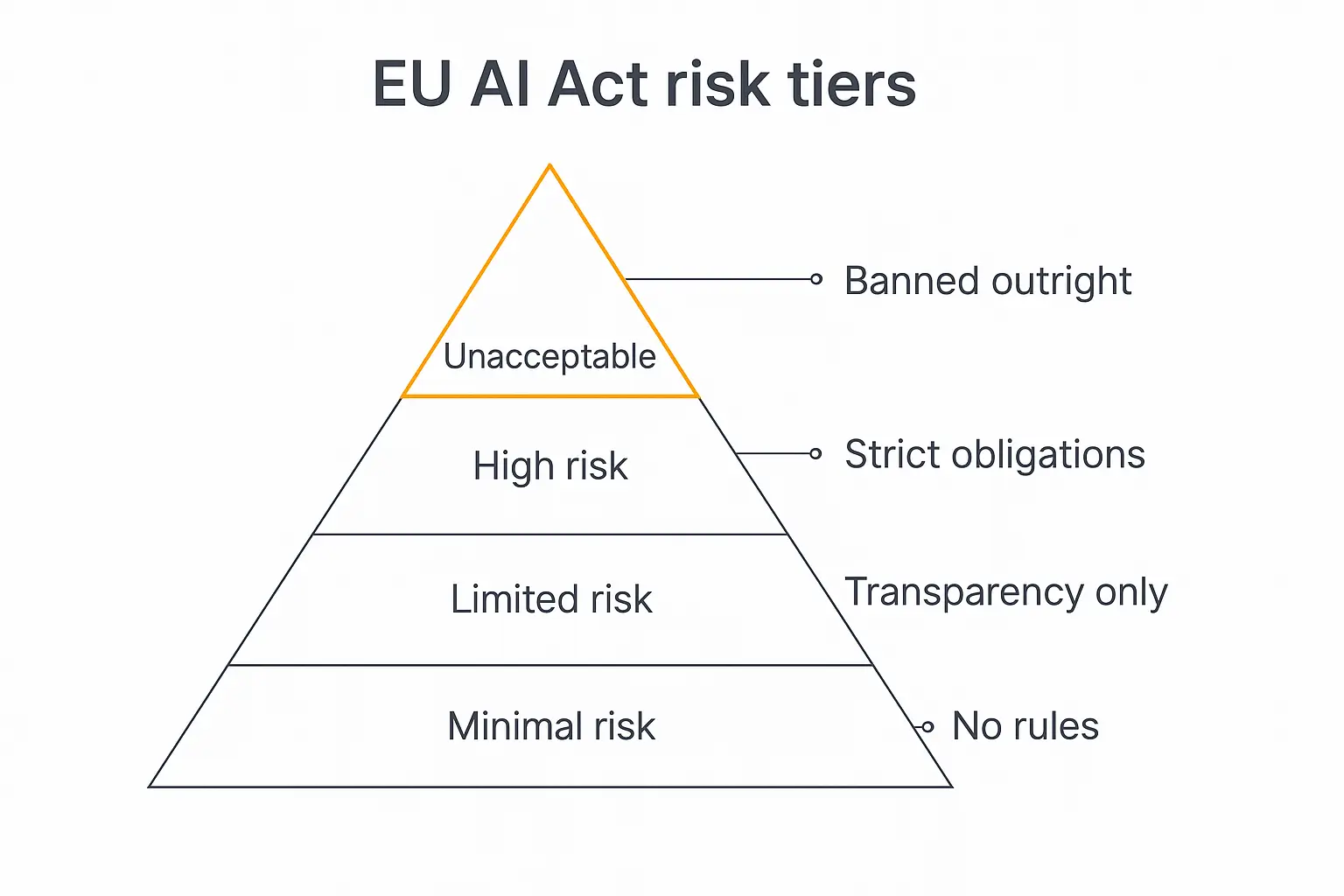
The Act sorts every AI system into four tiers. Your obligations depend entirely on which one you land in:
- Unacceptable risk — banned outright (e.g., social scoring, manipulative systems).
- High risk — heavy obligations (e.g., agents used in hiring, credit scoring, education, or critical infrastructure).
- Limited risk — transparency obligations (most chatbots and customer-facing agents live here).
- Minimal risk — no special rules (e.g., spam filters, simple automations).
Be honest about this. The temptation is to assume you're "limited risk," but an agent that screens applicants is squarely high-risk.
Step 2: Meet transparency obligations (Article 50)
This one applies to almost every customer-facing agent. Under Article 50, you must tell users they're interacting with an AI — clearly, and no later than the first interaction.
Fine print buried in your terms of service won't cut it. The disclosure has to be immediate and obvious. These transparency rules apply from 2 August 2026.
Step 3: For high-risk systems, build the full program
If you're high-risk, the obligations are serious: a risk-management system, data governance, technical documentation, human oversight by design, logging, and a conformity assessment. This is where you bring in legal counsel.
Step 4: Mind the deadlines
The timeline has shifted, so don't rely on old summaries. Banned practices and AI-literacy duties already applied from February 2025. GPAI model rules kicked in August 2025. Transparency obligations land August 2026. And under the Digital Omnibus agreement reached in 2026, the high-risk deadline for many systems was deferred to December 2027.
Penalties scale with severity: up to €35 million or 7% of global turnover for the worst violations, per Article 99.
Step 5: Invest in AI literacy
The Act expects organizations to ensure staff who deploy AI have a baseline understanding of it. That's a soft obligation with a real point: people who don't understand the agent can't govern it.
Ship agents your clients can trust
Pickaxe handles access control, usage limits, and disclosures so compliance isn't an afterthought.
The Cross-Cutting Checklist: What Every Framework Wants
Here's something I noticed working through all three: they ask for a lot of the same things. Nail these and you've covered the foundation of every framework at once.
Keep a complete audit trail
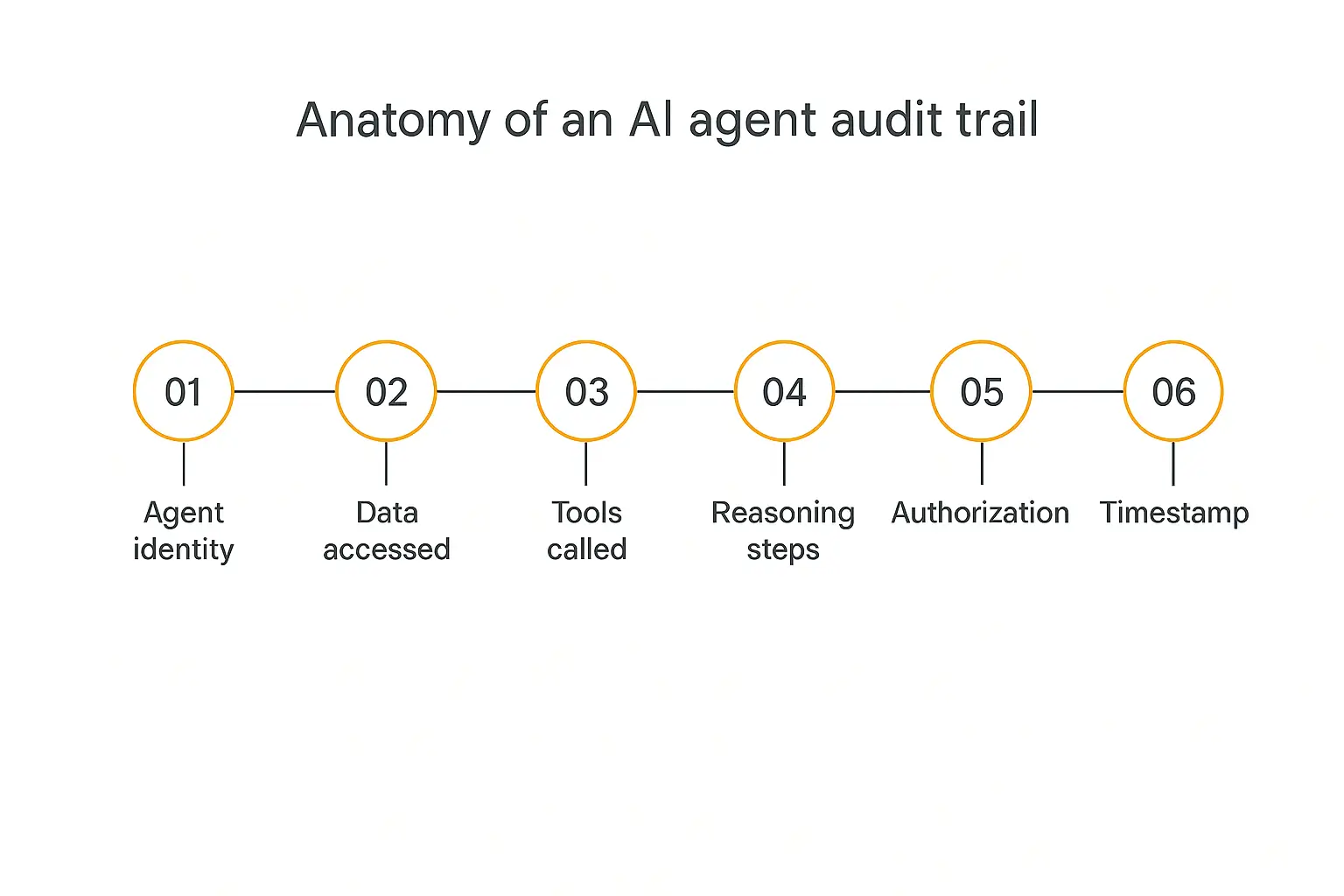
If you build one thing, build this. A proper agent audit trail captures agent identity, the data it accessed, the tools it called, its reasoning steps, the authorization chain, and timestamps for everything.
Without it, you can't prove anything to anyone. With it, most compliance questions become a query. This is also why testing matters — I covered how to validate agent behavior before launch in how to test and debug your AI agent.
Enforce least-privilege access
Your agent should only be able to touch what it genuinely needs. Scope every tool, every integration, every data source to the narrowest permission that still does the job. This shows up in GDPR, HIPAA, and the AI Act alike.
It's also a security best practice I lean on when wiring up tools through MCP and actions — fewer, tightly-scoped connections beat a sprawling toolbox every time.
Keep a human in the loop for high-stakes actions
Sending money, deleting records, making decisions about people — these deserve a human checkpoint. Every framework rewards it, and your future self will thank you.
Tackle shadow AI head-on
Remember those shadow AI numbers? The fix is governance, not prohibition. Give your team approved, compliant agents that are actually good enough to use, and the incentive to paste sensitive data into random consumer tools disappears.
The emerging standards back this up. NIST launched its AI Agent Standards Initiative in early 2026, and its broader AI Risk Management Framework is a genuinely useful, free starting point for structuring your own program.
Common AI Agent Compliance Mistakes
These are the traps I see most often — usually because someone treated compliance as a launch-day formality instead of a design constraint.
- Assuming the LLM provider handles it. They handle their infrastructure. Your deployment, data flows, and disclosures are on you.
- Over-collecting data "just in case." Every extra field is extra liability. Minimize.
- No audit logging. If you can't reconstruct what happened, you can't defend it.
- Skipping the BAA for anything healthcare-adjacent. Badges aren't agreements.
- Forgetting the AI disclosure. Article 50 is one of the easiest rules to comply with and one of the most commonly missed.
- Treating compliance as one-and-done. Models change, regulations change, your agent changes. Revisit it.
Most of these cost almost nothing to avoid if you plan for them — and a fortune to fix after a complaint.
How Your Platform Choice Changes the Math
Here's the practical truth: the platform you build on does a huge amount of compliance heavy lifting for you — or leaves it entirely on your plate.
When I build agents on Pickaxe, a lot of the checklist is handled at the platform level. It's SOC 2, GDPR, and CCPA compliant, which means the underlying data handling, access controls, and security posture are already in place rather than something I have to architect from scratch.
The features map cleanly onto the checklists. Access groups give you least-privilege control over who can use which agent. Usage tracking and activity monitoring form the backbone of an audit trail. And because you choose your model, you can pick a provider whose terms fit your compliance needs.
None of that makes you automatically compliant — your prompts, your data flows, and your disclosures still matter. But starting on compliant infrastructure means you're solving the last 20%, not the whole thing.
That's the difference between spending your week on conformity assessments and spending it on the agent your client actually wants. If you're weighing the broader trade-offs, our build vs buy guide digs into exactly this decision.
Your 10-Minute Pre-Deployment Compliance Check
Before any agent goes live, I run it through a quick gut-check. None of this replaces proper legal review, but it catches the obvious gaps before they become someone else's problem.
- What personal data does this agent touch, and what's my lawful basis? If you can't answer in one sentence, stop and figure it out.
- Could this ever process health data? If yes, confirm there's a signed BAA covering every link in the chain.
- What risk tier is this under the EU AI Act? Be honest. Anything deciding about people is probably high-risk.
- Does it disclose that it's an AI? Add the line at the top of the conversation if it doesn't.
- Can I reconstruct what it did? Verify your audit logging actually captures inputs, tool calls, and decisions.
- Is access scoped to least privilege? Strip any tool or data source the agent doesn't strictly need.
- Is there a human checkpoint on consequential actions? Money, deletions, and decisions about people all qualify.
- Can I honor a deletion request? Trace where personal data lives and confirm you can remove it on demand.
Eight questions. If you can answer all of them confidently, you're in far better shape than most teams shipping agents right now. If a few make you wince, that's exactly the list to hand your legal team — and the gap between a deal that closes and one that stalls in procurement.
This is also the kind of rigor that pays off later. The same discipline that keeps you compliant — knowing your data flows, logging everything, measuring outcomes — is what lets you prove value, too. I dug into that side in how to measure AI agent ROI.
Frequently Asked Questions
Does the EU AI Act apply to me if I'm not in Europe?
Yes, if you put an AI system on the EU market or its output is used in the EU. Like GDPR, the Act has extraterritorial reach. A US agency serving EU clients is in scope.
Do I need a DPIA for every AI agent?
Not every one — but you need one whenever processing is likely to be high-risk, which covers most agents that make decisions about people or process sensitive data at scale. When in doubt, do the assessment.
Can I use ChatGPT or Claude for healthcare data?
Only under a signed BAA. Major providers now offer healthcare-specific tiers with BAAs, but the consumer versions are not HIPAA-compliant. Check before you send a single piece of PHI.
What's the simplest way to comply with Article 50?
Tell users they're talking to an AI, clearly and up front. A short line at the start of the conversation usually does it. It's genuinely one of the easiest obligations to meet.
Is a no-code platform enough for compliance?
A compliant platform handles the infrastructure layer — security, access control, data handling. You're still responsible for what your specific agent does with data, how it's disclosed, and your lawful basis. It's a head start, not a finish line.
The Bottom Line
AI agent compliance feels intimidating until you turn it into a checklist — and then it's just a series of concrete steps you can actually do.
Know your frameworks: GDPR for personal data, HIPAA for health data, the EU AI Act for the system itself. Minimize what you collect, log what you do, keep a human on the big decisions, and tell people they're talking to an AI.
Do those things from day one and compliance stops being the thing that blocks your enterprise deal. It becomes the thing that wins it.
The fastest path is to start on infrastructure that's already done the hard part. If you want to build agents on a SOC 2, GDPR, and CCPA compliant platform — and actually deploy them to clients — Pickaxe handles the foundation so you can focus on the work. Spin up your first agent and build it right from the start.