

The single hardest question every AI agent builder hits: whether you're a founder shipping an SaaS product, a consultant deploying agents for clients, or an enterprise team rolling out internal tools: is the same one: how do you price this thing?
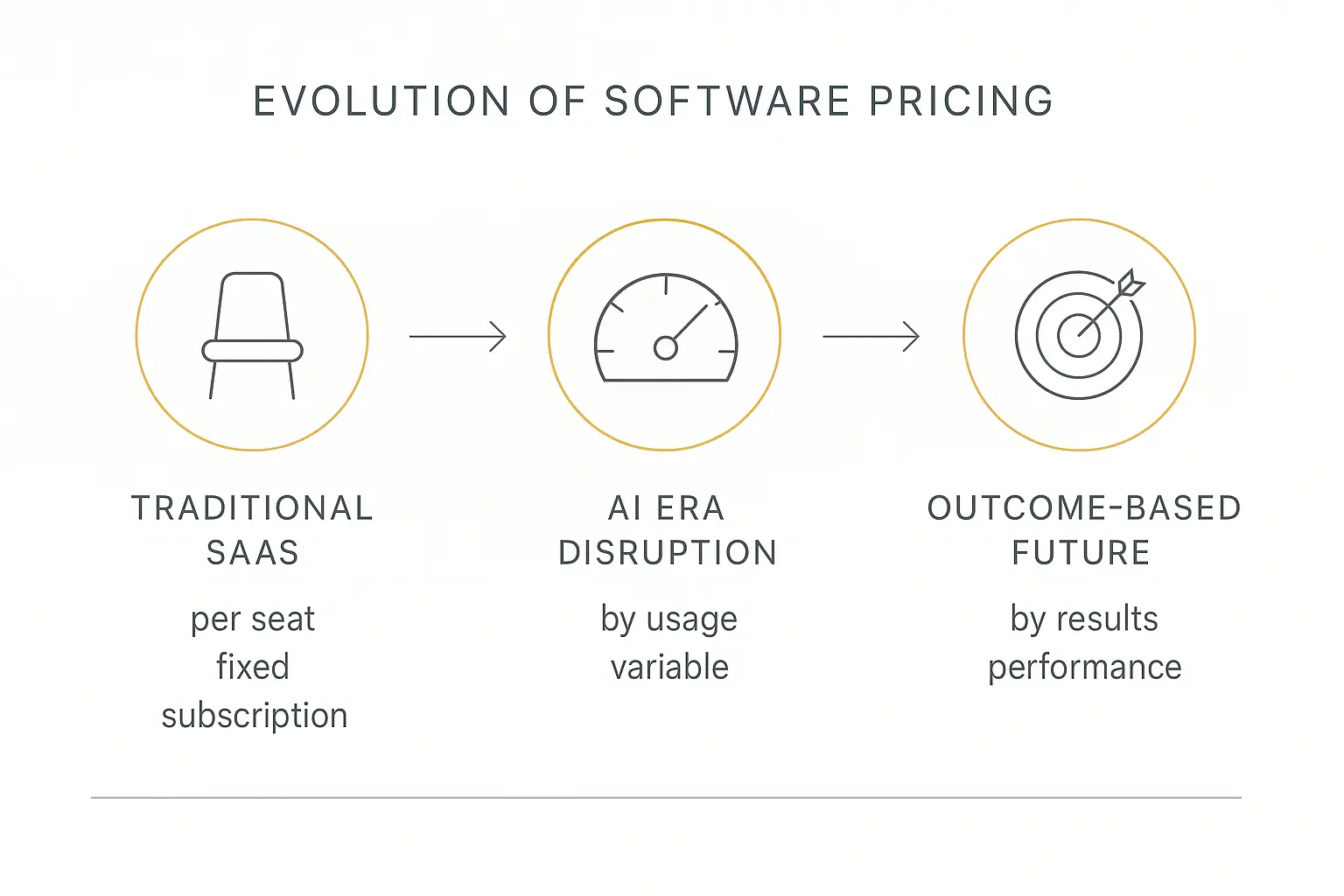
It used to be easy. Charge per seat, like every SaaS company since 2010. But AI broke that model.
An AI agent can do the work of ten people without asking for ten seats. A consultant deploying an agent for a client doesn't have "users": they have a system that processes tickets, qualifies leads, or drafts proposals. The seat metaphor falls apart the moment software starts replacing labor instead of augmenting it.
So the industry is rewriting the playbook in real time. Bessemer Venture Partners calls it "the AI pricing pivot." Andreessen Horowitz describes it as a shift toward outcome-based pricing. And the data backs it up: a Pilot study found seat-based pricing fell from 21% to 15% of SaaS companies in just 12 months, while hybrid models surged from 27% to 41%.
Here's the thing though: most of the advice out there is too abstract to actually act on. "Charge for value" sounds great until you're staring at a blank pricing page on a Tuesday afternoon trying to figure out what your AI agent should cost.
So this is the practical version. Three pricing models, what they actually mean, when each one works, real examples from companies pricing AI agents in 2026, and a framework for picking the right one for your situation.
Why AI Broke Traditional SaaS Pricing
Let me be specific about why this matters. Traditional SaaS pricing assumes a one-to-one relationship between users and value. More users = more value = more money. The pricing formula is: cost per seat × number of seats.
That formula is brittle the moment you have software that can do work autonomously.
If your AI customer support agent resolves 5,000 tickets a month and replaces three human agents, do you charge for three seats? Charge for one "AI seat"? Charge nothing, because the AI doesn't take up a chair?
And on the cost side, AI is genuinely different from traditional software. Every query incurs real compute costs that can vary 10x depending on input complexity. A flat per-seat fee doesn't reflect that variability. A customer running 50,000 AI queries a month costs you dramatically more than a customer running 500: but if they're both paying $50/seat, you're losing money on one and printing it on the other.
Three new pricing models have emerged to handle this reality. Let's go through each one.
Per-Seat Pricing (The Old Model, Reimagined)
Per-seat pricing charges a fixed fee for each user who has access to the software. It's familiar, predictable, and easy for procurement teams to budget. For AI agents that augment human work: like a Copilot-style assistant that helps a salesperson write better emails: per-seat still makes sense.
How it works: $X per user per month. The user gets access to the AI. Whether they use it once or a thousand times doesn't change the bill.
Real example: ChatGPT Team at $25/user/month. GitHub Copilot at $19/user/month. Microsoft Copilot for Microsoft 365 at $30/user/month.
When per-seat works for AI:
- Your AI is a productivity multiplier sitting next to humans, not replacing them.
- Usage volume per user is roughly predictable.
- Customers want budget predictability above all.
- You're selling to enterprise IT and procurement, who are most comfortable with this model.
Where it falls apart:
- Your AI is autonomous and works without a human seat behind it.
- Usage is wildly variable across customers.
- Your costs scale with AI consumption, not with user count.
- Customers feel they're paying for something they barely use (or paying too little for something they use heavily).
IDC forecasts that 70% of software vendors will move away from pure per-seat pricing by 2028, driven by AI agents reducing the number of human seats needed. But "moving away" doesn't mean abandoning. It means making per-seat one component of a hybrid model: which we'll get to.
Usage-Based Pricing (Pay for What You Use)
Usage-based pricing: sometimes called consumption-based: charges customers based on how much they actually use the AI. The unit can be tokens, tasks, API calls, queries, agent-hours, or workflow executions.
How it works: Customers buy a bucket of usage (or pay-as-they-go). When they consume tokens or tasks, the bill goes up. When they don't, it doesn't.
Real examples:
- OpenAI API: $5 per million input tokens for GPT-4 Turbo, $15 per million output tokens.
- Anthropic Claude API: $3 per million input tokens for Sonnet 4.6.
- Zapier: Per-task pricing, where each automation step counts as a "task."
- Make: Per-operation pricing, with each module call counted as one operation.
- Pickaxe Credits: $1 of credit equals $1 of underlying AI cost, so customers pay for actual usage with margin built in.
When usage-based works:
- Your costs are tightly coupled to consumption (true for most AI products).
- Customer value also scales with consumption: heavier users get more out of the product.
- You want low friction for customers to start (small users pay small bills).
- You're selling to developers or technical teams who are comfortable thinking in terms of API calls and tokens.
Where it falls apart:
- Customers hate unpredictable bills. The "AWS surprise bill" phenomenon is real, and it kills pilots.
- Hard to forecast revenue, which makes investors nervous.
- Procurement teams struggle to budget for variable costs.
- Token-based pricing is especially confusing for non-technical buyers: most people don't know what a token is, let alone how many they'll need.
Usage-based pricing is surging among AI companies precisely because the underlying costs scale with consumption. But the pure version of this model creates real friction. Most successful AI companies layer it on top of a base subscription: which is hybrid pricing, covered below.
Outcome-Based Pricing (Pay for Results)
This is the model that's getting the most attention in 2026, and for good reason. Outcome-based pricing charges customers only when the AI delivers a specific, measurable result. No outcome, no charge.
It's the closest thing to "pay for value" that the software industry has ever seen.
How it works: Define a clear, attributable outcome: a resolved support ticket, a qualified lead, a closed deal, a generated invoice. Charge a flat fee per outcome. Customers pay only when the AI actually does the thing.
Real examples:
- Intercom's Fin AI Agent charges $0.99 per resolved customer support conversation. If Fin doesn't fully resolve the ticket, the customer doesn't pay for that interaction.
- Zendesk launched outcome-based pricing for its AI agents at $1.50 per automated resolution on committed volume, $2.00 on pay-as-you-go.
- Sierra built its entire business model around outcome-based pricing for customer experience AI agents.
- 11x charges for booked meetings rather than seats for its AI sales rep.
When outcome-based works:
- The outcome is technically verifiable. Did the ticket get resolved? Did the lead get qualified? Did the meeting get booked?
- Attribution is clean. You can clearly say "this AI did this thing" without arguing about credit.
- Customers are willing to agree on what counts as success before the engagement starts.
- The outcome has obvious dollar value to the customer (so $1.50 per resolution feels like a steal).
Where it falls apart:
- Outcomes are fuzzy or hard to define (a lot of AI work is creative or open-ended).
- Attribution is messy: was it the AI that closed the deal, or the salesperson who followed up?
- You can't reliably measure success at scale (customer support is easy, strategy work is hard).
- Your AI doesn't actually deliver outcomes consistently enough to bet your revenue on it.
Zendesk's research found that companies using outcome-based components see 31% higher customer retention and 21% higher satisfaction. The customer alignment is real: when you only pay for what works, both sides are motivated to make it work.
The catch: outcome-based pricing only makes sense for well-defined, repeatable workflows. Customer support is the obvious win. Sales development is gaining ground. But outcome pricing for "AI that helps with strategy" or "AI that summarizes meetings" doesn't really work: there's no clean unit to charge for.
Hybrid Pricing (What Most Companies Actually Do)
Here's what nobody tells you when they pitch you on the "future of pricing": almost no successful AI company uses just one model.
The math doesn't work. Pure usage pricing creates billing anxiety. Pure outcome pricing leaves money on the table for high-frequency users. Pure per-seat pricing ignores cost variability. So mature companies blend models.
The 2026 standard structure looks like this:
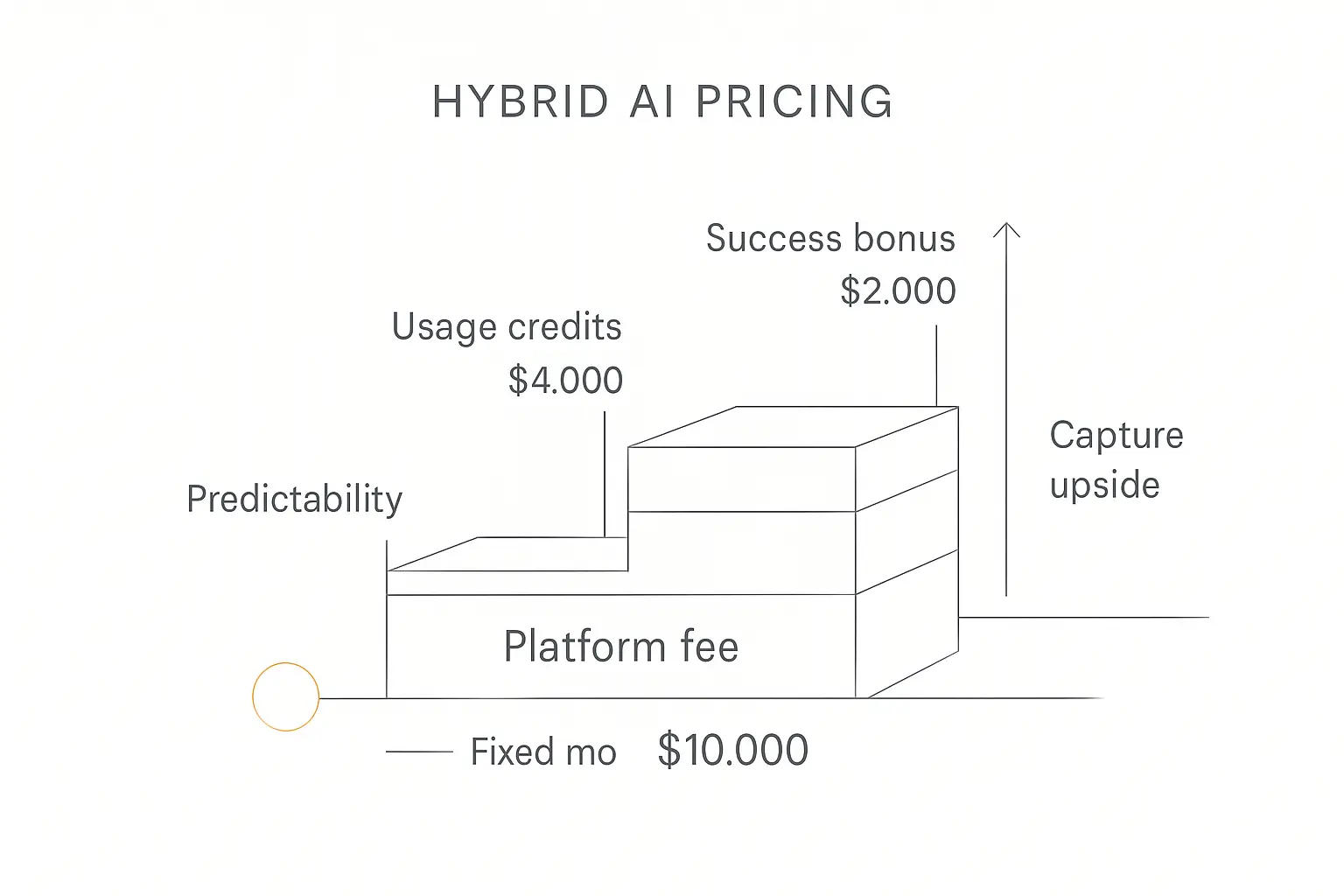
- Platform fee: A fixed monthly cost that covers access, onboarding, base support. This gives the customer a predictable bill and gives you predictable revenue.
- Usage allowance: A bucket of tasks, tokens, or agent-hours included in the platform fee. Most customers stay within the bucket, which makes their experience feel like a flat subscription.
- Overage rate: A per-unit price for usage beyond the included bucket. Heavy users pay more, which aligns your revenue with their value.
- Outcome bonus or discount: An optional adjustment tied to achieved outcomes: sometimes a refund for missed targets, sometimes a premium for over-delivery.
Why hybrid wins: The data is striking. Companies using hybrid pricing report 38% higher revenue growth and 38% higher net revenue retention compared to pure subscription firms. 43% of SaaS companies now use hybrid models, projected to hit 61% by end of 2026.
Customers like it because they get predictability for the base case and pay-for-what-you-use for the edge cases. Vendors like it because revenue scales with usage without becoming entirely volatile.
If you're starting from scratch and don't know which model to pick, hybrid is almost always the right starting point. Pick a low-friction base subscription, pick a usage unit your customers understand, and let outcomes drive expansion later.
Build AI agents you can actually charge for
Pickaxe gives you the tools to create, brand, and monetize AI agents: with flexible pricing built in.
How Consultants and Agencies Should Price AI Agents
Most of the pricing analysis above is about SaaS products. But a huge chunk of the AI agent economy in 2026 is consultants and agencies building AI agents for clients. The pricing math here is different.
You're not selling software access. You're selling a custom-built system, often paired with strategy work, integration, and ongoing optimization. The pricing structure that's working for AI agencies right now looks like this:
The Three-Tier Engagement Structure
This framework is used by most successful AI agencies:
- Tier 1: Discovery & Strategy ($1,500–$3,000): A scoped engagement to audit the client's current workflows, identify automation opportunities, define KPIs, and produce an implementation roadmap. This is the "no-commitment intro" that filters serious clients from tire-kickers.
- Tier 2: Implementation ($5,000–$25,000): Build and launch the AI agents. Includes design, development, integration with the client's existing tools, testing, and rollout. This is where most of the revenue lives.
- Tier 3: Ongoing Retainer ($1,000–$5,000/month): Optimization, performance reporting, model updates, new feature development, and ongoing support. This is the recurring revenue that turns one-off projects into stable agency income.
With Whop, the discovery and build fees can go out as one-time charges while the retainer runs as a monthly plan that renews on its own.
The Per-Client Recurring Model
Some agencies are skipping the project-based model entirely and selling AI agents on a per-client recurring basis. The math: $300–$1,500 per month per client for an embedded AI agent that handles a specific workflow (lead qualification, customer support, content generation).
If you can build one agent and deploy it to 20 clients, that's $6,000–$30,000/month in recurring revenue from a single piece of work. The unit economics are wildly different from traditional consulting.
Outcome-Based for Agencies?
Agencies sometimes try outcome-based pricing: getting paid per qualified lead, per closed deal, per resolved ticket. It can work, but it's risky for small agencies. You're betting your revenue on the client's downstream processes (sales follow-up, conversion, etc.) which you don't control.
The honest take: outcome-based pricing for agencies works best when paired with a base retainer. Charge a fixed monthly fee for access and maintenance, plus a per-outcome bonus for results above a baseline. This protects your downside while giving you upside if the agent crushes its targets.
How to Choose: A Decision Framework
Here's the framework I'd use if I were sitting down with a blank pricing page tomorrow.
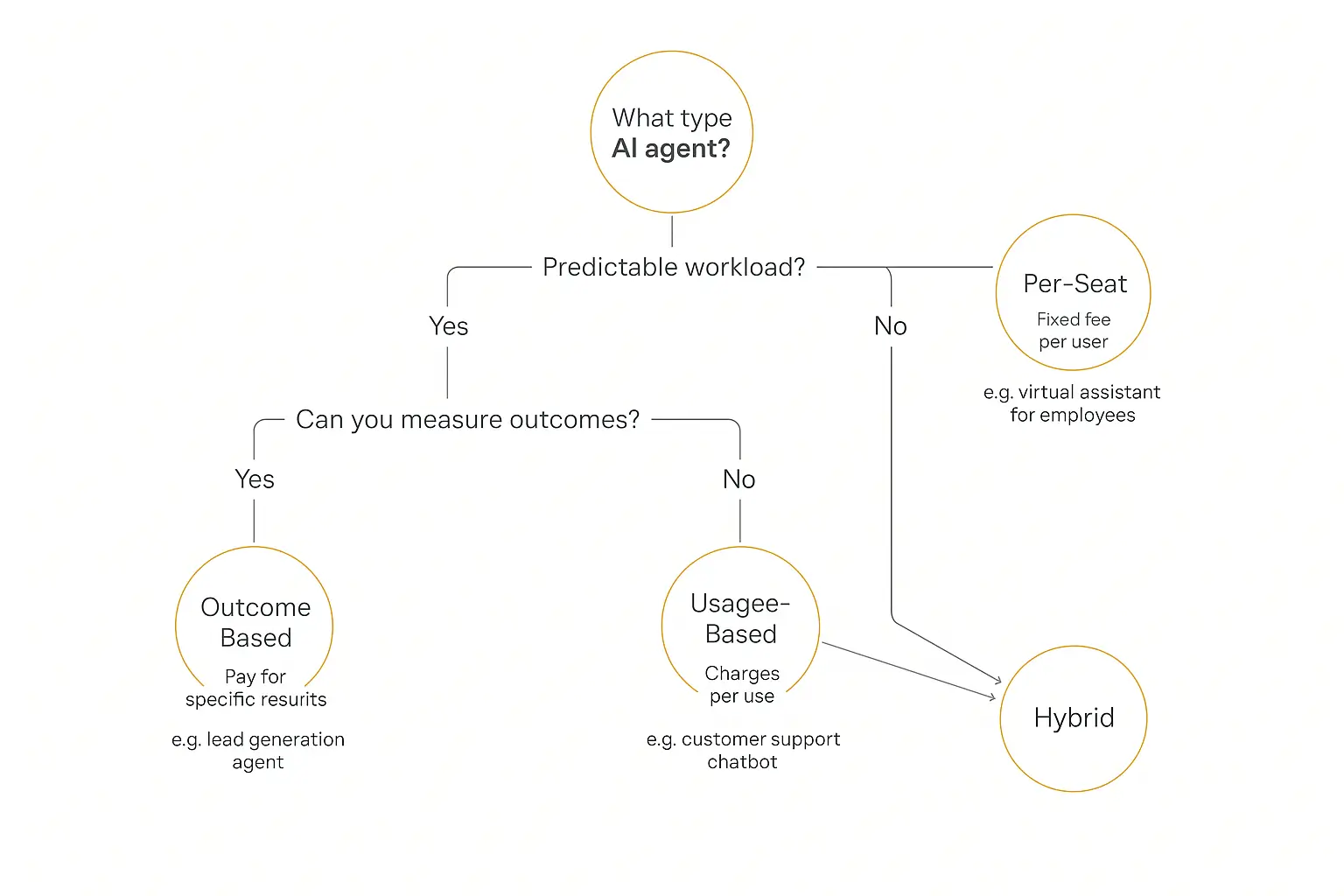
Question 1: Is your AI augmenting humans or replacing them?
- Augmenting: Per-seat or per-seat-plus-usage works. The seat metaphor still maps to value.
- Replacing: Per-seat doesn't work. Use usage-based, outcome-based, or hybrid.
Question 2: Are your costs predictable per customer?
- Predictable: Flat subscriptions are fine. You can absorb cost variability.
- Wildly variable: You need a usage component. Otherwise you'll lose money on heavy users.
Question 3: Can you cleanly attribute outcomes?
- Yes (e.g., resolved tickets, booked meetings): Outcome-based pricing is on the table. Strongly consider it for high-volume use cases.
- No (e.g., research assistance, content generation): Stick with usage-based or subscription. Don't try to fake outcomes.
Question 4: Who are you selling to?
- Enterprise procurement: They want predictability. Lead with subscription, layer usage and outcomes underneath.
- SMB owners: They want simplicity. A single number per month, with a clear unit they understand.
- Developers: They're comfortable with usage-based. API pricing per token or call works fine.
- End consumers: Subscription, almost always. Usage anxiety kills consumer adoption.
Real Pricing Examples Across Categories
Here's a snapshot of how leading AI products are pricing in 2026:
| Product | Category | Pricing Model | Price Point |
|---|---|---|---|
| ChatGPT Team | Productivity AI | Per-seat | $25/user/mo |
| GitHub Copilot | Code AI | Per-seat | $19/user/mo |
| Microsoft Copilot 365 | Productivity AI | Per-seat | $30/user/mo |
| OpenAI API | LLM API | Usage (tokens) | $5/$15 per 1M tokens |
| Anthropic Claude API | LLM API | Usage (tokens) | $3 per 1M input tokens |
| Zapier | Automation | Hybrid (sub + usage) | $29.99/mo + per-task |
| Make | Automation | Hybrid (sub + usage) | $10.59/mo + per-op |
| Intercom Fin | Customer Support AI | Outcome-based | $0.99 per resolution |
| Zendesk AI Agents | Customer Support AI | Outcome-based | $1.50–$2.00 per resolution |
| Sierra | Customer Experience AI | Outcome-based (custom) | Per-resolution (enterprise) |
| 11x | AI Sales Rep | Outcome-based | Per-meeting booked |
| Pickaxe | AI Agent Builder | Hybrid (sub + credits) | $19/mo + AI credits |
The pattern is clear: category drives the model. Productivity AI = per-seat. APIs = usage. Customer support = outcome. Multi-purpose platforms = hybrid.
The Pricing Mistakes I See Most Often
A few patterns I've watched founders and consultants get burned by:
1. Underpricing because the marginal cost feels low
"It only costs me 2 cents per query, so I can charge 10 cents and still make 5x." Sure, until your customer runs 100,000 queries a month, your margin is great, but your absolute pricing is so low that no enterprise will take you seriously. Anchor on the value delivered, not the cost incurred.
2. Picking a usage unit nobody understands
Tokens are great for API pricing because developers get them. Tokens for a small business owner buying an AI receptionist? Disaster. Pick a unit that maps to something the customer cares about: conversations, tickets, leads, hours.
3. Outcome pricing without measurement infrastructure
You can't charge per resolution if you can't reliably measure resolutions. Build the measurement layer first. Otherwise you'll be arguing with customers about which tickets count and which don't, and you'll lose those arguments.
4. Charging the same for tiny customers and enterprise
If your platform fee is $99/month, you'll either price out small customers or leave money on the table with enterprise. Tier your pricing. Let small customers in cheap, charge enterprise customers what enterprise pricing actually costs.
5. Refusing to revisit pricing
The AI market is moving so fast that pricing decisions made six months ago might be wildly wrong today. Most successful AI companies adjust pricing every 6-12 months. Don't lock yourself into a model you can never escape.
Frequently Asked Questions
What's the most common pricing model for AI agents in 2026?
Hybrid pricing: a base subscription combined with usage and/or outcome components: is the dominant model among successful AI companies, used by 43% of SaaS firms and growing fast. Pure per-seat is declining for autonomous AI agents but still standard for productivity AI.
How do I know if outcome-based pricing will work for my product?
Three tests: (1) Can you define an outcome that's technically verifiable? (2) Can you cleanly attribute that outcome to your AI? (3) Will your customer agree on what counts as success before signing? If you can answer yes to all three, outcome pricing is worth exploring. If any answer is "no" or "maybe," stick with usage or subscription.
How much should I charge for an AI agent I built for a client?
If you're a consultant or agency, the range is $300–$1,500/month per client for a deployed agent handling a specific workflow. Custom development projects typically run $5,000–$25,000 upfront, plus a $1,000–$3,000/month retainer for optimization. Don't undersell: the value you're delivering is "AI employee" levels, not "WordPress plugin" levels.
Should I charge per token, per task, or per outcome?
It depends on the customer. Tokens are great for developer-facing API products. Tasks (or operations) are better for SMB-facing automation tools. Outcomes are best for high-volume, well-defined workflows like customer support tickets or qualified leads. Most successful products use one of these as a meter, layered on top of a base subscription.
Can I charge enterprise prices as a solo consultant?
Yes, but you have to position the work that way. An AI agent agency charging $5,000–$25,000 per implementation isn't doing more hours of work than a freelancer charging $100/hour for the same project. They're packaging the deliverable as a system rather than as time. The customer pays for the outcome, not the labor.
What's the right model when I genuinely don't know what to charge?
Start with hybrid: a low base subscription ($19–$49/month) plus a usage allowance and overage rate. This gives you signal: you'll quickly learn whether customers are bumping into the usage cap (charge more) or rarely using the product (raise the base). Iterate from there.
Where to Go From Here
The biggest takeaway: pricing is product strategy, not finance. The model you pick shapes the customer relationship, the product roadmap, and how you talk about your AI to the world. A per-seat product becomes a productivity tool. An outcome-based product becomes an AI worker. A usage-based product becomes infrastructure.
Pick the model that matches the role you want your AI to play in your customer's life.
And don't agonize over getting it perfect on day one. The best founders I know revisit pricing every 6 to 12 months, run experiments, and treat their pricing page like a product surface: something that can be improved with iteration.
If you're building agents you want to actually charge for, Pickaxe handles the entire monetization layer: subscriptions, pay-per-use credits, one-time payments, white-labeled portals with billing, and Stripe integration: without you having to wire any of it up. You can white-label agents for clients, run a hybrid pricing model out of the box, and focus on the agent itself rather than the billing infrastructure.
Whatever model you choose, make sure it's defensible, explainable in one sentence, and tied to something your customer actually values. Get those three right and the pricing page mostly writes itself.
Turn the plan into a client pilot
I would define the first workflow and its acceptance criteria before quoting a broader build. Our agency playbook includes a pilot scope and proposal template. The local business sales guide covers discovery and outreach, while the onboarding example provides an intake prompt and handoff tests.