
We're past the "build cool AI demos" phase. In 2026, the question isn't whether AI agents work — it's who's making money from them and how.
I've had a front-row seat to this shift. Running Pickaxe, I've watched thousands of creators, consultants, and small agencies go from tinkering with chatbots to generating real, recurring revenue from AI agents. Some hit $5K/month within 90 days. Others stall out and wonder why.
The difference almost always comes down to monetization strategy — not technical skill. This is the complete playbook for how to monetize AI agents in 2026, based on what I'm actually seeing work right now.
Why 2026 Is the Inflection Point for Monetizing AI Agents
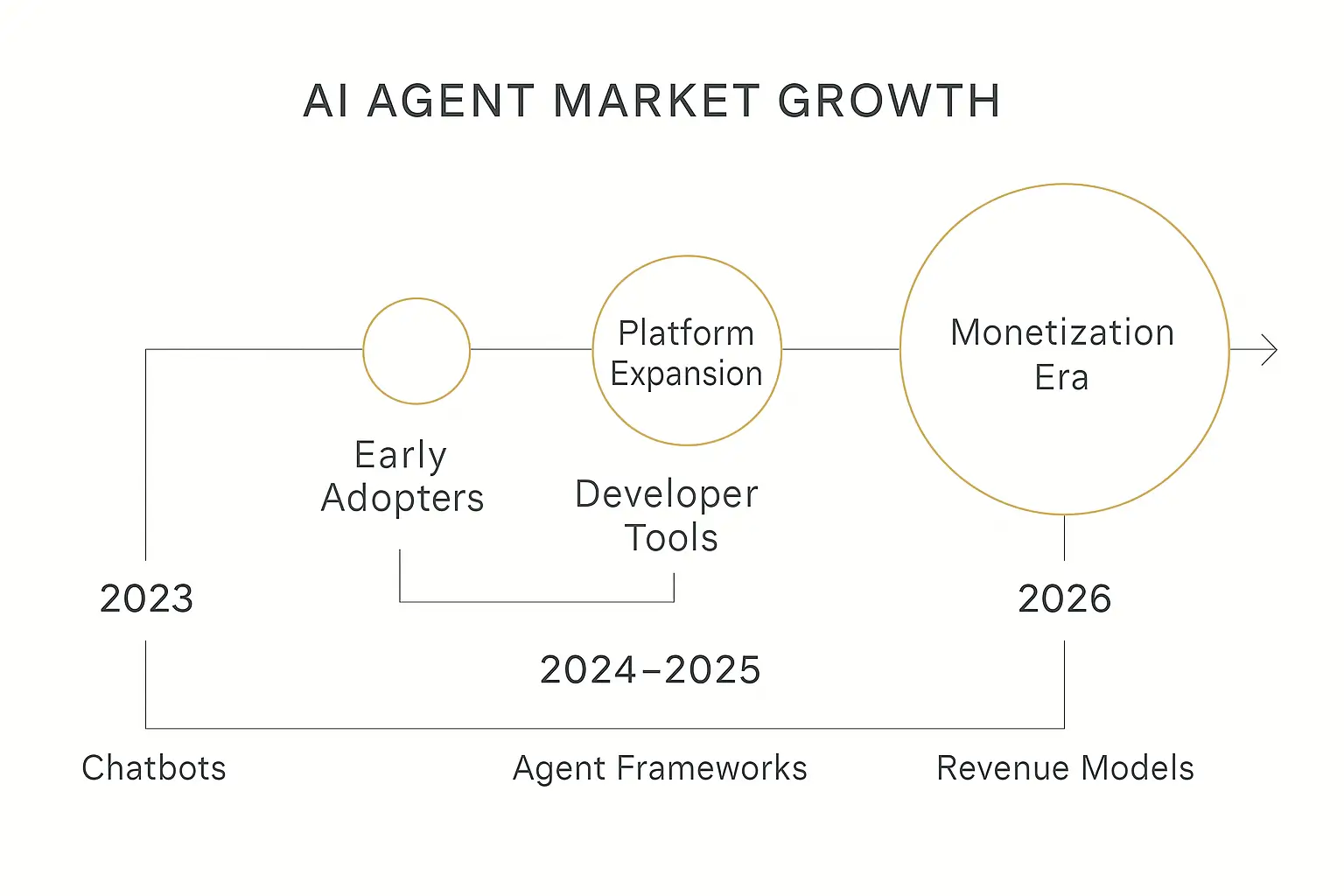
Let me be blunt: 2024 was experimentation. 2025 was early adoption. 2026 is when AI agents become a real revenue category.
The numbers tell the story. The AI agent market hit $7.6 billion in 2025 and is projected to reach $47 billion by 2030, according to Grand View Research. That's not gradual growth — that's a market multiplying 6x in five years.
Gartner predicts that 40% of enterprise applications will include task-specific AI agents by the end of 2026, up from less than 5% in 2025. Read that again. We're going from 1-in-20 to nearly half in a single year.
McKinsey estimates AI agents could generate roughly $2.9 trillion in US economic value per year by 2030. And companies are already placing massive bets. Salesforce's Agentforce hit $800 million in ARR with 29,000 deals in Q4 of their fiscal 2026 alone.
But here's what matters for you and me — the people actually building and selling agents, not just reading analyst reports.
Three Shifts That Make 2026 Different
1. Buyers finally understand what agents are. In 2024, I spent half of every sales conversation explaining what an AI agent even was. In 2026, prospects come to me already knowing they need one. The education phase is over for most markets — even traditionally slow-to-adopt sectors like K-12, where AI tools for teachers are now mainstream.
2. The tooling caught up. You no longer need a dev team to build production-quality agents. No-code platforms let you go from idea to deployed agent in hours, not months. That collapsed the barrier to entry — which means the competitive advantage shifted from "can you build it" to "can you monetize it."
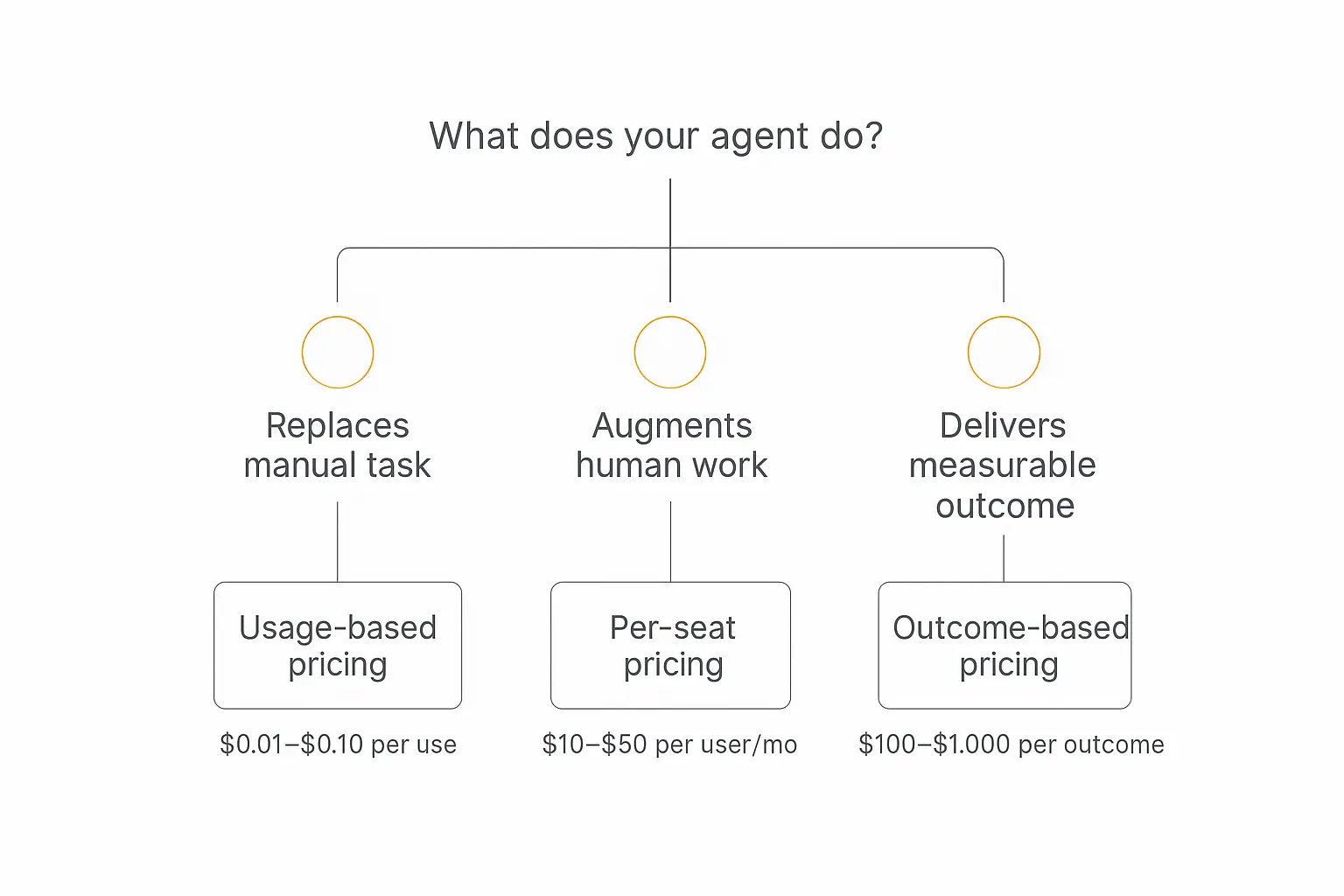
3. Pricing models matured. The industry figured out that flat SaaS subscriptions don't work well for AI. Bessemer Venture Partners reports that 43% of SaaS companies now use hybrid pricing models in 2026, projected to hit 61% by year-end. Meanwhile, seat-based pricing fell from 21% to 15% in just 12 months. The market is telling us something: usage-based and outcome-based pricing is where the money is heading.
That context matters because the monetization strategy you pick will determine your ceiling. Choose wrong and you cap your upside. Choose right and you build something that compounds.
Let's get into the seven proven models.
1. Sell AI Agent Services to Local Businesses
This is the fastest path to revenue I've seen, and I've written about it in depth before. The model is simple: build AI agents that solve specific problems for local businesses, charge $300–$1,500/month on retainer.
Why does this work so well? Because local businesses have painful, obvious problems that AI agents solve immediately — missed calls, slow lead response, repetitive customer questions, after-hours coverage gaps.
The Speed-to-Lead Agent: A Case Study
The agent I see generating the most consistent revenue right now is the speed-to-lead agent. It sits on a business's website, qualifies incoming leads in real time, and routes hot prospects to the sales team immediately.
Here's why businesses pay for this without hesitation: studies consistently show that responding to a lead within 5 minutes makes you 21x more likely to qualify them. Most local businesses respond in hours, if at all. An AI agent responds in seconds.
These agents take 4–8 hours to build and sell for $1,500+ as a one-time setup fee or $500/month on retainer. The margins are absurd because once it's built and deployed, your ongoing costs are minimal.
Corey Ganim put it perfectly on X — he's been vocal about building AI agents in 2 hours and selling them for $2K+. That's not an exaggeration. When you get your process dialed, the build time drops dramatically but the value to the client stays high.
What to Charge and How
I've found the sweet spot for local business AI agent services falls into three tiers:
- Starter ($300–$500/month): Single-purpose agent. FAQ bot, appointment scheduler, or lead qualifier. Includes hosting, monitoring, and basic updates.
- Growth ($500–$1,000/month): Multi-function agent with integrations. Connects to their CRM, calendar, or email. Weekly performance reports.
- Premium ($1,000–$1,500/month): Multiple agents across their business, custom integrations, priority support, monthly optimization calls.
The key insight: don't charge for the technology. Charge for the outcome. A dentist doesn't care about your RAG pipeline. They care that they booked 40 more appointments this month.
If you want the full step-by-step, my guide on how to start an AI agent agency covers everything from picking your niche to closing your first 10 clients.
2. Usage-Based and Outcome-Based Pricing
This is the pricing model that's eating the AI world right now. And for good reason — it aligns what you charge with the value you deliver.
The poster child is Intercom's Fin AI agent. They charge $0.99 per resolved customer support ticket. Not per seat. Not per month. Per resolution. That model helped Intercom reach 9-figure revenue. When the agent resolves 10,000 tickets a month, nobody complains about paying $9,900 — because without the agent, they'd be paying $50K+ in human support costs.
According to Chargebee's analysis, the shift away from seat-based pricing is accelerating because AI agents fundamentally break the per-user model. When one agent does the work of five humans, charging per seat makes no sense.
Three Usage-Based Models That Work
Per-action pricing. Charge for each meaningful thing the agent does: each lead qualified, each email drafted, each document processed. This works best when the action has a clear, measurable value.
Per-resolution pricing. The Intercom model. Only charge when the agent successfully completes the task — a ticket resolved, a question answered without human escalation, a sale closed. This is the hardest model to implement but has the highest willingness-to-pay because the client takes zero risk.
Credit/token-based pricing. Sell credits that users spend as they interact with the agent. Each interaction consumes a certain number of credits based on complexity. This works particularly well for B2C applications where consumers interact with your agent directly.
When Usage-Based Pricing Backfires
I should be honest about the downsides.
Revenue unpredictability is real. If a client's usage drops 40% one month — maybe they had a slow season — your revenue drops 40% too. Subscriptions smooth this out. Usage pricing doesn't.
Cost tracking gets complex. You need to understand your per-interaction costs precisely. If your agent costs $0.12 per interaction and you're charging $0.15, your margins are razor-thin. If usage spikes and you're on a flat-rate API plan, you could lose money.
My recommendation: use a hybrid model. Charge a modest base subscription ($49–$199/month) plus usage fees above a certain threshold. You get predictable base revenue and upside when usage grows. This is exactly what Monetizely's research shows is becoming the industry default.
For a deeper dive on structuring these models, check out our AI agent pricing models breakdown.
3. White-Label AI Agents for Clients
This is the model with the best unit economics if you execute it well. The idea: build an AI agent once, then resell it to multiple clients under their own branding.
Think of it like a franchise model for AI. You build a "lead qualification agent for real estate agents." Then you sell that same core agent — with custom branding, custom knowledge base, and custom integrations — to 20, 50, 100 different real estate agents. Each one pays you monthly. Your incremental cost per client is near zero.
I've written a complete white-label playbook if you want the tactical details, but here's the strategic overview.
Why White-Labeling Works So Well
Build once, sell many. The initial build takes the same effort whether you sell to 1 client or 100. Every additional client is almost pure margin.
Clients want their brand, not yours. A law firm doesn't want to send clients to "SuperAI ChatBot." They want their own branded experience. White-labeling lets you deliver that without rebuilding from scratch each time.
Retention is higher. When a client's customers associate the AI experience with the client's brand — not yours — switching costs increase. The agent becomes part of their business identity.
The Economics
Let me walk through real numbers.
Say you build a customer support agent template for e-commerce brands. Your build cost (your time) is maybe 40 hours upfront. You charge each client:
- $2,000 one-time setup fee (customization, knowledge base loading, testing)
- $500/month ongoing (hosting, monitoring, updates, support)
After 10 clients, you're at:
- $20,000 in setup fees (covers your initial build time many times over)
- $5,000/month recurring revenue
- Your marginal cost per client: maybe $50–$100/month in AI compute costs
That's 80–90% gross margins on recurring revenue. And every new client you add barely moves your cost needle.
Platforms like Pickaxe make white-labeling straightforward — you can customize branding, connect the agent to each client's specific knowledge base and tools, and deploy through branded portals or embedded widgets on their websites. The client sees their brand. You manage the infrastructure.
The Verticals Where This Crushes It
- Real estate: Property Q&A agents, lead qualification, showing schedulers
- Legal: Client intake, document Q&A, appointment booking
- Healthcare: Patient FAQ, appointment scheduling, pre-visit intake
- E-commerce: Product recommendations, order tracking, returns handling
- Financial services: Account FAQ, loan pre-qualification, onboarding
The pattern: pick an industry where the core agent logic is 80% the same across clients, and only the knowledge base and integrations change.
Ready to start monetizing AI agents?
Pickaxe gives you everything to build, brand, and sell AI agents to clients — from knowledge base to deployment.
4. Subscription Access to Specialized AI Agents
This is the model for solo creators, subject-matter experts, and niche consultants. You build an AI agent around your unique expertise, then sell monthly access to it.
Think of it as "productized consulting." Instead of trading your time for money in 1:1 sessions, you encode your knowledge into an agent and let it serve unlimited users simultaneously.
What This Looks Like in Practice
A tax strategist builds an agent that knows the latest tax code changes, common deductions by profession, and entity structuring strategies. They charge freelancers $29/month for unlimited access. At 200 subscribers, that's $5,800/month — more than most tax preparers earn from a handful of clients.
A fitness coach creates an agent loaded with their programming methodology, nutrition frameworks, and form correction knowledge. $19/month for personalized workout and nutrition guidance. At 500 subscribers, $9,500/month.
A marketing consultant builds an agent that can audit landing pages, suggest copy improvements, and generate campaign strategies based on their proven frameworks. $49/month for startup founders. At 100 subscribers, $4,900/month.
Pricing the Subscription
The range I see working for specialized agents:
- $9–$19/month: Broad consumer agents. High volume needed. Works for fitness, personal finance, general productivity.
- $29–$49/month: Professional tools. Tax strategy, marketing audits, legal guidance. Lower volume, higher intent users.
- $99–$249/month: Premium B2B agents. Industry-specific analysis, compliance checking, technical documentation. Fewer users, much higher lifetime value.
The mistake most people make: pricing too low. If your agent saves a freelancer 5 hours a month on tax questions, $29/month is a rounding error compared to what those 5 hours are worth. Don't anchor to consumer app pricing ($4.99/month). Anchor to the value of the problem you're solving.
How to Make Subscriptions Sticky
Keep the knowledge base fresh. An agent trained on 2024 tax code isn't useful in 2026. The agents with the highest retention are the ones where the creator continuously updates the knowledge base with new information, case studies, and insights.
Build in personalization. The best subscription agents remember user context. A marketing agent that remembers your brand voice, your target audience, and your past campaigns is 10x more valuable than one that starts fresh every session.
Create tiers. Offer a base tier for access and a premium tier for deeper features — more interactions, priority responses, access to specialized sub-agents. This lets you capture more value from power users without overcharging casual ones.
If you want to set this up, our guide on setting up monetization with Stripe walks through the exact technical steps.
5. AI Agent Marketplaces
Marketplaces are the newest monetization channel — and potentially the most scalable. The idea: list your agents on platforms where buyers are already looking, and let the marketplace handle discovery, payments, and distribution. We compared the options in the best platforms to build and sell AI tools.
Greg Isenberg has been vocal on X about this space. He's talked about OpenClaw and AI agent marketplaces keeping him up at night — and I think he's right to be excited. We're in the early innings of what could become an app-store-scale ecosystem. Before an agent can be sold it needs logins, branding, and billing, which is the subject of making an agent client-facing without writing code.
Where to List Your Agents
Platform-native marketplaces. OpenAI's GPT Store, Anthropic's ecosystem, and other model providers are building marketplaces for agents built on their platforms. These give you distribution but limit you to that platform's capabilities.
Vertical marketplaces. Industry-specific hubs are emerging for real estate, legal, healthcare, and e-commerce agents. These are smaller but have much higher buyer intent — people browsing a "real estate AI tools" marketplace know exactly what they want.
MCP (Model Context Protocol) hubs. With MCP becoming an interoperability standard, marketplaces are emerging for MCP-compatible agents and tools that can plug into multiple AI ecosystems. This is still early but worth watching.
Independent agent platforms. Platforms like Pickaxe let you build agents and sell them through your own branded portal with built-in payments — so you get marketplace-like monetization infrastructure without giving up control of the customer relationship.
The Economics of Marketplaces
Revenue splits on agent marketplaces typically range from 70–85% to the creator, with 15–30% going to the platform. That's comparable to the App Store model.
The upside: zero customer acquisition cost. The marketplace brings the buyers. Your job is to build something good and optimize your listing.
The downside: you don't own the customer relationship. The platform does. If they change the algorithm, raise their cut, or shut down, your revenue disappears. This is the same risk creators faced on every platform from YouTube to the App Store.
My take: use marketplaces as a distribution channel, not your only channel. List your agents everywhere, but also build your own direct sales engine. Diversification is how you survive platform risk.
What Sells on Marketplaces
From what I've observed, the agents that do best on marketplaces share three traits:
- Narrow, specific use case. "Marketing assistant" gets lost in the noise. "LinkedIn post generator for B2B SaaS founders" stands out.
- Immediate, obvious value. Users should see the value within the first 30 seconds. If it takes a 10-minute onboarding flow, marketplace browsers will bounce.
- Clear pricing. Free trials convert, but only if the paid version offers a clear step up. "5 free uses, then $19/month for unlimited" works better than complex tiered pricing.
6. Productized AI Consulting Packages
This model is for people with consulting or agency backgrounds who want to package AI agent services into repeatable, scalable offerings.
The difference between "consulting" and "productized consulting" is structure. A consultant says "I'll build you whatever you need — let's scope it." A productized consultant says "Here's our AI Agent Accelerator package. It's a 4-week engagement: audit, build, deploy, train. $15,000."
The Four-Phase Framework
The most successful AI consulting packages I see follow this structure:
Phase 1: Audit ($2,000–$5,000)
Map the client's workflows, identify where AI agents can have the biggest impact, and prioritize by ROI. Deliverable: a strategy document with 3–5 agent recommendations, expected impact, and implementation timeline.
This phase is pure profit. It's your expertise, not technology. And it often pays for itself because the client now has a clear roadmap — whether they hire you to build it or not. (They almost always hire you.)
Phase 2: Build ($10,000–$50,000)
Design, develop, and test the agents. This is where the real work happens. For context, custom AI agent development typically runs $30K–$150K at traditional dev shops with 60–70% margins. If you're using no-code tools, your delivery cost drops dramatically but you can still price at a premium because the client is paying for the outcome, not the hours.
Phase 3: Deploy ($2,000–$5,000)
Integration with the client's existing systems, testing in their environment, user training, and go-live support. This is where most projects fail — not because the agent doesn't work, but because adoption sucks. Budget real time for change management.
Phase 4: Maintain ($1,000–$3,000/month)
Ongoing optimization, knowledge base updates, performance monitoring, and support. This is the recurring revenue engine. Once you've deployed an agent, the maintenance retainer is nearly pure margin.
Why This Model Scales
The beauty of productized consulting is that you get smarter and faster with every engagement. Your third real estate client takes half the time of your first because you've already built the templates, figured out the integrations, and documented the playbook.
Deloitte found that only 1 in 5 companies has mature governance for AI agents. That gap is your opportunity. Companies know they need agents but don't know how to evaluate, build, deploy, or manage them. You're selling the entire capability, not just the code.
If you're starting from scratch, our AI agent agency playbook covers the business setup, and our guide on building an AI agent for client onboarding shows how to streamline your own delivery process with agents.
7. Internal AI Agents That Save Money
Not every monetization strategy means selling to someone else. Sometimes the most valuable AI agent is the one that saves your own company money.
I know, "saving money" doesn't sound as exciting as "recurring revenue." But consider this: if you build an internal agent that replaces $8,000/month in outsourced work, that's $8,000/month in value creation. From a P&L perspective, a dollar saved is worth more than a dollar earned because you don't have to pay sales and marketing costs to get it.
Where Internal Agents Create the Most Value
Customer support triage. An internal agent that handles tier-1 support tickets — password resets, FAQ answers, order status checks — can deflect 40–60% of incoming volume. If your support team costs $15,000/month, that's $6,000–$9,000 in savings.
Employee onboarding. A new hire has 500 questions in their first month. An onboarding agent that knows your company policies, tech stack, and processes can answer 80% of them instantly — instead of pulling senior employees away from their work.
Internal knowledge management. Every company has institutional knowledge trapped in someone's head, buried in Confluence, or scattered across Slack threads. An internal agent that indexes all of it and answers questions is like giving every employee a personal research assistant.
Sales enablement. An agent that helps sales reps draft proposals, answer technical questions about your product, or prep for calls using CRM data. This doesn't replace reps — it makes each rep 20–30% more productive.
How to Calculate ROI
The formula is straightforward:
Monthly value = (hours saved × average hourly cost) + (errors prevented × cost per error) + (faster response × value of speed)
Be conservative in your estimates. If your agent saves your support team 100 hours/month at a fully loaded cost of $35/hour, that's $3,500/month in hard savings. Your AI compute costs might be $200–$500/month. The ROI is obvious.
AWS notes that SaaS companies transforming for agentic AI are seeing the biggest gains not from selling agents, but from deploying them internally first — reducing support costs, accelerating product development, and automating repetitive operational work.
Pricing Your AI Agent: A Decision Framework
Choosing the right pricing model isn't just about what sounds good. It depends on who your buyer is, what your agent does, and how much value it creates.
Here's the framework I use:
| Pricing Model | Best For | Typical Range | Pros | Cons |
|---|---|---|---|---|
| Monthly Retainer | Local businesses, agencies | $300–$1,500/mo | Predictable revenue, simple to explain | Hard to scale without adding clients |
| Per-Action / Per-Resolution | Support, sales, lead gen agents | $0.50–$5.00 per action | Aligns price with value, easy to justify | Revenue volatility, complex tracking |
| Subscription (B2C) | Niche expertise agents | $9–$49/mo | Scalable, passive income potential | Needs volume, higher churn |
| Subscription (B2B) | Professional/enterprise tools | $99–$499/mo | Higher LTV, lower churn | Longer sales cycle, more support needed |
| Hybrid (Base + Usage) | Any agent with variable usage | $49–$199 base + usage | Predictable floor with upside | More complex to communicate |
| One-Time + Maintenance | Custom builds, consulting | $5K–$150K + $1K–$3K/mo | Big upfront cash, recurring tail | Feast-or-famine without pipeline |
| White-Label License | Agency/reseller model | $200–$500/mo per client | Best unit economics, compounds | Requires upfront template investment |
How to Choose
Ask yourself three questions:
1. Is the value easily measurable? If your agent resolves support tickets or qualifies leads, outcome-based pricing lets you capture more value. If the value is diffuse (general productivity, knowledge access), subscription pricing is cleaner.
2. Who is your buyer? Local business owners want simple monthly retainers. Enterprise buyers expect usage-based pricing with committed spend. Consumers want cheap subscriptions.
3. How much of your cost is variable? If your AI compute costs scale linearly with usage, you need usage-based pricing to protect your margins. If costs are mostly fixed (your time building, flat-rate hosting), retainers and subscriptions work fine.
SaaS Mag's research shows the most successful AI agent companies in 2026 aren't locked into one model — they adapt their pricing to the customer segment. Your enterprise clients might be on outcome-based pricing while your SMB clients are on simple retainers. That's fine. Don't force one model on everyone.
Turn AI agents into a revenue stream
Consultants and agencies use Pickaxe to create white-labeled AI agents their clients pay for monthly.
The Economics: What AI Agent Margins Actually Look Like
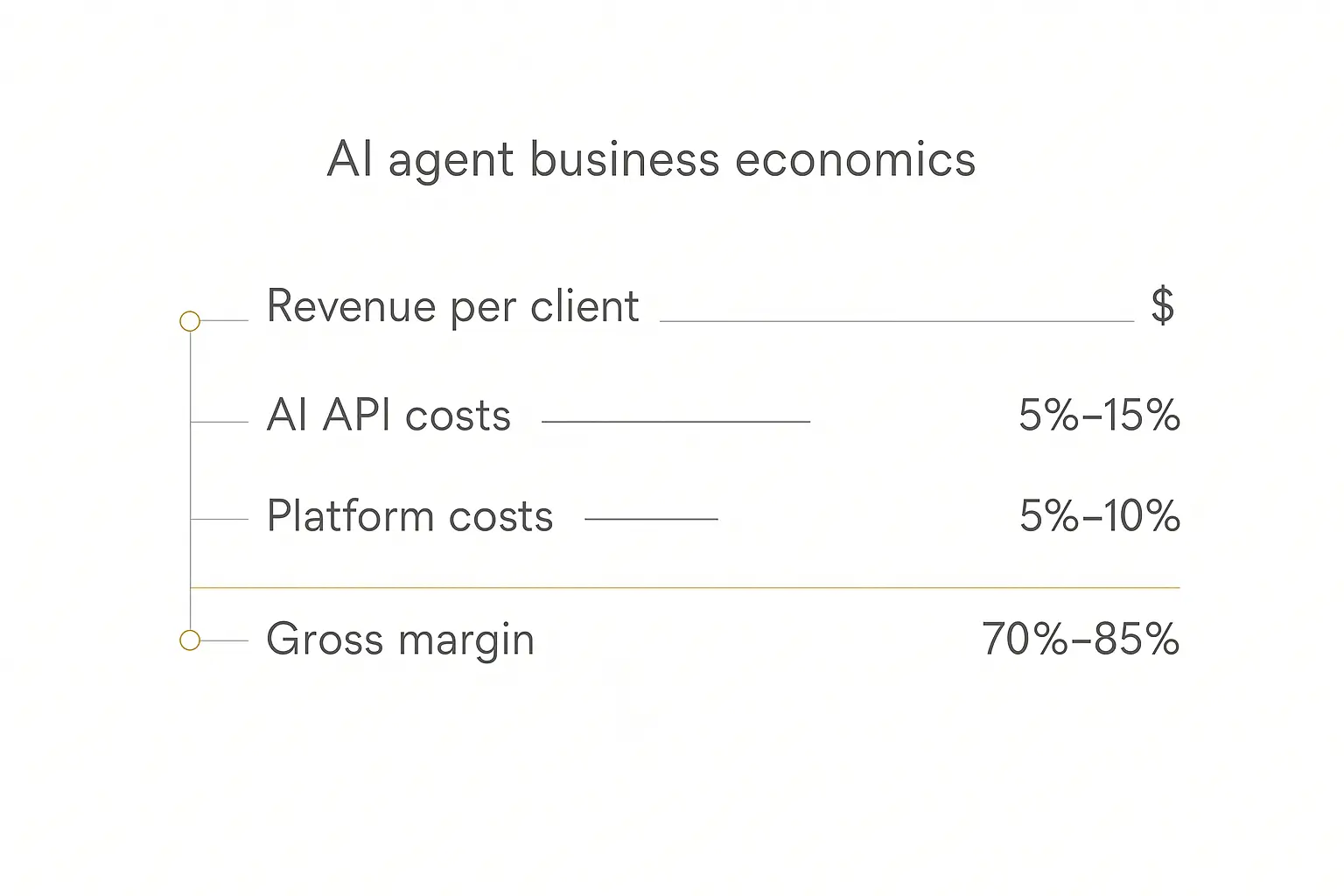
Let's talk about the numbers nobody else wants to publish. Because if you're going to monetize AI agents in 2026, you need to know what the real cost structure looks like — not the optimistic projections in pitch decks.
The Cost Stack
Every AI agent has four cost components:
1. AI compute (LLM API costs). This is your biggest variable cost. Depending on the model and usage volume, this runs $0.01–$0.50 per interaction. GPT-4-class models cost more. Smaller, fine-tuned models cost less. The trend is sharply downward — costs have dropped roughly 10x per performance level over the past 18 months — but it's still your primary COGS line item.
2. Infrastructure. Hosting, databases, monitoring, vector storage for knowledge bases. For most agent builders using no-code platforms, this is bundled into the platform fee. If you're self-hosting, budget $100–$500/month depending on scale.
3. Your time. Building, maintaining, updating knowledge bases, handling support requests. This is the cost most people undercount. Even a "passive" agent needs 2–5 hours/month of maintenance to stay current and effective.
4. Platform fees. If you're using a no-code builder, you're paying a monthly platform fee plus potentially a revenue share on monetized agents. Factor this into your margins.
Real Margin Scenarios
Here's what margins actually look like across different models:
Scenario 1: Local business retainer ($750/month client)
- AI compute: ~$50–$100/month
- Platform costs: ~$30–$50/month
- Your time: ~2 hours/month (~$100 at $50/hr opportunity cost)
- Gross margin: ~65–75%
Scenario 2: White-label agent ($500/month, 20 clients)
- AI compute: ~$50–$100/month per client ($1,000–$2,000 total)
- Platform costs: ~$200/month total
- Your time: ~10 hours/month across all clients (~$500)
- Revenue: $10,000/month
- Gross margin: ~73–83%
Scenario 3: Subscription agent ($29/month, 300 subscribers)
- AI compute: ~$500–$1,500/month (depends on usage per subscriber)
- Platform costs: ~$100–$200/month
- Your time: ~8 hours/month on updates (~$400)
- Revenue: $8,700/month
- Gross margin: ~74–85%
Compare this to industry benchmarks: AI agent businesses typically run 50–60% gross margins, versus 80–90% for traditional SaaS. The gap is entirely due to AI compute costs. But two forces are closing it: model costs are falling fast, and pricing is shifting toward usage-based models that pass compute costs through to the end user.
The margin play for 2026: Use cheaper, specialized models where you can. Don't default to the most expensive model for every task. A well-prompted smaller model can handle 70% of agent tasks at 10% of the cost. Reserve the powerful models for complex reasoning. This single optimization can bump your margins 10–15 points.
Common Mistakes That Kill AI Agent Revenue
I've watched dozens of people build genuinely useful AI agents and still fail to make money. The agent isn't the problem. The business model is. Here are the mistakes I see most often. If you are still choosing which model to pursue at all, we mapped the fourteen ways people actually make money with AI and what each one pays.
Mistake 1: Pricing on Cost Instead of Value
This is the most common one. You calculate that your agent costs $50/month in compute, so you charge $99/month and think you're doing great with a 50% margin.
Meanwhile, the agent is saving the client $3,000/month in labor costs. You left $2,900 of value on the table.
Always price based on the outcome the agent delivers, not what it costs you to run. If your agent saves a business $3,000/month, charging $500–$750/month is a no-brainer for them and dramatically better for you.
Mistake 2: Building Before You Have a Buyer
The "build it and they will come" approach kills more AI agent businesses than anything else. You spend two months building the perfect agent, launch it, and... crickets.
Flip the order. Talk to potential buyers first. Understand their problems. Validate willingness to pay. Then build the minimum viable agent that solves their problem. Your first version doesn't need to be perfect. It needs to be useful enough that someone will pay for it.
Mistake 3: Ignoring Retention
Acquiring a new client costs 5–7x more than keeping an existing one. But most agent builders spend all their energy on new sales and zero energy on making current clients stickier.
Build retention into the product. Monthly performance reports. Usage dashboards. Regular knowledge base updates. Quarterly optimization reviews. The agents with the best retention aren't necessarily the most sophisticated — they're the ones that visibly deliver value every month.
Mistake 4: The "Feature Creep" Death Spiral
Client asks for one more integration. Then another. Then they want the agent to handle a completely different workflow. Before you know it, you're maintaining a Frankenstein agent that does 20 things poorly instead of 1 thing brilliantly.
Scope discipline is everything. Each agent should do one thing extremely well. If a client needs multiple capabilities, build multiple agents. It's better for the client (each agent is focused and reliable) and better for you (modular agents are easier to maintain and resell). The recommended best practice is no more than 4 integrations per agent — for more complex workflows, use a primary agent that routes to specialized sub-agents.
Mistake 5: No Governance Story
Deloitte's research found that only 1 in 5 companies has mature governance for AI agents. But enterprise buyers increasingly require it. If you can't answer basic questions about data privacy, model transparency, error handling, and compliance — you'll lose deals to competitors who can.
Build your governance story early. Document how your agents handle sensitive data. Explain your model selection criteria. Show error-handling workflows. If you're building on a platform with SOC2, GDPR, and CCPA compliance, leverage that in your sales conversations. It's a differentiator, especially with mid-market and enterprise buyers.
Getting Started: Your First $5K Month From AI Agents
Enough theory. Here's the practical roadmap to your first $5,000/month in AI agent revenue. This is the path I'd take if I were starting from zero today.
Week 1–2: Pick Your Niche and Validate
Choose one industry and one use case. Not "AI agents for everyone." Something specific: "after-hours lead capture for dental practices" or "client intake automation for immigration lawyers" or "product recommendation agents for Shopify stores."
Then validate demand. Talk to 10–15 potential buyers. Not a survey. Actual conversations. Ask:
- What's your biggest headache with [the problem your agent solves]?
- How are you handling this today?
- What are you spending on the current solution?
- If I could solve this for $X/month, would that be interesting?
If at least 4–5 people say yes to the last question, you have a viable niche.
Week 2–3: Build Your MVP Agent
Use a no-code platform to build your first agent. You don't need to code. You need to deeply understand the problem and design the right conversation flows, knowledge base, and integrations.
Check out our roundup of no-code AI agent builders to pick the right platform. Look for one that handles deployment, monetization, and white-labeling so you're not stitching together five different tools.
Your MVP should:
- Handle the core use case well (not perfectly — well)
- Connect to 1–2 essential integrations (CRM, calendar, email)
- Have a solid knowledge base covering the most common scenarios
- Look professional (custom branding, clean UI)
Don't spend more than 2 weeks building. If you're still tweaking after 2 weeks, you're procrastinating, not perfecting.
Week 3–4: Land Your First 3 Clients
Go back to the people from your validation conversations. Offer them a founding client deal: 50% off the first 3 months in exchange for feedback and a testimonial. This isn't discounting — it's smart GTM strategy. You get:
- Paying clients immediately (even at 50% off, revenue is revenue)
- Real usage data to improve your agent
- Social proof for future sales
At 3 clients paying $500/month (or $250/month at founding client pricing), you're already at $750–$1,500/month.
Month 2: Optimize and Raise Prices
With real client data, you can now:
- See which agent features get used and which don't
- Identify gaps in your knowledge base
- Collect outcome metrics (leads captured, tickets resolved, hours saved)
- Build case studies from your founding clients
Raise your prices for new clients. Your founding clients locked in their rate, but every new client pays full price. With proof of results, you can confidently charge $750–$1,500/month.
Month 3: Scale to $5K
You need 5–7 clients at $750–$1,000/month, or 10+ at $500/month. Focus on:
- Referrals: Ask happy clients to introduce you to colleagues. In local business especially, referrals are gold.
- Content: Share results on LinkedIn, in industry forums, in local business groups. "I built an AI agent that booked $12K in new appointments for a med spa" gets attention.
- Outbound: Reach out directly to businesses in your niche. Personalized messages that reference their specific situation convert 3–5x better than generic pitches.
$5K/month is 3–7 clients depending on your pricing. That's not a massive sales operation. It's a handful of conversations with the right people.
Beyond $5K: The Scaling Playbook
Once you're consistently at $5K/month, you have options:
Go deeper in your niche. Become the AI agent provider for dental practices in your region. Then expand nationally. Vertical dominance beats horizontal sprawl every time.
Productize and white-label. Take your best-performing agent, templatize it, and sell it to other agencies or consultants who serve the same niche. Now you're making money while they do the selling.
Add a marketplace channel. List your agents on relevant platforms and marketplaces to add a passive revenue stream on top of your direct sales. Agents are one lane of several — 14 ways to make money with AI lays out the rest with real numbers attached.
Build a team. Hire a part-time VA to handle onboarding and support. Hire a salesperson on commission. Your $5K/month becomes $20K/month when you're not the bottleneck for every task.
What the Next 12 Months Look Like for AI Agent Monetization
Let me share what I think is coming, based on the trends I'm watching from inside the space.
Outcome-based pricing becomes the default. By the end of 2026, I expect the majority of AI agent businesses to include some form of outcome-based pricing component. The Intercom model — paying per resolution, per action, per result — is too compelling for buyers to resist. According to Vendasta's research, the businesses seeing the fastest agent adoption are the ones offering transparent, outcome-linked pricing.
Agent-to-agent economies emerge. Right now, agents mostly serve humans. In the next 12 months, we'll see agents that serve other agents — orchestrator agents that coordinate specialist agents, marketplace agents that broker between buyer agents and seller agents. Nevermined is already building infrastructure for agent-to-agent transactions. This opens entirely new monetization surfaces.
Regulation creates moats. As governments catch up to AI agent deployment, compliance requirements will increase. Companies that build governance, transparency, and audit trails into their agents early will have a structural advantage. The Deloitte stat — only 1 in 5 companies with mature agent governance — means this moat is still wide open.
The "agency-in-a-box" model explodes. More platforms will offer end-to-end infrastructure for building, deploying, and monetizing agents without code. The barrier to entry will keep dropping, which means differentiation will shift entirely to domain expertise, distribution, and customer relationships. The technical ability to build an agent stops being a competitive advantage.
Monetize AI Agents in 2026: The Bottom Line
Here's my honest take after watching this space evolve from the inside.
The opportunity to monetize AI agents in 2026 is real, large, and growing. We're not in speculative territory anymore. The market data is clear: $7.6 billion today, $47 billion by 2030. Companies like Salesforce are doing $800M ARR on agents alone. Intercom is at 9 figures charging less than a dollar per resolution.
But the opportunity isn't evenly distributed. The people making real money from AI agents aren't the ones with the most technical sophistication. They're the ones who:
- Pick a specific niche and understand the buyer's problems deeply
- Price on value, not on cost or gut feel
- Choose the right monetization model for their market and agent type
- Build retention into the product, not just the sales pitch
- Start selling before the agent is perfect — then iterate based on real usage
You don't need to be a developer. You don't need a massive budget. You need a clear niche, a useful agent, and the willingness to have sales conversations before you have a polished product.
If you want to get started building agents without writing code, Pickaxe lets you build, deploy, and monetize AI agents from one platform — with white-labeling, Stripe-powered payments, and deployment across websites, portals, email, WhatsApp, Slack, and API. Check out our pricing and see what makes sense for where you're starting.
The agent economy is here. The playbook is in front of you. The only question is whether you'll execute on it.