

Pricing is the single hardest part of selling AI services. I've watched talented people build genuinely valuable AI agents and then quote $1,500 for work that was worth $50,000 to the client.
The problem is that AI service pricing breaks most of the rules people learned from selling regular software or consulting. The cost to deliver is weird. The client's mental model is wrong. And the technology underneath changes its own price every few months.
So in this guide I want to give you a real framework. Not "charge what you're worth," which is useless advice, but an actual method: how to find your floor, how to find your ceiling, which pricing model to pick, and how to handle the objection every AI seller eventually hears.
I'll use real 2026 benchmark numbers throughout so you have something concrete to anchor to. Let's get into it.
Why Pricing AI Services Is Uniquely Hard
Three things make AI services harder to price than almost anything else.
First, your cost to deliver is variable and partly out of your control. Every conversation your agent has burns tokens, and those tokens are a real cost of goods sold, not overhead. A flat monthly price that looked profitable can quietly go underwater when usage spikes.
Second, the client's mental model is wrong. Most buyers think AI is "basically free" because they've used ChatGPT for $20 a month. They don't see the prompt engineering, the knowledge base, the integrations, the testing, and the ongoing maintenance. You're selling a system; they think they're buying an API call.
Third, the ground keeps moving. Model prices drop, models get deprecated, and new capabilities appear constantly. A price you set against today's model math can invert in six months.
None of this means AI services are hard to sell. Demand is enormous. It means you need a pricing method that accounts for all three. Most people skip straight to "what's the going rate" and underprice themselves into the ground.
Speaking of the going rate, let's look at it.
What AI Consultants and Agencies Actually Charge
Here are the typical ranges reported across AI agencies and consultants in 2025 and 2026. Treat these as a map, not gospel. Most are self-reported by agencies, so anchor your credibility on the value you create, not on matching a table.
| Engagement type | Typical 2026 range |
|---|---|
| Freelance AI engineer (marketplace) | $30–$100+/hr (median ~$50) |
| Independent AI consultant | $100–$450/hr; $600–$1,200/day |
| Strategy firm / Big-4 day rate | $2,500–$3,500+/day |
| Discovery / strategy sprint | $1,500–$3,000 |
| Simple support chatbot build | $3,500–$12,500 |
| AI automation setup | $2,500–$15,000+ |
| Custom AI agent build | $10,000–$100,000+ |
| Multi-agent / enterprise system | $60,000–$200,000+ |
| Monthly retainer | $2,000–$50,000/mo by scope |
| Per-agent ongoing management | $300–$1,500/mo |
Sources: Orient Software, Upwork, Digital Agency Network, and Softermii.
Notice the spread. A "custom AI agent" ranges from $10K to over $100K. That gap isn't about hours. It's about perceived value and positioning. The same build can be a $10K commodity or a $100K business outcome depending on how you price and frame it.
Notice also the marketplace floor. The median freelance AI engineer on Upwork charges about $50 an hour. If you compete on hourly rate, that's your gravity, and AI keeps pulling it down because it makes everyone faster. The whole point of this guide is to climb away from that floor. Tooling helps you climb faster, so we sorted 18 AI tools for freelancers by whether they raise your rate or only your output.
The 8 Ways to Price AI Services
There are eight pricing models worth knowing. Most successful AI businesses end up using two or three of them in combination.
| Model | Best when | Watch out for |
|---|---|---|
| Hourly / time-and-materials | Scope is genuinely unknown; pure R&D | Caps your income at hours and punishes you for being fast. AI makes you faster, so you earn less. |
| Fixed project | A well-defined deliverable | Scope creep eats your margin if you mis-scope. |
| Retainer | Ongoing optimization and monitoring | You must keep proving value or it churns. |
| Value-based | You can quantify a business outcome | Requires a real value conversation and trust. |
| Outcome / performance | The result is measurable and attributable to you | You carry delivery risk; high volume can swamp you with AI costs. |
| Usage-based / per-agent | A productized agent with variable consumption | "Bill anxiety" for clients; unpredictable revenue. |
| Productized packages | A repeatable, standardized service | Commoditization if you don't differentiate. |
| Hybrid (setup + monthly) | Most real AI agent engagements | Slightly more complex to quote. |
If you take one thing from this table: hourly is the worst model for AI work, and it's the one most beginners default to. As Jonathan Stark argues in Hourly Billing Is Nuts, billing by the hour makes your client focus on time instead of results, and it caps your upside. With AI, it's actively self-defeating, because the tooling that should make you more profitable instead shrinks your invoice.
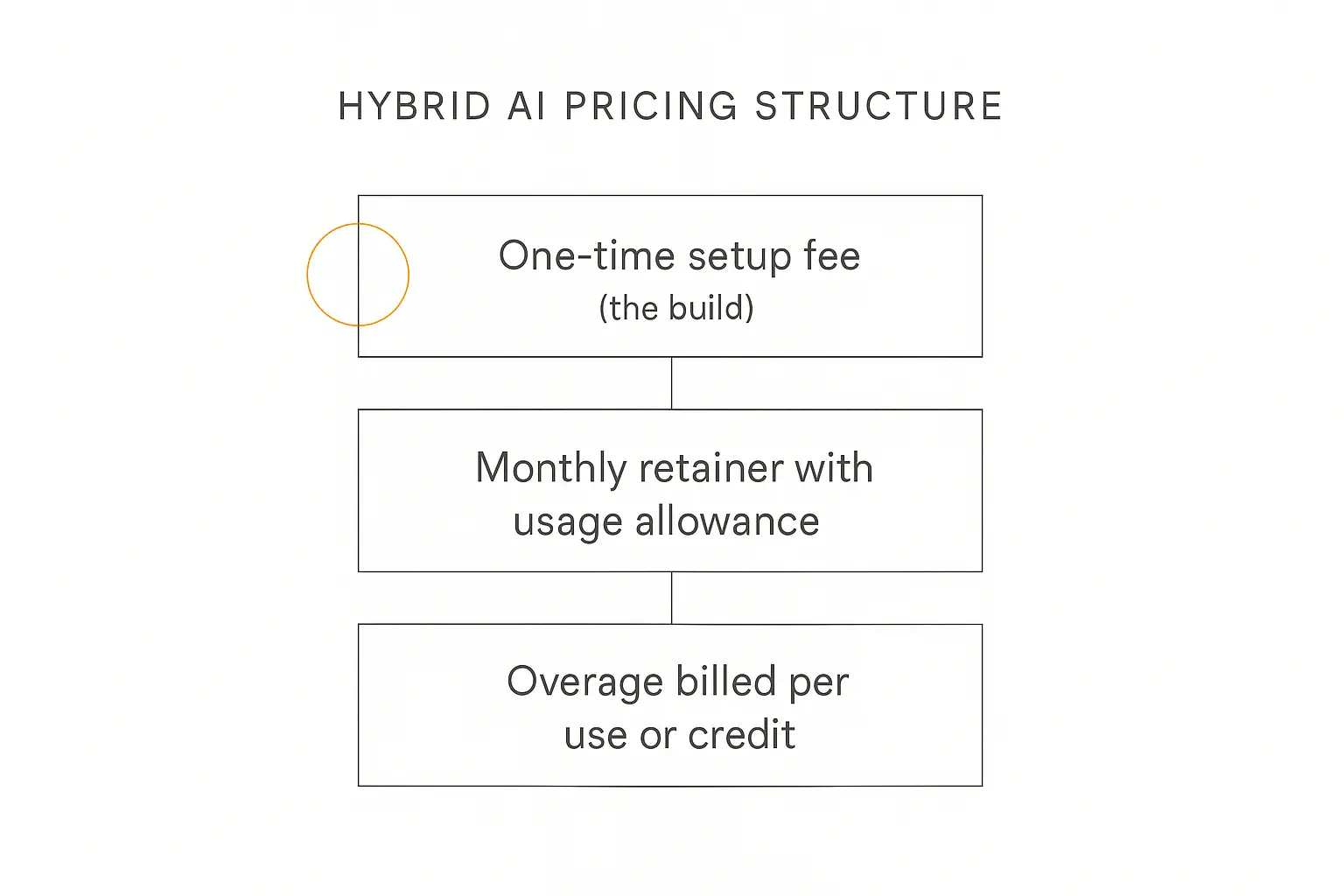
The model I recommend as a default for AI agent work is the hybrid: a one-time setup fee for the build, plus a monthly retainer or usage allowance. It covers your upfront cost and gives you recurring, higher-margin revenue. More on that shortly.
How AI Changes the Math: Tokens, Margins, and Volatility
This is the section most pricing guides skip, and it's the one that will save your business.
When you deliver an AI service, the model usage is cost of goods sold. It sits above the line, like the raw materials in a physical product. That changes your margin profile dramatically.
Traditional SaaS runs 80 to 90% gross margins. AI products often run 50 to 60%, and the fastest-growing ones sometimes dip to 25% or even negative while they figure pricing out. (Source: The SaaS CFO.)
Worse, people routinely underestimate token usage by two to five times. The hidden costs are the model's internal reasoning, agent loops, retries, and the context you stuff in for retrieval. (Source: Line of Sight.)
Two practical rules come out of this:
- Always estimate your real token cost, then multiply by 2 to 5x as a safety buffer before you quote a flat price. Tools like CloudZero's cost-per-call breakdown help you get the base number.
- Put a re-pricing or model-cost passthrough clause in your contract. If usage doubles or a model changes, you're protected. This is normal and clients accept it when you explain it upfront.
Now you understand the cost side. Let's turn that into an actual price, starting with the floor.
Charge for Discovery Before You Quote the Build
Here's a tactic that pays for itself immediately: sell a paid discovery sprint before you quote the main project.
A discovery or strategy engagement, typically $1,500 to $3,000, does three things at once. It qualifies the client (people who won't pay for discovery won't pay for the build). It gives you the real numbers you need to price the build accurately. And it lets you run the value conversation properly instead of guessing.
It also flips the dynamic. Instead of giving away free scoping in a sales call and hoping to win the work, you're already a paid advisor by the time you quote. That alone tends to raise your win rate and your prices.
Never quote a fixed price for a complex AI build off a single call. You'll either underprice it and bleed margin, or overprice it defensively and lose the deal. Scope first, then price from facts.
Step 1: Find Your Floor
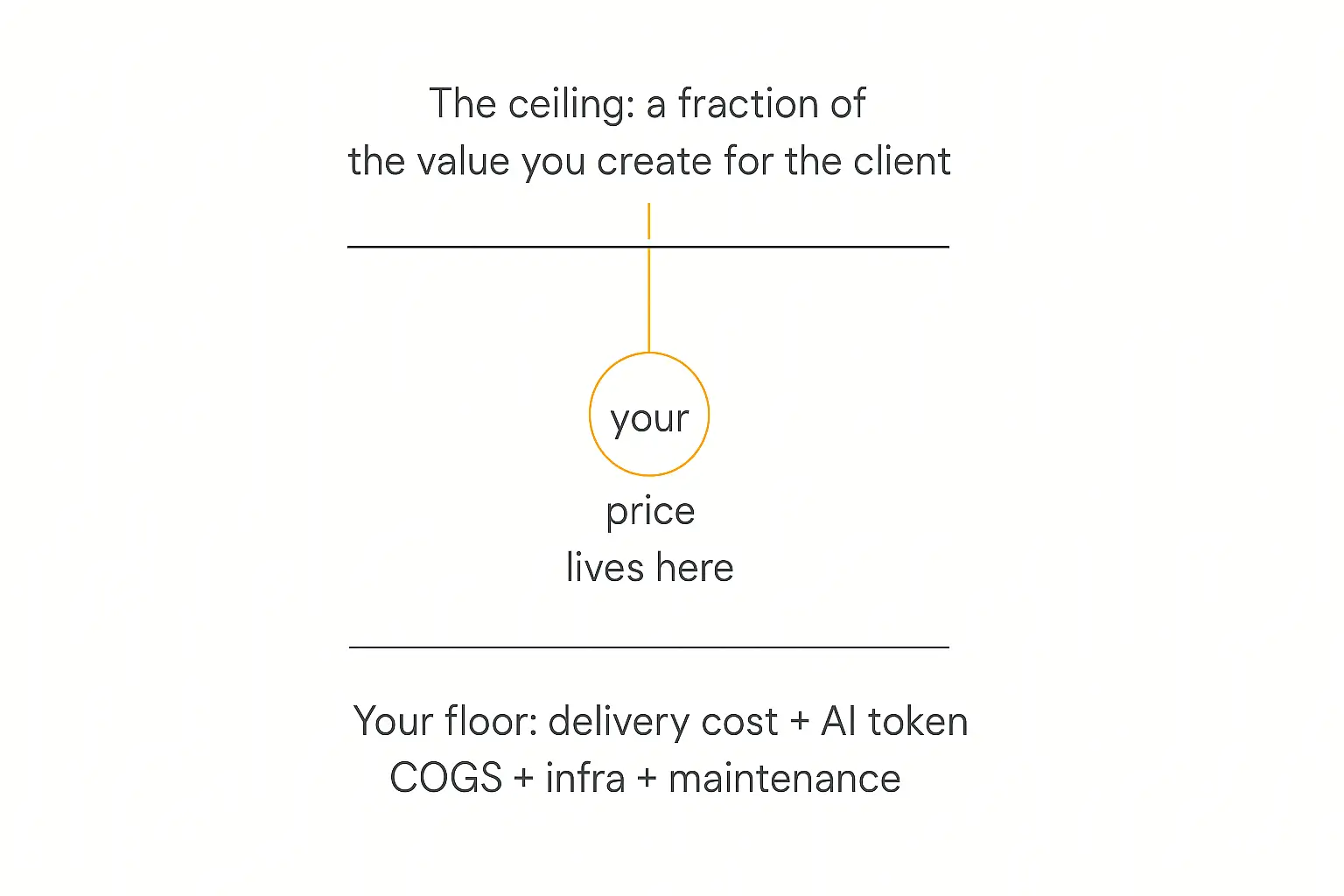
Your floor is the price below which the deal isn't worth doing. It is not your price. It's your walk-away number.
Calculate it cost-plus, AI-aware:
- Delivery cost: your hours times a loaded rate (include your time even if you're a solo operator).
- AI COGS: the real, buffered token cost to run the thing.
- Infrastructure overhead: hosting, monitoring, logging, roughly 10 to 15% of inference cost.
- Maintenance reserve: ongoing upkeep runs 15 to 30% of the build cost per year. Reserve for it.
Add those up and you have your floor. If a client won't clear it, walk. Competing below your floor is how agencies go out of business while looking busy.
But here's the key mindset shift: your floor should almost never determine your price. It's a safety check. The actual price comes from the other end, the ceiling.
Step 2: Find Your Ceiling With Value-Based Pricing
The ceiling is set by the value you create for the client, not by your costs.
Alan Weiss, who wrote the book on value-based fees, has one unbreakable rule: never quote a fee before you've established the project's objectives and their value to the client. Price follows value, and value lives in the buyer's perception.
Blair Enns of Win Without Pitching calls the value conversation the most valuable skill in all of business: find out what the client wants and what they'd pay if you could create that.
In practice, here's how to run it:
- Quantify the outcome. Hours saved, revenue gained, or cost reduced. Get a real number with the client, not a guess.
- Price a fraction of that value. A common range is 10 to 25% of the quantified annual impact, aiming for roughly 5x ROI for the client. If your agent saves a team $200,000 a year, a $30,000 build is an easy yes.
- Anchor with data. Use real productivity numbers so the value feels credible.
And the data is strong. A peer-reviewed study in the Quarterly Journal of Economics found generative AI raised customer-support productivity by 14% on average and 34% for less-experienced agents. (Source: Brynjolfsson, Li & Raymond, NBER.) McKinsey reports function-level cost reductions of 10 to 20% in engineering and revenue uplifts above 10% in marketing. (Source: McKinsey State of AI.)
Here's the part that justifies premium pricing. McKinsey also found that while 88% of organizations use AI, only a tiny fraction actually capture meaningful financial returns from it. Clients aren't paying you to "add AI." They're paying you to be the person who makes it actually work. That's worth a lot.
If you want a structured way to put ROI numbers in front of clients, our guide on how to measure AI agent ROI gives you the formulas to do it.
Build the agent you're pricing
Pickaxe is the no-code platform to build, deploy, and monetize the AI agents you sell to clients.
Step 3: Package It as Good, Better, Best
Once you know your floor and ceiling, package the offer. The most effective structure is three tiers, because it anchors the middle option and gives buyers an easy upgrade path.
- Good: a standardized build with usage caps and self-serve support.
- Better: higher usage limits, more integrations, priority support. This is the one you want most clients to choose.
- Best: custom scope, dedicated support, enterprise terms.
Within each tier, the default structure for AI agent work is the hybrid I mentioned: a setup fee plus a monthly fee with a usage allowance and overage. This is now the de-facto standard for AI products, and for good reason. It covers your build cost upfront and turns the engagement into recurring revenue. (Source: Bessemer's AI Pricing Playbook.) Pricing is one piece of a larger question: the fourteen ways to make money with AI covers which model to be in at all.
If you're new to structuring recurring AI pricing, our breakdown of AI agent pricing models goes deeper on per-seat, usage-based, and outcome-based billing with examples.
A Real Pricing Example, Start to Finish
Let's make this concrete. Say a 12-person law firm wants an AI intake agent that answers prospective-client questions, qualifies leads, and books consultations.
Step 1, the floor. You estimate 25 hours of build time at a loaded rate of $120, which is $3,000. Real token costs, buffered 3x for agent loops and retrieval, come to about $180 a month. Add 12% infrastructure overhead and a maintenance reserve. Your floor for the build lands around $4,500, with an ongoing floor near $300 a month.
Step 2, the ceiling. You run the value conversation. The firm currently loses roughly a third of after-hours leads because nobody answers. Each new case is worth about $4,000 in fees, and they get maybe 15 inbound leads a week. Capturing even five extra cases a month is $20,000 in new revenue, or $240,000 a year.
Suddenly your floor is irrelevant. Ten percent of that annual value is $24,000.
Step 3, the package. You don't quote $4,500. You present three tiers built on a setup-fee-plus-monthly structure:
| Tier | Setup | Monthly | What's included |
|---|---|---|---|
| Good | $6,000 | $500/mo | Intake agent, booking, capped usage, email support |
| Better | $9,000 | $1,200/mo | Higher usage, CRM integration, monthly tuning, priority support |
| Best | $15,000 | $2,500/mo | Multi-agent, custom integrations, SLA, quarterly reviews |
Every tier clears your floor comfortably. The middle tier, which most clients pick, brings in $9,000 upfront and $14,400 a year recurring. And it's still a fraction of the value the firm captures, so it's an easy yes.
That's the entire method in one example. The build cost barely moved. The price moved 3x, because it was anchored to value instead of hours.
How to Handle "It's Just an API Call"
Every AI seller eventually hears some version of this. "Isn't this just ChatGPT? Why does it cost that much?"
Don't get defensive. Reframe. There are three moves:
1. Sell the outcome, not the call. The client isn't buying a token. They're buying the resolved support tickets, the qualified leads, the hours their team gets back. Price the result.
2. Sell the system, not the model. The API call is maybe 5% of the work. The other 95% is the prompt engineering, the knowledge base, the integrations, the testing, the guardrails, the monitoring, and the iteration that keeps it working. That's what they can't do themselves.
3. Sell the risk you absorb. When you guarantee an outcome or carry the maintenance, you're taking on risk the client doesn't want. That has value.
A useful closer: quantify their alternative. Hiring a person to do this costs six figures a year. Doing it themselves costs months of fumbling. Your fee is cheap by comparison, and you can show the math.
From Project to Product: Turning a Build Into Recurring Revenue
The biggest leverage in AI service pricing isn't charging more per project. It's turning one-off projects into recurring products.
A custom build you sell once for $20,000 is good money. The same build, packaged as a productized agent that ten clients subscribe to at $500 a month, is $60,000 a year and it grows.
This is where your delivery platform matters. When I build client agents, I use Pickaxe specifically because it handles the monetization layer, not just the build. You can put an agent behind a subscription, sell usage as credits or uses, or charge a one-time fee, all with Stripe billing and access control built in.
The credits system is especially handy for the COGS problem we talked about. Credits map to real AI cost, and you can set your own cost per credit to bake in margin. That's a clean, honest way to pass through token costs with a markup instead of eating them.
You can also bundle several agents into a branded portal and sell access to the whole thing, which is how a consultant turns a service into a small software business. If that's the direction you're headed, our playbook on monetizing AI agents and the guide to starting an AI agent agency are both worth reading next.
Move Up the Pricing Ladder Over Time
Pricing isn't a one-time decision. Treat every engagement as a chance to climb.
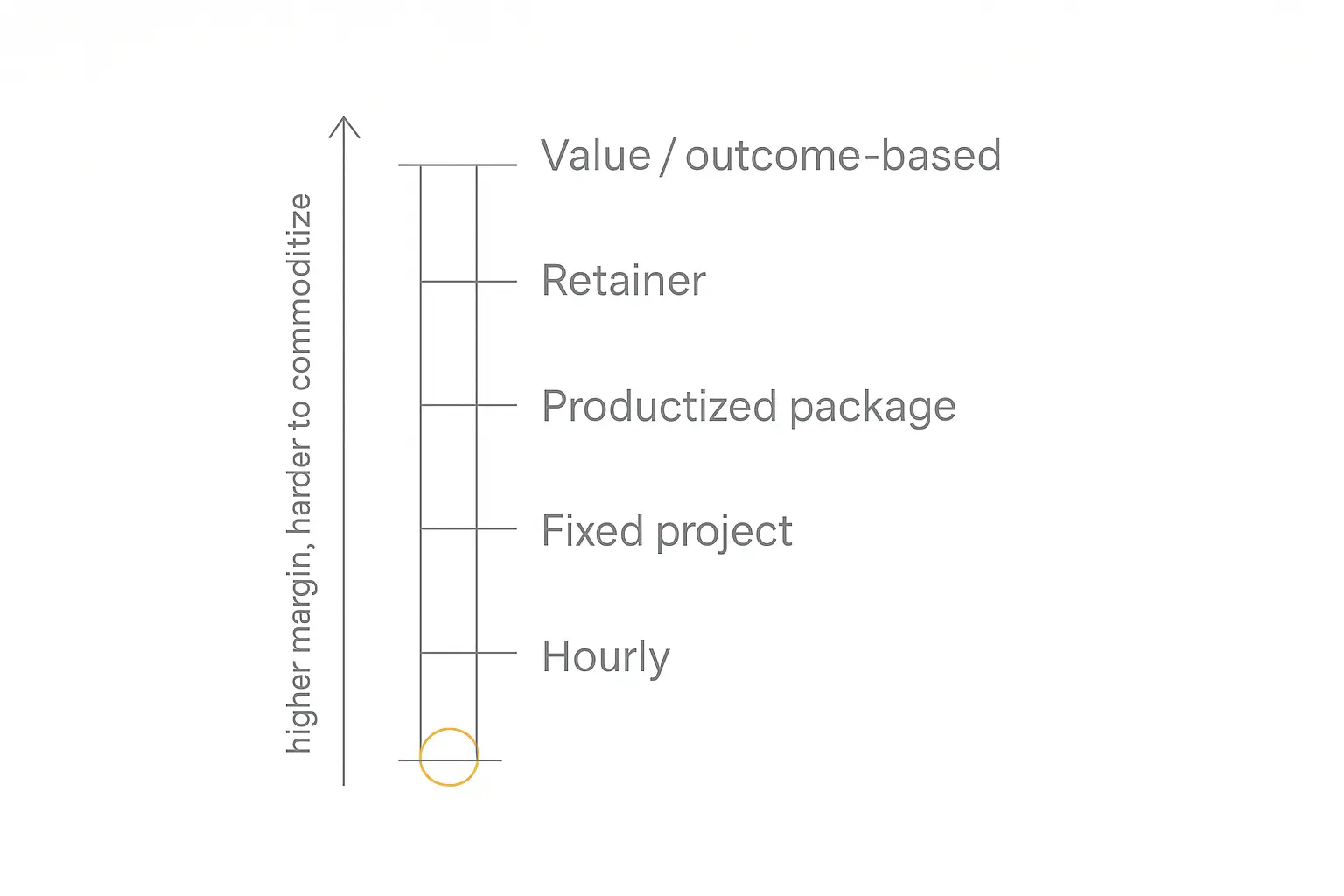
The ladder goes roughly: hourly, then fixed project, then productized package, then retainer, then value and outcome-based. Each rung is higher margin and harder to commoditize than the last.
As Blair Enns puts it, every price is a creative act. You're not looking up a rate, you're making a decision each time based on this client and this value. So raise your prices deliberately:
- Start a notch above where you're comfortable. The discomfort means you're close to right.
- Raise prices on every new engagement until you start hearing "no" occasionally. If everyone says yes instantly, you're too cheap.
- Move recurring clients from project pricing toward retainers and value-based deals as trust builds.
The marketplace floor is brutal and AI keeps lowering it. The only winning move is to stop competing on rate and start competing on outcomes. If you're selling to small local businesses, our guide on selling AI agents to local businesses shows what that looks like at the $300 to $1,500 per month level.
Charge recurring, not one-and-done
Package your agents into a branded portal with subscriptions, credits, and Stripe billing built in.
Frequently Asked Questions
How much should I charge to build an AI agent?
It depends entirely on the value, but as a benchmark, simple chatbots run $3,500 to $12,500, custom agents run $10,000 to $100,000+, and enterprise multi-agent systems start around $60,000. Price toward the value you create, then sanity-check against your cost floor.
Should I charge hourly for AI work?
Almost never. Hourly billing caps your income and punishes you for being efficient, and AI makes you very efficient. Use fixed, productized, retainer, or value-based pricing instead. Reserve hourly for genuinely open-ended R&D.
How do I price ongoing AI agent costs?
Charge a monthly fee that covers your real token COGS plus margin, plus a maintenance reserve of 15 to 30% of the build cost per year. A usage allowance with overage protects you when consumption spikes. A credits system that maps to AI cost makes this clean.
What's the best pricing model for AI services?
For most AI agent work, a hybrid of a one-time setup fee plus a monthly retainer or usage allowance. It covers your build cost and creates recurring revenue. Layer value-based pricing on top when you can quantify the client's outcome.
How do I handle clients who say AI is cheap?
Reframe from the API call to the outcome, the system around it, and the risk you absorb. Then quantify their alternative: hiring someone costs six figures, doing it themselves costs months. Your fee is cheap by comparison.
Putting It Together
Good AI service pricing comes down to a simple loop. Find your floor with cost-plus math that respects token COGS. Find your ceiling with a real value conversation. Price between them, package it as three tiers with a setup fee plus monthly, and move up the ladder over time.
Do that and you'll stop leaving five figures on the table, and you'll stop racing the marketplace to the bottom.
When you're ready to build and monetize the agents you're pricing, you can get started with Pickaxe and have a sellable, billable agent live in an afternoon. And if you're still mapping out the business around it, start with what AI agents are and the AI agent agency playbook.
Price for the value you create. Your clients can tell the difference, and so can your bank account.
Turn the plan into a client pilot
I would define the first workflow and its acceptance criteria before quoting a broader build. Our agency playbook includes a pilot scope and proposal template. The local business sales guide covers discovery and outreach, while the onboarding example provides an intake prompt and handoff tests.