For most of the last two years, building with AI meant building one agent. You wrote a clever prompt, gave it some tools, and hoped it could juggle everything you threw at it. That worked right up until the task got complicated — and then it didn't.
Multi-agent systems are what happens when you stop asking one AI to do everything and start treating AI agents the way you'd treat a team: specialists who each own a slice of the problem and coordinate to get it done.
This isn't a fringe idea anymore. The global agentic AI market hit roughly $10.8 billion in 2026, with multi-agent systems commanding over 53% of that share, and Databricks reported that multi-agent workflows on its platform grew 327% in just five months. If you're still wrapping your head around what an AI agent even is, start there first — this guide assumes you know the basics and want to understand how multiple agents work together.
I've spent a lot of time looking into how these systems are actually built — the architectures, the coordination patterns, where they shine, and where they quietly fall apart. Here's the honest version.
What Is a Multi-Agent System?
A multi-agent system (MAS) is a setup where multiple AI agents — each with its own role, tools, and sometimes its own model — work together to accomplish a task that's too big, too complex, or too unreliable for a single agent to handle alone.
Think of it like the difference between a solo freelancer and an agency.
A solo freelancer can do a bit of everything, but they get overwhelmed when the project sprawls. An agency assigns a researcher, a writer, an editor, and a project manager — each focused, each good at one thing, all coordinated toward the same goal.
That's a multi-agent system. Instead of one model trying to research, reason, write, fact-check, and format all in a single context window, you split the work across specialized agents that communicate and hand off to each other.
The key word is specialized. Each agent has a narrow focus and its own workspace. A research agent only researches. A coding agent only codes. A coordinator decides who does what and stitches the results back together.
The four ingredients every multi-agent system needs
Strip away the jargon and almost every multi-agent system has the same four parts:
- Agents — the individual workers, each with a defined role and a set of tools.
- An orchestrator (or coordinator) — the "manager" that breaks the task into pieces and routes them to the right agent.
- A communication layer — how agents pass information, requests, and results to each other.
- Shared state or memory — a common place where context, intermediate results, and conversation history live so agents aren't working blind.
Get those four right and you have a working system. Get them wrong — usually the communication and shared state — and you get a pile of agents talking past each other.
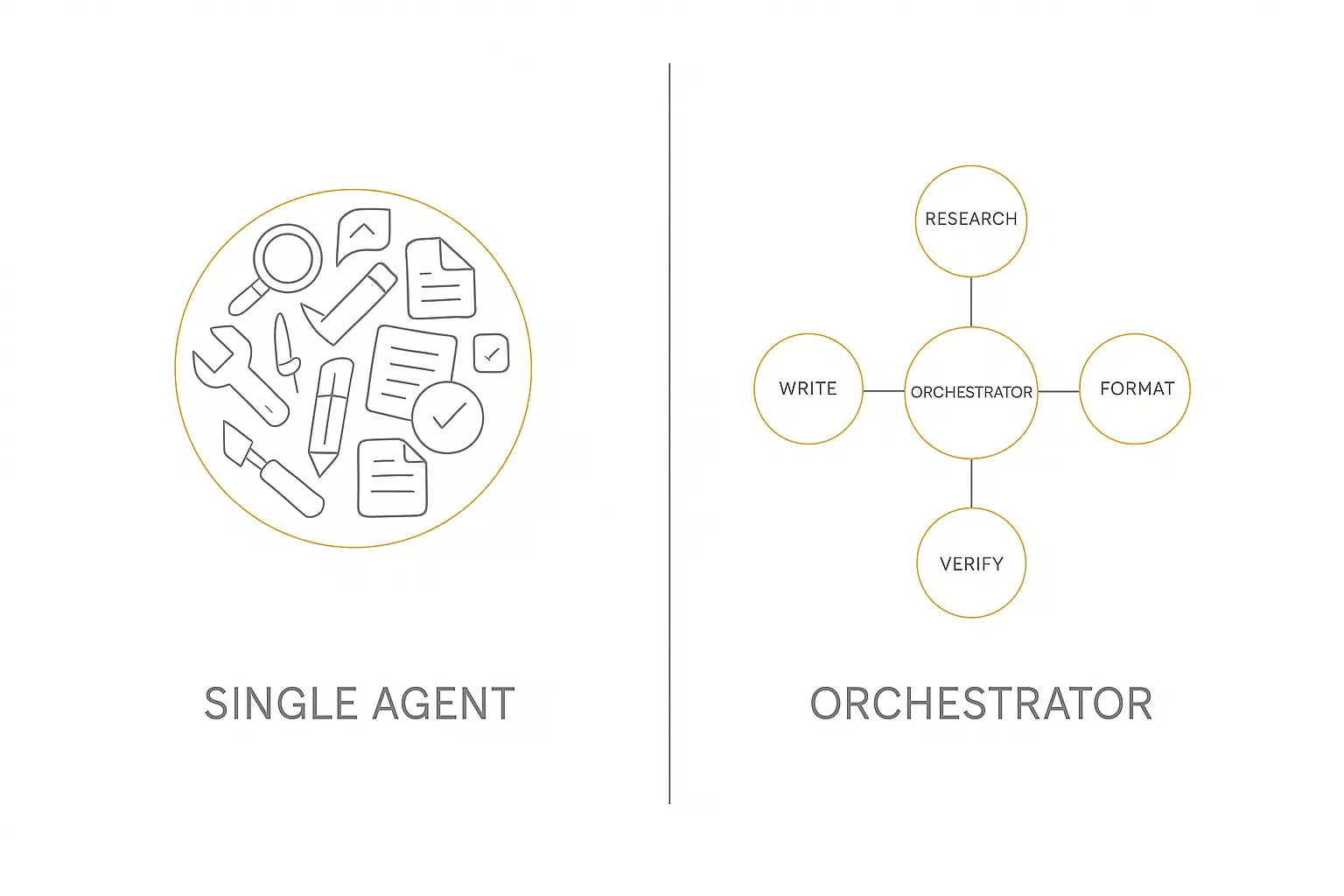
Single Agent vs Multi-Agent: When You Actually Need a Team
Here's the part most hype articles skip: you don't always need multiple agents. A lot of the time, one well-built agent is faster, cheaper, and easier to debug.
The honest rule of thumb is this. Reach for multiple agents when a single agent starts buckling under the load — too many tools, too much context, too many distinct skills crammed into one prompt. Splitting those skills into separate loadable files is the other way out of that squeeze, which we cover in our primer on agent skills.
Anthropic put real numbers on this. Their internal research found that a multi-agent system (Claude Opus as the lead, Claude Sonnet as subagents) outperformed a single agent by 90.2% on complex research tasks. The reason is simple: splitting work across agents gives each one its own context window, which adds capacity for parallel reasoning.
But — and this is the part worth tattooing on your monitor — the same research showed multi-agent systems burn through roughly 15 times as many tokens as a single chat. And for tasks that require tight step-by-step reasoning, some studies found multi-agent setups performed 39% to 70% worse because the extra coordination just got in the way.
So it's not "multi-agent good, single-agent bad." It's about matching the architecture to the job.
A quick decision table
| Situation | Use a single agent | Use a multi-agent system |
|---|---|---|
| Task complexity | One clear, linear job | Many sub-tasks needing different skills |
| Tools needed | A handful (≤4) | Many tools across distinct domains |
| Parallelism | Steps must happen in order | Work can be split and run at once |
| Cost sensitivity | High — you want efficiency | Lower — the task is high-value |
| Example | FAQ chatbot, simple lookup | Research report, end-to-end client onboarding |
If you take one thing from this section: start with a single agent, and only break it into a team when you can point to a specific bottleneck a single agent can't clear.
How Multi-Agent Systems Actually Work
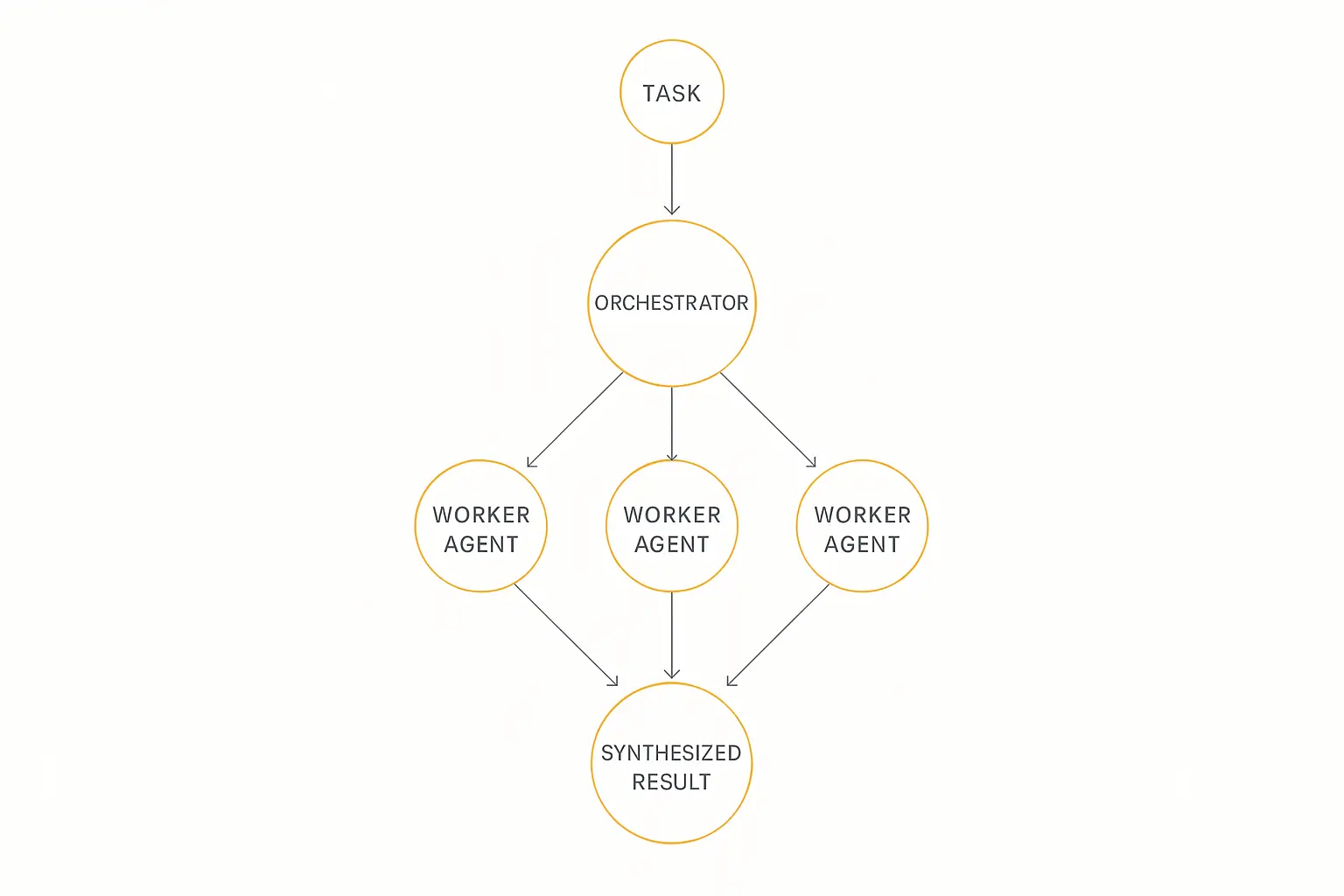
Let's open the hood. When you give a multi-agent system a task, here's the typical flow.
1. The orchestrator receives the request. A user (or another system) hands the orchestrator a goal: "Write me a competitive analysis of the top three CRMs."
2. It decomposes the task. The orchestrator breaks that goal into subtasks — research CRM A, research CRM B, research CRM C, compare pricing, write the summary.
3. It delegates to specialists. Each subtask goes to an agent built for it. A research agent gathers data. A comparison agent crunches the differences. A writing agent drafts the prose.
4. Agents work — often in parallel. This is where the speed comes from. Instead of doing things one after another, the orchestrator can spin up 3–5 subagents at once, each working in its own context window. Anthropic's system does exactly this, which is how it cut research time on complex queries by up to 90%.
5. Results flow back and get synthesized. The orchestrator collects each agent's output, resolves conflicts, and assembles a single coherent answer.
One subtle but important detail: in the most common setup, workers don't talk to each other directly. All coordination flows through the orchestrator. Each worker is stateless, focused on one capability, and blind to what the others are doing. That keeps the system simple and prevents agents from spiraling into endless back-and-forth chatter.
The implementation pieces under the hood
At a technical level, a production orchestrator usually has four moving parts (a structure laid out well in Redis's guide to agent architecture patterns):
- A registry — a directory of available agents and what each one can do.
- A router — logic that maps each incoming task to the best agent or sequence of agents.
- A state store — shared memory holding context and conversation history.
- A supervisor — the watchdog that handles timeouts, retries, and escalations when an agent gets stuck.
You don't need to build all of this from scratch — which is the whole point of the no-code platforms we'll get to later. But understanding the pieces helps you reason about why a system behaves the way it does.
Watch one run: a concrete walkthrough
Let's make this tangible. Say you ask a multi-agent system: "Find the three best project management tools for a 10-person design agency and recommend one."
Here's what happens, step by step:
- The orchestrator reads the request and recognizes it needs research, comparison, and a recommendation. It writes a plan.
- It spins up three research subagents in parallel — one per candidate tool. Each one searches the web, reads pricing pages, and pulls reviews. Because they run at the same time, this takes seconds, not minutes.
- Each subagent returns a structured summary to the orchestrator and then disappears. It doesn't need to stick around.
- The orchestrator hands all three summaries to a comparison agent, which scores them against the criteria — price, team size fit, design-specific features.
- A writing agent turns the scored comparison into a clean recommendation with reasoning.
- The orchestrator does a final sanity check and returns the answer.
Notice the shape: parallel where possible, sequential where necessary. Research happens all at once; comparison and writing happen in order because each depends on the previous step. That blend of parallel and sequential work is the signature of a well-designed multi-agent system.
Now imagine asking a single agent to do all of that in one context window — research three tools, hold every pricing detail in its head, compare them, and write the recommendation without losing track. It can, up to a point. But the more you pile on, the more it drops. That's the overload multi-agent systems are built to solve.
The Main Multi-Agent Architecture Patterns
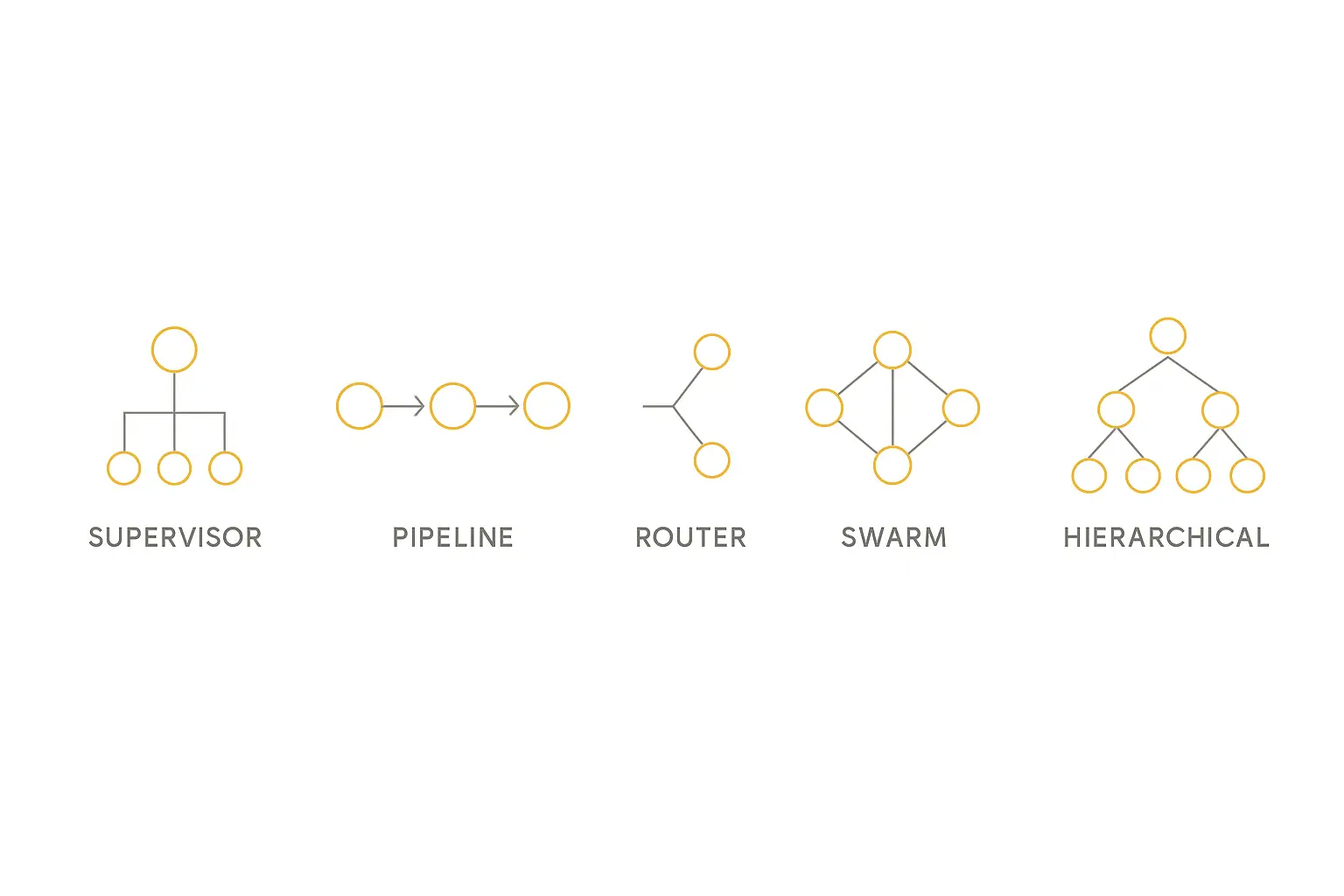
Not all multi-agent systems are wired the same way. There are a handful of patterns that keep showing up in production, and picking the right one matters more than picking the right model.
Here are the five you'll actually encounter.
1. Supervisor (Orchestrator-Worker)
The most common pattern by far. A central supervisor agent owns the conversation, decomposes the task, delegates to workers, validates their output, and synthesizes the final answer.
Workers don't communicate with each other — everything routes through the supervisor. It's clean, easy to reason about, and easy to debug because there's one clear "brain."
Best for: research, content generation, customer support triage — anything where a manager-and-team mental model fits.
2. Pipeline (Sequential)
Agents are chained in a fixed order, each one's output feeding the next. Agent A's result becomes Agent B's input, and so on — like an assembly line.
Best for: workflows with clear stages. Think: intake → analysis → draft → review. Pickaxe calls this a "waterfall setup," and it's the backbone of a lot of real client workflows.
3. Router
A lightweight classifier sits at the front and sends each request to exactly one specialist. There's no decomposition — just smart triage.
Best for: support systems where a "billing question" goes to the billing agent and a "technical issue" goes to the tech agent. Fast and cheap because only one agent runs per request.
4. Swarm (Mesh / Decentralized)
No central boss. Agents talk to each other directly and hand off control peer-to-peer based on who's best suited for the current step.
Best for: dynamic, open-ended problems where you can't predict the path in advance. More powerful, but much harder to control and debug — coordination can get chaotic fast.
5. Hierarchical
Supervisors all the way down. Domain-specific clusters of agents are each managed by a mid-level supervisor, and those supervisors report up to a top-level coordinator.
Best for: enterprise-scale deployments with 50+ agents across multiple business domains. For systems that big, hierarchical is usually the only pattern that holds up.
Pattern comparison at a glance
| Pattern | Coordination | Complexity | Best for |
|---|---|---|---|
| Supervisor | Central orchestrator | Low–medium | Research, content, support triage |
| Pipeline | Fixed sequence | Low | Staged workflows (intake → output) |
| Router | One-shot triage | Low | Directing requests to one specialist |
| Swarm | Peer-to-peer | High | Open-ended, unpredictable tasks |
| Hierarchical | Layered supervisors | Very high | Enterprise scale (50+ agents) |
If you're just getting started, the supervisor and pipeline patterns will cover 90% of what you need. Save swarm and hierarchical for when you genuinely outgrow them.
How AI Agents Communicate: MCP, A2A, and Shared Context
Agents are only as good as their ability to share information. For a long time, every connection between an agent and a tool — or between two agents — was a custom integration. That didn't scale.
Two open standards changed that, and if you're building anything serious in 2026 you should know both.
MCP (Model Context Protocol) is how agents connect to tools and data sources. It's the "USB-C port" for AI — a research agent and a fact-checking agent can share the same web-search tool without anyone building a custom integration for each. MCP adoption has been staggering: it hit roughly 97 million monthly SDK downloads by early 2026.
A2A (Agent2Agent) is how agents talk to each other. Where MCP connects an agent to its tools, A2A lets one agent discover, message, and delegate to another — even if they were built by different vendors on different frameworks.
Both protocols now live under the Linux Foundation's AI & Agents umbrella, with backing from Anthropic, Google, Microsoft, AWS, OpenAI, and others. That kind of cross-vendor convergence is rare, and it's a strong signal that multi-agent communication is standardizing fast.
I wrote a full breakdown of how these two protocols differ and when to use each in our MCP vs A2A guide — worth a read if you're choosing between them.
Underneath the protocols sits shared context: the memory store every agent reads from and writes to. This is where a lot of multi-agent systems live or die. If agents can't see each other's results, they duplicate work and contradict each other. Good shared state is the unglamorous foundation that makes the whole thing feel coordinated rather than chaotic.
Multi-Agent Systems vs Traditional Automation
A fair question at this point: how is this different from a Zapier or n8n workflow? Both connect steps together to get a job done.
The difference is where the intelligence lives.
Traditional automation is deterministic. You define every step and every branch in advance: "when a form is submitted, add a row to this sheet, then send this email." It does exactly what you told it, every time. If something unexpected shows up, it breaks or ignores it. Exactly where the line falls between that and an agent is the whole subject of AI agents vs agentic workflows vs automation.
A multi-agent system is adaptive. The orchestrator decides how to break down a task at runtime, and each agent reasons about its piece rather than following a fixed script. Give it a request it's never seen, and it figures out an approach.
| Traditional automation | Multi-agent system | |
|---|---|---|
| Logic | Fixed, pre-defined steps | Decided at runtime by the agents |
| Handles novelty | Poorly — breaks on the unexpected | Well — reasons through new cases |
| Cost per run | Tiny | Higher (LLM tokens) |
| Best for | Repetitive, predictable tasks | Judgment-heavy, variable tasks |
In practice, the two work together. A lot of real systems use automation tools to trigger agents and to carry out their decisions — Pickaxe connects to Zapier, Make, and n8n through MCP for exactly this reason. The agents supply the judgment; the automation supplies the plumbing. If you're comparing pure automation tools, our roundup of automation software covers that side.
Real-World Examples of Multi-Agent Systems
Abstract patterns are fine, but here's what this looks like in the wild.
Deep research assistants
The flagship example. A lead agent takes a research question, spins up several subagents to investigate different angles in parallel, and synthesizes their findings into a cited report. This is exactly how Anthropic's Research feature and similar "deep research" tools work — and it's the use case where multi-agent earns its 15x token cost.
Customer support systems
A router agent reads the incoming message and sends it to the right specialist: billing, technical, account management, or escalation to a human. Each specialist has its own knowledge base and tools. Faster resolutions, fewer tickets bouncing around.
Client onboarding
A pipeline of agents handles intake. One collects information, another verifies it, a third sets up accounts, and a fourth sends a welcome sequence. We broke down how to build this kind of flow in our guide to building an AI agent for client onboarding.
Content production
A research agent gathers sources, a writer drafts, an editor polishes, and an SEO agent optimizes. Each hands off to the next — a textbook pipeline. (Yes, this is roughly how a lot of content gets made now.)
Sales and lead qualification
One agent qualifies inbound leads against your criteria, another enriches them with data, and a third logs everything to your CRM and drafts a follow-up. The hand-offs mean no lead falls through the cracks.
What ties all of these together: each is a workflow that used to require a human team or a tangle of brittle automations, and each maps cleanly onto one of the architecture patterns above.
Build your first multi-agent workflow without code
Pickaxe lets you chain specialized agents into a coordinated team — no orchestration framework required.
The Honest Downsides of Multi-Agent Systems
This is where I diverge from the breathless takes. Multi-agent systems are powerful, but they come with real costs that a lot of people learn the hard way.
They're expensive. That 15x token figure isn't a typo. Every agent has its own context, its own back-and-forth, its own overhead. For a high-value research task, worth it. For a simple lookup, you're lighting money on fire.
They're harder to debug. When one agent in a chain produces a bad result, tracing which agent and why is genuinely difficult. More agents means more places for things to go sideways.
Coordination can backfire. Remember that stat — multi-agent setups performing 39–70% worse on step-by-step reasoning tasks? That's coordination overhead in action. Sometimes the hand-offs introduce more error than the parallelism removes.
There's a real "don't build multi-agents" camp. Cognition, the team behind Devin, published a widely-shared essay arguing that most multi-agent systems are fragile because context gets fragmented across agents and decisions made in isolation conflict. Their take: for many tasks, a single agent with good context management beats a committee.
I think both camps are right, depending on the task. The lesson isn't "never build multi-agent systems" — it's don't reach for one until a single agent clearly can't do the job. Start simple. Add agents when you feel a specific pain, not because multi-agent is the trendy architecture.
If you're weighing whether to build this yourself, buy a platform, or wait, our build vs buy framework walks through that decision in detail.
How to Build a Multi-Agent System Without Code
Here's the good news: you don't need to write Python or wrestle with LangGraph to build a working multi-agent system anymore.
If you are a developer and want the framework route, I'd point you to our comparison of CrewAI, LangGraph, and AutoGen or the broader roundup of AI agent frameworks. Those give you maximum control at the cost of maximum effort.
But for most consultants, agencies, and businesses, the framework route is overkill. You don't want to maintain orchestration code — you want a multi-agent workflow that works.
That's the gap Pickaxe fills. It's a no-code platform for building, deploying, and monetizing AI agents, and it has multi-agent coordination built in through two features:
- Actions that chain agents. You can connect one agent to another so a primary agent routes work to specialized sub-agents — exactly the supervisor pattern, no orchestration code required.
- Waterfall setups. For more complex workflows, Pickaxe recommends a primary agent that hands off to specialized agents in sequence — the pipeline pattern, built visually.
A practical example: say you're building a client-research tool. You'd set up one agent to gather company info, hand it off to a second agent that analyzes it against your framework, and a third that drafts a formatted report. Each agent has its own instructions, knowledge base, and model — and because Pickaxe is model-agnostic, you can run a cheap fast model for the simple steps and a smarter one for the synthesis. (You can compare options on the models page.)
The recommended ceiling is about 4 actions per agent — beyond that, you split into a waterfall of agents, which keeps each one focused and reliable. That constraint isn't a limitation; it's the same "narrow specialist" principle that makes the big multi-agent research systems work.
And because Pickaxe handles deployment, access control, and billing too, the multi-agent system you build can become an actual product — embedded on your site, deployed to Slack or WhatsApp, or sold through a branded portal. If you're thinking about the business side, our guide on monetizing AI agents covers that end.
Multi-Agent Systems FAQ
What is a multi-agent system in simple terms?
It's a group of AI agents that each specialize in one job and work together — like a team of coworkers instead of one overworked generalist. A coordinator splits the task, hands pieces to the right specialists, and combines their results.
Are multi-agent systems better than single agents?
Not always. They're better for complex, multi-skill tasks that can be split up — Anthropic measured a 90% improvement on hard research. But they cost roughly 15x more in tokens and can actually perform worse on tasks needing tight step-by-step reasoning. Match the architecture to the job.
What's the difference between MCP and A2A?
MCP (Model Context Protocol) connects an agent to its tools and data. A2A (Agent2Agent) connects agents to each other so they can delegate and collaborate. Most serious systems use both. See our MCP vs A2A breakdown for the full picture.
Do I need to code to build a multi-agent system?
No. Frameworks like CrewAI and LangGraph require coding, but no-code platforms like Pickaxe let you chain specialized agents through Actions and waterfall setups without writing orchestration logic.
What's the most common multi-agent architecture?
The supervisor (orchestrator-worker) pattern, where one coordinator delegates to specialized workers and synthesizes their output. It's the easiest to reason about and covers the majority of real-world use cases.
The Bottom Line
Multi-agent systems are the natural next step once a single agent can't carry the whole load. By splitting work across specialists — coordinated by a supervisor, chained in a pipeline, or routed by a classifier — you get systems that handle complexity a lone agent simply can't.
But the smart move isn't to start with a team. It's to start with one agent, find the bottleneck, and add agents only where they earn their keep. Multi-agent isn't a flex; it's a tool for a specific class of problem.
The encouraging part is that you no longer need a research lab's engineering team to build one. With a no-code platform like Pickaxe, you can chain specialized agents into a coordinated workflow, deploy it anywhere, and even turn it into a product — all without touching an orchestration framework.
Start small, stay honest about the trade-offs, and let the complexity of the problem — not the hype — decide when it's time to build a team.