

I started selling AI agents to local businesses almost by accident.
A friend who owns a med spa asked if I could build her "one of those chatbot things" to handle appointment questions after hours. I put something together in an afternoon, and within a month she told me it had booked $12,000 in new appointments — from people who would've called, gotten voicemail, and never called back.
That's when the lightbulb went off. Local businesses don't need another SaaS subscription. They need someone to solve a specific, expensive problem with AI — and they'll pay $300 to $1,500 a month for it without blinking.
The numbers back this up. The agentic AI market is expected to hit $10.9 billion in 2026, up from $7.6 billion in 2025, according to Grand View Research. And the U.S. Chamber of Commerce found that 98% of small businesses are already using AI-enabled tools in some form. The appetite is there. What's missing is someone to actually set it up for them. That mismatch between owning AI tools and getting anything out of them is the AI adoption gap, and it is the whole reason this work sells.
This guide is the exact playbook I'd follow to sell AI agents to local businesses — from picking your niche and pricing your services to closing deals and scaling beyond your first handful of clients. If the niche is still the open question, compare nine practical starting points in our AI agency niche guide.
Why Local Businesses Are the Best Market for AI Agents Right Now
Everyone in the AI agency space is chasing enterprise clients. Six-figure contracts, long sales cycles, procurement departments. I get the appeal.
But local businesses are where the fastest, most predictable money is right now. Here's why.
They Have Painful, Obvious Problems
A dentist's office misses 30% of incoming calls because the front desk is busy with patients. A plumber's website gets traffic at 11 PM but there's nobody to answer questions. A restaurant gets the same 15 questions about hours, parking, and dietary restrictions over and over.
These aren't abstract "digital transformation" challenges. They're money left on the table every single day.
The Decision-Maker Is the Owner
When you pitch a local business, you're usually talking to the person who writes the checks. No layers of management. No six-month evaluation process. No procurement committee.
If they see the value, they say yes — often in the same conversation.
They're Already Spending on Worse Solutions
Most local businesses are paying for some combination of answering services, after-hours call centers, lead gen tools, or virtual assistants. These cost $500 to $2,000+ per month and deliver mediocre results.
An AI agent that actually works is a straightforward upgrade at the same or lower price point.
Retention Is Built In
Once an AI agent is handling inquiries, booking appointments, or qualifying leads for a business, turning it off feels like firing a staff member. Monthly churn on AI agent services is remarkably low — I've seen operators report 90%+ retention rates across their client base.
The 8 Most Profitable AI Agents to Sell to Local Businesses
Not all agents are created equal. Some are easy to build and deliver immediate, obvious value. Others require more customization but command higher prices.
Here are the eight agent types I'd focus on, ranked roughly by how easy they are to sell and deliver.
1. After-Hours Receptionist / FAQ Bot
Price range: $300–$500/month
Best for: dental offices, nonprofits, medical practices, law firms, salons, spas
This is the easiest sell in the business. Every local service business has the same problem: people call or visit their website outside business hours, get no answer, and move on to the next option on Google.
An AI agent that answers common questions — hours, pricing, insurance acceptance, service details — and captures contact info or books appointments is worth its weight in gold.
According to recent chatbot statistics, 80% of routine customer interactions can now be fully handled by AI without human intervention. For a local business, that translates directly into fewer missed opportunities.
2. Lead Qualification Agent
Price range: $500–$800/month
Best for: Real estate agents, contractors, home service companies, financial advisors
This agent sits on the business's website or landing page and asks qualifying questions before passing warm leads to the sales team. Think of it as an always-on intake coordinator.
For a real estate agent, the agent might ask about budget, timeline, preferred neighborhoods, and pre-approval status — then only forward the leads that are actually ready to buy.
The pitch writes itself: "Instead of chasing 50 leads a week, you'd talk to the 10 that are actually ready to move."
3. AI Voice Agent / Phone Receptionist
Price range: $500–$1,000/month
Best for: HVAC companies, plumbers, electricians, medical offices, restaurants
This is the hottest category right now. AI voice agents answer the phone, handle routine questions, book appointments, and route urgent calls — all in a natural-sounding voice.
Home service businesses are the sweet spot here. When someone's AC breaks in July, they call the first three companies on Google. The one that answers — even if it's an AI — gets the job. We went deeper on this vertical in AI agents for home services businesses.
A missed call for an HVAC company can mean a $3,000–$8,000 lost job. Framing your $500/month agent against that number makes the ROI conversation trivial.
4. Review Generation Agent
Price range: $300–$500/month
Best for: Any local business, especially restaurants, medical practices, auto shops
Google reviews are the lifeblood of local SEO. This agent follows up with customers after their visit — via text, email, or WhatsApp — and makes leaving a review dead simple.
The businesses that need this most are the ones with fewer than 20 Google reviews. That's a clear indicator they aren't focused on their online presence, and they're probably losing business to competitors with 200+ reviews.
5. Client Onboarding Agent
Price range: $500–$1,000/month
Best for: Law firms, accounting firms, insurance agencies, consulting practices
Professional services firms spend a shocking amount of time on intake paperwork, document collection, and orientation. An AI onboarding agent walks new clients through the process, collects necessary information, answers standard questions, and flags anything that needs human attention.
For an insurance agency, this could mean the difference between onboarding 5 new clients a week and onboarding 15 — without hiring another admin.
6. Internal Knowledge Base / Training Agent
Price range: $500–$800/month
Best for: Businesses with 10+ employees, franchises, multi-location operations
This agent knows everything about the business's processes, policies, and SOPs. New employees can ask it questions instead of interrupting a manager. Existing employees can look up procedures without digging through binders or shared drives.
The value prop is simple: reduce training time, reduce manager interruptions, and keep operations consistent across locations.
7. Appointment Scheduling + Follow-Up Agent
Price range: $400–$700/month
Best for: Med spas, chiropractors, fitness studios, salons, therapists
Goes beyond basic scheduling. This agent handles booking, sends reminders, follows up on no-shows, offers rebooking, and can even upsell complementary services.
Med spas love this one. A no-show on a $300 Botox appointment isn't just lost revenue — it's a slot that could've gone to a paying client. An agent that reduces no-shows by even 20% pays for itself immediately.
8. Custom Workflow Agent
Price range: $800–$1,500/month
Best for: Property managers, recruiting agencies, event planners
These are more complex but command premium pricing. A property management agent that handles tenant screening inquiries, maintenance requests, and lease renewal conversations. A recruiting agent that pre-screens candidates and schedules interviews.
The key is that you're automating a workflow that currently requires a part-time or full-time employee. When you're replacing a $3,000–$4,000/month salary with a $1,000/month agent, the ROI is crystal clear.
Pricing Your AI Agent Services: The $300–$1,500/Month Sweet Spot
Pricing is where most people overcomplicate things. Here's the framework I'd use.
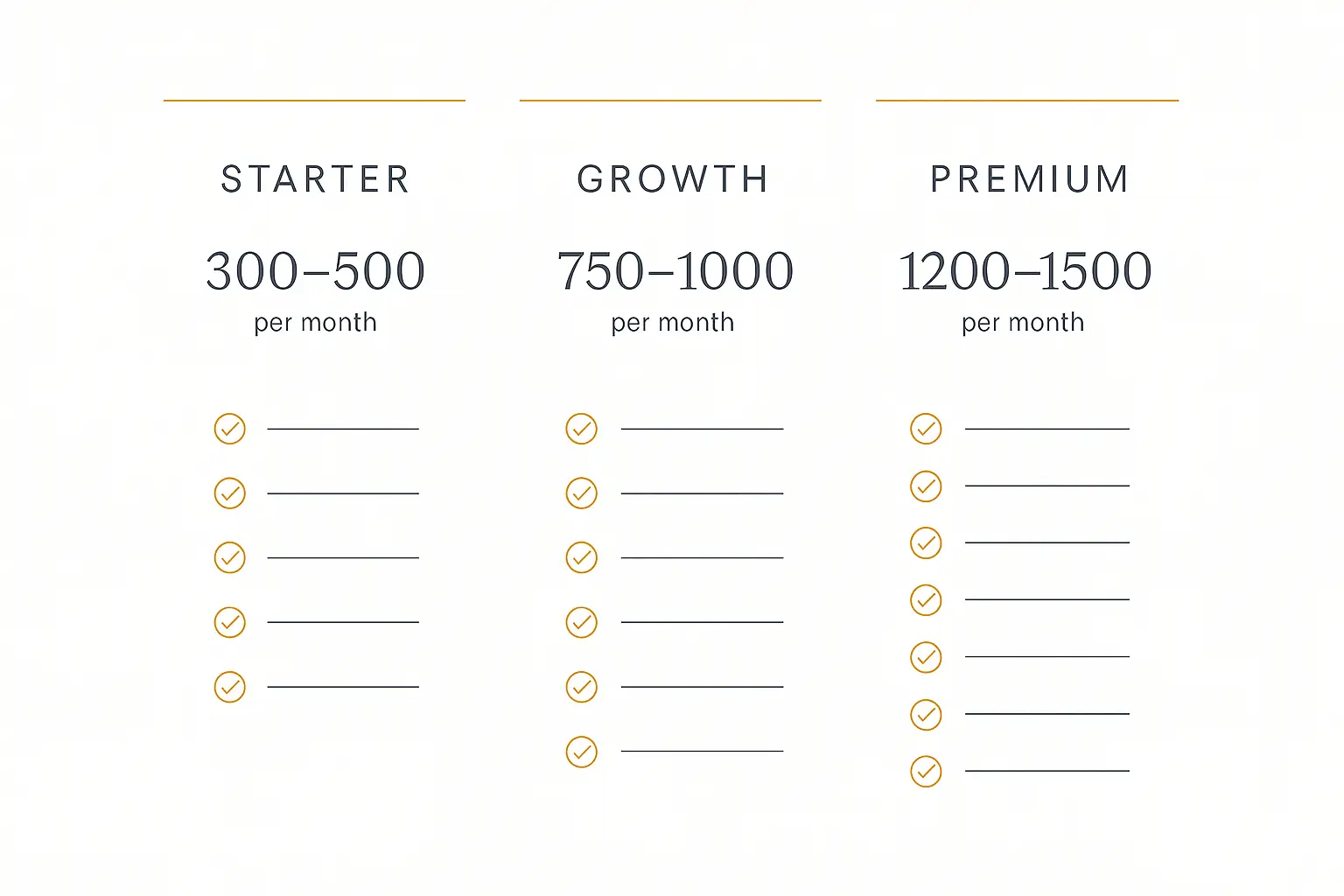
| Tier | Monthly Price | What's Included | Best For |
|---|---|---|---|
| Starter | $300–$500/mo | Single agent, basic FAQ/chat, email support, monthly check-in | Solo practitioners, small shops |
| Growth | $500–$800/mo | 1–2 agents, CRM integration, lead qualification, bi-weekly optimization | Growing practices, service companies |
| Premium | $800–$1,500/mo | Multi-agent workflows, voice + chat, custom integrations, weekly optimization | Multi-location businesses, agencies |
A few principles that matter:
Charge monthly, not one-time. One-time builds are a trap. You deliver the agent, the client doesn't maintain it, it stops working well, and they blame you. Monthly retainers align your incentives — you keep optimizing, they keep getting results.
Include a setup fee for custom work. If the build takes more than a day or two, charge $500–$2,000 upfront. This covers your time and filters out clients who aren't serious. As noted in our breakdown of AI agent pricing models, the most successful agencies combine setup fees with recurring revenue. Event-based businesses are a good early niche for exactly this reason — we broke that one down in AI agents for event planners.
Price against the alternative, not your costs. If a business is paying $1,500/month for a virtual receptionist service, your $500/month AI agent that works 24/7 without breaks isn't expensive — it's a bargain. Frame it that way.
Don't race to the bottom. $300/month is the floor, not the target. Businesses that pay too little tend to undervalue the service and churn faster than clients paying $800+.
For deeper thinking on pricing structures, I wrote a whole breakdown on per-seat vs. usage-based vs. outcome-based pricing that goes into the nuances of each model.
How to Find Local Business Clients (Without Cold Calling 500 People)
Client acquisition is where most AI agent sellers stall out. They build a great agent, put up a website, and wait for clients to find them.
That doesn't work. Here's what does.
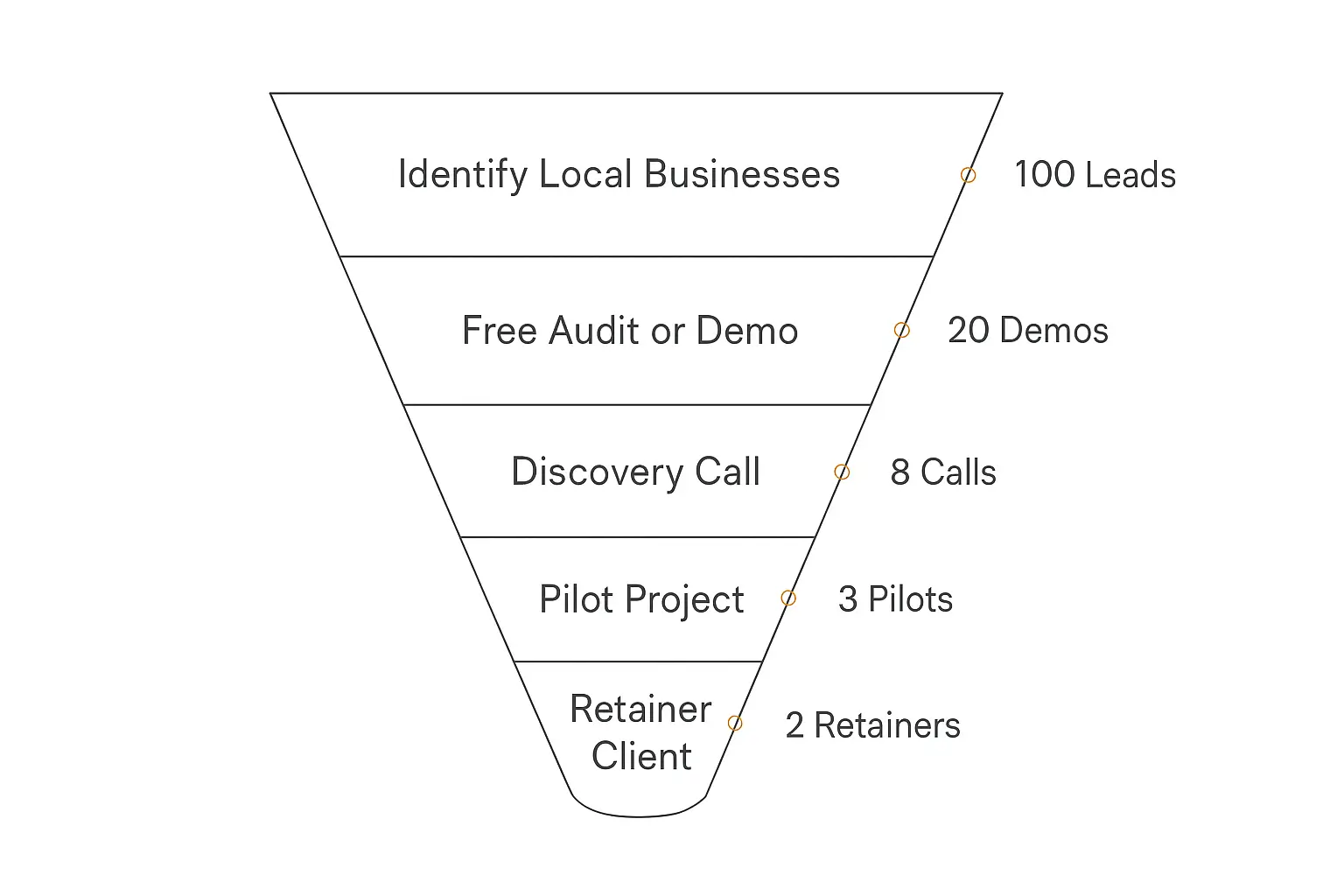
Strategy 1: The "Free Audit" Approach
Pick a niche — say, dental offices in your city. Call or email 20 of them with this pitch:
"Hey, I checked out your website and noticed you don't have any way for patients to get answers or book appointments after hours. I put together a quick analysis of what that might be costing you in missed appointments. Mind if I send it over?"
No ask for money. No pitch deck. Just a helpful observation backed by data. This gets responses because it's specific and low-stakes.
Strategy 2: Partner with Existing Service Providers
Web designers, marketing agencies, and business consultants already have relationships with local businesses. They're looking for ways to add value and increase their revenue per client.
Offer a white-label partnership where they resell your AI agent under their brand, keeping a markup. You handle the build and maintenance, they handle the relationship.
This is one of the fastest paths to scale. One good agency partner can send you 5–10 clients in a month.
Strategy 3: Pick One Vertical and Dominate It
There's a clip of Mark Cuban giving advice on selling AI agents to SMBs that's been making the rounds on X (formerly Twitter). His core point: pick one vertical, learn the flows, become the AI team they never hired.
He's right. When you specialize in one industry, everything gets easier:
- You understand their pain points deeply
- You can build a template agent and customize it quickly
- Your case studies speak directly to new prospects
- You can charge more because you're the expert, not a generalist
The riches really are in the niches. The person who says "I build AI agents for dental offices" will always outsell the person who says "I build AI agents for businesses."
Strategy 4: Leverage Local Business Groups and Chambers of Commerce
BNI groups, Rotary clubs, chambers of commerce, and local Facebook business groups are goldmines. Show up, offer a free presentation on "How AI Is Changing Local Business in 2026," and let the questions come to you.
Don't pitch. Educate. The best salespeople in this space teach first and sell second.
Strategy 5: The "Proof of Concept" Close
This is my favorite tactic and it works almost unfairly well. Build a basic version of the agent for a prospect before you meet with them, customized with their actual business information.
When you show a dentist an AI agent that already knows their services, pricing, and office hours — and can book appointments on the spot — the conversation shifts from "should I buy this?" to "when can we go live?"
The few hours you invest in the POC close more deals than any pitch deck ever will.
The fastest way to build AI agents for local businesses
Pickaxe lets you create branded AI agents with custom knowledge bases and deploy them in minutes.
The Sales Conversation: How to Pitch AI Without Being Technical
Here's the single biggest mistake I see: talking about the technology.
Local business owners don't care about large language models, RAG architecture, or which model you're using. They care about three things:
- Will this make me more money?
- Will this save me time?
- Is it going to be a headache to manage?
Your entire pitch should answer those three questions. Here's a framework that works.
The "Problem → Cost → Solution → Proof" Framework
Problem: "I noticed your office is closed from 5 PM to 8 AM. During that time, potential patients are visiting your website and leaving without booking because there's no way to get their questions answered."
Cost: "Based on your average case value of $2,500 and the amount of after-hours traffic your site gets, that's likely 8–12 missed patient opportunities per month. That's somewhere between $20,000 and $30,000 in potential revenue you're not capturing."
Solution: "What I do is set up an AI assistant that lives on your website. It knows everything about your practice — services, pricing, insurance, location. It answers patient questions in real time and books appointments directly on your calendar."
Proof: "I set up the same thing for [similar practice] and they saw 15 new bookings in the first month from after-hours visitors alone."
Notice what's missing: any mention of AI models, training data, or technical architecture. You're selling the outcome, not the mechanism.
Handling the "I'm Not Sure About AI" Objection
Some business owners are skeptical of AI. That's fine. Reframe it.
"Think of it less as AI and more as a really smart FAQ page that can have a conversation. It only says what you've told it to say. It can't go off-script. And if a question comes up it can't handle, it collects the person's info so your team can follow up."
This addresses the two real fears: that the AI will say something wrong, and that it'll replace human interaction. Position it as an assistant, not a replacement.
Handling the "It's Too Expensive" Objection
Never defend your price. Instead, reframe the cost.
"Totally understand. Let me ask — what would it cost you to hire someone to sit at the front desk from 5 PM to 8 AM, seven days a week? Even at minimum wage, that's $3,000+ a month. This does the same job for a fraction of that, and it never calls in sick."
According to SumGenius AI's research, companies see an average return of $3.50 for every $1 spent on AI customer service. That's a stat worth having in your back pocket.
Building and Delivering AI Agents (Without Writing Code)
You don't need to be a developer to build and sell AI agents. The no-code tooling in this space has gotten remarkably good.
Here's the tech stack I'd recommend for someone starting out.
The Agent Builder
You need a platform that lets you build, customize, deploy, and — critically — monetize agents without writing code. This is where Pickaxe comes in.
What I like about Pickaxe for this use case is that it's built for exactly this business model. You build the agent, deploy it through a branded portal (their term for a white-labeled agent hub), connect Stripe for billing, and your client gets a clean, professional experience with your branding — not Pickaxe's.
The platform handles the things that would otherwise eat your time: access control, usage tracking, billing, multi-agent deployment, and embedding on websites. So you can focus on selling and optimizing rather than wrangling infrastructure.
If you want a full comparison of the builder landscape, check out our roundup of no-code AI agent builders.
The CRM / Pipeline
Once you have more than a few clients, you need somewhere to track prospects and manage relationships. HubSpot's free tier or Attio both work well for small AI agencies. Nothing fancy — just enough to know who you've talked to, what you promised, and when to follow up.
The Integration Layer
Most local business agents need to connect to something: a calendar, a CRM, a Google Sheet, an email inbox. Platforms like Make or Zapier handle this without code. Pickaxe also supports Actions — direct integrations that let agents trigger workflows, look up data, or push information to external tools.
The key is keeping it simple. Most agents need at most 2–3 integrations. Don't overbuild.
From First Client to Scalable Agency: The Growth Playbook
Landing your first client feels like the hard part. Scaling to 20+ clients is a different challenge entirely.
Here's how I'd think about the growth stages.
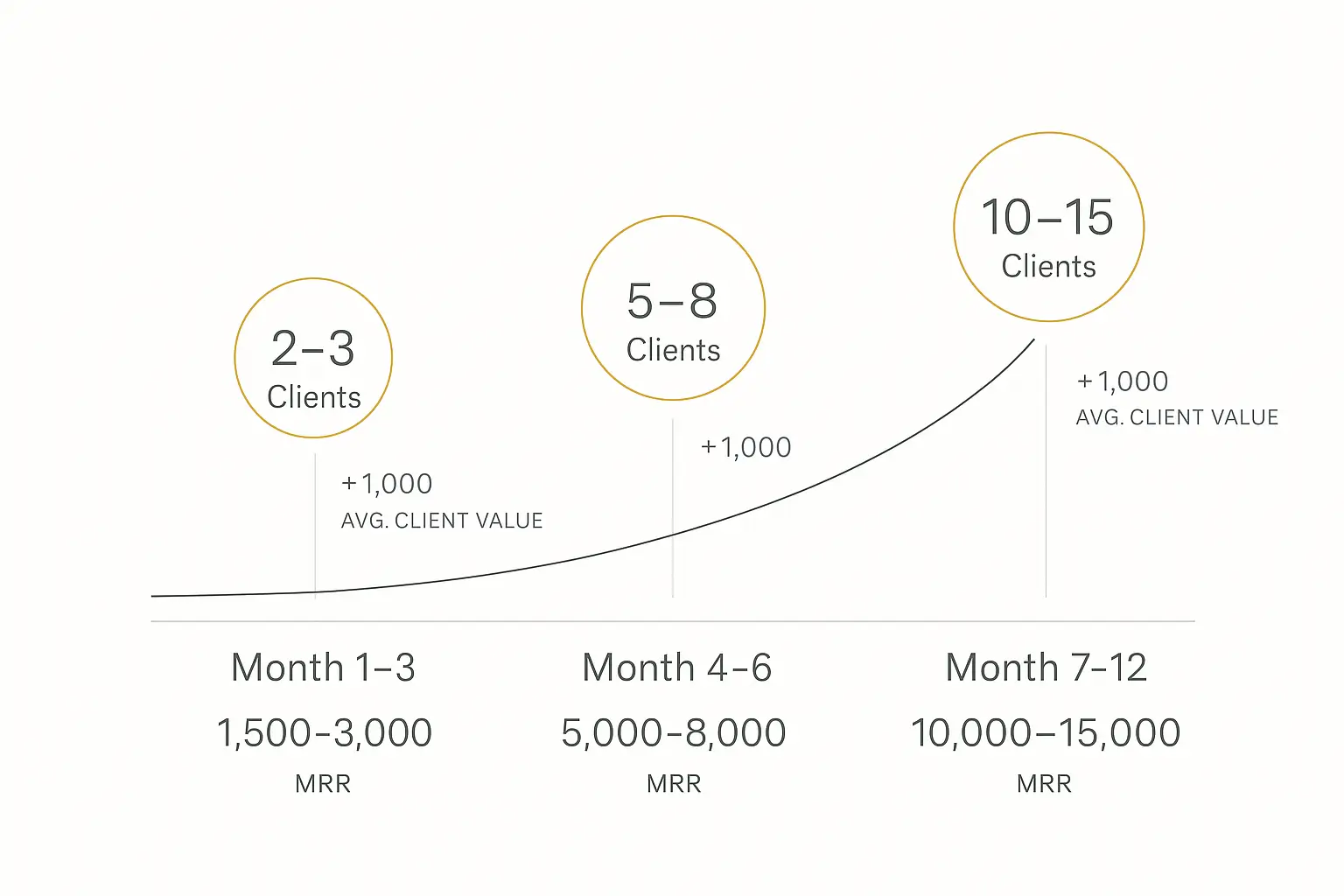
Stage 1: First 5 Clients ($1,500–$5,000/month MRR)
Your entire focus is on getting results and collecting proof. Undercharge if you have to — your first five clients are case studies, not revenue.
Document everything: before/after metrics, client testimonials, screenshots of results. This becomes your sales ammunition for the next 50 clients.
At this stage, you're doing everything yourself: sales, building, support, optimization. That's fine. You're learning what works.
Stage 2: 5–15 Clients ($5,000–$15,000/month MRR)
This is where you systematize. Build agent templates for your niche so every new client takes hours to set up, not days. Create onboarding documents. Set up a simple support process (even if it's just a shared inbox).
You should also start raising your prices. If you launched at $300/month, move new clients to $500. Your early clients stay at their locked-in rate (they'll appreciate it and refer you business).
This is also when white-labeling becomes important. Your clients should see your brand, not the underlying platform. Pickaxe's portal system handles this natively — custom domains, your logo, your colors — so clients never see the plumbing.
Stage 3: 15–50 Clients ($15,000–$50,000/month MRR)
Now you need help. Hire a part-time VA for client communication and basic agent maintenance. Consider bringing on a sales person (commission-only works at this stage).
The magic number is 30 clients at $500/month average. That's $15,000/month in recurring revenue with 60–75% margins, meaning you're taking home $9,000–$11,000/month. For a business you can run from your laptop, that's life-changing money.
If you want the full-length version of this growth trajectory, I wrote a complete playbook on starting an AI agent agency that goes much deeper into hiring, systems, and operations.
Stage 4: 50+ Clients ($50,000+/month MRR)
At this point, you're running a real agency. You need account managers, a dedicated builder, and potentially a sales team. Your role shifts from operator to CEO.
Many operators at this stage also start productizing — building a standardized agent package for a specific vertical and selling it at scale with minimal customization. This is where the "Shopify for agents" model really shines, because you can spin up new client instances quickly without rebuilding from scratch each time.
7 Mistakes That Kill AI Agent Businesses (And How to Avoid Them)
1. Selling Technology Instead of Outcomes
I've already hammered this point, but it's worth repeating because it's the #1 killer. Nobody buys "an AI agent." They buy more appointments, fewer missed calls, faster response times, or lower payroll costs.
Every piece of your marketing, your pitch, and your proposals should lead with the outcome.
2. Trying to Serve Every Industry
The generalist AI agency is a race to the bottom. You can't build deep case studies, you can't develop template agents, and you can't speak your client's language.
Pick one or two verticals. Go deep. You can always expand later. Some of the most underserved verticals include nonprofits and churches, which have high-volume donor and volunteer communication needs but tiny budgets for software.
3. Underpricing to Win Clients
Charging $100/month for an AI agent attracts clients who don't value what you do. They'll be the most demanding, least loyal clients you ever have.
If you're providing real value — saving a business time or making them money — $300/month is the bare minimum. Most clients at that price point will never even think about canceling.
4. Over-Promising and Under-Delivering
"This AI agent will replace your entire front desk staff" is a promise that will come back to haunt you. Set realistic expectations: the agent handles the routine stuff so your team can focus on the complex stuff.
Under-promise, over-deliver. Every time.
5. Neglecting Ongoing Optimization
An AI agent isn't a set-it-and-forget-it product. You need to review conversation logs, identify where the agent struggles, update its knowledge base, and refine its responses.
Build optimization time into your monthly retainer. Two to four hours per client per month is usually enough. This is what keeps churn low and results high.
6. Ignoring Compliance and Data Privacy
If you're working with medical practices, law firms, or financial advisors, you need to understand the basics of HIPAA, attorney-client privilege, and financial regulations. The good news is that modern platforms handle data security at the infrastructure level — Pickaxe, for example, is SOC2, GDPR, and CCPA compliant — but you still need to configure agents appropriately and educate clients on what the agent should and shouldn't handle.
7. Not Building a Referral Engine
Happy clients are your best sales channel. But they won't refer you on their own — you have to ask and make it easy.
Set up a simple referral incentive: one month free for every client they send your way. Then ask for referrals at every positive touchpoint — after a great monthly report, after they mention the agent's results, after any moment of delight.
Start your AI agent business today
Everything you need to build, brand, and sell AI agents — without writing a line of code.
The Numbers: What a Realistic AI Agent Business Looks Like
Let's get concrete. Here's what a solo operator can realistically build in 12 months.
| Month | Clients | Avg. MRR/Client | Total MRR | AI/Platform Costs | Net Revenue |
|---|---|---|---|---|---|
| 1–3 | 3 | $400 | $1,200 | ~$200 | $1,000 |
| 4–6 | 8 | $500 | $4,000 | ~$500 | $3,500 |
| 7–9 | 15 | $550 | $8,250 | ~$900 | $7,350 |
| 10–12 | 25 | $600 | $15,000 | ~$1,500 | $13,500 |
That's $13,500/month in net revenue by month 12 — working roughly 20–30 hours per week once you have systems in place.
The margins are excellent because AI platform costs scale linearly while your revenue grows. According to AI Acquisition's analysis, successful AI agent businesses maintain 60–75% gross margins, far exceeding traditional service businesses.
And this is conservative. Operators who nail a vertical and build referral loops have hit $30,000–$50,000/month MRR in under 18 months. Liam Ottley's AAA community alone has 35,000+ members pursuing this model, with hundreds reporting five-figure monthly recurring revenue.
Getting Started This Week: Your 7-Day Action Plan
If you've read this far, you're interested. Here's how to go from interested to operational in seven days.
Day 1: Pick your niche. Choose one local business vertical. Dental offices, med spas, real estate agents, home service companies — whatever you understand or have connections to.
Day 2: Research the pain points. Talk to 3–5 business owners in that niche. Ask: "What tasks eat up the most time in your day?" and "How do you handle customer inquiries after hours?" Listen more than you talk.
Day 3: Build your first agent. Sign up for Pickaxe and build a template agent for your niche. Keep it simple: FAQ handling, lead capture, and appointment booking. Use the AI Helper in the Agent Builder to walk through the setup quickly.
Day 4: Create your offer page. You don't need a fancy website. A clean one-page site explaining what you do, who you help, and one testimonial (use a beta client or a demo result) is enough to start.
Day 5: Build a proof-of-concept for a real prospect. Pick the most promising business from your Day 2 conversations. Build them a custom demo agent with their actual business info.
Day 6: Reach out. Send 10 personalized emails or LinkedIn messages to local businesses in your niche. Use the "Free Audit" approach. Don't pitch — offer value.
Day 7: Follow up and book demos. Follow up on your outreach. Book demos with anyone who responds. Show them the agent in action.
That's it. Seven days from zero to having real conversations with potential clients. Not theoretical. Not "someday." This week.
The Best Verticals for Selling AI Agents (Ranked by Ease of Entry)
If you're still deciding which niche to target, here's my honest ranking of local business verticals based on three factors: how easy the sale is, how much they'll pay, and how long they'll stay.
Tier 1: Easiest to Sell, Highest Retention
Medical and dental practices. They have high customer lifetime values ($2,000–$10,000+ per patient), they understand the cost of missed appointments, and they're used to paying for practice management tools. A dental office will pay $500/month for an after-hours booking agent without hesitation because one new patient covers the annual cost of the agent. We laid out what that build actually looks like in AI agents for medical and dental practices, from patient intake to the after-hours FAQ layer.
Home service companies (HVAC, plumbing, electrical). These businesses live and die by phone calls. If they miss a call from someone whose AC just broke, that's a $3,000–$8,000 job gone to a competitor. AI voice agents are transformational for this vertical.
Tier 2: Moderate Difficulty, Great Revenue
Law firms (small to mid-size). Lawyers are busy and they know their time is expensive. An intake agent that qualifies potential clients before a consultation saves them hours of unpaid screening time. The challenge is that lawyers can be cautious about technology — compliance and confidentiality must be front and center in your pitch.
Real estate agents and brokerages. Lead qualification is the killer use case. Real estate agents are drowning in leads from Zillow and Realtor.com, and most of them go nowhere. An agent that pre-qualifies leads and only surfaces the serious buyers is worth its weight in gold. Check out our guide to AI tools for realtors for more context on this space.
Tier 3: Viable but Requires More Education
Restaurants and hospitality. The use cases are clear — reservation management, menu questions, catering inquiries — but margins are thin in this industry. Price sensitivity is real. Stick to the $300/month range and keep the pitch focused on filling empty tables.
Gyms and fitness studios. Member onboarding, class scheduling, and retention outreach all lend themselves to AI agents. The challenge is that many gym owners are less tech-savvy and need more hand-holding during setup.
Insurance agencies. Complex workflows around quoting, claims, and renewals make this a premium-priced vertical. But the sales cycle is longer because insurance agents tend to evaluate tools carefully before committing. If you crack this niche, though, the retention rates are exceptional.
Frequently Asked Questions
Do I need technical skills to sell AI agents to local businesses?
No. Platforms like Pickaxe are designed for non-technical users. You need to understand your client's business problems and how to configure an agent to solve them — but you don't need to write code.
How long does it take to build an AI agent for a client?
For a standard FAQ/chat agent, 2–4 hours once you have a template. More complex workflow agents with integrations might take 1–2 days. As you build more agents in the same vertical, the setup time drops significantly.
What if the AI agent gives a wrong answer to a customer?
This is the most common concern from business owners. The answer: you configure the agent to only answer questions it's been trained on, and for anything outside its scope, it collects the person's contact info and routes to a human. Modern AI agents are remarkably good at staying in their lane when properly configured.
Can I really make $10,000+ per month doing this?
Yes, but it requires consistent effort in client acquisition and delivery. Twenty clients at $500/month is $10,000/month. That's very achievable within 6–12 months if you're focused on one niche and actively pursuing new business.
What's the difference between selling AI agents and starting an AI agency?
Selling AI agents can be a solo side hustle — a few clients, some extra income. An AI agency is a full business with employees, systems, and a growth trajectory. Many people start with the former and evolve into the latter as they see the opportunity.
How do I handle clients who want to cancel?
First, make sure you're delivering real results and communicating them. Send monthly reports showing conversations handled, leads captured, and appointments booked. If a client still wants to cancel, have an honest conversation about what's not working and whether you can fix it. Some churn is inevitable, but keeping it under 10% monthly is very doable.
Should I build agents for free to get my first clients?
I'd recommend a middle path: build a proof-of-concept demo for free, but charge for the actual deployment and ongoing service — even if it's discounted. Free work attracts clients who don't value what you do. A small "founding client" discount (say, 30% off for the first 3 months) respects both your time and their budget while getting you real-world case studies.
What about AI voice agents — are they harder to sell?
They're actually easier to sell in certain verticals because the value is so tangible. "Your phone gets answered 24/7" is a pitch anyone understands. The build is slightly more complex than a chat agent, but platforms are making it increasingly straightforward. If you're targeting home service companies or medical practices, voice should be part of your offer from day one.
How do I stay competitive as more people enter this space?
Three things: specialize in a vertical so you understand your clients better than a generalist ever could. Deliver measurable results and communicate them proactively. And build relationships — the operators who treat this like a partnership rather than a software sale will retain clients long after cheaper alternatives appear. Technical commoditization is inevitable; expertise and trust are not.
The Window Is Open — But It Won't Stay Open Forever
Right now, selling AI agents to local businesses is high demand, low competition. Most local businesses know they need AI but have no idea where to start. The person who shows up with a clear offer and a working demo wins.
That window will narrow. As more people enter the space, competition will increase and margins will compress. But the operators who build a client base and a reputation now will have an enormous head start.
The AI agent market is projected to grow from $10.9 billion to over $93 billion by 2032, according to Markets and Markets. McKinsey estimates that AI agents could generate $2.9 trillion in annual value in the U.S. alone.
You don't need to capture a big piece of that pie. You need 20–30 local businesses paying you $500/month. That's a $150,000+/year business that you can build from your laptop.
If that sounds interesting, start with Day 1 of the action plan above. Pick your niche. Build your first agent. Start the conversation.
The businesses are waiting. They just don't know you exist yet.