

Almost everything written about how to make money with AI is either a list of tools with no business attached, or a screenshot of someone's Stripe dashboard with no method attached.
This is my attempt at the version I wanted when I started: what actually generates revenue, what the numbers realistically look like, what's already picked over, and how to choose between them.
Two things are true at once right now, and holding both is the whole game.
The demand is real. Upwork's own data shows demand for top AI skills grew 109% year over year — against 23% for other high-demand skills. Freelancers who apply AI report earning roughly 40% more per hour than those who don't.
And the easy version is already gone. Generic AI content writing has had its price floor collapse. Faceless AI video channels are competing with thousands of identical faceless AI video channels. The stuff you can start this afternoon with no skill is, by definition, the stuff everyone else already started.
The money hasn't disappeared. It moved. This guide is about where.
All 14 Paths at a Glance
| # | Path | Best if | Realistic year-1 monthly |
|---|---|---|---|
| 1 | AI-augmented freelancing | You already have a billable skill | $1k–5k |
| 2 | Local business automation | You can handle local sales | $2k–8k |
| 3 | AI audits and consulting | You have credibility in an industry | $3k–10k |
| 4 | Done-for-you content operations | You can own a metric, not a word count | $2k–8k |
| 5 | Fractional AI lead | You have senior experience to lend | $4k–12k per client |
| 6 | Niche agent products | You know one industry deeply | $0–3k |
| 7 | Productizing a service | You already deliver it by hand | Varies |
| 8 | Templates and workflow packs | You have a tested, specific workflow | $200–2k |
| 9 | Courses and workshops | You can teach your own profession | $1k–6k |
| 10 | White-labeling and reselling | You have one solid build to clone | Scales past $15k |
| 11 | Niche newsletter | You'll write weekly for a year | $0–2k direct |
| 12 | Short-form and video | You're a real expert on camera | Mostly indirect |
| 13 | Affiliate and review content | You'll publish for 9–18 months first | Slow, compounding |
| 14 | Internal leverage | You already run or work in a business | Cost saved, not revenue |
The rest of this piece is what each of those actually involves, what kills it, and how to pick.
What Actually Changed
It helps to be precise about what AI did to the economics, because the wrong mental model produces the wrong business.
AI did not create demand for new things. Nobody woke up in 2026 wanting more blog posts. What AI did was collapse the cost of producing a large category of work.
When the cost of producing something falls to near zero, the price of that thing falls too. That's not a market failure, it's just what happens. Which means selling the raw output of an AI tool is a structurally bad business — you're selling a commodity that your customer could produce themselves for $20 a month.
But collapsing production cost does something else: it makes work economical that previously wasn't. A local dental practice was never going to pay a human $4,000 a month to answer after-hours questions. At a tenth of that, delivered by an agent someone configured for them, the math suddenly works.
Anthropic's Economic Index data supports the shape of this. Across millions of conversations, roughly 57% of AI usage is augmentation rather than automation — people iterating and validating alongside the model, not handing over the whole job. And about 49% of jobs have seen at least a quarter of their tasks touched by it.
That's the opportunity in one sentence: a quarter of a lot of jobs is now cheap to do, and most businesses have no idea how to capture that. You get paid for knowing how.
The Distinction That Decides Everything
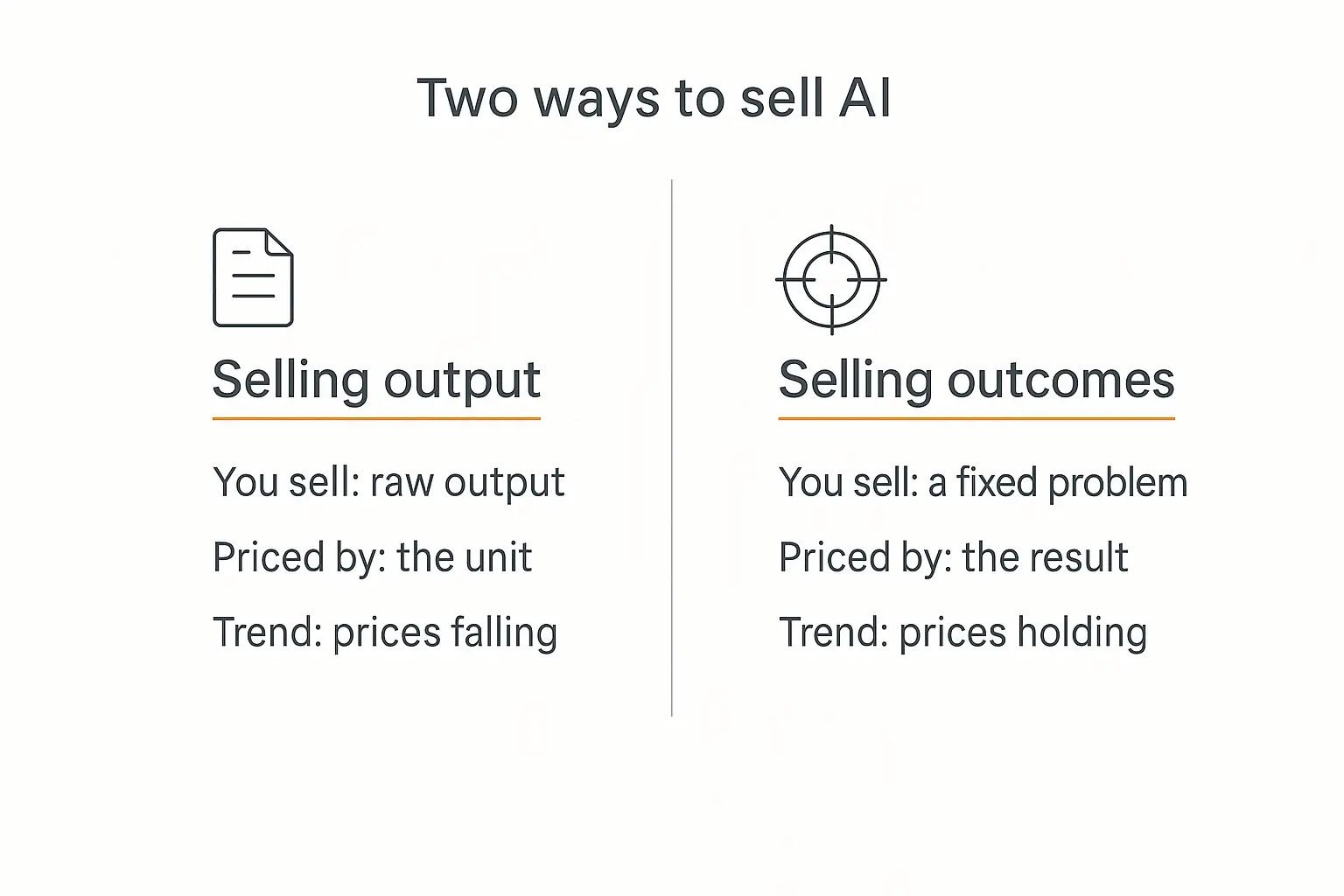
Before any specific method, there's one fork in the road, and which side you land on predicts your income more than which tool you pick.
Selling output means you deliver artifacts. Words, images, videos, a pile of generated copy. You're paid per unit. Your competition is everyone with the same subscription, and the price only goes one direction.
Selling outcomes means you deliver a changed situation. The client's support inbox no longer has a 12-hour backlog. Their leads get qualified before Monday. Their proposals go out same-day instead of next-week. You're paid for the result, and the price holds because the alternative isn't "a cheaper freelancer," it's "keep having the problem."
Practically, the difference shows up in how you talk about the work:
| Output framing | Outcome framing |
|---|---|
| "I'll write 20 blog posts a month" | "I'll own your organic pipeline and report on qualified traffic" |
| "I'll build you a chatbot" | "I'll cut your first-response time to under two minutes" |
| "I'll set up an automation" | "I'll take intake off your team's plate — 15 hours a week back" |
| $500/mo, always under threat | $2,500/mo, renews without a conversation |
Same underlying work. Wildly different business. Every method below works far better on the right-hand side of that table, and most of them barely work at all on the left.
The Four Ways Money Actually Arrives
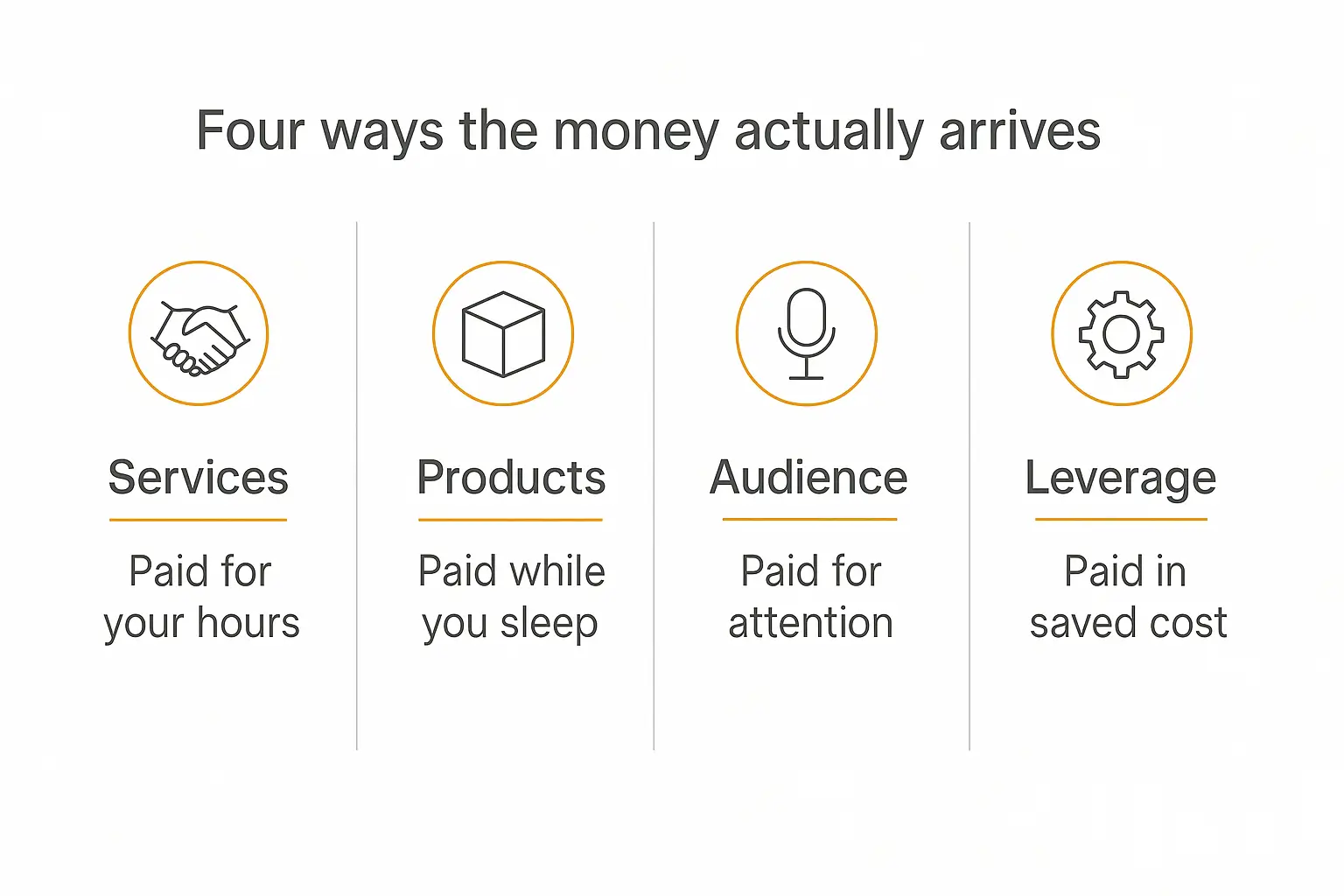
Every AI income method is a variation on one of four structures. Knowing which one you're in tells you what to optimize and what your ceiling looks like.
Services — you're paid for your hours, or for outcomes delivered by your hours. Fastest to first dollar, hardest to scale, most reliable.
Products — you build once and sell repeatedly. Slowest to first dollar, best margins, most likely to end in silence if you build the wrong thing.
Audience — you accumulate attention and monetize it indirectly. Long lead time, compounding, and it makes everything else easier.
Leverage — you apply AI inside a business you already have or work in. No new customers required. Least glamorous, frequently the highest return per hour invested.
Most people who succeed run two of these at once, usually services plus one other. Almost nobody succeeds running all four in year one.
Services — you are paid for your hours, or for outcomes your hours deliver.
This is where the overwhelming majority of real AI income is being made right now, and it's the one most "AI side hustle" content undersells because it involves talking to people.
1. AI-augmented freelancing in a craft you already have
The highest-probability path for most people, and the least discussed.
You don't become an "AI freelancer." You take a skill you already have — bookkeeping, recruiting, legal research, design, paralegal work, technical writing — and you use AI to do it three times faster, then take on three times the work or charge for the speed.
The Upwork data on rates by specialization bears this out: AI-adjacent roles command $35–$200/hr depending on depth, and generative AI and LLM development sits around $80–$150/hr. But the interesting number is the premium — AI-fluent freelancers earning ~40% more for the same underlying service. Which tools actually produce that premium is the question we work through in our roundup of AI tools for freelancers.
Why it works: you're not competing on AI. You're competing on the domain expertise you already had, with better margins than the people who don't use the tools.
Realistic first six months: $500–$2,000/month alongside existing work.
The trap: using the speed gain to lower your price. Don't. The client is buying the outcome, and the outcome didn't get cheaper for them.
2. AI automation for local and small businesses
The most under-saturated real opportunity I can point at, and it's boring, which is exactly why.
Local businesses — clinics, contractors, law firms, property managers, agencies, home services — are drowning in repetitive work: appointment scheduling, intake forms, quote requests, review requests, after-hours enquiries, follow-up sequences. Every one of these is now solvable with an agent and a couple of integrations. The property management slice is worth reading up on first, since tenant screening and lease renewals are unusually well suited to it.
The reason this stays under-saturated is that it requires the two things AI-hustle audiences avoid: local sales, and caring about someone's unglamorous business problem.
Pricing lands roughly where agency retainer data puts it — small business engagements at $500–$2,000/month, mid-market $3,000–$8,000/month, with the median for small-to-mid sitting somewhere around $2,800–$7,000. Setup fees of $1,500–$5,000 on top are normal.
Why it works: churn is remarkably low. Once a business's intake runs through your system, ripping it out is a project nobody wants.
We wrote a full breakdown of this specific motion in how to sell AI agents to local businesses, including the outreach scripts and what the first call should cover.
3. AI audits and implementation consulting
Sell the diagnosis before the treatment.
Mid-size companies know they're behind on AI and have no idea where to start. A paid audit — map the workflows, find the three highest-value automation candidates, quantify the hours, deliver a prioritized roadmap — is a $2,500–$15,000 engagement that requires no build at all.
It also solves the hardest problem in services: you get paid to do the scoping that would otherwise be free pre-sales work, and the audit naturally produces the implementation proposal.
Why it works: you're selling clarity to people with budget and no internal expertise. And the deliverable is a document, which means you control the scope precisely.
Our AI consulting playbook covers the engagement structure, and how to price AI services gets into what to actually charge.
4. Done-for-you content operations
Note the word operations. Not "content."
Selling AI-written articles is the commodity trap in its purest form. Selling a system — research, drafting, editing, SEO, publishing, distribution, reporting, run reliably every week by someone accountable for the numbers — is a service businesses still pay real money for.
The difference is that you own the outcome. If the traffic doesn't move, that's your problem, and you're priced accordingly.
Realistic range: $2,000–$8,000/month per client, with 3–6 clients being a full workload for one person with good systems.
The trap: taking on clients who want volume rather than results. They will grind your margin to nothing and leave anyway.
5. Fractional AI lead
The senior version. You embed with a company one or two days a week and own their AI adoption — tool selection, policy, training, vendor evaluation, building the first internal agents.
This is $4,000–$12,000/month per client and you can hold two or three. It requires genuine credibility, so it's not a starting point — but it's frequently where consultants land after 18 months of doing implementations.
Build the agent you're going to sell
Pickaxe handles the build, the branding, the access control, and the billing in one place.
Products — you build once and sell repeatedly.
Better margins, longer runway to revenue, and a much higher failure rate — almost always because the product was chosen before the customer.
6. Niche AI agents sold as products
The clearest product opportunity right now: take one specific, painful, repetitive job in one specific industry and build an agent that does it properly.
Not "an AI assistant for lawyers." Something like: an agent that turns a recorded client intake call into a formatted matter summary, a conflict-check list, and a draft engagement letter, for immigration firms specifically.
Narrow beats broad here for a reason. A narrow agent can be genuinely excellent because the surface area is small enough to actually cover, and a narrow buyer knows immediately whether it's for them.
Pricing works as a subscription ($49–$499/month depending on who's buying), usage-based, or a hybrid. We covered the tradeoffs in AI agent pricing models.
Why it works: the build cost has collapsed. What used to be a funded startup is now a weekend of configuration on a no-code platform — the whole reason we built Pickaxe was to make the packaging, access control, and billing side as cheap as the building side.
The trap: building for a buyer you've never met. If you can't name five real people who would pay for it, you're guessing.
7. Productizing a service you already deliver
The highest-success-rate product path, because the validation already happened.
You do a service manually for a dozen clients. You notice you're doing the same four steps every time. You turn those steps into a tool. Now you either sell the tool directly, or keep the service and take 70% of the delivery time out of it.
This is the sequence that works: service first, product second. Almost every durable AI product I've seen started as somebody's repetitive client work.
8. Templates, prompt libraries, and workflow packs
Real, small, and honest about its ceiling.
People pay $20–$200 for a well-built pack that saves them a day of fiddling — a set of agent configurations for a specific industry, a tested prompt library for a niche discipline, an automation blueprint that works out of the box.
Realistic: a few hundred to a few thousand dollars a month for a good one with distribution. It is not a business by itself for most people, but it's an excellent second product and a very good lead magnet for the service business that pays your rent.
The trap: the market for generic prompt packs is thoroughly saturated. Specific, tested, industry-bound packs still sell.
9. Courses, training, and workshops
Companies are actively paying for AI training right now because their teams are using the tools badly and everyone knows it.
Corporate workshops run $2,000–$10,000 a day. Self-serve courses are harder — the market is loud — but a course aimed at a specific profession ("AI for insurance brokers") rather than a general audience ("AI for everyone") still works well.
The honest caveat: teaching how to make money with AI, to people who want to make money with AI, is the most saturated corner of this entire category. Teaching your actual profession how to use AI is not.
10. White-labeling and reselling
Build once, deploy under a dozen different brands.
You build a solid agent for one client, strip the specifics, and resell the same core under each new client's branding on their own domain. Each deployment is a fraction of the original build effort.
This is the highest-leverage model in services-to-products, and it's how most one-person AI agencies get past the hours-for-money ceiling. We went deep on it in white-label AI tools for agencies.
What a Sellable Agent Actually Looks Like
A quick detour into the craft, because "build an AI agent" is doing a lot of unexamined work in most of these articles.
The gap between a demo that impresses you and a system a client will pay for every month is mostly unglamorous. Four things separate them.
It knows things only that client knows
An agent running on a general model with a clever prompt is a party trick. An agent that has read the client's actual pricing sheet, service catalogue, past proposals, policy documents, and FAQ is a colleague.
This is the single biggest quality jump available to you, and it's mostly a matter of gathering documents. Load their real material into a knowledge base — PDFs, spreadsheets, pages from their site, transcripts of their sales calls — and the output stops sounding like a stranger.
It's also the thing the client cannot replicate by signing up for ChatGPT, which is exactly why it protects your pricing.
It connects to where the work actually lives
An agent that produces text a human then copies into another system has saved maybe 30% of the work. An agent that writes the record into their CRM, sends the email, books the slot, and posts the summary to the right Slack channel has saved 90%.
That last 60% is where your fee lives. In Pickaxe terms this is Actions — the connections that let an agent do something rather than just say something — and in practice it's the difference between a client saying "neat" and a client saying "how much to keep it."
Keep the number of connections small. Four is plenty; past that, reliability drops faster than capability rises, and reliability is what you're being paid for.
It fails safely and visibly
Every agent you sell will be wrong sometimes. What separates a professional deployment from a liability is what happens next.
Decide explicitly, before launch: what does it refuse to answer, when does it escalate to a human, what does it say when it doesn't know, and where does the client see what it did? An agent that hands off cleanly on the 5% it can't handle is worth far more than one that confidently guesses.
Write these rules into the instructions and test them deliberately — feed it the edge cases you're afraid of and watch what it does before a customer does.
It looks like the client's business, not like yours
Their logo, their colours, their domain, their tone. A tool that looks like a generic AI product gets treated like one at renewal time.
This is also what makes the same underlying build sellable ten times over: the core is yours, the surface is theirs. For the mechanics of running one agent under many brands, white-labeling AI for clients covers the setup.
Audience — you accumulate attention and monetize it indirectly.
Slowest path to money, and the one that makes every other path dramatically easier once it exists.
11. A newsletter for a specific professional niche
Not "AI news." There are a thousand AI newsletters and you will not win that.
"AI for veterinary practices," on the other hand, has approximately no competition, a clearly defined audience, obvious sponsors, and an obvious upsell into consulting for exactly the people who read it.
How it monetizes: sponsorships once you're past a few thousand engaged subscribers, but far more importantly, inbound consulting leads from readers who now think of you as the person who understands this.
12. Short-form and video
Possible, saturated, and mostly misunderstood.
The faceless-AI-channel play is done — the market is drowning in generic AI footage and the platforms have gotten good at detecting low-effort output. What still works is a real person with real expertise using AI to produce more, faster.
Treat it as distribution for a business that already exists, not as the business.
13. Affiliate and review content
Genuine, unglamorous, and slower than it looks.
Deep, honest reviews of AI tools for a specific use case earn real affiliate revenue. But it takes 9–18 months of consistent publishing before the traffic compounds, and the AI tools space is one of the most competitive affiliate niches in existence right now.
Worth doing if you enjoy writing anyway. A bad plan if you need income this quarter.
14. Leverage: Applying AI Inside a Business You Already Have
If you already run a business, or work inside one, this is almost certainly your highest return and you should read this section twice.
You don't need new customers. You don't need a product. You need to take cost and time out of something that already generates revenue.
A few that consistently pay off:
- Proposal and quote generation. Turn a discovery call transcript into a first-draft proposal. Hours to minutes, and quotes go out while the lead is still warm.
- Inbound lead qualification. Score, route, and pre-qualify before a human ever opens the email. We walked through building one in this guide.
- Support deflection. Answer the 60% of tickets that are the same eight questions.
- Internal knowledge. Stop paying senior people to answer "where's the template for X."
- Onboarding. The single most repetitive high-touch process in most service businesses.
The reason this is undervalued is that it produces no story. Nobody posts "I saved 14 hours a week in my existing business." But 14 hours a week at your billable rate is, for most people reading this, more money than their AI side project will make in its first year.
If you want to quantify it before committing, how to measure AI agent ROI has the formulas.
What People Realistically Earn
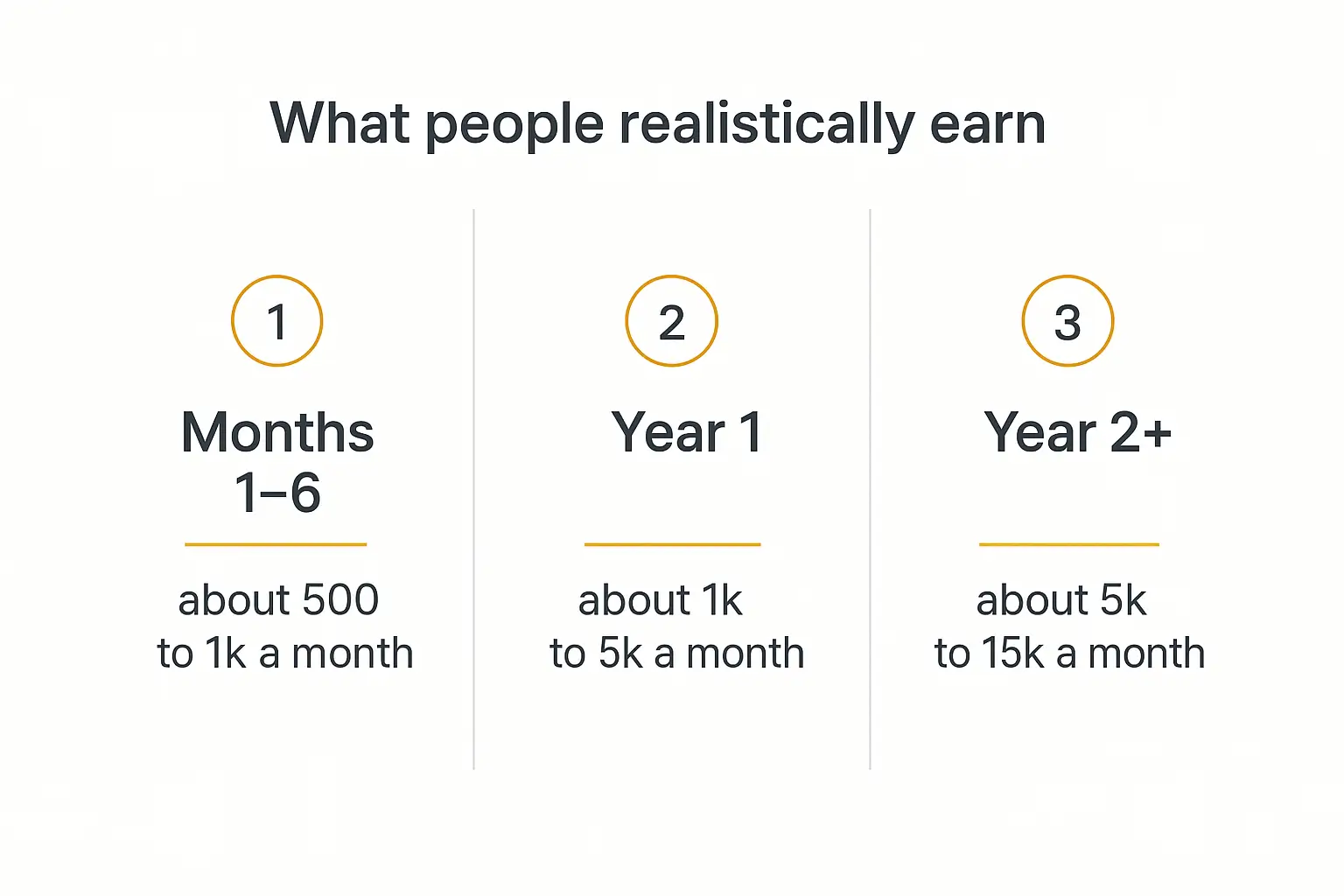
Here's where I want to be more careful than most articles on this topic, because the expectation-setting is where people get hurt.
The consistent picture across the reporting: beginners land around $500–$1,000/month in the first six months. By the end of year one, $1,000–$5,000/month is a realistic target. Experienced practitioners with a genuine niche reach $5,000–$15,000/month — where "experienced" means 12–18 months of consistent client work, not 12 weeks of consuming content.
A more granular view by path:
| Path | Time to first $1k | Realistic year-1 monthly | Ceiling for one person |
|---|---|---|---|
| AI-augmented freelancing | 2–6 weeks | $1k–$5k | ~$15k |
| Local business automation | 1–3 months | $2k–$8k | ~$30k with white-labeling |
| Audits & consulting | 1–3 months | $3k–$10k | ~$25k |
| Content operations | 1–2 months | $2k–$8k | ~$20k |
| Niche agent products | 4–12 months | $0–$3k | Uncapped, low probability |
| Templates & packs | 1–4 months | $200–$2k | ~$5k |
| Courses & workshops | 2–6 months | $1k–$6k | ~$40k |
| Newsletter / audience | 6–18 months | $0–$2k direct | High, indirectly |
| Internal leverage | 2–4 weeks | Cost saved, not revenue | Bounded by the business |
Two patterns worth noticing.
The fast paths are all services. If you need money soon, the answer is services, and it isn't close.
The uncapped path has the worst expected value. Niche products can go anywhere, but most go nowhere. That's a fine bet to make with your evenings while services pay your bills. It's a bad bet to make with your only runway.
A Worked Example, End to End
Abstract advice is easy to nod along with and hard to act on, so here's one path all the way through with numbers attached. I've used a dental practice because it's about as unglamorous as it gets, which is the point.
The problem
A three-chair practice gets roughly 40 enquiries a week — phone, web form, and Instagram DMs. The front desk handles them between patients. Evenings and weekends go unanswered until Monday. That gap is the entire subject of AI agents for medical and dental practices if you want the scheduling and intake detail.
They don't know how many they lose. That's the first thing worth finding out, and asking the question is most of the sale.
The discovery conversation
Three questions, and no pitch:
- What happens to an enquiry that arrives at 7pm on a Friday?
- How long does the average one take to answer properly?
- What's a new patient worth to you over their first two years?
Say the answers are: nothing until Monday, about eight minutes, and roughly $1,200. Now the size of the problem is a number, and it isn't yours — it's theirs. If they're losing four after-hours enquiries a week and converting even half of what they'd otherwise convert, that's real money, and you haven't proposed anything yet.
The manual run
For two weeks you answer their after-hours enquiries yourself, using AI to draft the responses. You charge a token amount or nothing.
You will discover things no amount of planning would have surfaced. Which questions actually come in (insurance and pricing, overwhelmingly). Which ones absolutely must not be answered by software (anything sounding like clinical advice). That the practice manager cares far more about the tone than the speed. That half the DMs are existing patients asking to reschedule, which is a different problem with a different solution.
The build
Now the requirements are obvious, and the build takes a couple of days:
- A knowledge base of their service list, pricing ranges, accepted insurers, hours, parking, and the twenty questions you saw repeatedly
- Instructions that answer logistics confidently, refuse anything clinical, and escalate by flagging for the practice manager
- Actions that book into their scheduling system and drop a summary into the front-desk inbox each morning
- An embed on their site and a connection to the channels the enquiries actually arrive on
The clinical-refusal rule isn't optional garnish. It's the thing that makes the deployment defensible, and you should say so out loud in the proposal.
The pricing
Not "two days of work." The proposal reads: $2,500 setup, $1,500/month ongoing, covering hosting, monitoring, monthly tuning, and a report on what came in.
Against a problem they now believe costs them thousands a month, that's a straightforward yes. Against "two days of my time," it would have been a negotiation.
What happens next
The second dental practice is a fraction of the work — the knowledge base changes, the structure doesn't. The fifth takes an afternoon.
Ten practices at $1,500/month is $15,000/month from one build you keep sharpening, and you now know more about dental front-office workflow than anyone else selling AI in your city. That knowledge, not the agent, is the durable asset.
The same shape works for HVAC companies, immigration firms, veterinary clinics, physiotherapists, and about two hundred other categories where the front office is the bottleneck. The HVAC and plumbing version of that playbook is laid out in AI agents for home services.
What's Saturated and What Isn't
An honest map, because picking a picked-over niche is the single most common way this goes wrong.
| Thoroughly saturated | Still wide open |
|---|---|
| Generic AI blog writing | Industry-specific content ops with reporting |
| Faceless AI YouTube channels | Real-expert video in a narrow profession |
| Generic prompt packs | Tested, industry-bound agent configurations |
| "AI for everyone" courses | AI training for one specific profession |
| Generic AI stock imagery and video | Brand-consistent creative for named clients |
| Teaching people to make money with AI | Doing an unglamorous job better with AI |
| General-purpose chatbot builds | Local business intake and follow-up systems |
The pattern is not subtle. Everything on the left requires no domain knowledge. Everything on the right requires you to know something specific about someone's actual business.
That's the moat now. Not the tools — everyone has the tools.
Charge for it, don't just build it
Subscriptions, usage-based billing, and access control come built in.
How to Choose Your Path
Four questions. Answer them honestly and the list above collapses to one or two options.
1. How soon do you need money?
Under 90 days: services, full stop. Six months or more: you can afford to build a product.
2. What industry do you already understand?
This is the most important question and the one people skip because their answer feels boring. Insurance, dentistry, freight, church administration, municipal government — the more unglamorous your background, the less competition you have. Domain knowledge you already possess is worth more than any tool you could learn.
3. Can you sell, or do you need to hide?
Be honest. If direct outreach genuinely isn't going to happen, cross off local business automation and consulting, and go toward products and audience — accepting the slower timeline.
4. Do you already have a business or a job with repetitive work?
If yes, start with leverage. It's faster, it's lower risk, and doing it teaches you the exact skill you'd be selling.
If you're weighing building your own thing against buying something off the shelf for a client, build vs buy vs wait lays out the framework.
Finding Your First Client
The step where most people stall, so it's worth being specific rather than saying "do outreach."
Start with people who already know your name
Your first client is almost never a stranger. It's a former colleague, a past client, someone from an industry association, a friend who runs a business, someone you worked with two jobs ago.
The message that works isn't a pitch, it's a question: "I'm building automation for [industry] — can I ask you two questions about how you handle [specific process]? Not selling you anything."
Then genuinely don't sell them anything. Ask the questions. Roughly one in five of those conversations turns into "could you do that for us," and it arrives without you ever pitching.
Go where the industry already talks
Every profession has forums, subreddits, Facebook groups, Slack communities, and association events where practitioners complain about their workflow in public.
Read for a few weeks before saying anything. The recurring complaints are your product roadmap and your outreach list simultaneously. Answering questions helpfully in those spaces — without a link in every reply — generates better leads than any cold email sequence, though it takes longer to warm up. If you want a system for drafting those contributions without sounding like marketing, we wrote about it in building a Reddit post generator.
Cold outreach, if you're going to do it
It works, but only in a specific form: short, specific to their business, and asking for a conversation rather than a sale.
What fails is the template blast. What works is fifteen genuinely researched emails a week that reference something real — the unanswered enquiry form on their site, the two-week response time you experienced as a customer, the job posting for the role you'd be replacing the need for.
Fifteen thoughtful emails beat three hundred generic ones, and the irony of using AI to mass-produce the generic version is not lost on anyone receiving them.
Let one result do the selling
The moment you have one delivered outcome, your pitch changes entirely. "I built this for a practice like yours and it handles 40 enquiries a week" is a fundamentally different conversation from "I could build you something."
This is why the free or cheap first engagement is worth so much more than the money you didn't charge for it. You're buying a case study, and case studies are the only sales asset that reliably compounds.
Your First Ninety Days
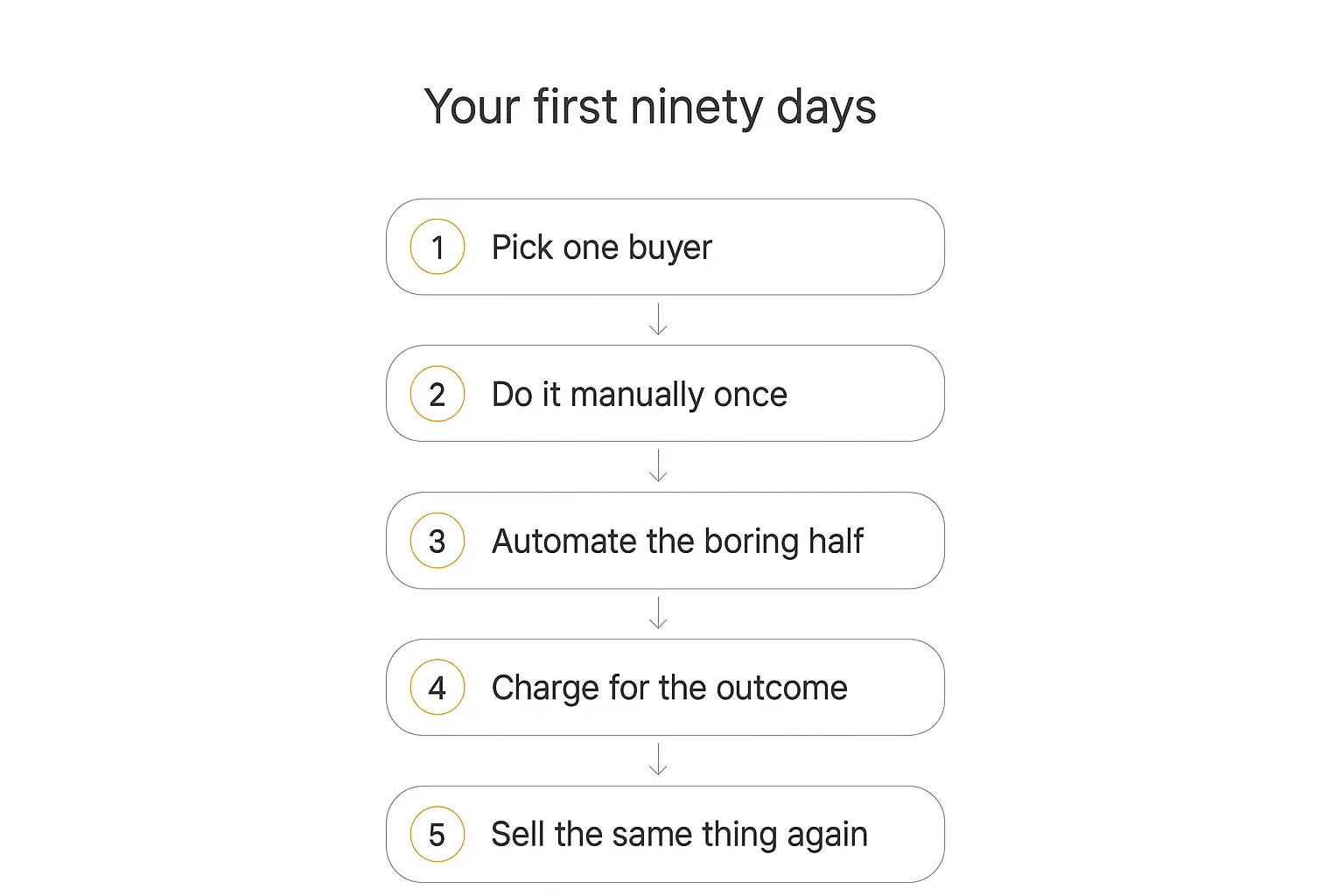
A concrete sequence that works regardless of which path you picked.
Days 1–14: Pick one buyer
One industry, one job title, one problem. Write it as a sentence: "I help [specific person] stop [specific painful thing]."
Then find twenty real examples of that person. Not a market size estimate — twenty names.
Days 15–30: Do it manually, once, for free or cheap
Find one of the twenty and solve their problem by hand. Use AI to help you, but don't build anything reusable yet.
This step is non-negotiable and it's the one everyone skips. You will learn more about what the product needs to be in this one engagement than in three months of planning, and most of what you learn will be things you'd never have guessed.
Days 31–60: Automate the boring half
Now you know the workflow. Take the repetitive 60% and build it properly — an agent with the right instructions, a knowledge base of the reference material, and connections to wherever the data lives.
This is where a no-code platform earns its keep; if you're comparing options, we reviewed the field in the best no-code AI agent builders. Keep an eye on your cost per run while you're at it — token economics has a habit of surprising people who priced on a flat monthly fee.
Days 61–75: Charge for the outcome
Go back to the same client and price the ongoing version. Price the result, not your hours. If you saved them 15 hours a week, $2,000/month is not an aggressive ask.
Days 76–90: Sell the same thing again
Go to the other nineteen names with a case study instead of a pitch. The second sale is dramatically easier than the first, and the fifth is easier still, because you're now selling something that demonstrably exists.
At the end of ninety days you have a delivered outcome, a paying client, a reusable system, and a pipeline. That's a business. Most people at day 90 have a tool subscription and a list of ideas.
The Boring Operational Stuff Nobody Mentions
None of this is exciting and all of it will save you a bad month at some point.
Put the scope in writing, including what it doesn't do
The most common way an AI engagement goes wrong isn't technical. It's a client who assumed the agent would also handle a thing you never discussed.
Your proposal should have an explicit "not included" section. What the agent won't answer, what channels it doesn't cover, how many revisions the setup fee includes, and what constitutes new work. This is a five-minute addition that prevents the slow scope bleed that turns a profitable retainer into a bad job.
Decide who owns what
Be clear on three things before you start: who owns the account, who owns the configuration you built, and what happens to it if the engagement ends.
Both models are fine — building inside your own workspace and providing access, or building in theirs and handing over the keys. What isn't fine is nobody having thought about it until the relationship is ending.
Understand the client's data situation
If you're touching customer records, health information, financial details, or anything covered by GDPR, HIPAA, or a client's own contractual obligations, that has to be a conversation up front rather than a discovery afterward.
You don't need to be a lawyer. You do need to know what data flows where, be able to answer "where does this get processed," and not be the person who quietly piped a clinic's patient enquiries through a tool nobody vetted. Enterprise clients will ask. Small ones won't, which doesn't make it their risk instead of yours.
Watch your unit costs
A flat monthly retainer against variable model usage is a margin trap if the client's volume triples. Know roughly what a run costs you, check it after the first busy month, and put a fair-use ceiling in the agreement for genuinely unbounded usage.
This rarely bites at small scale and bites hard at medium scale, which is the worst possible timing.
Be straightforward about using AI
Don't hide it and don't oversell it. Clients who feel misled about how the work gets done churn badly, and in some contexts — anything customer-facing where people might reasonably think they're talking to a person — disclosure is becoming an expectation rather than a courtesy.
The honest version is also the better sales position: you're not pretending to be a bigger team, you're openly better equipped than one.
Charge a setup fee, always
Even a small one. It filters out tire-kickers, it funds the discovery work, and it establishes that your time has a price before you're deep in an unpaid build for someone who was never going to sign.
Mistakes That Cost People Months
Choosing the method before the customer. "I want to build an AI SaaS" is not a plan. "Immigration lawyers waste six hours a week on intake summaries" is a plan.
Competing on price against a commodity. If your pitch is "same thing, cheaper, because AI," you've entered a race that ends at zero.
Building for months before talking to anyone. The build is the easy part now. Distribution and knowing what to build are the hard parts, and neither improves while you're in your editor.
Chasing the newest model instead of shipping. The model you have is more than good enough for essentially every business use case in this article. Model choice matters at the margin — see our model comparison — but it is never the thing standing between you and your first client.
Underpricing because the work felt easy. The client is buying the outcome and their alternative was hiring someone. What it cost you is not their concern.
Trying three paths at once. Three half-built businesses generate exactly as much revenue as zero businesses.
Assuming the tool is the value. Your client can sign up for the same platform you did. What they can't do is know which problem to point it at, which is what you're actually selling.
FAQ
What's the fastest legitimate way to make money with AI?
Apply it to a service skill you already have and take on more work at the same rate. That's days-to-weeks, not months. Every path that's faster than that is either a scam or someone selling you a course about it.
Do I need to know how to code?
No, for everything in this article. Building and deploying agents is a no-code activity now, and the hard parts — picking the problem, selling the work, delivering reliably — were never coding problems. Coding widens what you can build; it doesn't gate entry.
How much money do I need to start?
Under $200/month covers a platform subscription and the model usage for early clients. The real cost is time. If someone tells you that you need a $3,000 program first, that's their business model, not yours.
Is it too late?
It's too late for the frictionless version — mass-produced AI content, generic prompt packs, faceless channels. It's early for almost everything requiring domain knowledge and a sales conversation. The AI automation agency count went from roughly 2,000 in 2024 to over 12,000 in 2026, which sounds like a lot until you consider how many millions of small businesses have automated nothing at all.
Should I build a product or sell services?
Services first, nearly always. They fund you, they teach you what to build, and they hand you the customer list you'll sell the product to. The people who go product-first and succeed usually already had the audience or the domain expertise.
How do I actually charge clients?
Subscription for ongoing value, project fee for one-time builds, usage-based when consumption varies a lot, and a setup fee alongside any retainer. How to monetize AI agents covers the mechanics, including how to handle billing without building a payment system.
What if a client asks whether I'm just using ChatGPT?
Tell them yes, partly, the same way their accountant uses software. You're being paid for knowing which problem to solve, how to configure it, and for standing behind the result when it breaks. That answer has never lost me a deal; being cagey about it would.
The Short Version
If you read nothing else: the money is in knowing which specific problem to point AI at, for a specific group of people, and being accountable for whether it works.
Everything that doesn't require that — the generic output, the generic packs, the generic channels — has already been competed down to nothing, and it happened faster than anyone expected.
Everything that does require it is wide open, because it demands the unfashionable combination of domain knowledge, a sales conversation, and the patience to deliver something reliably for a year.
Pick one buyer. Solve their problem by hand. Automate the boring half. Charge for the result. Then do it nineteen more times.
That's the whole method. When you're ready to build the thing you're going to sell, Pickaxe covers the build, the branded deployment, the access control, and the billing — so the only part left is the part that was always the real work.