

Every business owner I talk to right now is asking some version of the same question: "We know we need to do something with AI — but what, exactly, and where do we start?"
That question is the entire AI strategy consulting business in one sentence.
The demand is staggering. McKinsey's late-2025 survey found that 88% of organizations now use AI in at least one business function (McKinsey, The State of AI). And yet most of those companies have almost nothing to show for it.
MIT's NANDA initiative put a hard number on the gap. In its "GenAI Divide" report, researchers found that 95% of enterprise generative AI pilots fail to deliver any measurable return — despite $30–40 billion in spending (Fortune coverage of the MIT report). That number is the AI adoption gap in a single statistic: capability arriving far faster than organizations can absorb it.
Read that again. Almost nine in ten companies are using AI. Almost all of them are failing to get value from it.
That chasm — between "we bought the tools" and "the tools actually changed our business" — is where AI strategy consulting lives.
This is the playbook I'd hand to anyone serious about building an AI strategy consulting practice in 2026. It's the advisory layer above the implementation work: helping organizations figure out where AI belongs, what to build first, how to govern it, and how to actually capture the value.
I run a platform — Pickaxe — that thousands of consultants use to turn strategy into working agents. So a lot of what follows comes from watching what separates the consultants who close $30k engagements from the ones who never get past the discovery call.
Let's get into it.
What AI Strategy Consulting Actually Is (and Isn't)
First, a definition, because the term gets thrown around loosely.
AI strategy consulting is advisory work: you help an organization decide where AI creates value, prioritize use cases, build a roadmap, set up governance, and lead the change. You're the architect, not necessarily the builder.
That's distinct from AI implementation — actually building the agents, integrations, and automations. Many consultants do both. But the strategy layer is where the high-margin, executive-level work lives.
Here's the difference in one line: an implementation shop gets asked "can you build us a chatbot?" A strategy consultant gets asked "should we even be building a chatbot, and if not, what should we do instead?"
The second question is worth a lot more money.
If you want the pure-implementation, agency-style path instead — building and shipping agents for clients on retainer — I wrote a separate guide on how to start an AI agent agency. This post is about the layer above it.
Why companies pay for strategy and not just tools
Tools are commoditized. Anyone can buy a ChatGPT Enterprise seat or spin up an automation in Zapier.
What companies can't buy off the shelf is judgment: which of their 40 possible AI projects will actually move the P&L, which will quietly leak data, and which are a waste of a quarter.
That judgment is the product. The MIT data backs this up — the report found that failures came not from weak models but from a "learning gap" in how organizations integrate AI. They're not buying the wrong tools; they're deploying them with no strategy.
You're selling the strategy.
The Market Opportunity in 2026
The numbers here are genuinely hard to ignore.
Estimates for the AI consulting market in 2026 range from roughly $14 billion to $39 billion, with most analysts projecting a compound annual growth rate north of 25% through the mid-2030s (Future Market Insights). By 2035, several forecasts put the market above $100 billion.
On the demand side, Gartner forecasts that 40% of enterprise applications will embed task-specific AI agents by the end of 2026, up from under 5% in 2025. Every one of those deployments needs someone to decide what the agent should do and how it fits the business.
And the spread of demand is unusually wide. This isn't just Fortune 500 work. Mid-market firms (500–999 employees) are projected to be among the fastest-growing buyers of AI consulting, and entire verticals — finance, healthcare, legal, manufacturing — are scrambling at once.
Here's the part that matters for a small or solo consultant: the big firms can't service the long tail. Deloitte and Accenture aren't taking a $25k engagement from a 60-person logistics company. You can.
The AI Strategy Consulting Engagement, End to End
Most successful AI strategy engagements follow the same arc. You don't have to reinvent it for every client — you productize it.
Here's the five-phase flow I see work over and over.
The genius of treating it as a repeatable flow is that each phase is a sellable deliverable on its own. A client who isn't ready for the full engagement can buy just the assessment. Then the assessment sells the roadmap, the roadmap sells the implementation, and so on.
Phase 1 — The AI Opportunity Assessment
This is the discovery phase, and it's where you earn trust.
The goal is to map the business: its workflows, its data, its bottlenecks, and the places where AI could realistically help. You're interviewing department heads, shadowing processes, and auditing the tech stack.
I have a standalone framework for this part — the AI workflow audit checklist — that walks through exactly which processes to score and how.
The output is a written assessment: here's what we found, here are the 8–12 candidate use cases, here's the rough value and effort of each. Never skip producing a document. A deliverable the client can forward to their CFO is what justifies the fee.
Phase 2 — Use-Case Prioritization
This is the single most valuable thing you do, and it's the step companies skip when they fail.
You take the candidate use cases from the assessment and plot them on two axes: business value and feasibility. Then you ruthlessly sequence them.
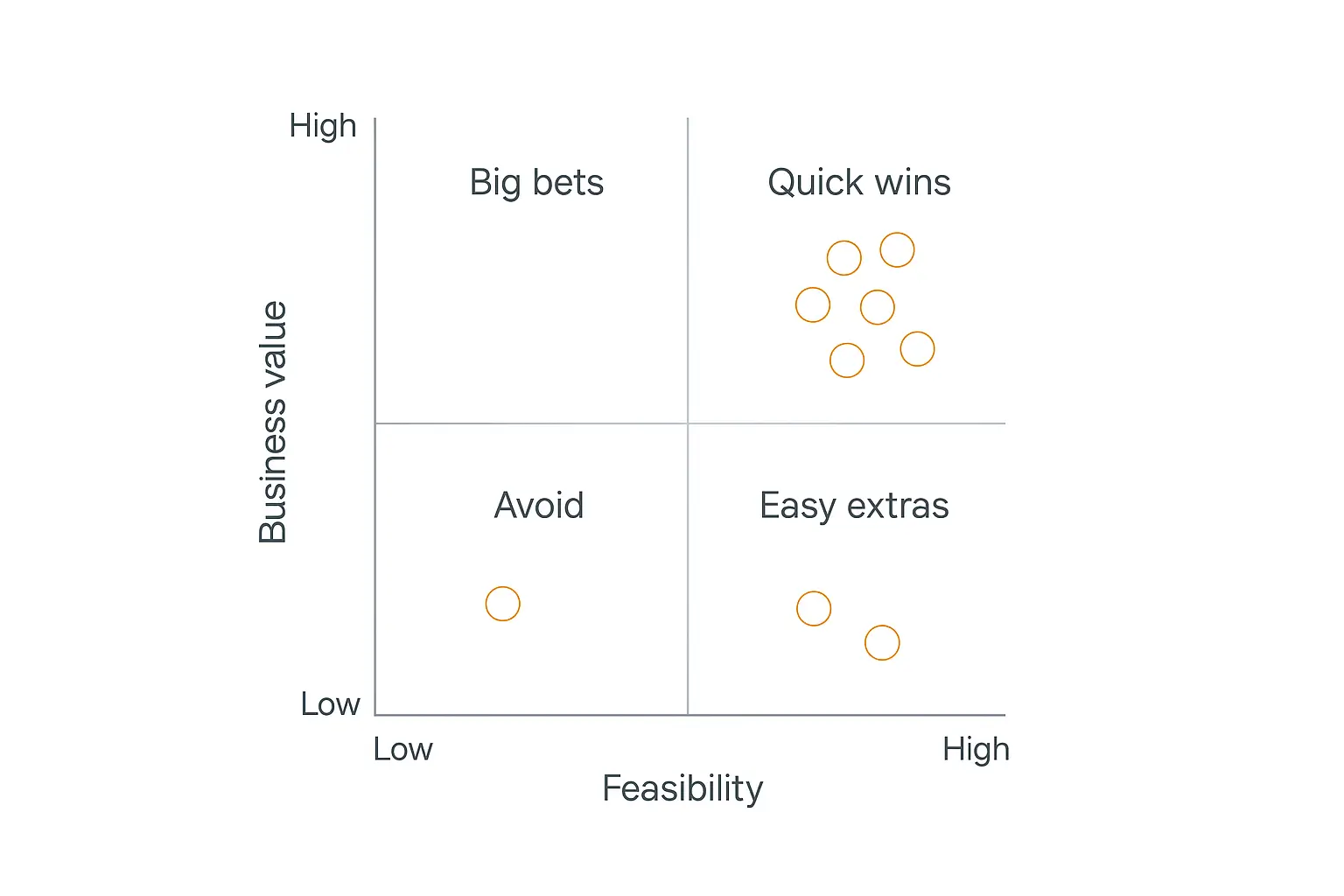
The top-right quadrant — high value, high feasibility — is where you tell the client to start. These are the "quick wins" that prove ROI fast and build internal momentum.
Resist the client's instinct to start with the moonshot. The MIT data is blunt here: the pilots that succeeded picked one pain point and executed it well, often in unglamorous back-office work, while the failures over-invested in flashy sales and marketing bots.
A quick-win-first sequence is also a sales strategy. Land a fast, visible win in month one and the client will happily fund the rest of the roadmap.
Phase 3 — The AI Roadmap
Now you turn the prioritized list into a time-phased plan.
A good roadmap has three horizons:
- Horizon 1 (0–90 days): The quick wins. One or two pilots that prove value and create reference points.
- Horizon 2 (3–9 months): Scaling what worked, hardening the data foundation, and launching the next tier of use cases.
- Horizon 3 (9+ months): The transformative bets — the work that's only sane once the organization has matured.
For each item, the roadmap should name an owner, a rough budget, a success metric, and dependencies. Vague roadmaps die in committee. Specific ones get funded.
Tie every initiative to a number the executive team already cares about. If you can't connect a use case to revenue, cost, or risk, it doesn't belong on the roadmap. My guide on measuring AI agent ROI has the formulas I use to back these projections.
Phase 4 — Governance and Risk
This is the phase amateurs forget and enterprises will not sign without.
Governance answers: Who's allowed to deploy AI? What data can it touch? How do we monitor it? What happens when it's wrong? How do we stay compliant with the EU AI Act, GDPR, HIPAA, or sector rules?
You don't need to be a lawyer. You need a framework: an approval process, an acceptable-use policy, a data-handling standard, and a monitoring plan. Enterprises increasingly treat this as table stakes, and being the consultant who brings it unprompted is a huge differentiator.
Phase 5 — Enablement and Change Management
The best strategy fails if nobody uses it.
That "learning gap" MIT identified is mostly a people problem. Employees don't trust the tool, weren't trained, or quietly route around it.
Enablement is training sessions, internal champions, documentation, and a feedback loop. Change management is the unglamorous work that determines whether your beautiful roadmap survives contact with the org chart.
Bill for it. It's often the difference between a one-off project and a multi-year retainer.
Turn your roadmap into a working pilot in an afternoon.
Pickaxe lets you build and deploy a client-ready AI agent without code — perfect for proving a quick win fast.
How to Position Your AI Strategy Consulting Practice
The fastest way to fail at this is to be a generalist. "I help businesses with AI" is invisible.
The consultants who win pick a lane. There are three ways to specialize, and the strongest practices combine at least two.
1. By industry
Own a vertical. "AI strategy for law firms" or "AI for mid-market manufacturers." You learn the workflows, the compliance landscape, and the jargon once, then reuse that knowledge across every client.
Vertical focus also makes referrals trivial — every happy client knows ten more businesses exactly like theirs.
2. By function
Own a department. "AI for finance teams" (AR, reconciliation, forecasting) or "AI for customer support." Functional expertise travels across industries.
3. By company stage or size
Serving 50-person companies is a completely different game than serving the enterprise. Smaller firms move fast and pay less; enterprises pay more but buy slowly and demand governance. Pick the motion that fits you.
My honest advice: start with a vertical you already understand from a past career. Domain credibility is the single biggest accelerator in this business, and it's the one thing you can't fake.
How to Price AI Strategy Consulting
Pricing is where new consultants leave the most money on the table.
The mistake is billing hourly. Hourly pricing caps your income at your calendar and signals that you're labor, not expertise. You want to price the outcome.
Here's the range of models I see working, roughly ordered from entry-level to mature practice.
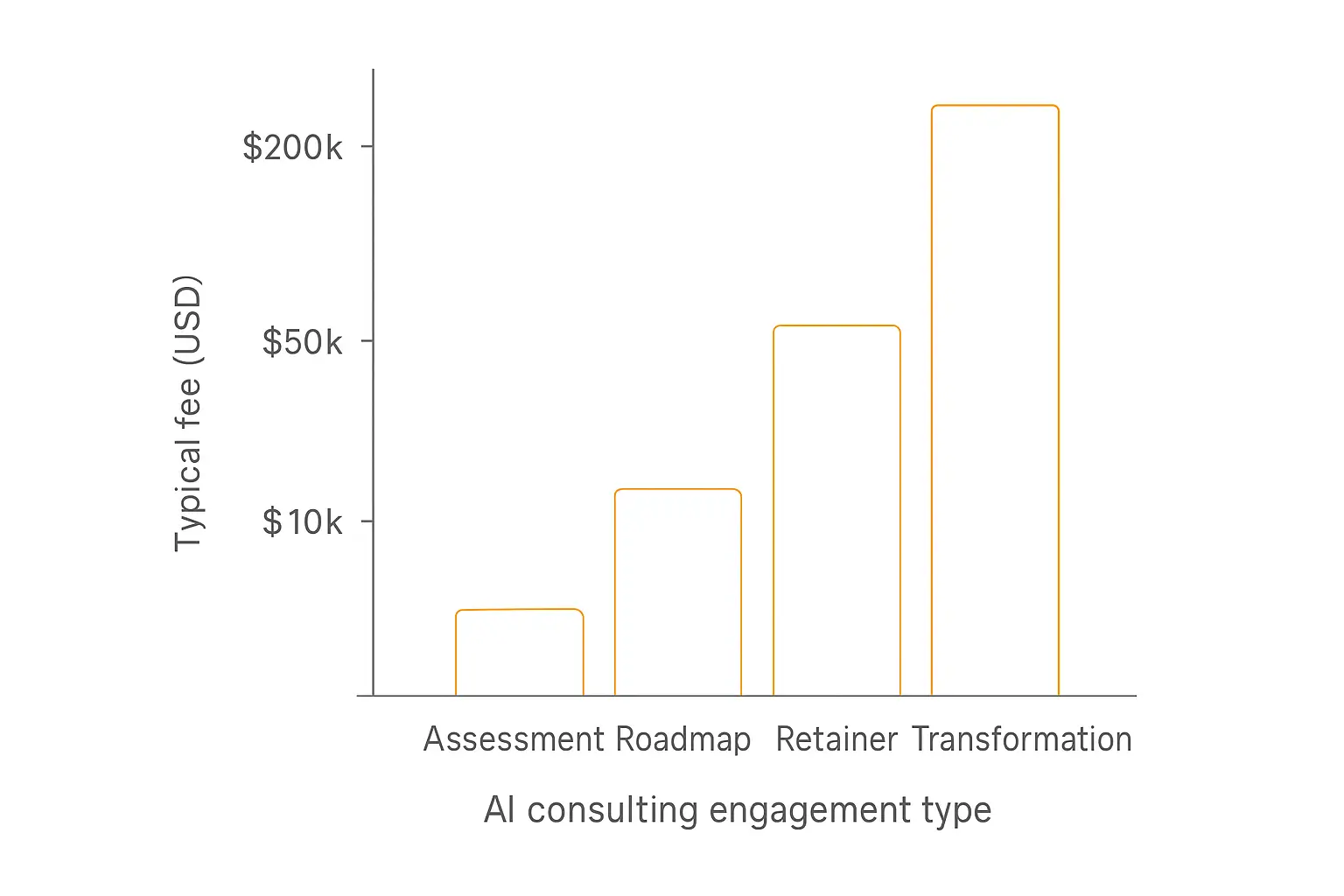
| Engagement Type | Typical Range | What It Includes |
|---|---|---|
| AI Opportunity Assessment | $5k–$20k | Discovery, workflow audit, prioritized use-case list. The "foot in the door" offer. |
| Strategy & Roadmap | $15k–$50k | Full assessment plus a time-phased roadmap, governance framework, and business case. |
| Monthly Retainer | $3k–$15k/mo | Ongoing advisory, oversight of implementation, enablement, and quarterly re-planning. |
| Transformation Program | $50k–$250k+ | End-to-end: strategy, implementation oversight, change management, multi-quarter. |
A few rules I'd tattoo on a new consultant:
Lead with the paid assessment. A productized $7,500 assessment is far easier to sell than a $60k transformation, and it does the selling for you. By the time it's delivered, the client already trusts you and sees the roadmap they need.
Anchor to value, not effort. If your roadmap unlocks $400k in annual savings, a $40k fee is a rounding error. Frame it that way.
Get to recurring revenue. Retainers are what turn a consulting hustle into a real business. The implementation oversight and enablement phases are natural retainers.
If you want to go deeper on the mechanics, I broke down the full approach in how to price AI services and the three dominant AI agent pricing models.
Your Consulting Toolkit: From Slide Deck to Working Agent
Here's the shift that's quietly reshaping this entire field.
For decades, strategy consulting ended at the slide deck. You handed over a beautiful roadmap and walked away, and 95% of the time it sat in a drawer.
The consultants winning in 2026 don't stop at the deck. They show up to the second meeting with a working prototype.
Nothing closes a transformation engagement like watching the client's own use case run live. It collapses the "will this even work?" objection instantly.
This is exactly where I lean on Pickaxe. Because it's no-code, I can take a prioritized use case from the roadmap and build a functioning agent — with the client's knowledge base, their tone, connected to their tools via Actions — in an afternoon, not a sprint.
A few ways consultants use it inside an engagement:
- Proof-of-concept in the pitch. Build a rough version of the client's top use case before the proposal is even signed. It's the most persuasive sales asset you can bring.
- Pilot delivery. Ship the Horizon 1 quick win as a real, deployable agent — embedded on their site, in Slack, or over WhatsApp — instead of a "phase 2" promise.
- White-labeled client portals. Deliver agents under the client's brand in a branded portal, which makes the work feel like a product, not a consulting artifact.
- Monetizable products. For clients who want to sell AI to their own customers, you can stand up billing and access control natively.
You don't have to use Pickaxe — but you do need something that lets you prototype fast. The era of strategy-without-execution is what produced that 95% failure rate. Don't be part of it.
Why Most AI Initiatives Fail (and How You Prevent It)
If you internalize one section of this playbook, make it this one. Knowing the failure modes is the consulting value.
From the MIT research and what I've seen firsthand, here are the recurring killers:
1. Starting with tools instead of problems. Companies buy a platform and then go looking for something to do with it. You reverse it: problem first, then the smallest tool that solves it.
2. Chasing the shiny use case. Everyone wants the customer-facing AI that wows the board. The ROI is usually hiding in boring back-office automation. Steer them there.
3. No owner. A use case without a named, accountable owner never ships. Assign one in the roadmap.
4. Skipping change management. The "learning gap" again. Tools that nobody's trained on get abandoned within weeks.
5. No measurement. If you can't prove the win, you can't fund the next one. Define the metric before you build, not after.
6. Ignoring governance until it's a crisis. A data leak or compliance scare ends the program. Bake guardrails in from day one.
Your job, in a sentence: keep the client out of the 95%.
Ship the pilot, not just the slide deck.
Build a client-branded AI agent, connect it to their tools, and deploy it anywhere — all without writing code.
How to Land Your First AI Strategy Clients
Strategy is the product. Now you have to sell it.
Start where you have credibility. Your former industry, your network, your old colleagues. The first three clients almost always come from people who already trust you. A vertical focus makes this far easier.
Lead with education, not a pitch. Run a free workshop, write a "state of AI in [your industry]" report, or post breakdowns on LinkedIn. Decision-makers hire the person who already taught them something.
Offer the assessment as the entry point. "Let's start with a paid AI opportunity assessment" is a low-risk yes for a buyer who isn't ready to commit to a six-figure program. It's the most reliable door-opener I know.
Show, don't tell. Bring a working prototype to the second meeting (see the toolkit section). It's worth more than any case study.
Productize your offer. "A 2-week AI Opportunity Assessment for $7,500, delivered as a roadmap your leadership can act on." A specific, fixed-scope offer outsells "I do AI consulting" every single time.
If you're targeting smaller local businesses rather than enterprises, the motion is different — I covered it in how to sell AI agents to local businesses.
Frequently Asked Questions
Do I need to be technical to do AI strategy consulting?
No — but you need to be conversant. You should understand what's possible, what's hard, and roughly what things cost. You don't need to write code, especially if you use no-code tools to prototype. The value is judgment and business sense, not engineering.
How is this different from running an AI agency?
An agency mostly builds and ships agents (implementation). Strategy consulting is the advisory layer above it — deciding what to build and why. Many people do both: strategy is the high-margin front end, implementation is the recurring back end. See the agency playbook for the build-focused path.
What should my first deliverable be?
A productized, paid AI Opportunity Assessment. It's low-risk for the client, proves your value, and naturally sells the larger roadmap and implementation work that follows.
How much can I charge as a solo AI strategy consultant?
Assessments commonly run $5k–$20k, full strategy-and-roadmap engagements $15k–$50k, and retainers $3k–$15k/month. The ceiling is set by the value you unlock, not your hours. Anchor to outcomes.
Should I specialize or stay general?
Specialize. A clear niche ("AI strategy for accounting firms") makes you findable, referable, and credible. Generalists compete on price; specialists compete on expertise.
How do I prove ROI to skeptical executives?
Start with a quick win that's easy to measure, define the success metric before you build, and tie everything to a number leadership already tracks. Our ROI guide has the formulas.
The Bottom Line
The opportunity in AI strategy consulting isn't subtle. Nearly every organization is adopting AI, and almost none of them are getting it right.
The consultants who win this decade won't be the ones with the prettiest decks. They'll be the ones who can diagnose where AI belongs, sequence it sanely, govern it responsibly, and prove the value with something that actually works.
Pick a niche. Productize an assessment. Lead with a quick win. And bring a working prototype to the table instead of a promise.
That last part is more achievable than it's ever been. With a no-code platform like Pickaxe, the gap between "here's the strategy" and "here's the agent doing the work" is now an afternoon — and closing that gap is exactly what keeps your clients out of the 95% that fail.
The businesses are ready. The demand is real. The only question is whether you'll be the one they call.