

AI agency retainer services work when a client can name what arrives next month. “We keep your AI running” might describe useful work, but it leaves the buyer guessing what they are paying for and leaves you guessing how much support you owe.
I looked through current agency service pages and technical guidance to separate recurring service packages from open-ended promises. My recommendation is to sell one repeatable business deliverable, attach a clear review process, and budget the maintenance needed to produce it.
The seven packages below are proposed offers, not Pickaxe customer results or market pricing benchmarks. Every sample volume, cadence, budget, and calculation is illustrative; adapt it to the client's workload and your actual delivery capacity.
What AI agency retainer services should promise
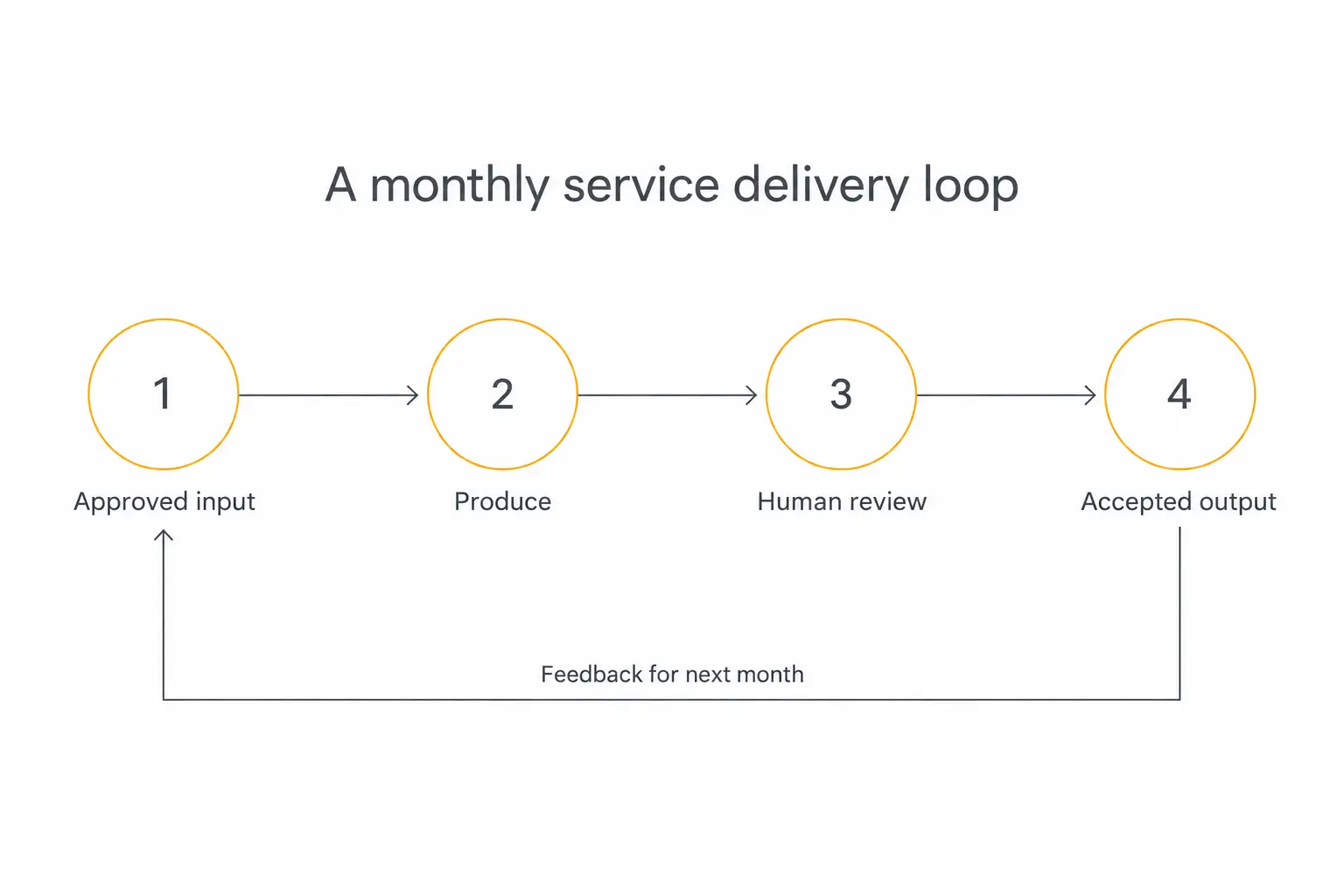
A monthly service needs a recurring input, a useful output, and someone responsible for accepting it. An intake agent receives new inquiries; the service delivers reviewed qualification records and a clear handoff to sales.
That is different from charging to preserve availability, and different again from reserving engineering hours. You can sell all three, but the client should know which one they bought.
The distinction appears in real agency offers: Tenaxity separates one-off builds, monthly care plans, and build retainers. Its published fees exclude VAT and third-party costs such as hosting, model usage, and the client's subscriptions; these are vendor offer terms checked November 6, 2026, not an industry standard.
Likewise, Forge describes monthly plans with ongoing builds and monitoring, while stating that AI usage is billed at cost and tools run on client accounts. The lesson I take from these pages is to compare scope and billing boundaries before comparing the monthly number.
Write the promise as a delivery sentence: “Each month, we turn this approved input into this reviewed output for this named team.” If the input only exists once, start with a project instead.
Choose among these seven AI agency retainer services
Pick the package whose output already has an owner and a place in the client's workflow. A busy process with nobody willing to review exceptions is a weak first engagement.
| Package | Likely buyer | Monthly evidence | Boundary to settle first |
|---|---|---|---|
| Lead intake | Sales manager | Reviewed qualification and handoff log | Qualification is not a sale |
| Support operations | Support lead | Answer review and escalation report | Who handles urgent cases |
| Knowledge stewardship | Operations lead | Approved source register and freshness checks | Who owns policy correctness |
| Content production | Marketing lead | Approved publication-ready assets | Approval and revision limits |
| Client onboarding | Account operations | Complete packets and exception queue | Reminders versus commitments |
| Management reporting | Department head | Reconciled report and action list | Access to authoritative data |
| Team enablement | Team manager | Reviewed practice cases and updated playbook | Training versus guaranteed adoption |
These are service designs, not a ranking of software products. One agent might support several designs, but I would avoid selling all seven to a new client before learning how much review each creates.
1. Lead intake and qualification operations
Buyer: a sales manager with inbound inquiries that arrive with missing context. The recurring value is a reliable qualification record and handoff, rather than an impressive chat transcript.
For a proposed starter package, cover one inbound channel and one agreed customer profile. Deliver a weekly reviewed lead queue, a monthly summary of disqualification reasons, and a record of inquiries awaiting a human decision.
A useful record includes the prospect's stated need, the relevant qualification criteria, missing information, and the next owner. Separate what the person actually said from what the model inferred.
Make the handoff measurable
Agree what counts as an eligible inquiry before calculating completion rates. Spam, existing customer questions, and duplicate submissions need explicit treatment so that the denominator does not change whenever the report looks inconvenient.
HubSpot's deduplication documentation specifically warns that companies created through its API are not deduplicated by the Company domain name property. Check the actual integration path rather than assuming a CRM prevents repeated records for you.
Boundary: do not promise closed revenue, unlimited outbound prospecting, or automatic acceptance of every lead. The client's sales team still owns outreach decisions and commercial commitments.
Maintenance workload: review misrouted inquiries, update the qualification rubric when the offer changes, and inspect failed CRM writes. Adding another channel or redesigning a pipeline is new scope, even if the same agent can technically attempt it.
I would report qualified records accepted by sales, records returned for correction, and unresolved handoffs. Our lead qualification agent guide covers the build; this package pays for the continuing delivery process around it.
2. Customer support answer and escalation operations
Buyer: a support lead whose team answers recurring product questions. The service should make routine answers easier to deliver while keeping sensitive exceptions visible.
A proposed monthly scope might cover one product line and a defined set of help topics. Deliver an approved answer update batch, a reviewed sample of conversations, a failure log, and a list of knowledge gaps requiring the client's input.
The client should receive examples of what changed and why. “Updated the bot” is hard to assess; “corrected the delivery-window answer after the approved shipping policy changed” is a usable record.
Separate answered from resolved
An agent producing an answer does not establish that the customer's problem is resolved. Agree whether resolution requires confirmation, a completed external action, or review by the support team.
This follows the distinction in Anthropic's agent evaluation guidance between the transcript and the actual outcome in the environment. A confident completion message is evidence of what the agent said, not proof that the intended result exists.
Boundary: define refund authority, account changes, urgent issues, and the hours when a human is available. Overnight chat availability does not mean overnight human incident coverage.
Maintenance workload: inspect incorrect answers, rerun approved cases after changes, and check the escalation destination. I would keep a route to a human visible even when the automation appears to work well.
Use a reusable agent evaluation set to preserve important behaviors across revisions. Sell the documented review and improvement cycle, with agreed acceptance rules, rather than an unsupported accuracy promise.
3. Knowledge base stewardship
Buyer: an operations lead whose procedures, service details, or internal policies change regularly. The recurring deliverable is a trustworthy source inventory and evidence that approved updates reach the agent.
This is a separate package from running a support desk. It can support an internal reference assistant, a training agent, or a collection of client-facing tools that depend on the same underlying documents.
A proposed scope could include one approved source collection, a monthly change register, and retrieval checks for changed material. Each source needs an owner, an effective date where relevant, and an explicit status such as active, superseded, or awaiting approval.
Deliver evidence of freshness
For a fictional policy update, preserve the old answer as a regression case, replace the approved source, and ask questions that distinguish the old rule from the new one. Also check what happens when the new document does not answer the question.
Pickaxe's Knowledge Base documentation describes workspace and agent-level source organization. I would use that organization as part of the implementation, then verify refresh and removal behavior for each connected source rather than promising that every upload or connector updates identically.
Boundary: the client's policy owner decides which version is authoritative. Your agency can maintain the register and flag contradictions; it should not quietly invent a policy to reconcile them.
Maintenance workload: chase missing approvals, inspect unsuccessful refreshes, and rerun affected questions. Large archive cleanup, new source systems, and specialist review should be scoped separately.
The monthly acceptance artifact is simple: these sources changed, these checks ran, these conflicts remain, and these answers are blocked pending a decision. That is considerably more useful than a file-count screenshot.
4. Reviewed content production
Buyer: a marketing lead with recurring publication needs and a reliable reviewer. Sell a defined batch of usable assets, with sources and approvals, rather than unrestricted access to a writing agent.
For an illustrative package, deliver four approved article drafts and eight adaptations from client-approved material each month. Include one revision round, an editorial calendar, and a source ledger for factual claims.
Those quantities are a scope example, not a recommended capacity target. A technical article with original interviews may take much more review than a short adaptation of an already approved webinar.
Price the review work
Budget research, factual checking, editing, image rights, and the client's approval cycle. Generation speed tells you little about the labor required to make something ready to publish.
Our content workflow guide explains the production stages. For the retainer, decide which stages you own and where an asset stops counting as delivered if the client has not supplied essential input.
Boundary: no invented testimonials, fabricated personal testing, or guaranteed search rankings. Publication requires an authorized person, and a new subject area needing specialist review can change the scope.
Maintenance workload: update approved language, refresh source material, inspect template failures, and retain an example set of accepted and rejected output. Avoid treating every preference change as a technical defect.
Report assets accepted, assets waiting on the client, correction reasons, and actual production hours. A smaller batch of publishable work is easier to renew than a large folder nobody trusts.
5. Client onboarding and document chasing
Buyer: an account operations manager who repeatedly collects the same information from new clients. The deliverable is an organized onboarding packet and an exception queue that a person can act on.
A proposed package covers one onboarding process, approved reminder templates, and a monthly review of incomplete cases. Track which fields are present, which documents were supplied, and which decisions still need an account owner.
In a fictional agency onboarding workflow, the assistant could identify a missing brand guide and prepare a reminder. It should not treat a plausible-looking upload as proof that the client approved a campaign budget.
Keep reminders and decisions separate
Pickaxe Actions connect agents to external tools and APIs. A proposed onboarding implementation could use an appropriately configured Action to update a task system, but the integration, credentials, and approval behavior need to be checked for the client's environment.
Boundary: define whether the service drafts reminders or sends them, who may receive them, and how to stop them after a human takes over. Contract acceptance and financial commitments remain with the authorized client owner.
Maintenance workload: inspect reminder delivery, changed forms, access failures, and duplicated tasks. Test the completed-case path as carefully as the missing-document path so that reminders actually stop.
Report complete packets, stalled cases by reason, and reminders requiring correction. A drop in incomplete cases can be promising, but use comparable cohorts before attributing the change to your service.
I would exclude historical document migration from the starter scope. Cleaning years of inconsistent files is a different project from keeping new onboarding cases orderly.
6. Management reporting with exception analysis
Buyer: a department head who needs the same operational report every week or month. The output is a reconciled report, explanations tied to evidence, and an action list with named owners.
A proposed scope includes one reporting template and a fixed set of approved data sources. Deliver the underlying figures, a checked narrative, and a record of missing or late data.
Start with deterministic calculations for totals and rates. Use the model to organize explanations and questions, while preserving the distinction between a documented cause and a plausible hypothesis.
Make the denominator visible
If the report says conversion fell, show the population, period, definition, and exclusions. A changed CRM stage or an incomplete import can create movement that has nothing to do with customer behavior.
The proposed service should include a reconciliation checklist and a reviewer who can reject unsupported explanations. A polished paragraph does not make an inconsistent dataset reliable.
Boundary: exclude financial attestation, guaranteed forecasts, and unapproved writes back to operational systems. New source connections, custom data modeling, and a redesign of the KPI framework should trigger separate scoping.
Maintenance workload: investigate missing rows, changed schemas, failed credentials, and revised metric definitions. These jobs can consume more time than generating the narrative.
Our agent analytics guide can help define operational measures. For the commercial package, make the recurring decision the report supports explicit: who will do what differently after reading it?
7. Team enablement and playbook improvement
Buyer: a team manager who has useful AI tools but uneven confidence using them. The recurring output is a reviewed practice session, updated examples, and a playbook grounded in the team's actual questions.
A proposed package includes one facilitated session, a batch of anonymized practice cases, and an updated quick-reference guide each month. Agree who supplies cases and who checks that sensitive material has been removed.
This can pair well with a client-facing agent, but it is a service in its own right. The team needs to know when to trust a response, when to inspect a source, and when to hand the task to a person.
Teach the exception path
Include exercises where the correct behavior is to stop, ask for missing information, or escalate. If every training example ends in successful automation, you are teaching the wrong operating habit.
NIST's AI RMF Core addresses roles, training, oversight, and post-deployment monitoring. I use it here as a voluntary planning reference, not a certification or a promise that these packages establish compliance.
Boundary: attendance does not guarantee adoption or productivity. Managers own process changes and staffing decisions; your service supplies practice, feedback, and documented learning needs.
Maintenance workload: refresh examples after tool changes, remove outdated instructions, and review recurring misunderstandings. A new department or an additional language needs an appropriately qualified reviewer and a fresh scope.
I would report completed practice cases, unresolved questions, and the next changes to the playbook. Avoid using login counts as the whole story of whether the team learned to work safely.
Build the economics before quoting a monthly fee
The following is hypothetical arithmetic, not an observed margin or a market rate. Suppose you price a reviewed reporting package at $1,500 per month, excluding applicable taxes, and estimate eight hours of delivery at a loaded internal cost of $75 per hour.
Assume another $150 in software and usage costs allocated to that client. Direct monthly cost would be $750: $600 of labor plus $150 of tools, leaving $750, or 50% of revenue, before sales, general overhead, tax, and unexpected work.
If the same package takes fourteen hours, labor becomes $1,050 and total direct cost becomes $1,200. The remaining contribution is $300, or 20%; a review bottleneck has changed the economics without changing the model bill.
These estimates are planning inputs, not proof the client receives $1,500 of value. Compare the offer with the client's actual alternatives and decision needs, then record delivery time during an explicitly scoped pilot.
Separate your fee from included usage and any overage mechanism. Stripe documents usage-based billing models, but a billing meter does not define your service boundary; you still need to specify what is counted, when the client is warned, and what happens at the cap.
For the broader commercial method, see our AI service pricing guide. I would quote the setup separately whenever discovery, integration, or data cleanup is substantial, rather than recovering unknown build work through a deceptively small monthly price.
Put the operating rules on one page
Give the buyer a record they can use to manage the service. I would include the following fields in every proposed monthly offer, with numbers agreed during scoping rather than copied from another agency's page.
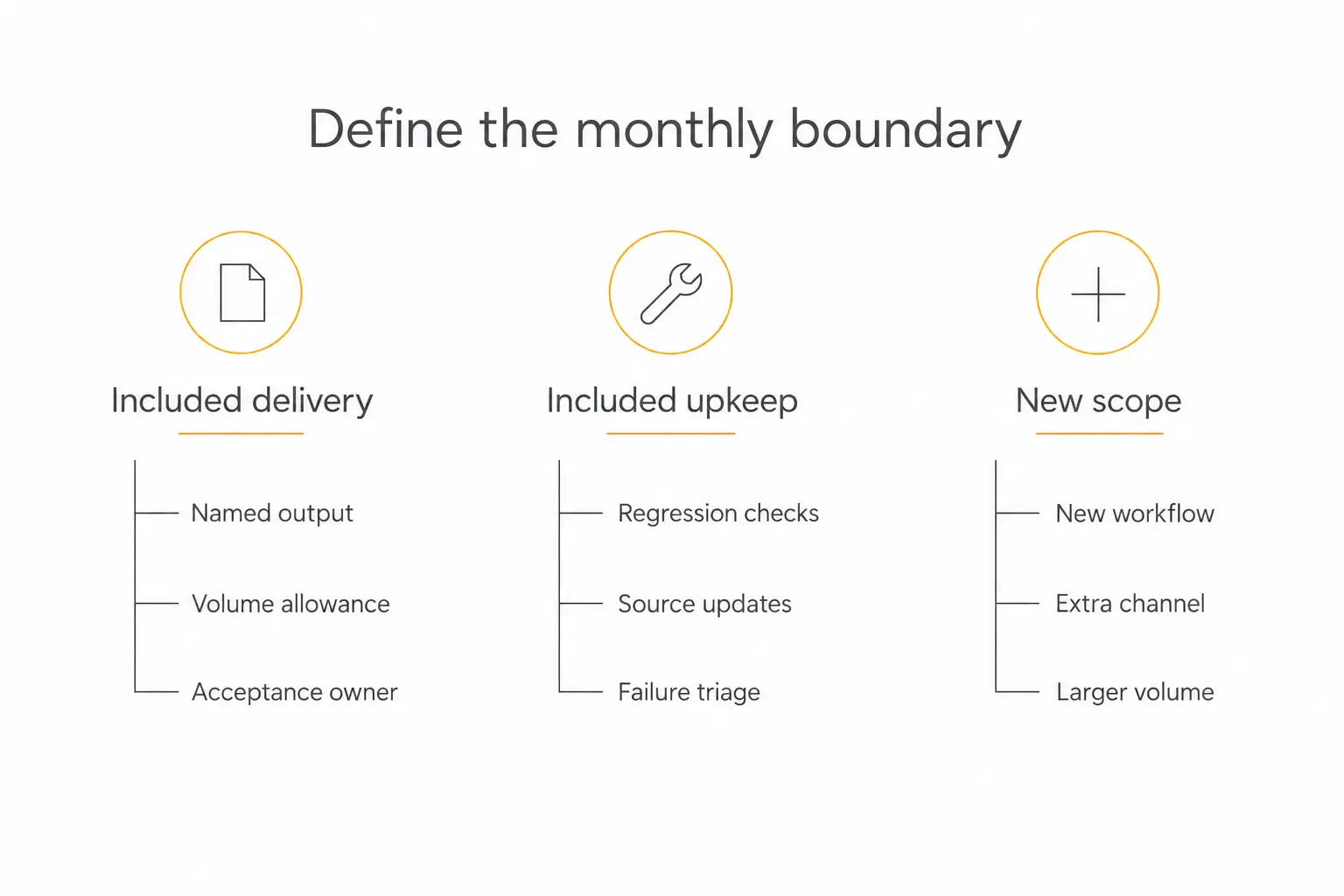
- Delivery: buyer, covered workflow, input sources, monthly output, acceptance owner, and delivery date.
- Capacity: included volume, review allowance, revision limit, usage budget, and treatment of unused capacity.
- Operations: maintenance tasks, monitoring hours, escalation contact, response window, and pause authority.
- Changes: what counts as a correction, what requires a new quote, and who approves extra spend.
- Exit: account ownership, document handover, access revocation, and which provider subscriptions continue.
For a fictional support package, the record might say that a reviewed answer update ships each month, urgent complaints go to the client's support lead, and another product line needs a change order. That is a manageable offer rather than unlimited responsibility for every conversation.
A response window means when you acknowledge and assess an issue, unless you expressly agree otherwise. Do not let “priority support” become an accidental promise to fix every provider outage immediately.
Pickaxe Portals provide branded hubs for multiple agents and pages. I would use a portal where it helps the client access the tools and instructions, while keeping the service record explicit about who monitors integrations and reviews results.
At renewal, show the accepted deliverables, open exceptions, actual delivery effort, and proposed scope changes. If the recurring need has disappeared, recommend a smaller service or a clean handoff.
Build one focused monthly service
Give your client a useful agent and a clear delivery promise.
Questions clients will ask before signing
Why pay monthly after the agent is built?
Because the offer delivers continuing work the client needs: reviewed leads, approved content, current knowledge, or reconciled reports. If the only need is an occasional repair, an on-demand support arrangement may be more appropriate.
Can I promise unlimited requests?
You can accept a queue without promising unlimited delivery. Specify concurrency, monthly capacity, prioritization, and response expectations so that the buyer understands what happens when demand exceeds the allowance.
Should maintenance be a separate line item?
It can be separate or included, provided its scope and cost are visible. Define the recurring business deliverable first, then show which upkeep is necessary to produce it and which changes require approval.
What if the client supplies no new material?
Agree the treatment in advance: a documented pause, a reduced scope, or reserved capacity with clearly explained terms. Do not manufacture content or invent completed work to fill the monthly report.
Start with one service you can demonstrate
I would choose one buyer, one recurring workflow, and one output they can accept or reject. Run a proposed pilot with a written scope, measure review effort, and use the results to decide whether a monthly agreement makes sense.
Pickaxe can provide the agent and delivery surface; your agency's value is the judgment and operating work around them. Start with a focused agent, then build an offer whose next month's deliverable is easy to explain.