

Answer engine optimization is suddenly everywhere, but most advice about it mixes documented platform behavior, small vendor tests, and outright folklore into one confident checklist.
I reviewed nine current AEO and GEO guides, the crawler documentation from the major answer engines, and the strongest recent citation studies I could find. My conclusion is simple: you can improve the odds of being cited, but nobody can sell you a guaranteed placement.
The useful work is less glamorous. Make your best answers accessible, specific, defensible, and easy to measure. Then run the same buyer questions often enough to tell a pattern from a lucky screenshot.
The interest is real. In an April 28, 2026 post on X, Ahrefs founder Tim Soulo said the three most popular episodes in the current Ahrefs podcast season all focused on AI search data, AEO myths, and how to show up. That is a useful signal about practitioner attention, not evidence of any ranking factor.
What is answer engine optimization?
Answer engine optimization is the practice of making your information more likely to be retrieved, cited, and accurately represented in AI-generated answers. It applies to experiences such as ChatGPT Search, Claude with web search, Perplexity, Google AI Overviews, and Google AI Mode.
You will also see the terms generative engine optimization, GEO, AI SEO, and LLM optimization. The labels overlap. What matters is the job: help an answer system find a source it can safely use for a specific question.
Traditional SEO still matters because these systems need sources. Google explicitly says its generative search features use core Search systems and that the same SEO foundations remain relevant in its official generative AI optimization guide.
| Question | Traditional SEO | Answer engine optimization |
|---|---|---|
| Primary outcome | A ranked search result and a click | A mention, citation, or recommendation inside an answer |
| Operating unit | Keyword to page | Buyer question to source passage |
| What gets measured | Rank, impressions, clicks, conversions | Search activation, citation, brand mention, visits, conversions |
| Main risk | Ranking without useful traffic | Being cited without recognition or business impact |
| Shared foundation | Accessible pages, relevant content, real expertise, trusted references, and a good user experience | |
The mistake is treating AEO as a replacement for SEO. A better model is that AEO adds several observable steps between discovery and business value.
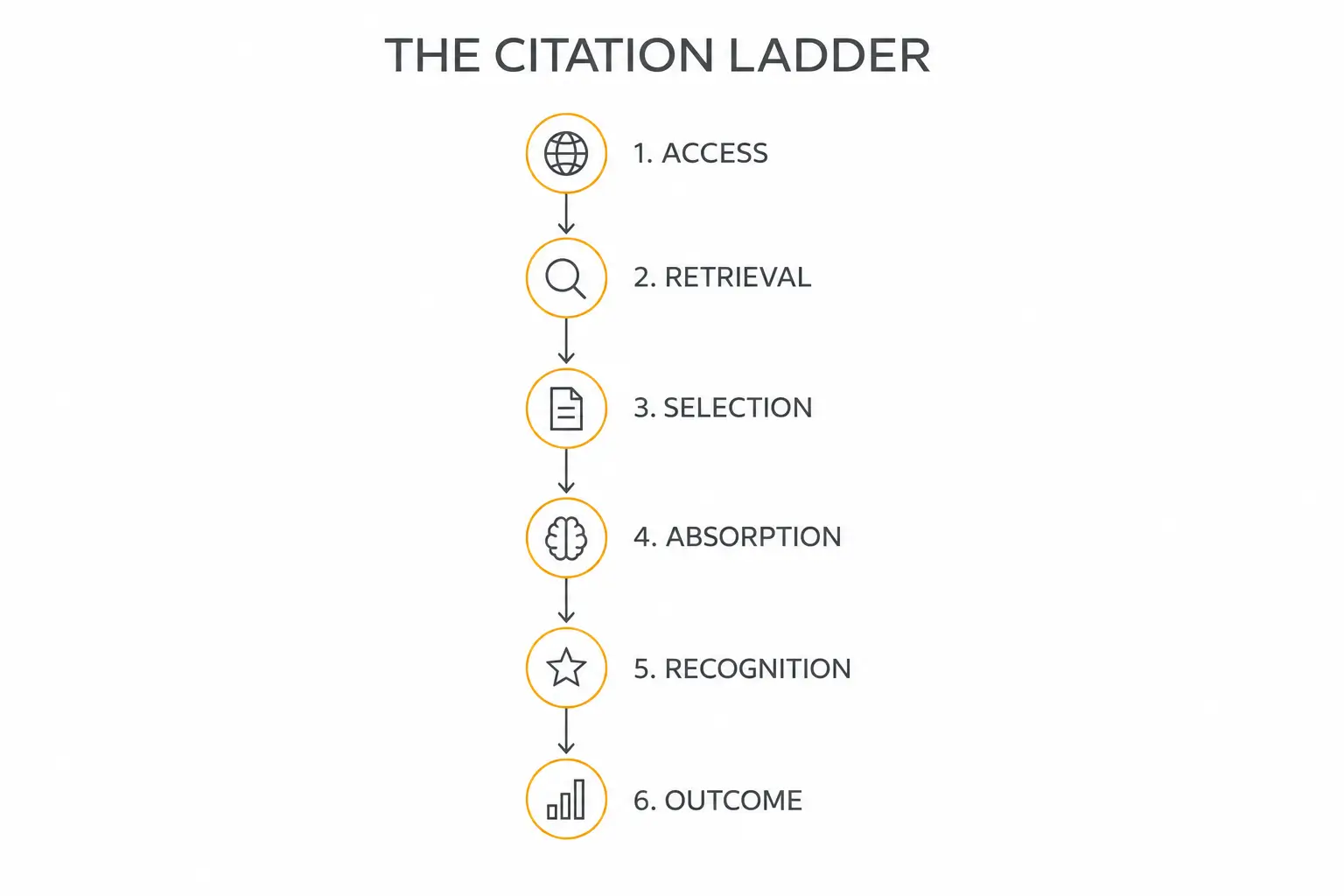
How answer engine optimization citations actually happen
I use a six-stage citation ladder because it prevents teams from calling every source link a win.
1. Access
The relevant crawler must be able to fetch the page. A robots.txt rule, firewall challenge, login wall, or client-only rendering failure can end the process before content quality matters.
2. Retrieval
The engine must decide to search, form one or more retrieval queries, and find your page. Google documents a query fan-out technique that can issue related searches across subtopics and sources.
3. Citation selection
Your page can be retrieved and still lose to another source. A 2026 Ahrefs analysis of 1.4 million prompts found that ChatGPT cited roughly half of the URLs it retrieved, while warning that source composition makes simple ranking-factor conclusions unreliable.
4. Answer absorption
A citation does not prove the answer used your distinctive evidence. A 2026 analysis of 602 prompts and 21,143 search-layer citations separates citation selection from citation absorption, meaning how much a cited page actually contributes to the generated answer.
5. Brand recognition
The source link may appear while the brand name does not. Semrush calls this a ghost citation; its June 2026 vendor study reported that 62 percent of citations in its dataset lacked an in-answer brand mention. Treat that figure as directional, not universal.
6. Business outcome
Finally, a named citation still needs to produce something useful: a qualified visit, signup, sales conversation, or assisted conversion. Visibility is not revenue, and an AEO report should never merge those columns.
Which AEO tactics are supported by evidence?
The most important distinction in this field is not between SEO and GEO. It is between documented mechanics, measured associations, controlled experiments, and unsupported recipes.
The original KDD 2024 GEO paper reported visibility gains as high as 40 percent for some interventions in its benchmark. That result is worth knowing, but the benchmark began with sources already placed in a fixed context.
A July 2026 critical survey of 45 studies makes the boundary clear: topical relevance and context position are the most reproducible levers, while no reviewed technique showed a stable, long-term, cross-platform causal effect on organic discovery or downstream behavior.
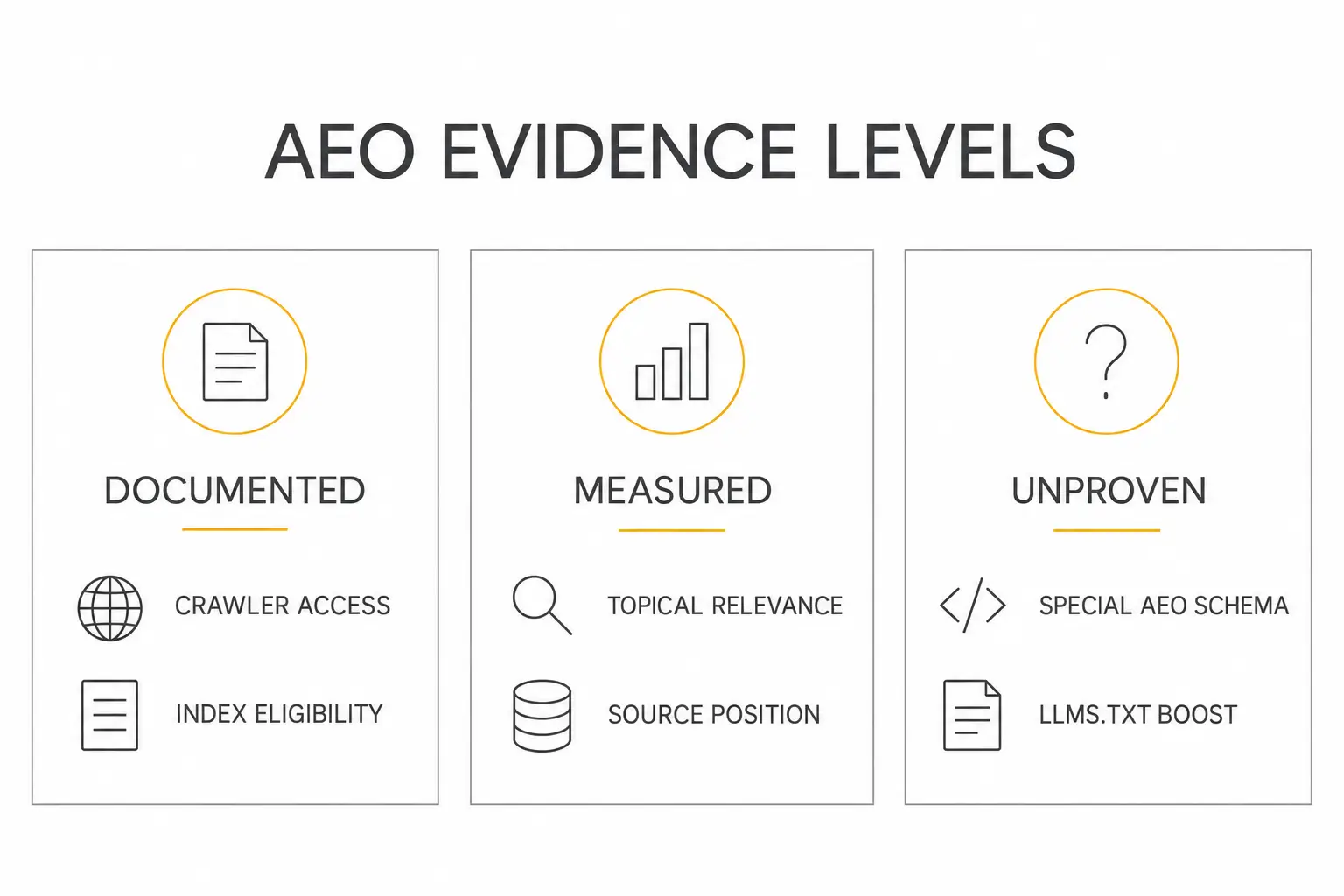
Documented mechanics
- Crawler purpose matters. Search crawlers and training crawlers are not interchangeable.
- Index eligibility matters. Google requires a page to be indexed and eligible for a snippet before it can appear as a supporting link in its AI features.
- Original, useful content matters. Google recommends unique, expert-led, non-commodity content rather than special AI rewrites.
Measured or controlled signals
A 2026 controlled study ran 252,000 paired trials across six models. Topical relevance and list position had the largest effects on being cited first; explicit price information and a recent timestamp helped consistently; formatting-only changes had little impact.
That does not mean every live engine uses the same weights. It means relevance and usable evidence deserve priority over decorative markup.
Unproven shortcuts
There is no special AEO schema. Google says no additional schema is required for its AI features and that it ignores llms.txt for Search ranking. Use accurate structured data for supported search features, not as a magic AI citation switch.
An Ahrefs matched analysis reinforces the caution. It tracked 1,885 pages that added JSON-LD against 4,000 controls and found little citation movement, despite schema being more common on strong sites.
The same skepticism applies to rigid rules such as “always answer in 40 words” or “every heading must be a question.” Clear answers help readers and make passages easier to reuse, but the evidence does not support one universal template.
Audit crawler access before rewriting content
Most AEO checklists begin with prose. I would begin with access, because each platform publishes different bot roles.
| Platform | Search or retrieval bot | Separate training bot | Practical implication |
|---|---|---|---|
| OpenAI | OAI-SearchBot; ChatGPT-User for some user-directed visits | GPTBot | You can allow Search while disallowing training |
| Anthropic | Claude-SearchBot; Claude-User for user-directed retrieval | ClaudeBot | Configure each purpose separately |
| Perplexity | PerplexityBot | Check current publisher controls separately | Confirm robots.txt and firewall access |
| Googlebot | Google-Extended controls some other AI uses | Normal Search eligibility governs AI Overviews and AI Mode |
OpenAI's current crawler documentation says OAI-SearchBot controls inclusion in ChatGPT search answers, GPTBot is for content that may be used in model training, and ChatGPT-User does not determine Search inclusion.
Anthropic documents three separate agents: Claude-SearchBot for search quality, Claude-User for user-initiated retrieval, and ClaudeBot for content that may contribute to training.
Perplexity identifies PerplexityBot as its search crawler and says it respects explicit robots.txt limits. Google uses Googlebot and its existing Search controls.
Check more than robots.txt. Review server logs, CDN rules, bot protection, canonical tags, noindex directives, HTTP status, and whether the important answer is present in the returned HTML.
Build one page that deserves the citation
Once access works, choose one valuable buyer question and make one page the strongest source for it.
Start with a decision, not a head term
“AI accounting” is not an answer. “What should a five-person accounting firm automate first without exposing client tax data?” is a decision an answer engine can decompose and a business can act on.
Build a prompt map from sales calls, support tickets, search queries, comparison requests, and objections. Group paraphrases by the decision behind them so you do not publish ten thin pages that compete with each other.
Lead with a defensible answer
Open with a short conclusion, then show the evidence, boundaries, and exceptions. The goal is not to sound certain. It is to make each important claim easy to verify.
Original evidence is especially valuable because it gives other writers and engines a reason to choose your page over a generic summary. Useful assets include a small benchmark with disclosed methods, a pricing calculator, a template, a decision table, a public dataset, or a documented process.
Show where each claim came from
Link quantitative and changing claims to primary sources. Name the date, region, plan, billing interval, and sample when those details affect the conclusion.
This is the same discipline behind a trustworthy AI research agent that cites its sources. A link is not decoration; it lets a reader inspect whether the source actually supports the sentence.
Keep the page useful to a human
Use descriptive headings, short paragraphs, accessible tables, and concrete examples because people need them. Do not chop good writing into unnatural fragments just because a vendor says an engine prefers a fixed word count.
Mass production is the wrong response. If you use an AI content workflow, keep research, source checking, editorial judgment, and updates as explicit gates rather than turning every prompt variation into a page.
Build a prompt portfolio from real customer language
Keyword volume is a weak starting point for an AEO pilot because a single conversational question can trigger several hidden searches. Build a prompt portfolio around the decisions customers make instead.
I would collect raw language from call notes, site search, support tickets, community discussions, product reviews, and sales objections. Remove personal information, then label each question by intent and evidence need.
| Prompt type | Example | Best source asset | Evidence the answer needs |
|---|---|---|---|
| Definition | What is an AI client portal? | Plain-language guide | Clear scope, examples, boundaries |
| Comparison | Pickaxe or a custom app for a coaching business? | Decision table | Fit, tradeoffs, current capabilities |
| Implementation | How do I ground a support agent in policy documents? | Step-by-step method | Sequence, prerequisites, failure checks |
| Risk | Can an agent expose one client's data to another? | Security explainer | Architecture, controls, limitations |
| Proof | Does an FAQ agent reduce ticket volume? | Transparent case study | Baseline, sample, timeframe, exclusions |
The portfolio should include prompts where your business is a legitimate answer and prompts where it is not. If every question is designed to force the brand into the response, the test set measures your wish list rather than customer discovery.
Separate source prompts from recommendation prompts. A source prompt asks for a fact, method, or definition your page can support. A recommendation prompt asks the engine to name a provider, which depends more heavily on independent evidence and competitive context.
Also preserve natural paraphrases. “What is the safest way to...” and “Which option has the lowest data risk?” may represent the same decision, but an engine can retrieve different sources for each wording.
That is why the unit of work is a prompt cluster, not one exact phrase. Assign one canonical page to the cluster, make its purpose obvious in internal links, and update that page when the underlying facts change.
Run a 30-day answer engine optimization pilot
AEO answers change between platforms, prompt phrasings, accounts, locations, and runs. The practical response is repeated measurement, not false precision.
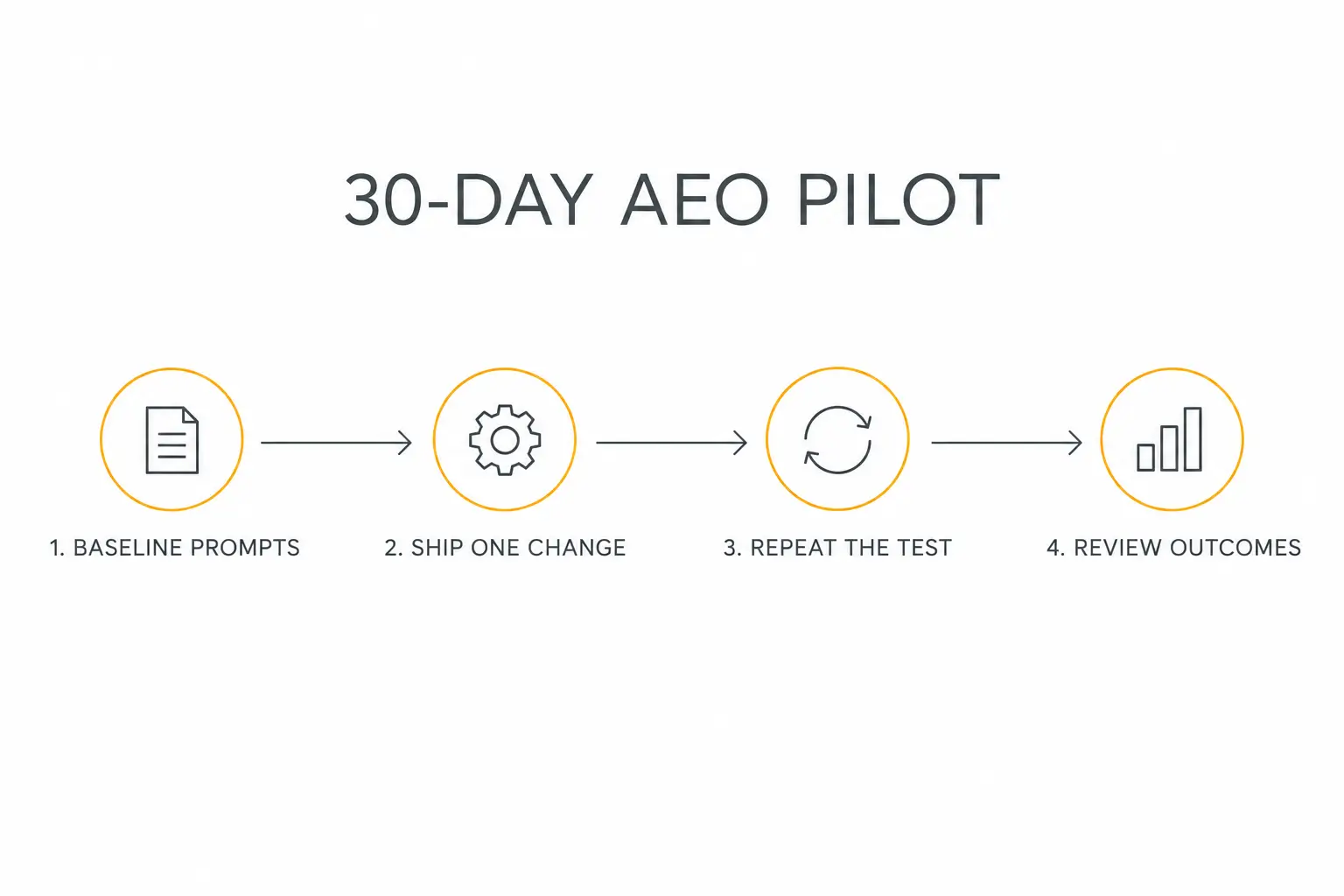
Here is a proposed pilot I would use for a small business or agency client. It is a methodology, not a report of a Pickaxe experiment.
Week 1: Define the test set
- Choose 20 buyer questions with commercial or high-trust intent.
- Write two natural paraphrases for each question.
- Choose three answer engines that matter to the audience.
- Record the account state, location, date, and whether web search was active.
- Run each question three times and save citations, mentions, and answer text.
That creates 180 observations for one baseline snapshot: 20 questions multiplied by three engines and three runs. This is illustrative arithmetic, not a statistically validated sample size.
Week 2: Ship one controlled change
Choose one content change tied to a clear failure. If the page was never retrieved, fix access and relevance. If it was retrieved but not cited, strengthen the direct answer and evidence. If it was cited but unnamed, make the source's authorship and brand ownership unmistakable.
Do not change the URL, title, body, schema, internal links, and publication date all at once. You will not know which intervention mattered.
Week 3: Repeat the same test
Use the same prompts, engine set, and logging rules. Treat a single new citation as an observation, not a victory.
Week 4: Review outcomes and decide
Compare retrieval, citation, brand mention, visits, and conversions separately. Keep changes that improve the distribution across repeated runs without hurting the page for human readers.
If nothing moves, the next experiment may be a stronger original asset or independent coverage rather than another rewrite. The 2026 research is blunt: generic formatting heuristics do not reliably overcome weak relevance or source position.
Turn repeat questions into a useful answer surface
Build a grounded Pickaxe agent, then use real conversations to improve the public pages your customers need.
Measure citations, recognition, and revenue separately
Your citation ledger can be a spreadsheet. Each row should include the prompt, paraphrase, engine, date, run number, web-search state, cited URL, citation position, brand mention, answer excerpt, referral session, and conversion if known.
Calculate at least four rates:
- Retrieval rate: your URL appeared among inspected sources.
- Citation rate: your URL appeared as a visible citation.
- Recognition rate: the answer named your brand when using your source.
- Outcome rate: the citation produced the business event you care about.
OpenAI says ChatGPT search referral URLs include utm_source=chatgpt.com, which makes those visits visible in normal analytics. Google announced dedicated generative AI visibility reports in Search Console in June 2026 and says the reports reached all websites worldwide by August 31, 2026.
Keep platform telemetry and your manual prompt set side by side. Neither is complete: referral data misses zero-click visibility, while prompt trackers do not prove that a citation created a customer.
How a public AI agent fits into answer engine optimization
A public-facing agent can support AEO, but the chat transcript itself is not automatically a citable page. Private sessions, client-rendered messages, and answers behind a login may never become crawlable source material.
The better pattern is a loop:
- Ground the agent in reviewed business knowledge.
- Deploy it where customers already ask questions.
- Log recurring gaps and objections with appropriate consent and privacy controls.
- Turn the most valuable questions into reviewed, indexable pages or research assets.
- Point the agent back to those canonical sources when it answers.
In Pickaxe, you can build the agent around a curated knowledge base and deploy it as a Page, Portal, direct link, or website embed. Use the agent as a discovery and conversion surface; keep the authoritative citation asset as a normal public page you control.
This also gives the page a human purpose. Instead of inventing question headings for a crawler, you are answering the real questions customers brought to the agent.
What should an AEO agency actually sell?
The market opportunity is not “guaranteed ChatGPT rankings.” That promise cannot survive contact with nondeterministic answers and platform changes.
A credible service has five deliverables:
- Access audit: robots.txt, bot roles, indexing, server rendering, status codes, canonicals, and firewall behavior.
- Buyer-question map: a finite test set tied to sales, support, or trust decisions.
- Citable answer asset: original data, a decision tool, an expert guide, or a transparent comparison.
- Citation ledger: repeated measurements across engines and paraphrases.
- Outcome report: citations, brand mentions, visits, leads, and conversions shown as separate stages.
That package also fits the reality behind the AI adoption gap: clients rarely need another dashboard or acronym. They need someone to connect a changing technology to a repeatable business process.
Price the work around the research, technical audit, asset creation, and measurement cadence you can control. Never price it as if you own the answer engine's ranking system.
Answer engine optimization mistakes to avoid
- Allowing every bot without understanding its purpose. Search visibility and model training are separate choices on OpenAI and Anthropic.
- Publishing commodity summaries. If ten pages contain the same claims, your version gives the engine no special reason to cite it.
- Confusing schema correlation with causation. Well-maintained sites tend to have both schema and strong content.
- Tracking one prompt once. Answers vary, so a screenshot is not a baseline.
- Reporting citations as revenue. A link, a named brand, a visit, and a sale are different events.
- Generating hundreds of prompt pages. Thin duplication can damage readers' trust and your existing search footprint.
- Hiding the limitation. Clients should know what the experiment can and cannot establish.
Frequently asked questions about answer engine optimization
Can you guarantee a citation in ChatGPT or Perplexity?
No. You can improve access, relevance, evidence, and measurement, but the systems are dynamic and their answers vary. Guaranteed placement is not a credible deliverable.
Do I need llms.txt?
You may publish it for systems that choose to use it, but Google says llms.txt neither helps nor hurts visibility in Google Search. Do not prioritize it above crawlability, strong content, and reliable sources.
Does schema help AEO?
Use valid schema that matches visible content and supports a real search feature. Current evidence does not show a universal citation lift from adding generic JSON-LD, and Google says there is no special schema for its generative AI results.
How long does AEO take?
There is no reliable universal timeline. Crawl frequency, index state, topic competition, platform, and the quality of the asset all matter. Set an observation window before the experiment and report no result when that is what happened.
Is AEO just SEO?
The foundation is shared, but the measurement is broader. SEO usually follows ranking, clicks, and conversions. AEO also tracks whether an engine searched, retrieved, cited, used, and named the source.
What should I do first?
Choose one buyer question, confirm that the relevant search crawlers can access the right page, and establish a repeated baseline before editing anything. Then improve the weakest stage of the citation ladder.
The practical takeaway
Answer engine optimization is real work, but the durable version looks more like careful publishing and measurement than a new bag of SEO tricks.
Make one valuable answer accessible. Add evidence nobody else has. Measure retrieval, citation, recognition, and outcome separately. Repeat the test.
If you want to turn the questions behind that work into a useful customer experience, Pickaxe lets you build and deploy a grounded agent without coding. The agent will not guarantee citations, but it can help you discover better questions, answer them consistently, and connect public expertise to a product people can actually use.