

AI change management starts with a change in somebody's working day. A new assistant might draft a reply faster, but the team still needs to know which source to trust, who checks the draft, and what happens when the answer is wrong.
I looked through current adoption guidance and workplace research to build the rollout plan I would want an agency to leave with a client. The deliverable is a working agreement, a rehearsal, and a decision about whether to expand.
The support-team example below is fictional. Its schedule, sample sizes, arithmetic, and acceptance rules are proposed starting points, not customer results or a promise that every rollout takes a month.
What an AI change management strategy should cover
The phrase has two useful meanings: managing the organizational changes caused by AI, and using AI to help run a change program. This guide focuses on the first, then shows where the second can help.
For a client deployment, I would define the strategy as a plan for changing a specific workflow while supporting the people responsible for its outcome. It connects the business reason, daily behavior, technical boundaries, learning, and ongoing ownership.
The human side deserves explicit attention. Prosci's AI adoption research reports that 63% of the organizations represented in its survey of 1,107 professionals cited human factors as a primary implementation challenge.
That is a vendor-reported survey finding, not proof that a particular training program causes success. I would use it to ask better rollout questions rather than turn it into a universal failure rate.
A useful plan leaves these artifacts behind:
- A brief describing the work that will change and the outcome it should improve.
- A role-impact map with named decision owners.
- Practice cases and observable acceptance criteria.
- A support route, fallback procedure, and shared issue backlog.
- A scorecard and an explicit expand, hold, or stop decision.
Our guide to the AI adoption gap explains why access, actual use, and business value are separate problems. This plan picks up once you have chosen a workflow worth changing.
Write the changed workflow before choosing the launch message
Start with two descriptions: how the job works today and how it will work during the pilot. Include the handoffs and exceptions people usually leave out of a process diagram.
For the fictional support team, today's process is: open a routine question, find the approved policy, draft a reply, check it, send it, and record the resolution. During the pilot, an assistant suggests a source-backed draft; the support worker checks the source and sends the final reply through the existing system.
The changed behavior is reviewing a proposed answer against policy. “Use the chatbot” is too vague to train or assess.
Write the boundaries beside that behavior. The pilot covers routine policy questions; it excludes refunds, account changes, sensitive disputes, and answers unsupported by an approved source.
Then state the business outcome: reduce handling effort for eligible questions while preserving the team's existing quality standard. Avoid an outcome such as “increase AI engagement,” which could reward unnecessary conversations.
If the workflow is still unclear, use the AI workflow audit checklist first. A rollout plan cannot repair an undefined service or a policy nobody owns.
I would ask the client to approve a one-page brief with the current process, proposed process, eligible work, exclusions, owner, baseline, and decision date. Keep it accessible to the people doing the work, not only the project sponsor.
Give each decision a named owner
An agency can build an agent without having authority to change the client's policy. Make that distinction explicit before the first live task.
The NIST AI RMF 1.0 Core connects documented responsibilities, training, executive accountability, and defined human oversight in its Govern function. It is a voluntary framework, and NIST says a revision is in progress.
Here is how I would translate those ideas into a small pilot. One person can hold several roles, but each decision needs an identifiable owner and a backup.
| Role | Decision owned | Evidence to review |
|---|---|---|
| Client sponsor | Whether the work and resourcing justify continuing | Outcome scorecard and unresolved risks |
| Workflow owner | Eligibility, policy, and acceptable final output | Reviewed examples and exceptions |
| Team manager | Practice time, coverage, and daily support | Observed task completion and support queue |
| Agency builder | Configuration, tests, and technical recovery | Versioned test results and issue history |
| Support worker | Whether a proposed reply is suitable to send | Approved source and actual customer context |
Also name who can pause the pilot. Reporting a bad answer is useful only if someone can prevent the same problem from reaching the next customer.
Give that owner an escalation route that works during normal operating hours. A founder who checks messages occasionally is a weak fallback for a busy service desk.
Ask what people stand to gain, lose, and inherit
I would interview a representative mix of workers before writing the training deck. Include an experienced person, someone newer, a manager, and whoever receives the exceptions.
Ask what makes the task difficult, which information is unreliable, and what invisible work keeps the current process functioning. A draft may be quick while checking conflicting policies consumes the afternoon.
Also ask what changes for the person: less repetitive writing, more verification, fewer opportunities to learn, or a new expectation to supervise software. These are different effects and deserve different support.
There is research behind treating roles differently. In the revised manuscript of Generative AI at Work, researchers studied 5,172 support agents and reported a 15% average increase in issues resolved per hour with AI assistance.
Effects varied: less experienced workers improved speed and quality, while the most experienced workers had small speed gains and small quality declines. That finding comes from a particular workplace setting; it is not a forecast for this fictional pilot.
My practical response would be to compare the experience of newer and experienced staff separately. Ask experienced workers to identify subtle errors, and make sure newer workers still learn how to verify an answer.
Be direct about employment questions. If leadership has not decided how responsibilities or staffing might change, say what remains undecided and when it will be discussed; do not invent a reassurance the sponsor has not authorized.
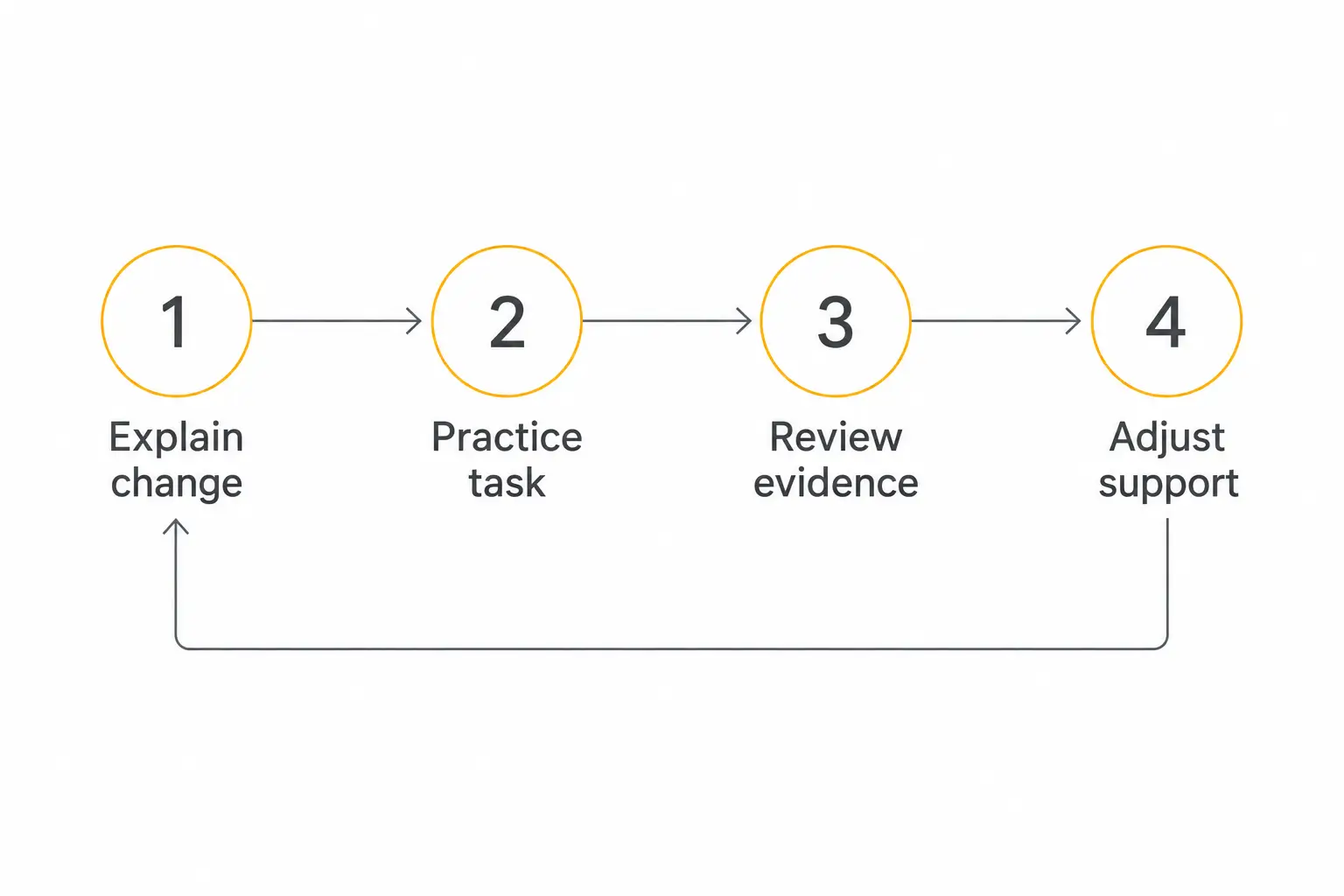
Build learning around the job people need to do
Prosci's ADKAR model names five elements of individual change: Awareness, Desire, Knowledge, Ability, and Reinforcement. I find the distinction between knowing what to do and being able to do it especially useful.
The following is my application to the fictional pilot, not a replacement for Prosci's methodology:
- Awareness: explain why routine support is the selected workflow and what problem the pilot addresses.
- Desire: discuss the worker's concerns and invite changes to the proposed process.
- Knowledge: show the allowed sources, exclusions, review steps, and escalation route.
- Ability: watch the person handle realistic requests, including a flawed draft.
- Reinforcement: review corrections, update examples, and keep practice time available.
A short demonstration can teach the happy path. It cannot establish that somebody can catch an outdated policy or recognize a request that should leave the pilot.
Provide a task card beside the work: check eligibility, inspect the source, verify the draft, then send or escalate. Put the failure path on the same card so people do not have to remember a separate policy document under pressure.
Microsoft's Copilot adoption resources separate guidance for users, champions, leaders, and administrators. That is a useful design example: each audience has a different job in the rollout.
I would make training accessible in the languages and formats the team uses, then check comprehension through the task itself. Completing a video should not be the sole condition for joining the pilot.
Rehearse the failure path before opening the pilot
For the support example, I would start with a small practice set containing a routine request, missing context, an outdated source, a convincing wrong draft, a restricted request, and an unavailable assistant. Those six categories are a proposed exercise design, not a validated sample size.
Ask each participant to explain their decision while handling the task. Can they locate the actual source, identify the unsupported claim, and finish the work manually when the assistant is unavailable?
Record whether the task was completed correctly, what help was needed, and where the process caused friction. A confident explanation of AI terminology does not compensate for sending an unsupported answer.
Keep agent testing and worker rehearsal separate. The builder needs evidence that the agent follows its boundaries; the manager needs evidence that the combined human-and-agent workflow is usable.
Our guide to AI agent evals explains how to define expected behavior and maintain reusable cases. For adoption, add an observation column describing what the person did with the output.
If everyone misses the same problem, revisit the interface, instructions, or source presentation before prescribing more training. If only one role struggles, inspect that role's actual task and constraints.
Do not turn rehearsal into a public ranking. I would use its results to direct support and decide readiness, with the client setting appropriate access and retention for individual records.
Make the safe path easier to follow
The pilot should have one approved entry point, one current task card, and one way to report a problem. Scattered links and conflicting instructions create avoidable friction.
In Pickaxe, I would use a branded Portal to put the support agent and its guidance Pages together, with access configured for the intended group. The client still needs to verify actual permissions using representative accounts.
Keep the first version deliberately bounded. In this example, the assistant drafts only; the worker sends the response separately through the existing support system.
Pickaxe Actions can connect agents to external tools and APIs. Adding a sending Action would change this pilot's consequences and require a new review of permissions, approvals, recovery, and training.
A prompt saying “ask first” is not evidence of an enforced approval gate. The system that performs a consequential action must enforce the agreed control, and the team must test that enforcement.
The human-in-the-loop guide goes deeper on choosing checkpoints. Here, the change-management question is whether the reviewer has enough context, time, and authority to make that checkpoint meaningful.
Keep manual work possible during the pilot. If the assistant fails, workers should know where the policy lives and how to finish the request without waiting for the agency.
Use an AI change management scorecard with denominators
I would track whether people can use the new process, whether they choose it when appropriate, and whether it improves the final work. Keep those questions separate so one healthy number cannot hide another problem.
Eligible use rate is assisted eligible tasks divided by all eligible tasks. The denominator comes from the work queue, not the number of people invited or the number of prompts sent.
Reviewed quality is acceptable final results divided by reviewed final results. State how the sample was chosen and include escalations and abandoned attempts in the operational record.
Handling effort includes drafting, verification, correction, and recording the result. Measure comparable tasks and describe material differences in complexity or staff experience.
Support burden includes manager help, office hours, agency fixes, and unresolved cases. Those costs can move out of the worker's queue and still belong in the business decision.
For hypothetical arithmetic, suppose 80 of 100 eligible tasks used the assistant, and 36 of 40 sampled final replies met the agreed standard. That is 80% eligible use and 90% reviewed quality; neither percentage establishes an improvement without the baseline and sampling context.
If drafting saves four minutes but checking and correcting adds three, the net saving is one minute per comparable task before shared support costs. These invented values illustrate the calculation, not expected performance.
Our AI agent ROI guide helps extend the cost picture. For an initial rollout, I would first insist on believable task evidence rather than a precise revenue forecast.
A proposed 30-day rollout for one support workflow
I would use a month as a planning container, with permission to extend or stop. High-consequence work, limited task volume, or missing source ownership can require a different timetable.
Days 1 to 5: agree on the change
Observe the existing workflow, identify eligible requests, review baseline examples, and complete the one-page brief. Interview workers and nominate the sponsor, workflow owner, builder, and support contact.
Before moving on, the team should be able to explain what the assistant may do and what remains with people. Unresolved policy disagreements stay in the backlog rather than becoming guessed agent instructions.
Days 6 to 10: prepare and rehearse
Build the bounded draft assistant, confirm sources, and test the agent separately from the human workflow. Run the practice cases with a small group and revise the task card from observed problems.
A reasonable release condition for this example is that every pilot participant can reject the deliberately wrong draft and use the manual fallback. That is a proposed readiness rule, not a statistically meaningful reliability claim.
Days 11 to 20: run the limited pilot
Use the agreed subset of routine requests, preserve human sending, and collect task-level outcomes. Hold a short support session at a frequency the manager can sustain, and make changes through one shared backlog.
Record configuration changes so outcomes remain interpretable. If a new source or model materially changes behavior, rerun relevant tests and tell participants what changed before combining the results.
Days 21 to 30: review and decide
Compare the pilot with similar baseline work, including quality, total handling effort, and support cost. Ask participants what became easier and what new work the process created.
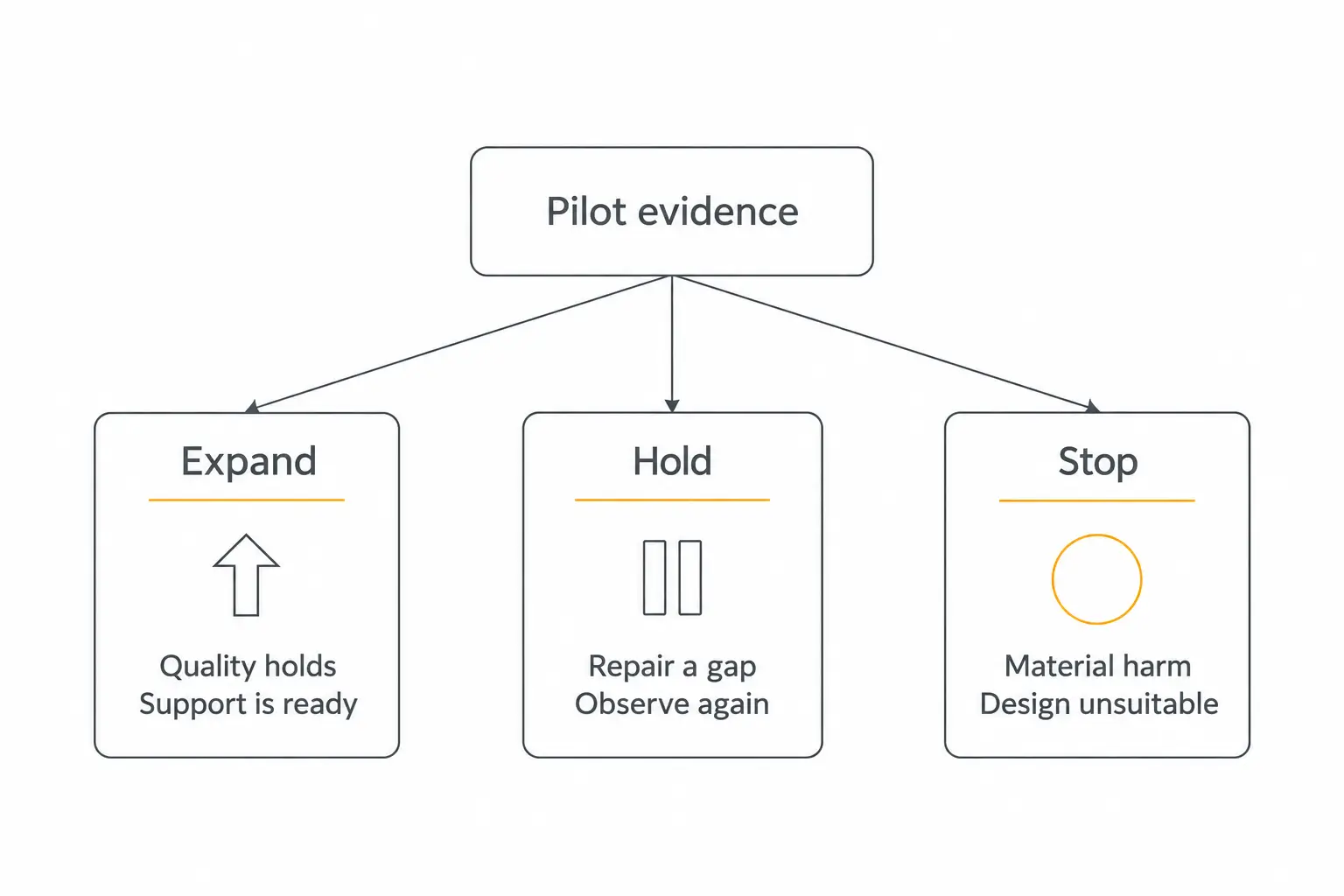
The client owner then chooses to expand, hold for a specific repair, or stop. Record the reason and next review date; the calendar alone should never trigger a wider launch.
Use AI to support the change program thoughtfully
An assistant can help draft role-specific task cards, turn approved notes into an FAQ, or propose practice scenarios. IBM's overview of AI in change management discusses communication, training, and feedback as potential applications.
I would treat those outputs as drafts. The workflow owner checks policy, the manager checks whether the instructions fit the actual job, and representative workers check whether the material is understandable.
For feedback synthesis, use an approved dataset with unnecessary personal details removed. Ask the assistant to group issues with references to the source comments and keep contradictory views visible.
A theme such as “verification takes too long” is worth investigating. An inferred label such as “this employee resists change” is a weak basis for judging a person and can conceal a real product defect.
I would avoid using private messages or covert sentiment scoring to manufacture an adoption dashboard. Tell participants what information the program collects, how it will be used, who can see it, and how to correct a misleading interpretation.
Keep staffing decisions and promises in human hands. An AI-generated announcement must not invent assurances about job security, performance assessment, or future responsibilities.
Expand only after the new responsibilities are workable
The next team inherits more than an agent link. It inherits source maintenance, review work, support demand, and a way to resolve ambiguous cases.
In a July 31, 2026 X post, Ethan Mollick argued that AI is blurring boundaries between jobs and that organizations need to reconsider the division of labor. That is his interpretation of emerging work patterns, not evidence that this pilot will change a particular role.
The useful question for a client is concrete: if support workers now draft policy explanations that previously needed a specialist, who still approves an exception? Broader capability does not settle decision authority.
McKinsey's agentic adoption analysis emphasizes process redesign and capability building alongside technology. I would turn that into a resourcing question rather than copy a general spending ratio into a client's budget.
- Expand: agreed quality holds, the workflow is usable, support capacity is funded, and the next group has an owner.
- Hold: the benefit is plausible but a named problem needs repair and another observed trial.
- Stop: material harm, unworkable review effort, or unreliable source ownership makes the current design unsuitable.
Prepare the handoff packet: current brief, source inventory, task card, practice cases, scorecard definitions, issue backlog, recovery instructions, and review cadence. Confirm who maintains each item after the agency's initial engagement ends.
Then expand one dimension at a time where practical: more people, broader questions, or more autonomy. Changing all three together makes it harder to tell why outcomes changed.
Give your pilot a clear place to start
Build a bounded agent and put its guidance alongside it in a Pickaxe Portal.
Questions I would settle before the launch
Who owns AI change management in a small company?
I would make the workflow owner accountable for the changed work, with a sponsor responsible for resourcing and an agency responsible for agreed build tasks. A dedicated change manager can help, but a title does not replace the decision assignments.
How do we handle low adoption?
Start with the denominator and the actual task. Low use may reflect few eligible requests, difficult access, slow verification, unclear policy, or a lack of confidence; each explanation suggests a different repair.
Should AI use be mandatory?
I would avoid a prompt-count target for this pilot. Require the agreed quality and reporting process, then investigate when people choose the manual route; bypassing an unsuitable assistant can be good judgment.
How long should the pilot last?
Long enough to observe representative work, corrections, and the support burden. The proposed month is a scheduling example; a quiet workflow may need longer to generate useful evidence.
What if the pilot saves time but creates more review work?
Count both. If the combined effort is unattractive, change the scope, improve source presentation, or stop; moving labor to a manager does not make it disappear.
Start with one agreement and one observed task
My first step would be a meeting with the person who owns the workflow and someone who performs it. Write the before-and-after process, agree on the boundary, and choose a realistic task to rehearse.
Then build only what that agreement requires. If you are using Pickaxe, start with the bounded draft agent and keep consequential actions outside the pilot until the controls and the people are ready.
A useful rollout makes the new work understandable, possible, and worth continuing. The expansion decision should follow that evidence.