
The first time I tried to automate my content, I did what everyone does: I wrote one enormous prompt, pasted in a keyword, and asked a single model to "write me a complete, SEO-optimized blog post."
What came back was fine. Technically. It was also flat, generic, and quietly wrong in two places. It read like every other AI article on the internet — because it was made the same way as every other AI article on the internet.
That's the trap. Scaling content in 2026 isn't about finding a cleverer prompt for one generalist model. It's about building a system — an assembly line of specialized AI agents that each do one job well and hand off to the next.
That system has a name that's caught on this year: the AI content factory. And when it's built right, it's the difference between publishing four decent articles a month and publishing forty that actually rank.
This guide is how I think about building one — the roles, the handoffs, the quality gates, and the practical way to assemble it without writing code. Let's start with what the thing actually is.
What Is an AI Content Factory?
An AI content factory is a multi-agent workflow that turns a topic into published content through a series of specialized stages, each handled by its own AI agent.
The key word is specialized. Instead of one model trying to research, structure, write, fact-check, and optimize all at once, you split those jobs across a team of agents — the same way a real publication has researchers, writers, and editors instead of one person doing everything.
Think of it like a factory line. Raw material (a keyword or a brief) goes in one end. It moves station to station — research, outline, draft, edit, optimize — and finished content comes out the other end. Between each station there's a quality check.
This is just a focused application of multi-agent systems: several agents, each with a narrow role, coordinating to complete a job no single agent could do as well alone.
Here's why that structure matters so much more than it sounds.
Why One Giant Prompt Can't Run a Factory
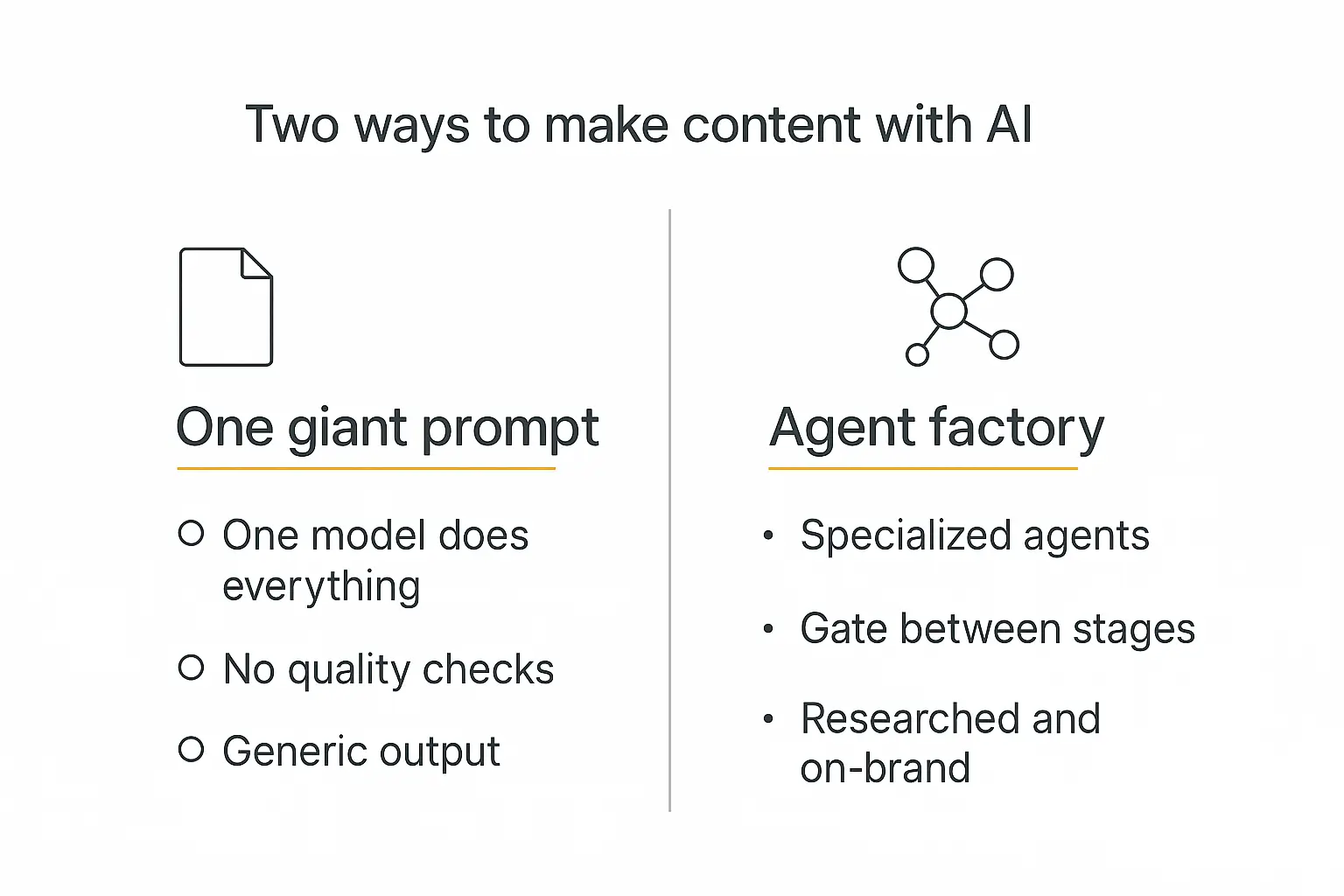
The single-prompt approach fails for a reason that has nothing to do with the model being "not smart enough." It fails because of attention and context.
When you ask one model to do everything in one pass, every instruction competes for the same limited attention. "Research deeply" fights with "match our brand voice" fights with "hit these keywords" fights with "don't hallucinate stats." Something always loses.
Split those jobs up and each agent gets to focus. The research agent optimizes for source quality and pulling real data. The writer gets a clean outline, your brand voice, and nothing else to worry about. The editor runs against a checklist. Each agent does less — and does it better.
There's a second, quieter win: quality gates between stages. When the outline is a discrete step, you (or an agent) can catch a bad structure before a single word gets written. Errors get caught early instead of compounding all the way to a finished draft.
This is exactly why teams report being able to scale from a handful of articles a month to dozens without the quality collapse everyone expects. The specialization is what makes automation safe enough to trust.
It's also the difference Google is now actively enforcing. Google's scaled content abuse policy doesn't punish AI content — it punishes low-value content produced at scale with no editorial oversight. A factory with real research and human sign-off produces the opposite of what gets penalized.
| Single-prompt generation | AI content factory (multi-agent) |
|---|---|
| One model does every job at once | Specialized agents, one job each |
| Instructions compete for attention | Each agent fully focused |
| No checkpoints — errors compound | Quality gate between every stage |
| Generic, "AI slop" output | Researched, on-brand, verifiable |
| Hard to improve one part | Tune any single agent independently |
The Six Stations of a Content Factory
Every content factory is a variation on the same assembly line. You can add or merge stations, but these six are the backbone. Here's what each agent owns.
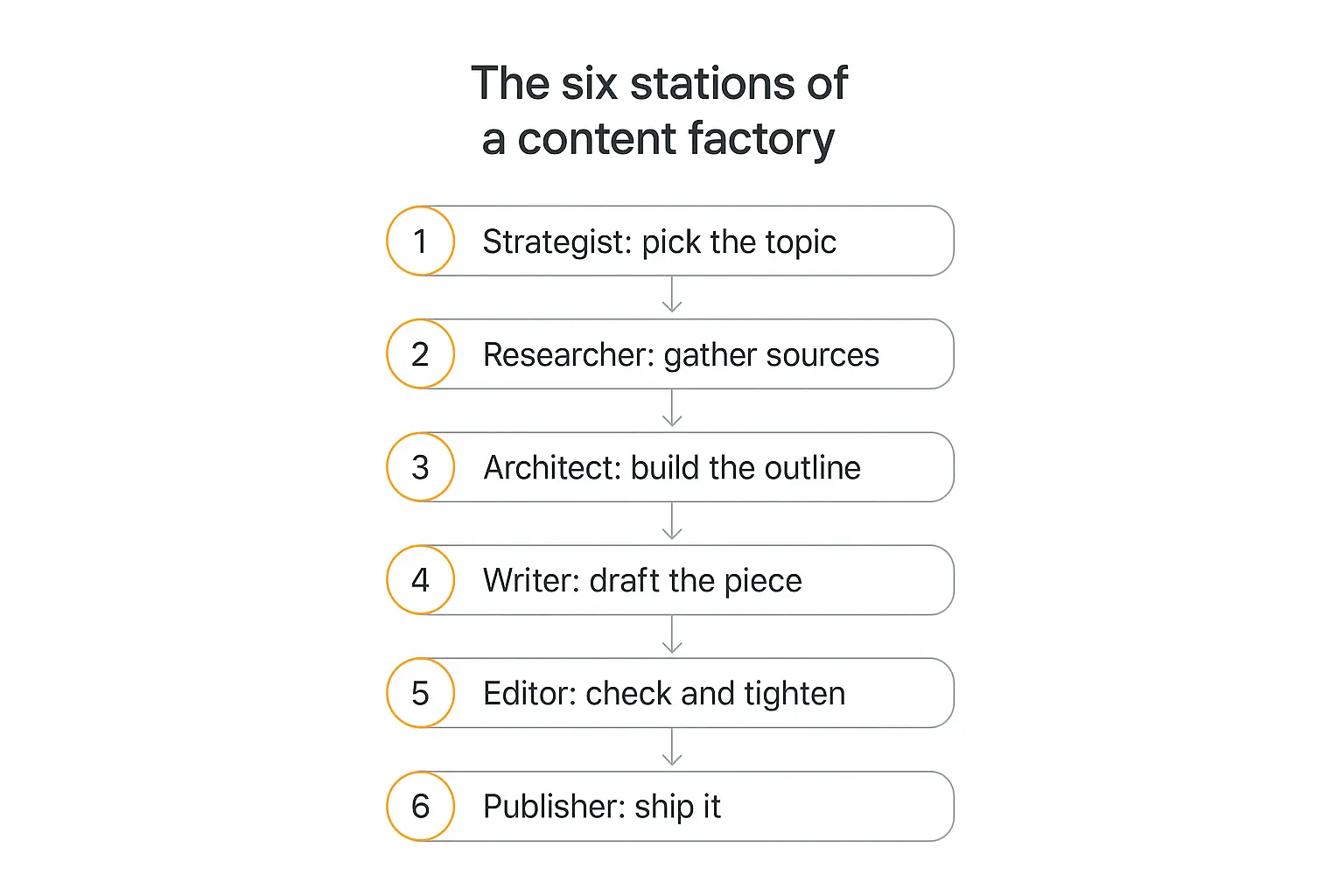
1. The Strategist — decides what to make
Before anything gets written, something has to decide what's worth writing. The strategist agent scans your keyword gaps, trending topics, and existing content, then proposes briefs: the topic, the angle, the target keyword, and the search intent.
This is the station most people skip, and it's why so much AI content targets things nobody searches for. Feed this agent real inputs — Search Console data, a competitor list, your content calendar — and it stops guessing.
2. The Researcher — gathers the raw material
The researcher agent goes and finds things: statistics, source material, competitor angles, expert quotes. Its whole job is source quality, not prose.
The best researchers cite where every claim came from, so a later agent (or a human) can verify it. If you want this done properly, it's worth reading how to build an AI research agent that actually cites its sources — the citation discipline is what keeps the whole factory honest.
3. The Architect — builds the outline
Structure is a separate skill from writing, so it gets its own agent. The architect takes the brief plus the research and produces a full H2/H3 outline — the headings, the order, the key points each section must hit, and where internal links should go.
Getting the skeleton right here means the writer never has to invent structure on the fly. A good outline is 80% of a good article.
4. The Writer — produces the draft
Now, and only now, does anything get written. The writer agent receives the outline, the research, and your brand voice guidelines, and drafts the piece section by section. Which tool you put behind that station matters too, and we ranked the options in the top AI writing tools.
Because it's handed everything it needs, the writer can focus purely on prose and tone. This is where your prompt engineering earns its keep — a tight voice prompt here is what makes the output sound like you and not like a template.
5. The Editor — checks and tightens
The editor agent runs the draft against a checklist: Are the claims supported by the research? Is the structure intact? Is the voice consistent? Are there hedge words, repetition, or filler to cut?
This is your most important quality gate. A dedicated editor catches the flat, generic phrasing and the unsupported stats that single-prompt generation ships straight to publish. Pair it with a human review for anything high-stakes.
6. The Publisher — ships it
Finally, the publisher agent handles the last mile: formatting to HTML or Markdown, adding meta title and description, setting internal links, and pushing to your CMS. Connected to the right tools, it can post the finished piece automatically.
Put those six together and you have a pipeline that takes a keyword and returns a publish-ready article — with checkpoints at every step.
Want to build this without wiring up APIs?
Pickaxe lets you chain specialized agents into one workflow — no code required.
How the Agents Hand Off to Each Other
A pile of agents isn't a factory. What makes it a factory is the orchestration — how work moves from one station to the next.
There are two ways agents connect, and good factories use both.
Sequential handoffs. Most of the line is a chain: research feeds the outline, the outline feeds the writer, the writer feeds the editor. Each agent's structured output becomes the next agent's input. Order matters here, because each stage depends on the last.
Parallel branches. Some jobs don't depend on each other and can run at the same time. A research agent and a competitor-analysis agent can work simultaneously, then deliver their findings to the outline agent together. Running independent tasks in parallel is a big part of why a multi-agent pipeline can outpace a linear human workflow.
Coordinating all this is usually the job of a coordinator (or orchestrator) agent — the invisible conductor that routes outputs, passes context between agents, and decides what runs when. Amazon's team described building exactly this kind of setup in their write-up on scaling content review with a multi-agent workflow, and Anthropic's multi-agent research system follows the same orchestrator-plus-subagents pattern.
The critical detail is that handoffs should be structured, not vague. The research agent shouldn't hand the outliner a wall of prose — it should hand over clean, labeled data the next agent can actually use. Sloppy handoffs are where multi-agent systems break down.
What One Topic Looks Like Going Through the Line
Theory is cheap, so let me trace a single topic through the factory to make it concrete. Say the keyword is "AI onboarding checklist for new hires."
The strategist confirms it's worth making — decent search volume, we have nothing on it, the intent is a how-to. It writes a one-paragraph brief with the angle and target keyword and hands it off.
The researcher pulls three recent onboarding stats, two competitor outlines, and a couple of expert quotes — each with a source link — and passes a tidy, labeled bundle forward.
The architect turns that into an outline: an intro, six H2s, a comparison table, and an FAQ, with notes on which internal links belong where.
The writer drafts section by section, matching the voice guide in its knowledge base. The editor then flags one unsupported stat and trims three hedge-y sentences. A human skims the flagged claim, fixes it, and approves.
The publisher formats it, writes the meta description, sets the links, and drops it into the CMS as a draft. Start to finish, no one wrote from a blank page — and every claim traces back to a source. That's the whole point.
Building Your Content Factory Step by Step
You don't need a team of engineers to build this. On a no-code platform you can assemble the whole line by configuring agents and connecting them. Here's the practical approach I'd take.
Step 1: Build each agent separately
Start by creating one agent per station, and get each one good in isolation. Give each a tight role prompt — "You are a research agent. Your only job is to gather sourced, cited facts on the given topic." Test it on its own before you connect anything.
Resist the urge to make any single agent do two jobs. The whole point is specialization.
Step 2: Give the right agents knowledge and tools
Your writer agent needs your brand voice; your researcher needs the ability to look things up. This is where a proper agent tech stack comes in — a knowledge base for your style guide and past content, and actions that let agents reach outside tools.
On Pickaxe, you'd load your brand guidelines and best-performing posts into the agent's Knowledge Base, and use Actions to connect the publisher agent to your CMS or to an automation platform like Zapier, Make, or n8n.
Step 3: Chain them into a waterfall
Now connect the line. Pickaxe supports a waterfall setup, where a primary agent routes to specialized sub-agents — which is exactly the shape of a content factory. The coordinator hands the topic to research, research to outline, and so on down the line.
Keep each agent to a small number of actions (four is a good ceiling) and let the waterfall do the heavy lifting of coordination. Complex workflows come from chaining simple agents, not from cramming everything into one.
Step 4: Add the quality gates
Between the stages that matter — especially before publishing — insert a checkpoint. That can be an editor agent scoring the draft against a rubric, or a human approval step. More on that next, because it's the part that keeps you out of trouble.
Step 5: Test the whole line, then automate
Run real topics through end to end and watch where quality drops. Fix the weak station, not the whole pipeline — that's the beauty of specialization. Before you trust it to run on its own, it's worth reading how to test and debug your AI agent properly.
Once it's reliable, you can even put it on a timer. A scheduled agent can kick off the whole factory every Monday morning and drop finished drafts in your queue.
Where Humans Stay in the Loop
Here's the part that separates a content factory from a content landfill: humans don't leave the loop. They move to higher-value spots in it.
Instead of grinding out first drafts, your role shifts to three things: setting direction, refining voice, and approving what ships. The factory does the labor; you do the judgment.
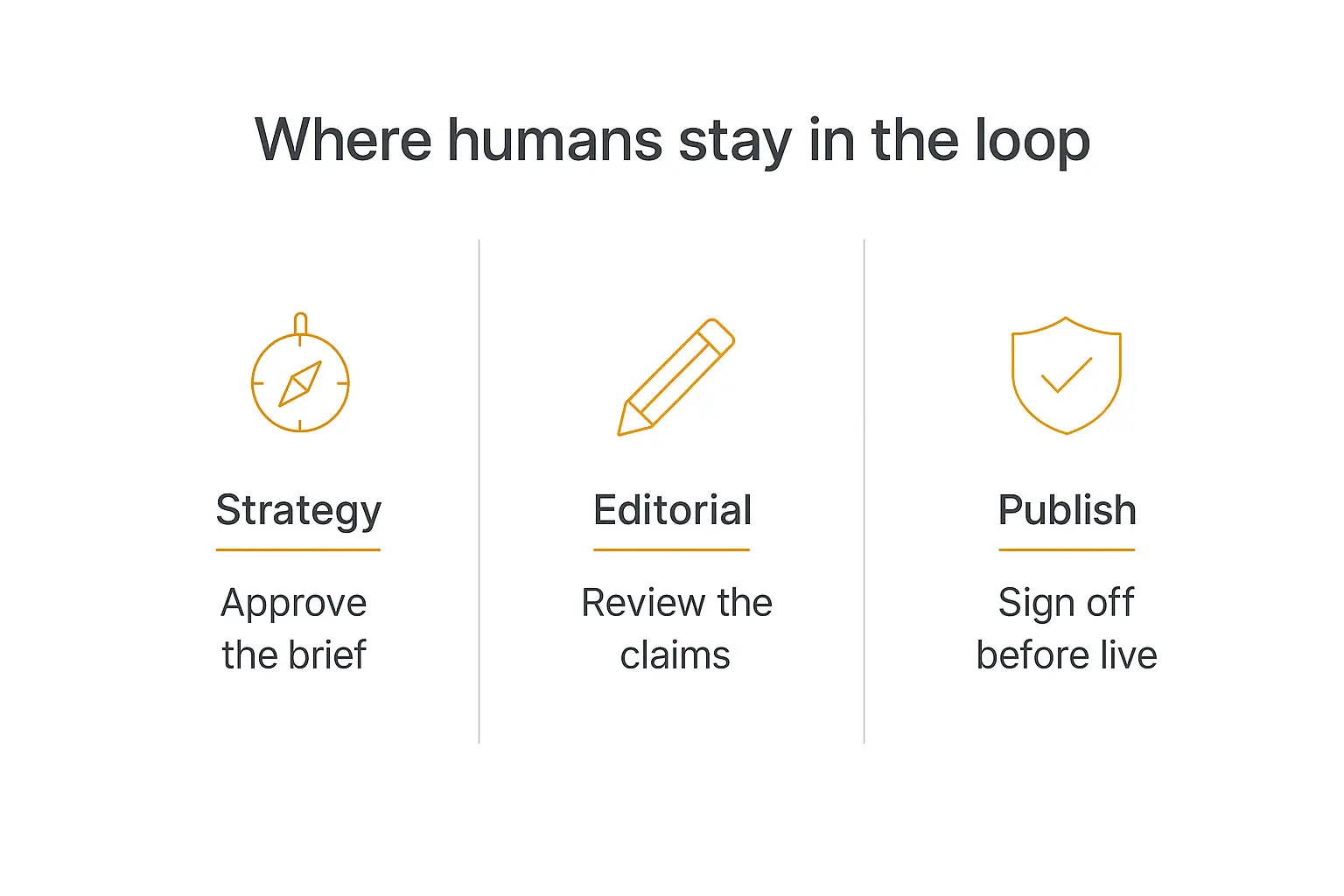
There are three moments where a human belongs in the loop:
- At the brief. Approve what topics and angles get made before the factory spends any tokens on them.
- At the editorial gate. Anything with real claims, data, or your name on it deserves a human read before it's final.
- At publish. Build a hard approval step so nothing goes live without a person clicking "yes."
This isn't just about quality — it's about not getting torched by a search update. The sites that got hammered in Google's 2026 core updates were the ones publishing hundreds of unreviewed pages a day. As Search Engine Journal put it, scaling AI content is now the top enterprise priority — but only if you can do it without a penalty. Human oversight is how.
The mindset shift I'd push: AI should help you outline, research, and draft — but the expertise, the point of view, and the final call stay human. Use AI as a tool, not as the whole product.
Don't Use Your Best Model for Every Station
A content factory runs many agents, and running your most powerful (most expensive) model at every station is how you turn a smart system into a runaway bill.
Most stations don't need a frontier model. Classifying a topic, formatting HTML, or checking a box on a rubric runs perfectly well on a fast, cheap model. Save the expensive reasoning model for the two jobs that actually need it: research synthesis and the final draft. Deciding which station gets which model is the whole subject of AI model routing.
This is model routing, and it's the single biggest cost lever in any multi-agent system. Because a platform like Pickaxe is model-agnostic, you can assign a budget model to the cheap stations and a frontier model to the hard ones without rewiring anything.
The savings are real — mixing models by task is the core idea behind multi-model AI agents, and it's why the same output can cost a fraction of what an all-frontier pipeline would. If you're running content at volume, this matters a lot, and the full breakdown lives in our guide to AI agent cost and token economics.
Pick the right model for each agent
Cheap models for the easy steps, frontier models for the hard ones — all in one workflow.
Common Mistakes That Sink a Content Factory
I've watched a lot of these get built. The failures cluster around a few predictable mistakes.
Skipping the strategist. If you start at "write," you'll produce beautiful articles about things nobody's searching for. Decide what to make before you make it.
Vague handoffs. When agents pass unstructured blobs of text to each other, context gets lost and quality decays down the line. Make each handoff a clean, labeled output.
No human gate. Fully autonomous publishing is how you end up on the wrong side of a Google update. Keep a person at the publish step, always.
One model for everything. Either you overpay by running a frontier model on trivial steps, or you underperform by running a cheap model on the hard ones. Route deliberately.
Trying to boil the ocean on day one. Don't build all six stations at once. Get a research-outline-write chain working, prove it, then add editing and publishing.
Measuring nothing. A factory you don't monitor drifts. Track which pieces perform and feed that back into the strategist. Our guide on AI agent analytics covers what to watch.
Frequently Asked Questions
What is an AI content factory?
An AI content factory is a multi-agent workflow that turns a topic into published content through a series of specialized stages — strategy, research, outlining, writing, editing, and publishing — each handled by its own AI agent, with quality checks between stages. It replaces the single-giant-prompt approach with an assembly line of focused agents.
Is an AI content factory just spamming AI content?
Not if it's built right. The whole point of the factory structure is quality gates and human oversight at the strategy and publish steps. Google penalizes low-value content produced at scale without editorial review — a factory with real research and human sign-off is designed to produce the opposite.
Do I need to know how to code to build one?
No. No-code platforms like Pickaxe let you build each agent, load knowledge, connect tools via actions, and chain agents into a waterfall workflow entirely through configuration. The engineering is in the design of the pipeline, not in writing software.
How many agents do I need?
Start with three — research, outline, and write — to prove the chain works. Then add an editor and a publisher. Six specialized stations (including a strategist) is a solid full pipeline, but there's no prize for more; each agent should earn its place.
How do I keep the cost under control?
Use model routing: assign cheap, fast models to simple stations (formatting, classification) and reserve your expensive frontier model for research synthesis and final drafting. This alone can cut the cost of a pipeline dramatically compared to running your best model everywhere.
The Bottom Line
The reason most AI content is forgettable isn't the model. It's the method — one prompt, one pass, no checks.
A content factory fixes the method. Split the work across specialized agents, connect them with clean handoffs, put quality gates where they matter, and keep a human on the strategy and the publish button. That's how you get volume and quality instead of trading one for the other.
Start small. Build a research-outline-write chain, run a few real topics through it, and feel the difference between an assembly line and a slot machine. Then add stations as you trust it more.
If you want to build your factory without touching an API, that's exactly what we made Pickaxe for — chain specialized agents into one workflow, give each the right model and knowledge, and ship content at scale with the guardrails built in. You can start building your first agent and assemble the line one station at a time.