

The best AI agency niches are not necessarily the industries making the most noise about AI. They are the markets where one repeated workflow is painful, expensive, measurable, and similar enough across clients that you can deliver it twice without rebuilding everything.
I reviewed the current niche roundups, official industry data, regulatory guidance, and Pickaxe's own deeper vertical guides. My conclusion is less exciting than a list of supposed $10,000 retainers, but much more useful: pick a buyer and a workflow, not just an industry.
"AI for healthcare" is not a niche. "After-hours FAQ and scheduling intake for independent dental practices" is. The second version tells you who buys, what you build, what stays out of scope, and how the client knows it worked.
This guide ranks nine AI agency niches using a transparent scorecard. The scores are editorial judgments, not audited market benchmarks. More importantly, every niche includes a practical first offer, a measurable outcome, and a boundary I would refuse to cross.
What makes the best AI agency niches?
The broad market is certainly large enough. The U.S. Small Business Administration counted 36.2 million small businesses, but only 7.6% of businesses reported using AI in 2025. That is opportunity, not proof of demand.
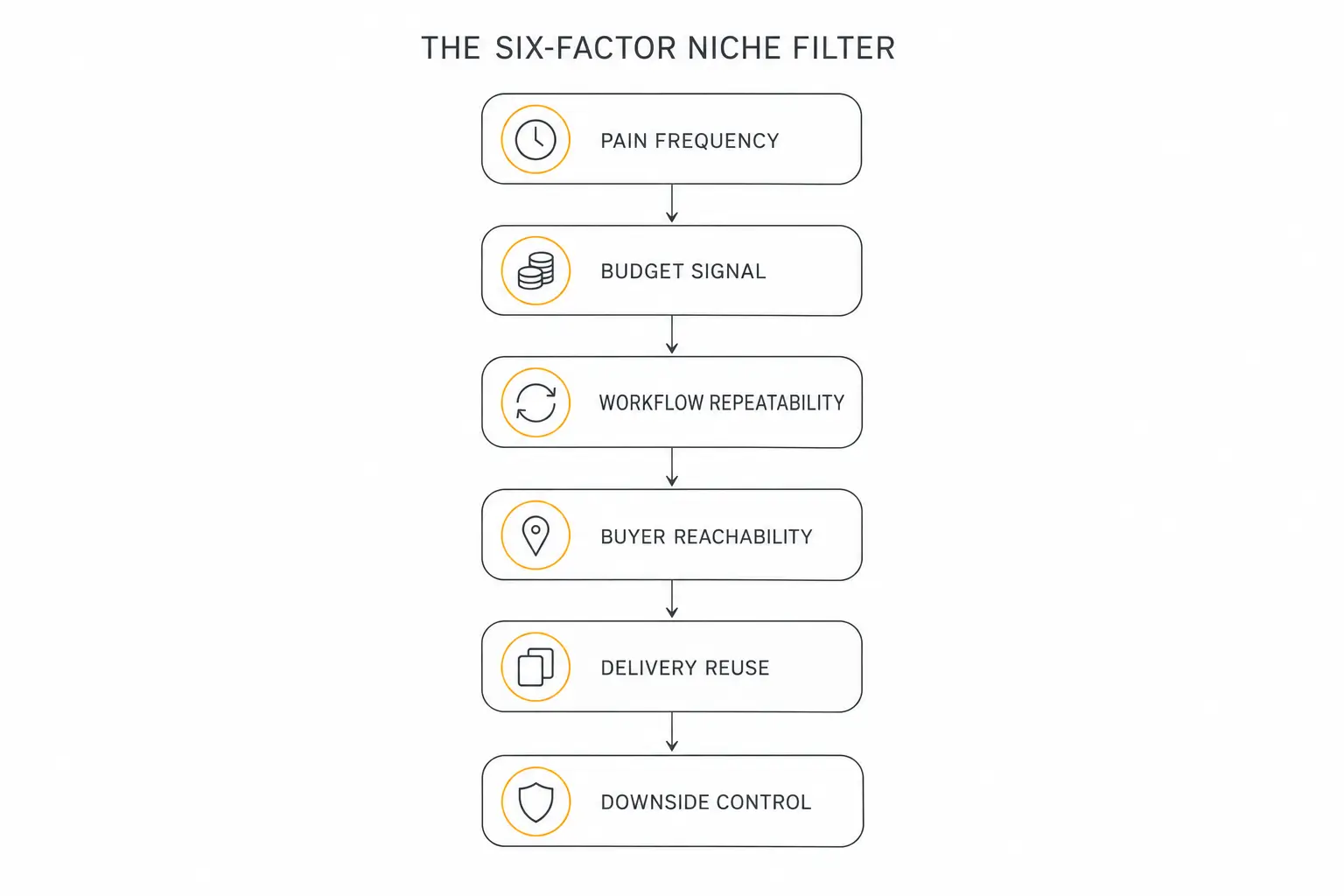
A good niche has to survive six tests:
- Pain frequency: Does the problem happen every day or every week?
- Budget signal: Does the buyer already pay people, software, or missed-opportunity costs to handle it?
- Workflow repeatability: Can you map a stable input, decision, output, and escalation path?
- Reachability: Can you identify and contact the person who owns the problem?
- Delivery reuse: Can your second client reuse most of the first client's architecture?
- Downside control: Can errors be caught before they create legal, financial, medical, or reputational harm?
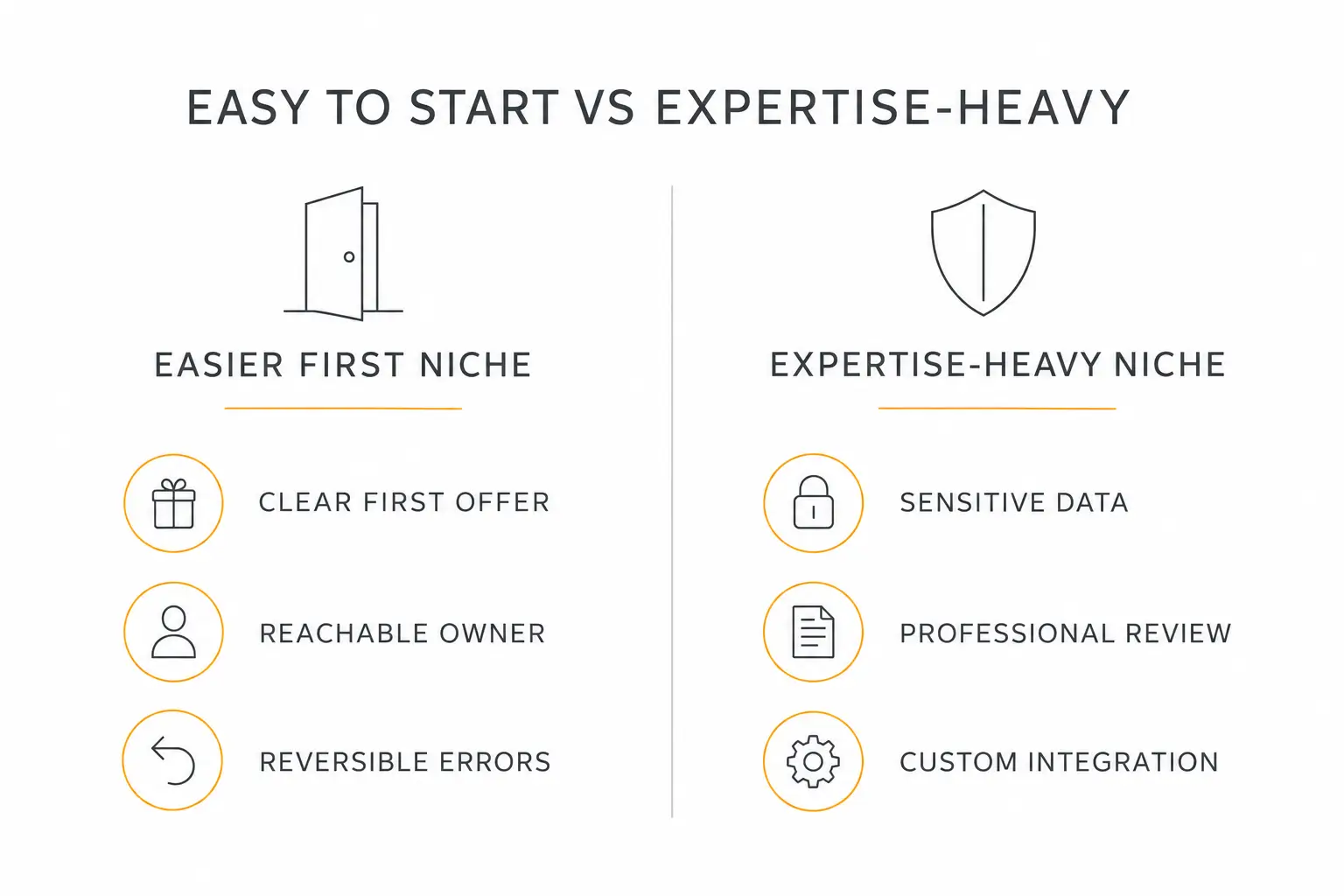
This last test is where most lists fall apart. A regulated vertical may have a large budget and urgent pain, yet still be a poor first niche if every workflow requires custom security review, deep integrations, and professional judgment.
On X, systems educator Dickie Bush described a useful workflow rule: break a system into smaller steps, then apply AI to the time-intensive step with a clear input and output. That is practitioner advice, not independent evidence, but it is a much better starting point than asking which industry sounds hottest.
AI agency niches ranked at a glance
I scored each niche from 1 to 5 on the six tests above, with 5 representing the most attractive condition. For downside control, a higher score means the risk is easier to contain. Treat the totals as a decision aid, not a universal league table.
| Niche | Best first offer | Pain | Budget | Repeatability | Reach | Reuse | Risk control | Total |
|---|---|---|---|---|---|---|---|---|
| Home services | Missed-call recovery and booking | 5 | 4 | 5 | 5 | 5 | 4 | 28 |
| Recruiting and staffing | Candidate re-engagement and scheduling | 5 | 4 | 5 | 4 | 5 | 3 | 26 |
| Property management | Maintenance intake and triage | 5 | 4 | 5 | 4 | 5 | 3 | 26 |
| Accounting and bookkeeping | Client document chasing | 5 | 4 | 5 | 4 | 4 | 3 | 25 |
| Legal services | Prospective-client intake | 5 | 5 | 4 | 4 | 4 | 2 | 24 |
| Medical and dental | No-PHI FAQ and routing | 5 | 5 | 4 | 4 | 4 | 2 | 24 |
| Ecommerce | Support triage and exception routing | 4 | 4 | 5 | 4 | 4 | 3 | 24 |
| Course creators and coaches | Student Q&A and onboarding | 4 | 3 | 5 | 5 | 5 | 4 | 26 |
| B2B SaaS | Onboarding and Tier-1 support | 4 | 4 | 4 | 3 | 4 | 4 | 23 |
Notice that the easiest niche is not always the highest-budget niche. Home services wins because the buyer is reachable, the missed-call problem is obvious, and delivery can be standardized. Legal and healthcare buyers may pay more, but their risk and review requirements make fulfillment harder.
Turn one narrow workflow into a client-ready agent
Build the knowledge, actions, access, and branded delivery in one place.
1. Home services: the best AI agency niche for a first offer
Home services is my first pick for a new agency because the operational pain is immediate. A homeowner with a failed air conditioner or a leaking pipe is not submitting a form and patiently waiting until Tuesday.
The market also has real labor pressure. The Bureau of Labor Statistics projects HVAC employment to grow 11% from 2025 to 2035, with about 40,600 openings a year. That does not prove an AI receptionist creates ROI, but it does show why contractors care about keeping skilled staff focused on skilled work.
Best first offer: missed-call recovery, basic qualification, and appointment-request capture for one trade. Start with chat or SMS before promising a fully autonomous voice receptionist.
Measure: qualified inquiries captured after hours, median response time, booked estimates, and human escalations.
Boundary: the agent must never diagnose a dangerous condition, promise emergency dispatch, or quote a firm price when a technician has not inspected the job. If you add outbound AI voice, remember that the FCC treats AI-generated voices as artificial voices under the TCPA. Consent and calling rules are part of the build.
Our guide to AI agents for home services covers the booking, quoting, and after-hours flow in more depth.
2. Recruiting and staffing: high volume with a clear human handoff
Recruiting has the workflow volume agencies dream about: job briefs, candidate questions, scheduling, status updates, and dormant-candidate re-engagement. The American Staffing Association says staffing firms provided opportunities to about 11 million employees in 2024.
Best first offer: re-engage a client's existing candidate pool for one open role, collect availability and interest, then hand qualified replies to a recruiter. This is easier to validate than an agent that claims to decide who is qualified.
Measure: reply rate, recruiter hours saved, interviews scheduled, opt-outs, and escalation accuracy.
Boundary: keep selection decisions with a person. The EEOC states that federal discrimination laws still apply when AI is used in recruiting and screening. Consistency, accommodation, recordkeeping, and bias review cannot be a line in a prompt that everyone forgets.
This niche gets even stronger when you already understand an applicant tracking system. If every client uses a different stack and your offer depends on deep custom integration, the attractive market can still become an unattractive agency.
3. Property management: automate the queue, not the housing decision
Property managers deal with a nonstop stream of repetitive requests. Maintenance intake, vendor coordination, showing questions, owner updates, and lease reminders all have recurring shapes.
Best first offer: maintenance intake and triage. The agent gathers the property, unit, issue, severity signals, photos, access preference, and availability. It creates a structured ticket and escalates safety-critical cases.
Measure: complete tickets on first submission, time to assignment, duplicate requests avoided, after-hours response, and emergency escalations.
Boundary: do not make tenant-screening decisions. HUD's tenant-screening guidance says the Fair Housing Act applies regardless of the technology used and warns that opaque or overbroad automated criteria can create discriminatory outcomes.
The safe wedge is operational intake. It is visible, measurable, and reversible. Our full property-management agent guide explains why maintenance requests usually beat screening as the first workflow.
4. Accounting and bookkeeping: sell document readiness
Accounting firms have an unglamorous problem that is ideal for automation: clients send incomplete information, in the wrong format, at the wrong time. Staff then spend hours chasing bank statements, payroll exports, receipts, signatures, and answers.
Best first offer: a client document-readiness agent. It explains the checklist, accepts files through an approved channel, identifies missing items, sends reminders, and produces a status summary for the accountant.
Measure: days from request to complete packet, reminder touches per client, staff follow-up time, and percentage of packets ready at first review.
Boundary: the agent should not give tax advice, classify ambiguous transactions without review, or move sensitive data through an unapproved consumer tool. The IRS says federal law requires tax professionals to maintain an information-security plan for client data.
This niche rewards agencies that are good at secure process design, not just chatbot demos. If you have accounting experience or a trusted partner who does, that domain edge matters more than a slightly better model.
5. Legal services: valuable intake, unforgiving mistakes
Law firms often have expensive leads, detailed intake, and obvious follow-up gaps. That makes legal services attractive. It also means a sloppy agent can create a conflict, expose confidential information, or imply advice where none was intended.
Best first offer: prospective-client intake for one practice area. The agent collects structured facts, explains what happens next, checks calendar availability, and routes the record for attorney review.
Measure: completed intakes, consultation bookings, time to first response, disqualified matters correctly routed, and attorney review corrections.
Boundary: no legal conclusions, case valuation, filing deadlines, or unsupervised document delivery. ABA Formal Opinion 512 identifies competence, confidentiality, communication, supervision, candor, and reasonable fees as relevant obligations when lawyers use generative AI. State rules may add more.
This is a strong niche for an agency with legal-operations experience. It is not where I would learn the basics of access control and human review. The deeper AI tools for lawyers comparison provides useful context on the current legal stack.
6. Medical and dental practices: start on the no-PHI side of the line
Practices have appointment friction, repetitive questions, recall campaigns, and overloaded phones. The value is obvious. The data boundary is not.
Best first offer: a public-information agent that answers office hours, location, parking, accepted payment methods, service descriptions, and general appointment policies, then routes requests without collecting clinical detail.
Measure: FAQ resolution, successful routing, staff calls avoided, and unsafe questions refused.
Boundary: no symptom assessment, medication advice, or emergency triage. Once a workflow handles protected health information, the architecture changes. HHS says a cloud provider maintaining electronic PHI is generally a business associate, and using one without the appropriate agreement can violate the HIPAA Rules.
Healthcare can be a great mature niche. For a beginner, a narrow no-PHI agent is better than calling an ordinary chatbot "HIPAA compliant." Our HIPAA-aware medical and dental guide draws the boundary in practical terms.
7. Ecommerce brands: win on exceptions, not generic automation
Ecommerce looks perfect because order status, returns, product questions, reviews, inventory, and support all generate structured events. The catch is that platforms already automate a lot.
For example, Shopify Flow already provides trigger, condition, and action workflows across stores and connected apps. An agency that sells "I will automate your store" is competing with features the client may already own.
Best first offer: support exception routing. Let ordinary order-status questions use native tools. Build an agent that gathers context for damaged deliveries, unusual returns, warranty questions, or high-value customer escalations, then sends a clean case to the right person.
Measure: first-response time, complete cases, resolution time, refund exceptions, and human touches per case.
Boundary: do not let the agent invent refund policy, issue high-value refunds without approval, or make product safety claims. The value is in coordinating the messy 20%, not rebuilding the clean 80% that the commerce platform already handles.
8. Course creators and coaches: easiest to reach and productize
Creators and coaches are unusually reachable. They publish in public, own their content, and often answer the same student questions repeatedly. Delivery can also be highly reusable across clients.
Best first offer: a course-grounded student Q&A and onboarding agent. It uses the creator's lessons, transcripts, worksheets, and policies, points students to the right material, and escalates questions that require personal coaching.
Measure: questions answered from approved material, time to first useful answer, links clicked, unresolved topics, and onboarding completion.
Boundary: the agent should not complete assignments, promise outcomes, or imitate personal coaching beyond the creator's approved scope. A course with weak material does not become good because it has a chatbot.
This niche may have smaller contracts than legal or healthcare, but it is far friendlier for a first productized offer. The course-creator agent guide shows how to build student Q&A, onboarding, and retention in that order.
9. B2B SaaS: strong expansion potential, tougher buyers
SaaS companies have documentation, support tickets, onboarding checklists, product events, and customer-success workflows. A good implementation can expand from one use case into several.
Best first offer: onboarding and Tier-1 support for one product area. Ground answers in current documentation, expose approved account actions, and send uncertain cases to a human with conversation context attached.
Measure: grounded resolution rate, time to resolution, successful action completion, handoff quality, and repeated documentation gaps.
Boundary: do not promise support deflection as the only goal. An agent that blocks access to a person can reduce ticket volume while making the customer experience worse.
The buyer is usually more technically sophisticated and already evaluating vendors. That raises the sales and security bar. If you know a particular software category, however, SaaS can turn one support agent into onboarding, expansion, and internal enablement work. See our SaaS AI agent guide for the full lifecycle.
Bad AI agency niches have one of these five problems
I would pause before committing to any market with these traits:
- The pain is occasional. A workflow that happens twice a year will not support an ongoing service unless the stakes are unusually high.
- The buyer cannot measure success. "More innovative" is not a metric. Response time, complete intake, booked appointments, prepared documents, and resolved requests are.
- Every client requires a new architecture. Custom work can pay well, but it is consulting, not yet a repeatable niche offer.
- The agent owns an irreversible decision. Medical, legal, employment, housing, refunds, and financial actions need scoped permissions and approval gates.
- The business has no usable source material. An agent cannot reliably answer policy questions if the policy lives only in the owner's head.
A low score does not mean "never." It means you need an edge: domain knowledge, a distribution partner, an existing integration, or a workflow template that removes delivery uncertainty.
How to validate AI agency niches in 30 days
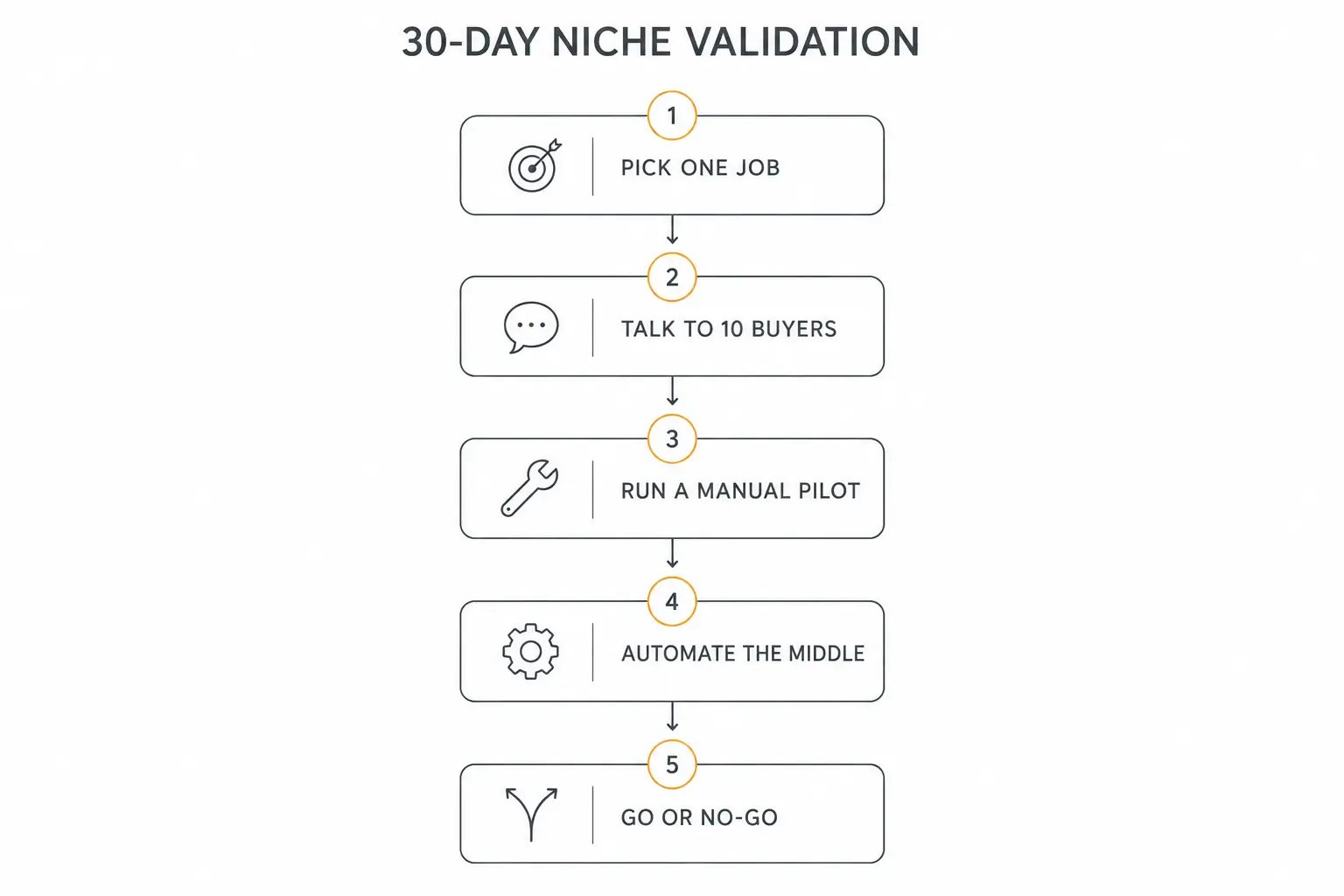
Do not spend a month building before you have heard the same pain from several buyers. A short validation sprint should test the workflow, the buyer, and your ability to deliver.
Days 1 to 5: choose one buyer and one repeated job
Write the offer in one sentence: "I help [specific buyer] reduce [repeated problem] by [workflow], while [human-owned boundary]." If the sentence needs three "ands," the offer is too broad.
Days 6 to 12: run ten problem interviews
Ask what happened the last three times the workflow ran. Which tools were involved? Where did the handoff break? What did a delay cost? Who approves changes? Do not pitch until you can draw the current process.
Days 13 to 20: deliver one manual pilot
Handle a bounded sample manually or in shadow mode. For illustration, you might process 30 maintenance requests, candidate replies, or intake records without sending anything automatically. Label this as a pilot and keep the client in control.
Days 21 to 26: automate the stable middle
Keep ambiguous intake and final approval with people. Automate the repeatable middle: extracting fields, retrieving approved information, preparing the next action, and routing exceptions.
Days 27 to 30: use a go or no-go rule
Continue only if buyers repeat the same problem, the pilot produces a measurable improvement, the integration path is repeatable, and at least one buyer is willing to pay. Interest without a budget is research, not a niche.
The broader AI agent agency playbook covers packaging, pricing, outreach, delivery, and scaling once you have chosen the market.
How Pickaxe fits a niche-first agency
Pickaxe is useful here because it lets an agency build a narrow agent, ground it in a client-specific knowledge base, connect approved Actions, and deploy it through a branded Portal, page, embed, Slack, WhatsApp, email, or API.
I would still start with the operating model, not the builder. Decide what the agent can read, what it can do, what requires approval, what gets logged, and how a person takes over.
Then build one reusable core and swap the client layer: their policies, content, integrations, access rules, and branding. That is the difference between a niche system and a pile of unrelated custom bots.
If you are comparing ways to package and sell the result, the white-label AI tools guide and AI agent monetization playbook are the natural next reads.
Frequently asked questions about AI agency niches
What is the most profitable AI agency niche?
There is no reliable public dataset that compares agency profit margins by vertical. A profitable niche combines an expensive repeated problem, a reachable buyer, reusable delivery, and controlled downside. For a new agency, home services often has the best balance. For an experienced operator, legal, healthcare, accounting, or SaaS may support larger engagements but require more expertise.
Should I choose an industry or a workflow?
Choose both. An industry gives you a buyer and shared context. A workflow gives you a concrete offer. "AI for recruiters" is broad. "Candidate re-engagement and interview scheduling for boutique staffing firms" is specific enough to sell and test.
How narrow should my first niche be?
Narrow enough that ten prospects recognize the same pain, but broad enough that you can find ten prospects. Start with one buyer, one workflow, one channel, and one outcome. Expand after the first offer works twice.
Do I need industry experience?
No, but you need access to it. Domain experience shortens discovery and helps you spot dangerous assumptions. If you lack it, partner with a practitioner, pay for expert review, and avoid high-stakes decisions until the workflow is well understood.
What should I charge?
Price after you understand the workflow, integration burden, support load, usage cost, and value of the outcome. Avoid copying retainer numbers from roundup posts. A bounded paid pilot followed by setup plus ongoing service is easier to defend than a number chosen from social media.
When should I expand into a second niche?
After the first offer has repeatable acquisition, onboarding, delivery, measurement, and support. If every new client still changes the product, your first niche is not mature enough to fund a second one.
The best niche is the one you can learn deeply
My short list for a first AI agency is home services, recruiting, property management, accounting, and course businesses. Each has repeated work, reachable buyers, and a narrow starting offer that can keep consequential decisions with a person.
Legal, medical, and SaaS work can be excellent, but expertise is part of the product. Do not treat compliance, security, or integration as details to handle after the demo.
Pick one market. Interview ten buyers. Run one manual pilot. Automate only the stable middle. If the same workflow hurts, the outcome is measurable, and a buyer pays, you have more than an AI idea. You have the beginning of a niche agency.