

Every few weeks someone asks me some version of the same question: Claude Opus vs Sonnet vs Haiku — which one should I actually use for my agent?
And every time, my honest answer is that the question is slightly wrong.
Not wrong in a pedantic way. Wrong in a way that costs real money.
Because "my agent" is almost never one job. A support agent that answers customer questions is doing at least five distinct things on every single request: working out what the customer is asking, searching a knowledge base, deciding whether to call a tool, writing a reply, and checking that reply doesn't promise something it shouldn't.
Those five jobs have wildly different difficulty levels. Treating them as one job — and buying one model to cover all of them — means you either overpay for the easy 80% or under-deliver on the hard 20%.
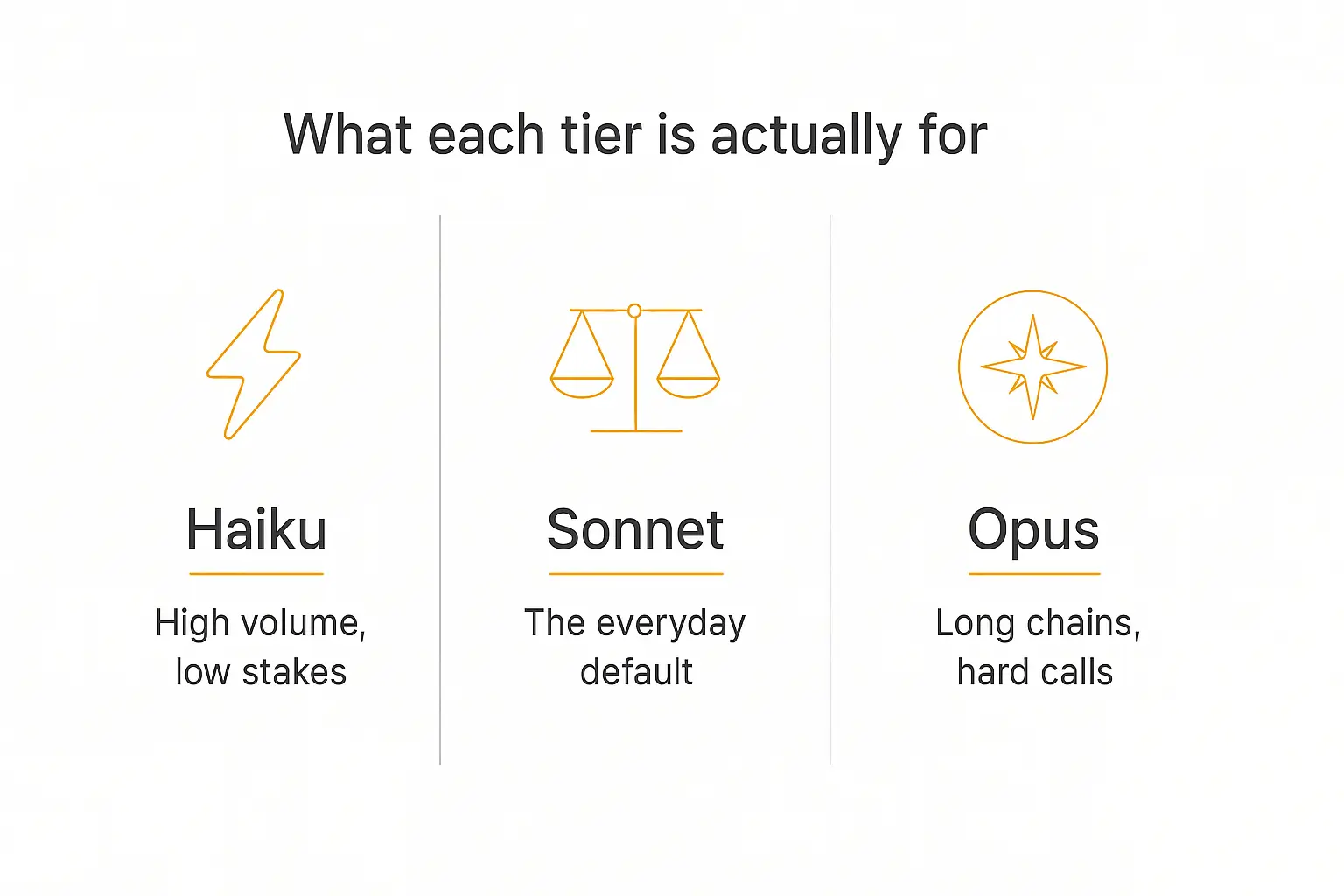
So this guide isn't really Claude Opus vs Sonnet vs Haiku as a beauty contest. It's a breakdown of what each tier is actually built for, what separates them beyond "one is smarter," and how to map the jobs inside your agent onto the cheapest tier that can still do each one properly.
I've been looking closely at the current lineup — Haiku 4.5, Sonnet 5, Opus 5, and the Fable tier above them — reading through Anthropic's published benchmarks and pricing, and paying particular attention to a couple of details that most comparison posts skip entirely. One of them (the tokenizer change) quietly makes the price gap between tiers about 30% wider than the headline numbers suggest. We ran the same exercise on the OpenAI side in the GPT-6 Astra breakdown, where the headline benchmark turned out to use a different harness.
Here's the whole thing.
The Claude lineup as of August 2026
First, the map. Anthropic's naming has picked up some scar tissue over the last year, so it's worth laying out exactly what exists right now.
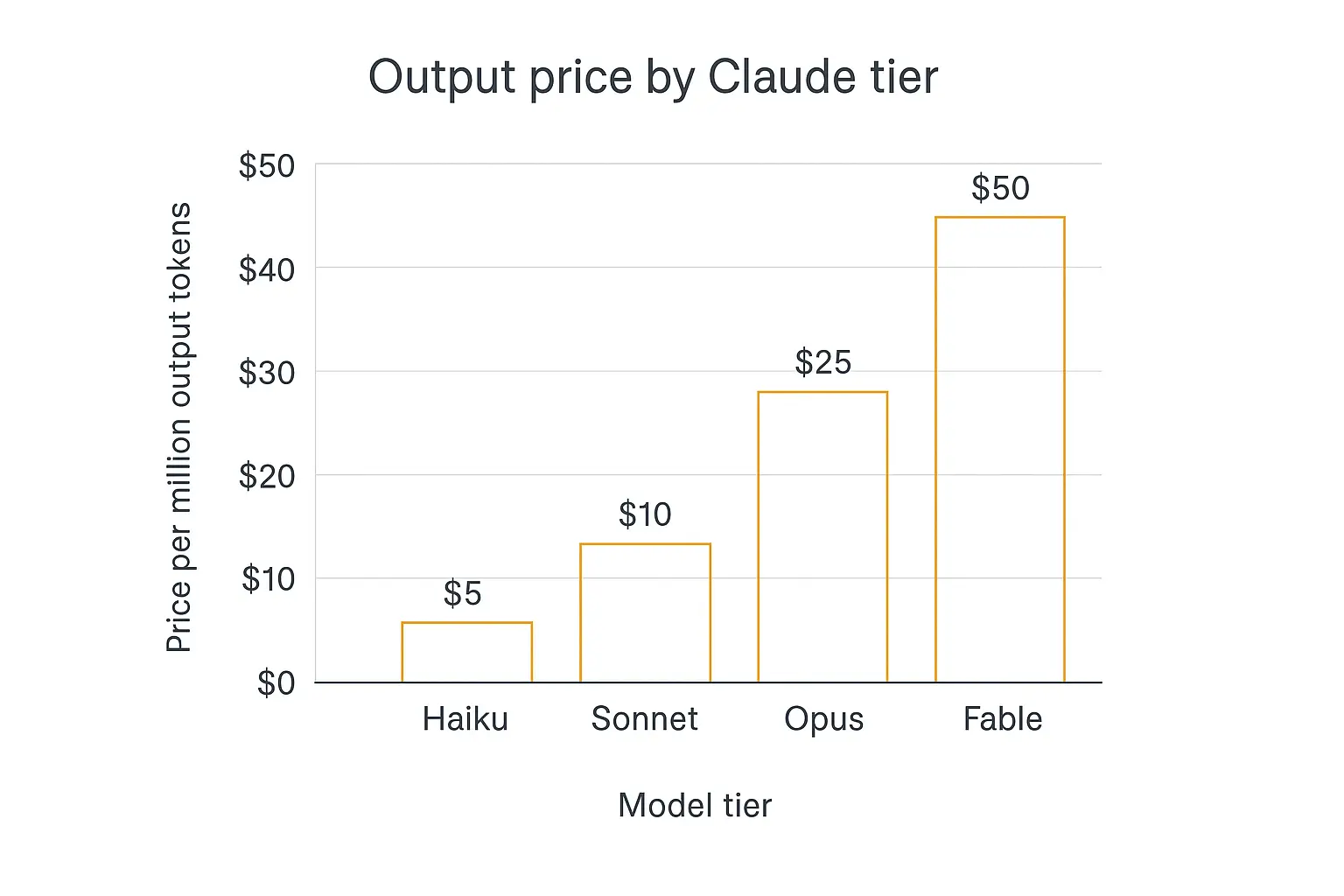
There are four tiers, not three. Most comparison posts stop at Opus, but there's a tier above it.
| Model | Model ID | Context | Input / 1M | Output / 1M | Built for |
|---|---|---|---|---|---|
| Claude Haiku 4.5 | claude-haiku-4-5 | 200K | $1.00 | $5.00 | Speed and volume |
| Claude Sonnet 5 | claude-sonnet-5 | 1M | $2.00 | $10.00 | The everyday default |
| Claude Opus 5 | claude-opus-5 | 1M | $5.00 | $25.00 | Long agentic chains |
| Claude Fable 5 | claude-fable-5 | 1M | $10.00 | $50.00 | The hardest reasoning |
A few notes that matter more than they look:
Sonnet 5 is permanently $2/$10. This one is genuinely fresh. Sonnet 5 launched on June 30, 2026 with introductory pricing of $2/$10, scheduled to rise to $3/$15 on September 1. In August, Anthropic confirmed in its pricing docs that the increase will not happen and $2/$10 is now the standard price.
That's not a rounding error. It means Sonnet 5 is cheaper than the Sonnet 4.6 it replaced ($3/$15), while being meaningfully better. If you built an agent on Sonnet 4.6 and never revisited the model string, you are currently paying 50% more for a worse model. Go change it.
Opus 5 is a July 24, 2026 release and, per Anthropic's announcement, it's a drop-in successor to Opus 4.8 at identical pricing. Same $5/$25. No migration cost.
Haiku 4.5 is the odd one out on context. It runs a 200K window while every tier above it carries 1M at standard pricing. For most Haiku jobs that's irrelevant — you're not feeding a classifier 800,000 tokens — but it does rule Haiku out of "read this entire codebase" work.
The older versions are still live. Opus 4.8, 4.7, 4.6 and Sonnet 4.6 all still serve traffic at their old prices. Anthropic maintains a model deprecations page worth bookmarking, because "the model I hardcoded 8 months ago" is one of the most common ways an agent quietly breaks.
Claude Opus vs Sonnet vs Haiku: what actually separates the tiers
The lazy framing is a single intelligence dial: Haiku dumb, Sonnet medium, Opus smart. That framing will lead you to bad decisions, because the tiers differ on at least three semi-independent axes.
1. How long a chain it can hold together
This is the big one for agents, and it's the axis that single-turn benchmarks hide completely.
A model can be excellent at answering one question and still fall apart on step 14 of a 30-step tool-using task — losing track of what it already tried, repeating a failed call, or quietly forgetting a constraint from the original instruction.
This is the specific thing the Opus tier is sold on. Anthropic's Opus 5 announcement leans almost entirely on agentic evaluations rather than one-shot quality: it leads Frontier-Bench v0.1 (Anthropic's own agentic-coding eval), and Anthropic states it "more than doubles Opus 4.8's performance at a lower cost per task."
If your agent does one thing per call, that advantage is largely wasted on you. If it runs a 20-step loop unattended, that advantage is the whole ballgame.
2. Tool-call reliability
Separate skill from raw reasoning. A model has to emit well-formed tool calls, pick the right tool, not hallucinate parameters, and correctly interpret what came back.
This is where the tier ordering gets genuinely interesting, because it isn't strictly monotonic. On Terminal-Bench 2.1, an agentic terminal-use eval, published comparisons put Sonnet 5 at 80.4 against Opus 4.8's 74.6.
Read that again: the mid-tier model beat the previous top-tier model on a tool-use benchmark. Not by a hair — by nearly six points.
The lesson isn't "Sonnet is secretly better than Opus." It's that "upgrade the tier" is not a reliable way to fix a tool-use problem. Sometimes it is. Sometimes a newer mid-tier model beats an older top-tier one, and you've doubled your bill for a regression.
3. Cost per attempt — and how many attempts you need
The headline price is per token. The number that actually hits your bill is price × tokens × attempts.
A cheaper model that needs three tries, burns a longer reasoning trace, or triggers a human escalation is not cheaper. This is the single most common miscalculation I see, and it's the reason "just use Haiku for everything" fails as a strategy.
It also cuts the other way. On OSWorld 2.0 (computer use), Anthropic reports Opus 5 surpassing Fable 5's best result at roughly one-third the cost. The more expensive model was the worse buy.
The tokenizer trap nobody mentions
Here's the detail that changes the arithmetic, and I've yet to see it in a single "Claude Opus vs Sonnet vs Haiku" comparison.
Not every Claude model counts tokens the same way.
Anthropic's pricing docs note that Claude 4.7 and later models use a newer tokenizer that "produces approximately 30% more tokens for the same text." Claude Sonnet 4.6 and earlier — which includes Haiku 4.5 — use the previous tokenizer.
Sit with what that means for a price comparison.
Haiku 4.5 at $1/$5 versus Opus 5 at $5/$25 looks like a clean 5× ratio. But feed both the same paragraph and Opus counts roughly 30% more tokens for it. The real, like-for-like cost ratio on identical input is closer to 6.5×.
Two practical consequences:
- Any spreadsheet you built comparing per-token prices across the tokenizer boundary is understating the gap. The tier jump is worse than it looks.
- Don't estimate. Measure. Anthropic exposes a token counting endpoint that tells you exactly what a given model will charge you for a given prompt. Run your real prompt through it on each candidate model before you commit.
The flip side is a small win: the newer tokenizer is part of why those models perform better, so you're not purely paying a tax. But you should know you're paying it.
Claude Haiku 4.5: fast, cheap, and better than you think
Haiku's reputation is "the cheap one," which undersells it badly.
Per Anthropic's own page, Haiku 4.5 scores 73.3% on SWE-bench Verified and matches Claude Sonnet 4's performance on coding, computer use, and agent tasks. Customers report it running 4–5× faster than Sonnet 4.5.
Think about what that sentence actually says. A model that costs $1 per million input tokens is matching, on real coding work, a model that was a flagship product a generation earlier.
Where Haiku genuinely wins:
- Classification and routing. "Is this a refund request, a bug report, or a sales question?" This is the highest-volume, lowest-difficulty call in most agents, and it does not need a frontier model.
- Extraction. Pulling a date, an order number, an email address, a company name out of unstructured text.
- Sub-agents. Anthropic explicitly positions Haiku for sub-agent orchestration in multi-agent systems. When a coordinator fans work out to ten parallel workers, those workers usually don't each need frontier reasoning — and Caylent's deep dive makes the same argument at length.
- Anything a human is waiting on in real time. Speed is a feature. A chat widget that responds in 800ms feels like a different product than one that takes four seconds.
- Reranking and filtering. Scoring 40 retrieved chunks for relevance before the expensive model reads the top five.
Where Haiku will let you down:
- Multi-step planning where an early mistake compounds.
- Anything needing more than 200K of context.
- Judgment calls with real consequences — refund approvals, medical or legal caveats, anything where "confidently wrong" is expensive.
- Long-form writing where quality is the product.
My rule: Haiku is for jobs where a wrong answer is cheap to catch. If a mistake surfaces immediately and gets corrected downstream, Haiku is almost always the right call. If a mistake silently propagates, move up.
Claude Sonnet 5: the default that quietly got cheaper
If you make exactly one model decision and never revisit it, make it Sonnet 5.
Anthropic describes it as "the most agentic Sonnet model yet," and the launch post positions it as narrowing the Sonnet-to-Opus gap — in some cases matching Opus 4.8's capability levels on agentic search.
The published comparisons back that up more than I expected:
| Benchmark | Sonnet 5 | Opus 4.8 | Sonnet 4.6 |
|---|---|---|---|
| SWE-Bench Pro (coding) | 63.2 | 69.2 | 58.1 |
| Terminal-Bench 2.1 (tool use) | 80.4 | 74.6 | 67.0 |
| Humanity's Last Exam (w/ tools) | 57.4 | 57.9 | 46.8 |
| OSWorld-Verified (computer use) | 81.2 | 83.4 | 78.5 |
| GDPval-AA v2 (knowledge work) | 1,618 | 1,615 | — |
Figures via Vellum's benchmark roundup.
Sonnet 5 wins two of five outright against a model costing 2.5× as much, and is within a point on two more. It only loses clearly on SWE-Bench Pro — the hardest pure-coding eval on the list.
That's the shape of the whole tier: Sonnet 5 is close enough to Opus on most things that the gap only shows up on genuinely hard work.
Sonnet 5 is the right default for:
- Customer-facing agents where quality is visible but the reasoning isn't deep.
- Content generation, summarization, and rewriting.
- Agents with a handful of tools and short chains — 3 to 8 steps.
- Anything you'd describe as "the main work" of the agent.
- Basically any starting point, before you have data telling you otherwise.
Start here, then move up or down with evidence. Starting on Opus "to be safe" is how people end up with a bill they can't explain and no idea which calls actually needed it.
Claude Opus 5: when the tier upgrade actually pays
Opus 5 is built for agents that run long and run alone.
The evaluations Anthropic chose to highlight tell you exactly what it's for. Not "writes nicer paragraphs." Instead:
- Frontier-Bench v0.1 — agentic coding. Opus 5 leads all models, more than doubling Opus 4.8 at a lower cost per task.
- ARC-AGI 3 — novel reasoning. Anthropic states Opus 5's score is three times the next-best model's.
- Zapier AutomationBench — real-world automation. Pass rate around 1.5× the next-best model for the same cost.
- OSWorld 2.0 — computer use. Beats Fable 5's best result at one-third the cost.
- CursorBench 3.2 — within 0.5% of Fable 5's peak, at half the price.
Every one of those is an agentic benchmark. That's the tell. You're buying the ability to stay coherent across many steps and many tool calls. A surprising amount of that coherence comes from the harness wrapped around the model rather than the model itself.
Move to Opus 5 when:
- Your agent runs 10+ steps unattended and the failure mode is "it went off the rails at step 12."
- You're doing computer use or browser automation, where a misread screen cascades.
- The task is genuinely novel — not pattern-matching against things in the training data.
- Being wrong is expensive — legal review, financial reconciliation, anything customer-facing and irreversible.
- A cheaper model needs so many retries that the retries cost more than the upgrade.
Opus 5 also unlocks two things worth knowing about. Fast mode runs the same model at up to 2.5× output speed for double the price — useful when latency is the constraint and quality can't drop. And it supports the full range of effort levels, which I'll come back to, because it changes the decision more than most people realise.
And the tier above: Claude Fable 5
Fable 5 sits above Opus at $10/$50 — ten times Haiku's price. It's Anthropic's most capable widely released model, with thinking always on and a 1M context window.
For most agent work, it's the wrong buy, and Anthropic's own numbers say so: Opus 5 beats it on OSWorld 2.0 at a third the cost and comes within half a percent on CursorBench at half the cost.
Reach for Fable only when you've hit a genuine reasoning ceiling on Opus and can demonstrate it with evals — not on a hunch. It also behaves differently at the API level (no assistant prefill, no budget_tokens, a refusal stop reason you have to handle), so it isn't a drop-in swap. We wrote about it in more depth in our GPT-5.6 Sol vs Claude Fable 5 comparison.
Stop picking a model. Start assigning jobs.
Here's the reframe that actually saves money.
Your agent is not one job. Break it into the discrete calls it makes, and assign each one the cheapest tier that clears the bar.
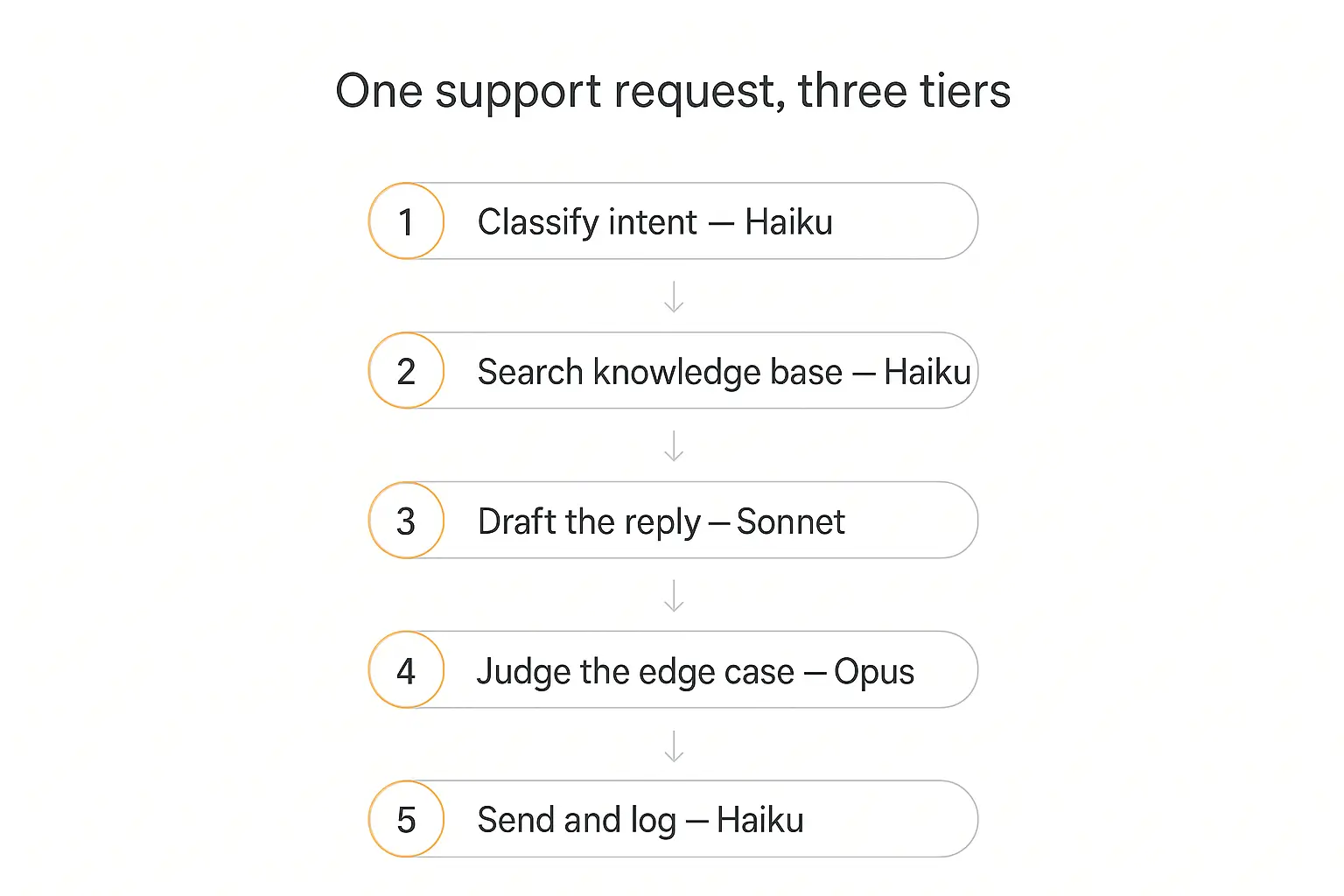
A typical support agent handling one message:
| Job | What it does | Tier | Why |
|---|---|---|---|
| Classify intent | Refund? Bug? Sales? | Haiku | Short, structured, easy to verify |
| Rewrite the query | Turn a rambling message into a search query | Haiku | Mechanical transformation |
| Rerank chunks | Score 40 results, keep 5 | Haiku | High volume, cheap to check |
| Draft the reply | Write the actual answer | Sonnet | Quality is visible to the customer |
| Handle the edge case | Policy exception, angry escalation | Opus | Judgment, real consequences |
| Log and tag | Structured output for the CRM | Haiku | Pure formatting |
Six calls. One of them justifies Opus. Four are comfortable on Haiku.
If you'd run all six on Opus 5, you'd pay Opus prices for four calls that a model costing a fifth as much handles identically — and you'd be slower, because Haiku is several times faster on exactly those short calls.
This is the core idea behind AI model routing, and it's the single highest-leverage change you can make to an agent that already works. You're not changing what it does. You're changing which engine handles each job.
The other dial: effort levels
Almost every comparison treats model choice as the only lever. It isn't.
Current Claude models take an effort setting — low, medium, high, xhigh, max — that controls how much thinking the model does before answering. Default is high.
This matters because the two dials interact, and people routinely turn the wrong one.
Consider a task Sonnet 5 almost handles. The instinct is to upgrade to Opus 5, which multiplies your per-token cost by 2.5. But often the actual fix is more deliberation, not more model — and the alternatives are:
- Sonnet 5 at higher effort. Same per-token price, more thinking tokens. Frequently enough.
- Opus 5 at low effort. Higher per-token price, but fewer tokens spent — and it can land cheaper and better than Sonnet at max effort.
Anthropic's own guidance points at xhigh as the sweet spot for most coding and agentic work on the current top-tier models, and low for sub-agents and simple tasks.
The practical takeaway: before you upgrade a tier, try turning effort up one notch. It's free to test and it's often the whole answer.
Five questions that decide the tier
When I'm sizing a specific call, I run through these in order. The first "yes" wins.
1. How many steps does this call have to hold together?
One step: Haiku is a serious candidate. Three to eight: Sonnet. Ten or more, unattended: Opus. Chain length is the strongest single predictor of which tier you need.
2. What happens when it's wrong?
If a wrong answer gets caught immediately — by a schema check, a downstream validator, a human glancing at it — go cheap. If a wrong answer silently reaches a customer or a database, go up a tier. You're buying insurance, and the premium is worth it exactly when the claim is expensive.
3. Is a human waiting?
Interactive chat has a latency budget. Haiku's speed advantage is a product feature there, not just a cost saving. Batch work overnight has no such constraint — and gets 50% off via the Batch API regardless of tier.
4. How often does this call run?
A call that runs once per conversation and a call that runs forty times per conversation deserve completely different scrutiny. Optimise the hot path. Ignore the cold one — shaving 60% off something that runs twice a day is wasted effort.
5. Have I actually measured it?
If the answer is no, the honest tier is "whatever Sonnet 5 does, until I have data." Guessing upward is expensive; guessing downward is embarrassing.
Five ways people get this wrong
Defaulting to the top tier "to be safe"
The most expensive mistake, and the most common. It feels prudent. What it actually does is hide which calls genuinely needed the horsepower, so you never learn anything and the bill only goes up.
Routing everything to Haiku to save money
The mirror-image error. Retries, escalations, and human cleanup are costs too — they're just costs that don't show up on your Anthropic invoice, which is exactly why they get missed.
Comparing prices across the tokenizer boundary
Covered above, and worth repeating because it's invisible: models on the newer tokenizer count roughly 30% more tokens for identical text. Your side-by-side price comparison is wrong unless you measured actual token counts per model.
Never revisiting a hardcoded model string
Sonnet 4.6 at $3/$15 is worse and more expensive than Sonnet 5 at $2/$10. Anyone who shipped in spring 2026 and moved on is paying that today. Model strings are not set-and-forget — put a calendar reminder on it.
Ignoring prompt caching
This is the one that dwarfs the model choice. A cache hit costs 10% of the base input price. If your agent sends the same long system prompt and knowledge base on every call — and most do — caching that prefix saves far more than dropping a tier ever will.
Run the numbers: Opus 5 with a well-cached prefix can genuinely beat Haiku 4.5 without caching on a prompt-heavy workload. Get caching right first, then optimise the tier. Doing it the other way round is solving the small problem.
How to actually decide (instead of guessing)
Everything above is a prior. The only thing that settles it is measurement.
1. Write down the jobs. List every distinct LLM call your agent makes. Most people are surprised — they think they have two and find nine.
2. Build a small eval set per job. Twenty to fifty real examples with known-good answers. Pull them from production logs, not your imagination. This is the step people skip, and skipping it is why model debates go in circles. Our guide on testing and debugging an AI agent walks through building one.
3. Start everything on Sonnet 5. Get a working baseline before optimising anything.
4. Push each job down a tier, one at a time. Swap one call to Haiku. Re-run the eval. If accuracy holds, keep it. If it drops, revert and try raising effort instead. Change one thing at a time or you'll learn nothing.
5. Push the failures up. Whatever fails on Sonnet even at high effort — that's your Opus list. It's usually shorter than you expect.
6. Instrument it and watch. Log per-call model, tokens, latency, and outcome. Model behaviour drifts as prompts evolve. See AI agent analytics for what's worth tracking.
The whole exercise takes an afternoon on an agent you've already built, and routinely cuts costs by half or more without touching quality. It's the same discipline we cover in the real cost of AI agents — measure first, then optimise the expensive part.
What this looks like in practice
The reason I frame this as jobs rather than models is that it's how the tooling increasingly works too.
In Pickaxe, the model is a per-agent setting, not a workspace-wide one — so a "waterfall" setup where a lightweight router agent triages requests and hands off to specialised sub-agents lets each of those agents sit on a different tier. The router runs on something fast and cheap; the agent that writes the client-facing deliverable runs on something better.
You can compare what's available and switch at any time at pickaxe.co/models, and because everything runs through Pickaxe credits, the cost difference between tiers shows up directly in your usage rather than in a separate provider bill you have to reconcile.
The broader point holds regardless of platform: the unit of model choice should be the job, not the agent. Any stack that forces one model per product is going to overcharge you for the easy work. We go deeper on mixing providers in multi-model AI agents.
Frequently asked questions
Which Claude model is best for AI agents?
For most agents, Claude Sonnet 5 is the right default — it's within a point of Opus 4.8 on several agentic benchmarks and actually beats it on Terminal-Bench 2.1, at $2/$10 per million tokens. Move to Opus 5 for long unattended chains (10+ steps), computer use, or high-consequence decisions. Use Haiku 4.5 for classification, extraction, reranking, and sub-agents.
Is Claude Opus worth it over Sonnet?
Only for specific jobs. Opus 5 costs 2.5× Sonnet 5 per token and its advantage concentrates in long agentic chains, novel reasoning, and computer use. On short tasks and general knowledge work the gap is small enough that it's hard to justify. Test on your own eval set before committing — and try raising Sonnet's effort level first, since that's free to evaluate.
How much cheaper is Claude Haiku than Opus?
The headline ratio is 5× ($1/$5 vs $5/$25). But because Opus 5 uses a newer tokenizer that produces roughly 30% more tokens for the same text, the real like-for-like ratio on identical input is closer to 6.5×. Use Anthropic's token counting endpoint to get exact figures for your prompts.
Can I use different Claude models in one agent?
Yes, and you should. This is model routing, and it's standard practice for production agents. A common pattern is a cheap model classifying and routing, a mid-tier model doing the main work, and a top-tier model handling escalations. Platforms like Pickaxe support per-agent model selection so you can chain agents on different tiers.
What's the difference between Claude Sonnet 5 and Sonnet 4.6?
Sonnet 5 is better and cheaper. It substantially outperforms Sonnet 4.6 on reasoning, tool use, coding, and knowledge work — 80.4 vs 67.0 on Terminal-Bench 2.1 — while costing $2/$10 against Sonnet 4.6's $3/$15. There's no good reason to still be on 4.6.
Does Claude Haiku 4.5 have a 1M context window?
No. Haiku 4.5 runs a 200K context window. Sonnet 5, Opus 5, and Fable 5 all carry 1M at standard pricing. For most Haiku-appropriate jobs 200K is plenty, but it rules Haiku out of very large document or whole-repository work.
Should I use Claude Fable 5 instead of Opus 5?
Usually not. Fable 5 costs $10/$50 — double Opus 5 — and Anthropic's own numbers show Opus 5 beating it on OSWorld 2.0 at a third the cost. Fable is for genuine reasoning ceilings you can demonstrate with evals, not for general agent work.
Claude Opus vs Sonnet vs Haiku: the short version
If you take one thing from this, make it this: the question isn't which Claude model, it's which Claude model for which job.
Start everything on Sonnet 5. Push the mechanical work down to Haiku 4.5 one call at a time, checking against a real eval set. Push the genuinely hard, long-running, high-consequence work up to Opus 5. Leave Fable 5 alone unless you can prove you need it.
And before you touch any of that, turn on prompt caching — it will save you more than every tier decision on this page combined.
The tiers aren't a quality ladder where more money buys a better agent. They're specialised tools, and the skill is knowing which job each one is for.
If you want to try this without wiring up routing logic yourself, Pickaxe lets you set the model per agent and chain agents together, so a fast router can hand off to a heavier specialist — and you can swap tiers whenever the evidence says to. Have a look at the model lineup and start with whichever job in your agent runs most often.