

Within a month of each other, the two frontier labs shipped their most capable models yet.
Anthropic released Claude Fable 5 on June 9, 2026 — a "Mythos-class" model that sits a full tier above the Opus line. Then on July 9, OpenAI answered with the GPT-5.6 family, led by its flagship, GPT-5.6 Sol.
If you're building an AI agent, that leaves a very practical question: GPT-5.6 Sol vs Claude Fable 5 — which one should actually power your agent?
I dug into the specs, the pricing, the benchmark claims (from both sides), and where each one genuinely pulls ahead. Here's the honest breakdown, plus why the real answer for most agent builders isn't "pick one and marry it."
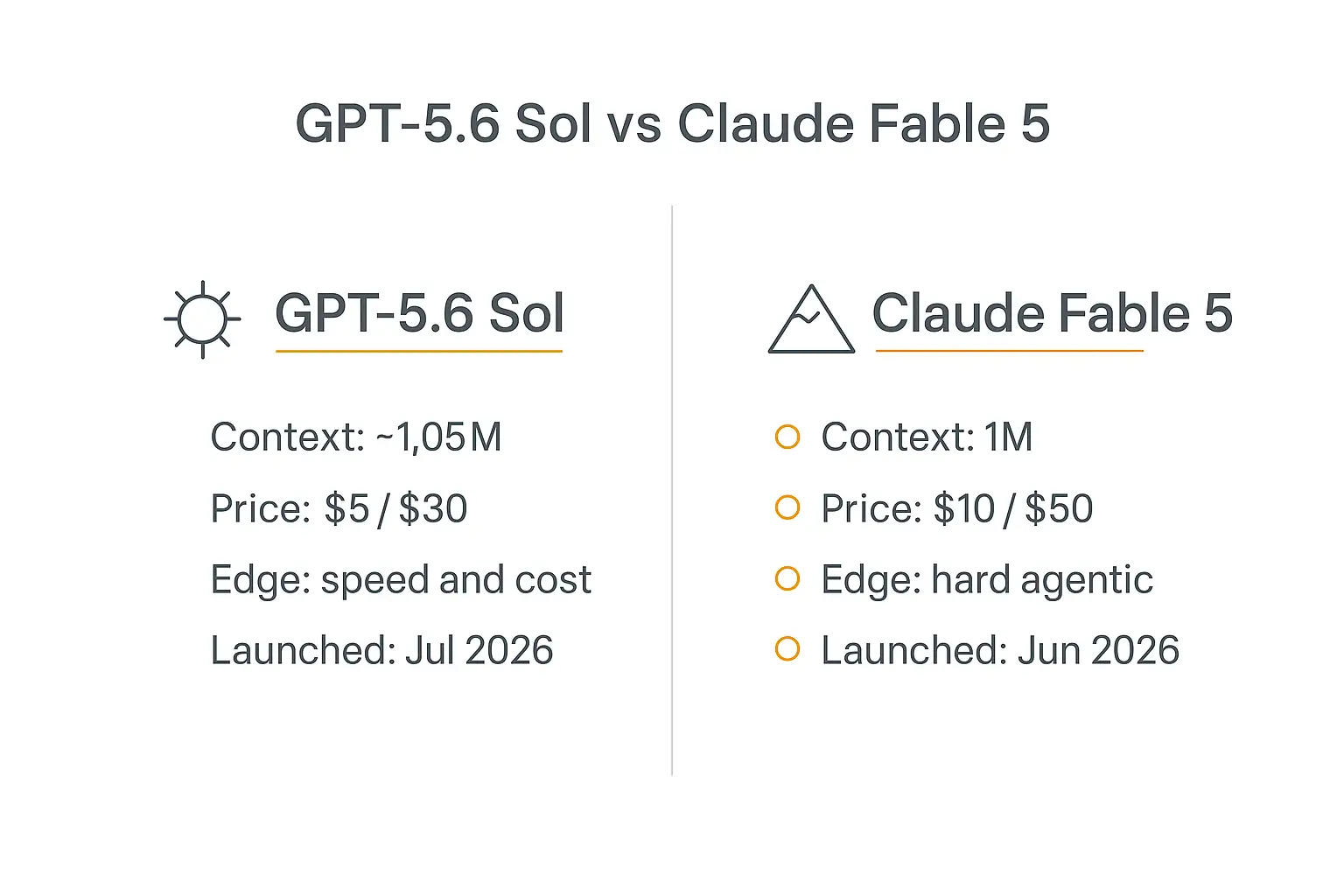
GPT-5.6 Sol vs Claude Fable 5: the spec sheet
Let's start with the numbers that don't require any interpretation.
| GPT-5.6 Sol | Claude Fable 5 | |
|---|---|---|
| Maker | OpenAI | Anthropic |
| Released | July 9, 2026 | June 9, 2026 |
| Context window | ~1,050,000 tokens | 1,000,000 tokens |
| Max output | 128,000 tokens | 128,000 tokens |
| Input price | $5 / 1M tokens | $10 / 1M tokens |
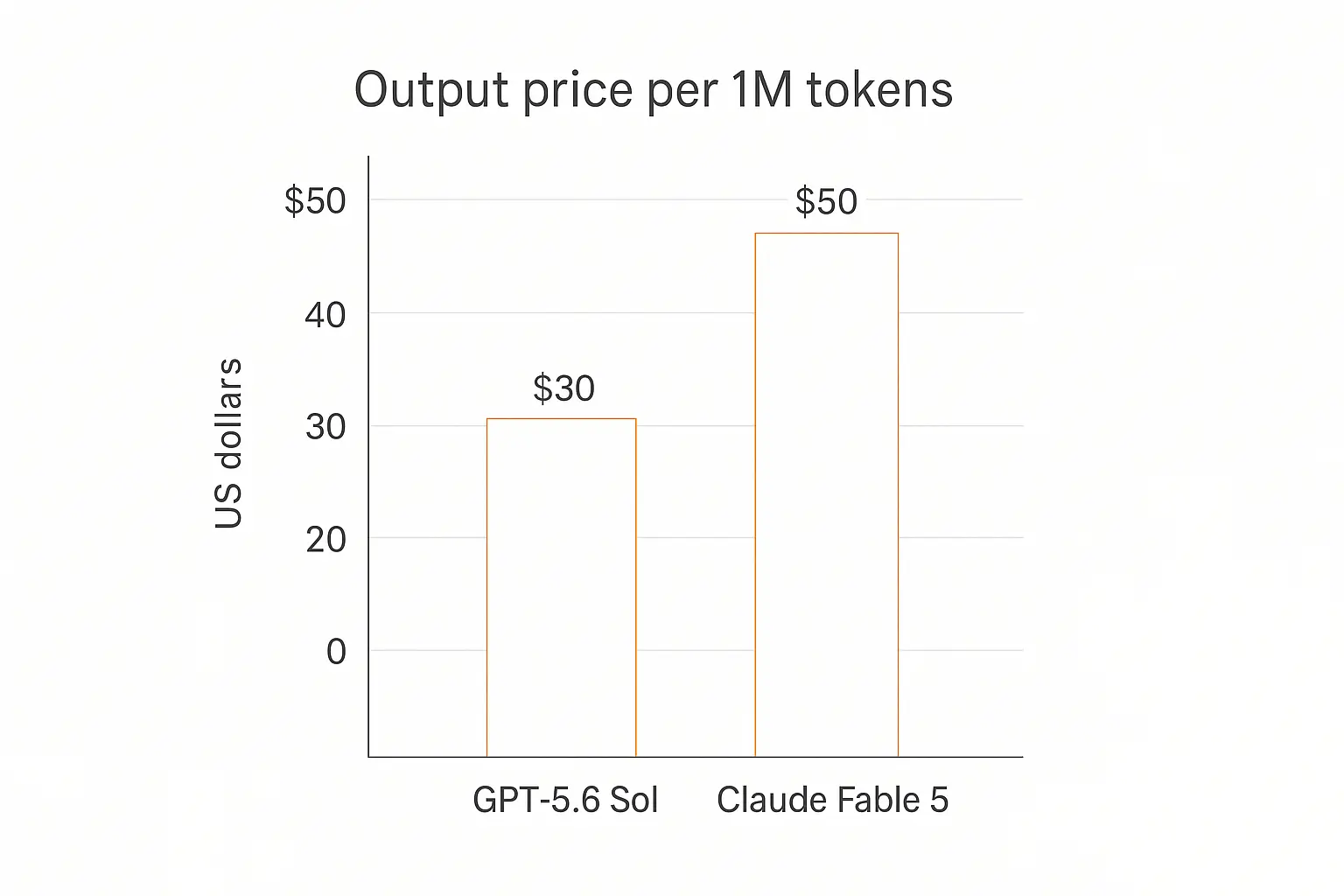
| Output price | $30 / 1M tokens | $50 / 1M tokens |
| Inputs | Text + image | Text + image |
| Model family | Sol / Terra / Luna (3 tiers) | Fable 5 (Mythos-class) |
Two things jump out immediately.
They're closely matched on context and output. Both give you a roughly 1M-token context window and up to 128K output tokens per request — plenty for long documents, big codebases, or extended agent runs.
Sol is meaningfully cheaper. At $5 input / $30 output per million tokens versus Fable 5's $10 / $50, GPT-5.6 Sol runs roughly half the price on input and 40% cheaper on output. For a high-volume agent, that gap compounds fast.
That's the headline tension of this whole comparison: Fable 5 is the more expensive, arguably more capable flagship; Sol is the faster, cheaper challenger that claims to have closed the gap. Let's test that claim.
What GPT-5.6 Sol is
Sol is the top tier of OpenAI's three-model GPT-5.6 release, per OpenAI's launch announcement. Below it sit Terra (balanced, $2.50/$15) and Luna (value, $1/$6) — a clean split of capability and cost into durable tiers, which is genuinely useful when you're routing different jobs to different price points.
Sol's pitch is frontier intelligence that's also fast and efficient. OpenAI leans hard on efficiency: its headline benchmark claim is that Sol "sets a new state of the art at 80" on the Coding Agent Index — 2.8 points above Fable 5's 77.2 — while using "less than half the output tokens, taking less than half the time, and costing about one-third less."
The other headline feature is programmatic tool calling in the Responses API: Sol writes JavaScript that runs in an isolated, no-network V8 runtime to orchestrate its own tool calls in code rather than one round-trip at a time. OpenAI reports customer token reductions of 38% to 63.5% from this alone. For tool-heavy agents, that's a real efficiency lever.
Sol is also OpenAI's strongest model yet for cybersecurity and long-horizon security work — a capability that cuts both ways, and one Anthropic deliberately restricts on its side (more on that below).
What Claude Fable 5 is
Fable 5 is a different kind of release. It's the first widely available "Mythos-class" model — a tier Anthropic explicitly describes as sitting above the Opus class in capability, per its announcement.
Anthropic's claim is broad: Fable 5 is "state-of-the-art on nearly all tested benchmarks" and exceeds anything the company had previously released. The supporting evidence is unusually concrete for a launch post:
- Software engineering: Stripe reported Fable 5 "compressed months of engineering into days," completing a 50-million-line Ruby migration in one day versus roughly two months by hand.
- Coding: highest score on Cognition's FrontierCode evaluation — "even at medium effort."
- Knowledge work: the highest score of any model on Hebbia's Finance Benchmark.
- Agentic endurance: Anthropic says Fable 5 "can work autonomously for longer than any previous Claude model," and it notably out-improves Opus 4.8 by roughly 3× on long, memory-driven tasks.
There's also one benchmark where Fable 5 clearly wins against Sol directly: on SWE-Bench Pro, Fable 5 scores 80% to Sol's 64.6% — about a 15-point lead on hard, real-world software-engineering tasks. So the "who's ahead" story genuinely depends on which benchmark you trust.
One more thing that matters for agent builders: Fable 5 ships with safety classifiers. On a narrow set of high-risk topics — cybersecurity, biology/chemistry, and model-distillation queries — it transparently falls back to Claude Opus 4.8. Anthropic says this triggers in fewer than 5% of sessions, so 95%+ of Fable traffic runs unaffected. But if your agent lives in security tooling, that's a real consideration.
The benchmark fight, decoded
Here's the thing about the dueling benchmark claims: both are true, and both are cherry-picked. That's normal — every lab leads with the eval it wins. The next launch ran the same play, and we pulled the numbers apart in our read of the GPT-6 Astra benchmarks.
| Benchmark | GPT-5.6 Sol | Claude Fable 5 | Winner |
|---|---|---|---|
| Coding Agent Index v1.1 | 80 | 77.2 | Sol (+2.8) |
| SWE-Bench Pro | 64.6% | 80% | Fable 5 (+15.4) |
| Output tokens used | ~half of Fable's | baseline | Sol (efficiency) |
| Cost per task | ~⅓ less | baseline | Sol |
Read it this way:
Sol wins on efficiency and agentic coding throughput. When the metric rewards doing the work fast, cheap, and with fewer tokens, Sol looks excellent. OpenAI optimized hard for that, and it shows.
Fable 5 wins on the hardest, messiest engineering tasks. SWE-Bench Pro is deliberately gnarly — real repos, real bugs — and a 15-point lead there is not noise. When correctness on genuinely hard problems matters more than cost, Fable 5 pulls ahead.
Neither number tells you what will happen on your workload. Benchmarks are a starting hypothesis, not a verdict. The only test that counts is running both against your actual agent tasks — which, conveniently, is exactly what a no-code platform lets you do without rewriting anything (we'll get there).
Cost: the difference that actually shows up on your bill
For a lot of agent builders, this is the deciding factor, so let's make it concrete.
Say your agent processes 2 million input tokens and 500,000 output tokens per day — a realistic load for a busy support or research agent.
| GPT-5.6 Sol | Claude Fable 5 | |
|---|---|---|
| Input (2M) | $10.00 | $20.00 |
| Output (0.5M) | $15.00 | $25.00 |
| Daily total | $25.00 | $45.00 |
| Monthly (~30d) | ~$750 | ~$1,350 |
That's roughly a $600/month difference at that volume — and it scales linearly. Add Sol's token-efficiency gains (fewer output tokens for the same task, per OpenAI's claims), and the real-world gap can widen further.
None of that means Sol is the right call. It means the premium for Fable 5 has to be earned by better outcomes on the tasks that matter to you. On a hard, high-stakes agent where a wrong answer is expensive, paying more for the model that's stronger on difficult problems is an easy trade. On a high-volume, lower-stakes agent, the cheaper model usually wins.
If you're trying to put actual numbers on that trade-off, our guide to measuring AI agent ROI has the formulas.
Try both models in the same agent
Pickaxe lets you switch the model powering your agent with a dropdown — build once, test Sol against Fable 5 on your real tasks.
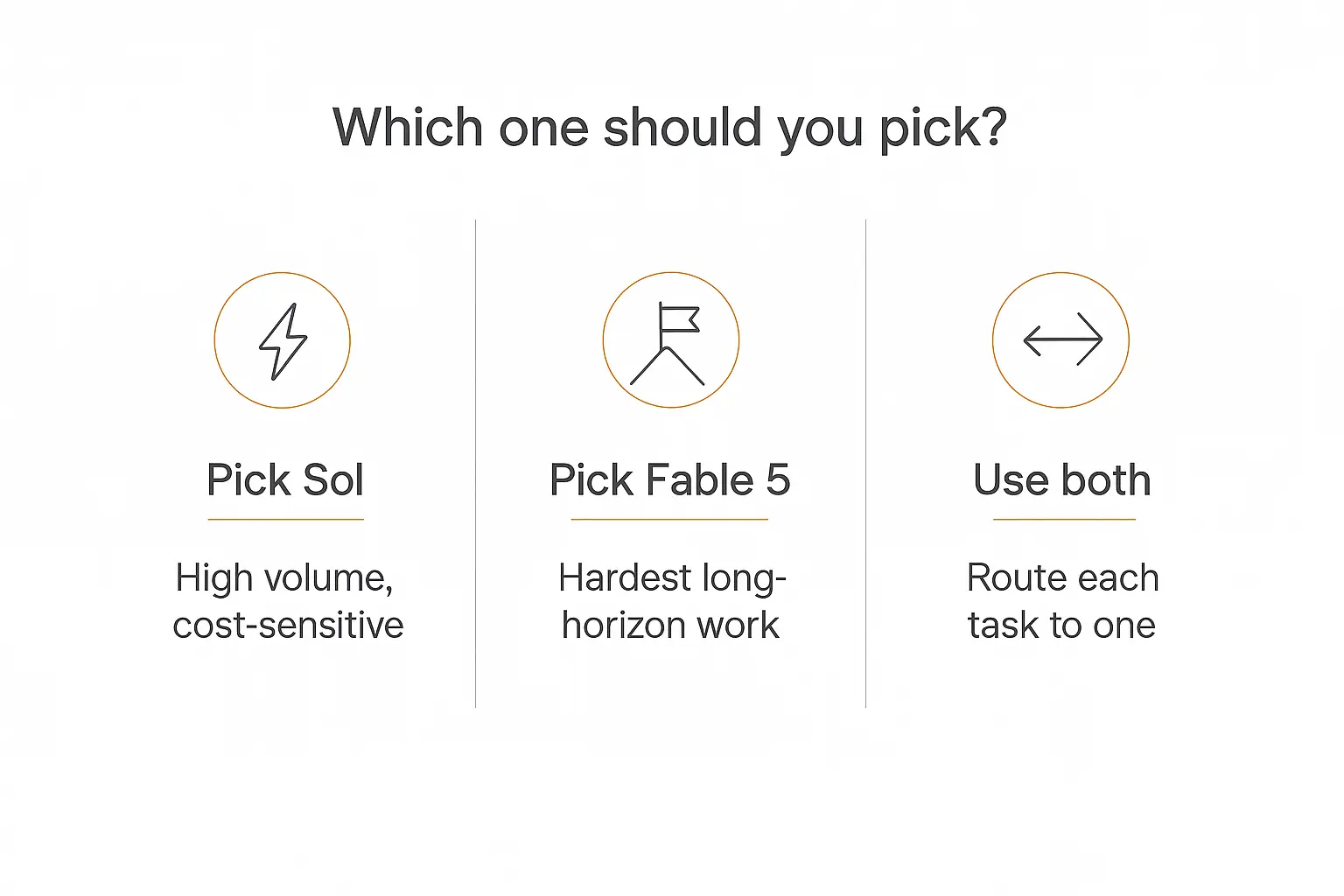
Which should you pick for your AI agent?
Here's how I'd actually decide, based on what each model is genuinely good at.
Pick GPT-5.6 Sol if…
- Your agent is high-volume and cost-sensitive — support, classification, research, content — where the per-task bill dominates.
- You want tool-heavy orchestration and can take advantage of programmatic tool calling to cut token usage.
- You value speed and throughput — Sol is built to do more, faster, for less.
- You want a tiered family so you can drop to Terra or Luna for cheaper subtasks without leaving the ecosystem.
Pick Claude Fable 5 if…
- Your agent tackles the hardest, longest-horizon work — complex refactors, multi-hour autonomous runs, deep research — where correctness beats cost.
- You're doing serious software engineering and want the model with the SWE-Bench Pro edge and the Stripe-scale migration receipts.
- You want agentic endurance and memory — Fable 5 sustains long, self-directed work better than anything before it.
- You value built-in safety guardrails and don't mind the occasional Opus 4.8 fallback.
Honestly? Use both.
This is the answer most experienced builders land on. There's no rule that your agent has to run on one model.
The smart pattern is model routing: send the hard, high-stakes reasoning steps to Fable 5, and the high-volume, routine steps to Sol (or even down to Terra/Luna). You get Fable's ceiling where it matters and Sol's economics everywhere else.
We wrote a whole guide on multi-model AI agents — mixing OpenAI, Anthropic, and Google in one agent — because this hybrid approach consistently beats picking a single model and forcing every task through it.
How this works in Pickaxe
Here's the part that makes the whole "which model" question lower-stakes than it sounds.
When you build an agent on Pickaxe, the model is a setting, not a rewrite. You build your agent once — its instructions, its knowledge base, its Actions and integrations — and choose which model powers it from a dropdown.
That means testing GPT-5.6 Sol vs Claude Fable 5 on your actual workflow is a two-minute experiment, not a migration project. Build the agent, run your real tasks on Sol, switch to Fable 5, run them again, and compare the outputs and the cost. Let your own results decide instead of a benchmark someone else ran.
A few things worth knowing if you build this way:
- You don't manage API keys or juggle two providers' billing — model usage runs on Pickaxe credits, so switching models is genuinely just a dropdown.
- You can run different agents on different models, or route steps within a workflow — the multi-model pattern, without the plumbing.
- You can track how each model actually performs over time using agent analytics, so the decision stays evidence-based as both models get updated.
If you're still deciding whether to build your own agent at all versus buying an off-the-shelf tool, our build vs buy framework is a good next read.
Frequently asked questions
Is GPT-5.6 Sol better than Claude Fable 5?
It depends on the task. Sol wins on efficiency, speed, cost, and agentic coding throughput (Coding Agent Index). Fable 5 wins on the hardest software-engineering problems (SWE-Bench Pro, where it leads by ~15 points) and long-horizon autonomous work. There's no single winner — match the model to the job.
Which is cheaper, GPT-5.6 Sol or Claude Fable 5?
GPT-5.6 Sol is cheaper: $5 input / $30 output per million tokens versus Fable 5's $10 / $50. Sol also tends to use fewer output tokens per task, so the real-world cost gap can be larger than the sticker prices suggest.
Do GPT-5.6 Sol and Claude Fable 5 have the same context window?
Almost. Sol offers roughly a 1,050,000-token context window and Fable 5 offers 1,000,000 — close enough that context size shouldn't be your deciding factor. Both support up to 128,000 output tokens.
Can I use both models in one AI agent?
Yes, and it's often the best approach. Model routing sends hard reasoning to Fable 5 and high-volume routine work to Sol. On a no-code platform like Pickaxe, switching or mixing models is a dropdown setting rather than a code change.
Which model is better for coding agents?
Both are excellent. Sol scores higher on the Coding Agent Index with far better token efficiency; Fable 5 scores higher on SWE-Bench Pro and has real-world receipts like Stripe's 50M-line migration. For high-volume coding tasks, Sol's economics are hard to beat; for the hardest problems, Fable 5 has the edge.
The bottom line
GPT-5.6 Sol and Claude Fable 5 are the two best models you can put behind an agent right now, and they're optimized for different things.
Fable 5 is the flagship's flagship — the model to reach for when the task is hard, long, and expensive to get wrong. Sol is the efficient frontier — nearly as capable on many tasks, faster, and cheaper, with a tidy three-tier family behind it.
For most real agents, the winning move isn't to crown one. It's to build your agent so the model is swappable, route each task to the model that fits it, and let your own outcomes — not a launch-day benchmark — settle the argument. Doing that deliberately rather than by feel is AI model routing, and it is worth setting up before you crown a winner.
That's exactly what Pickaxe is built for: pick your model from a dropdown, mix them when it helps, and change your mind whenever the next frontier model ships. Because at this pace, another one is never far off.