
There's a moment every AI builder hits. You've made something genuinely useful — a chatbot that answers your niche's hardest questions, a workflow that drafts proposals, a research agent that actually cites its sources. And then you think: could I sell this?
That question is where most people get stuck. Building an AI tool has never been easier. Selling one is a completely different problem.
Because to charge for an AI tool, you need more than a clever prompt. You need a place to host it, a login wall so only paying users get in, a billing system that handles subscriptions and usage, and a way to keep your model costs from eating your margin. A prompt in a text box doesn't do any of that. The concrete levers are laid out in our guide to reducing AI model costs without sacrificing quality.
So I went looking for the best platforms to build and sell AI tools — the ones that handle both halves of the job, not just the fun part. I looked into pure builders, marketplaces, custom-GPT wrappers, and full "build-plus-monetize" stacks to figure out which actually let you turn an AI tool into a business.
Here's the honest headline: most tools that claim to help you "monetize AI" only do one thing well. A few do the whole loop. Below are the ten I'd shortlist, what each is genuinely good at, how the money works, and roughly what it costs.
What Actually Matters When You Want to Sell AI Tools
Before the list, here's the lens I used. When you're choosing a platform to build and sell AI tools, four things decide whether you'll actually make money: If you have not settled on what to sell yet, the top ways to make money with AI ranks the options by what each one actually pays.
- Deployment you own. Can you put the tool on your own domain, with your brand — or are you renting space inside someone else's marketplace? White-label matters if you're selling to clients.
- Built-in billing. Subscriptions, usage-based credits, one-time payments — ideally through Stripe, without you writing a payment integration.
- Access control. A real login wall. Free users, paid users, tiers. If anyone can use it for free, you don't have a product.
- Margin control. AI usage costs money on every request. The platform needs to let you charge above your model cost so you don't lose money on your best customers.
A tool can be brilliant at building and still be useless for selling. That distinction runs through this whole list. If you want to go deeper on the money side specifically, my complete playbook on monetizing AI agents pairs perfectly with this piece.
The Best Platforms to Build and Sell AI Tools at a Glance
Here's the full shortlist before the deep dives.
| Platform | Best for | Build + Sell? | Starting price (approx.) |
|---|---|---|---|
| Pickaxe | Building and selling client-ready AI agents on your own brand | Both, end-to-end | ~$29/mo |
| MindStudio | Multi-model workflow apps + a marketplace | Both | Free; ~$20/mo |
| Poe | Reaching a huge built-in audience of chatters | Sell inside Poe | Free to build |
| Coze | Visual bot building across many channels | Build; limited selling | Free; ~$9/mo |
| CustomGPT.ai | RAG chatbots over your own content | Build; you host the sale | ~$99/mo |
| CalStudio | Paywalling a Custom GPT you already made | Sell layer for GPTs | Free; paid tiers |
| Stack AI | Enterprise-grade internal AI apps | Build; enterprise sales | ~$199/mo |
| Relevance AI | Multi-agent "AI workforce" automations | Build; you sell the outcome | Free; ~$19/mo |
| Gumroad | Selling AI products, prompts, and access | Sell only | No monthly fee |
| Lovable | Coding a full custom AI SaaS app | Build; you wire up billing | Free; ~$25/mo |
1. Pickaxe — The Full Build-and-Sell Stack
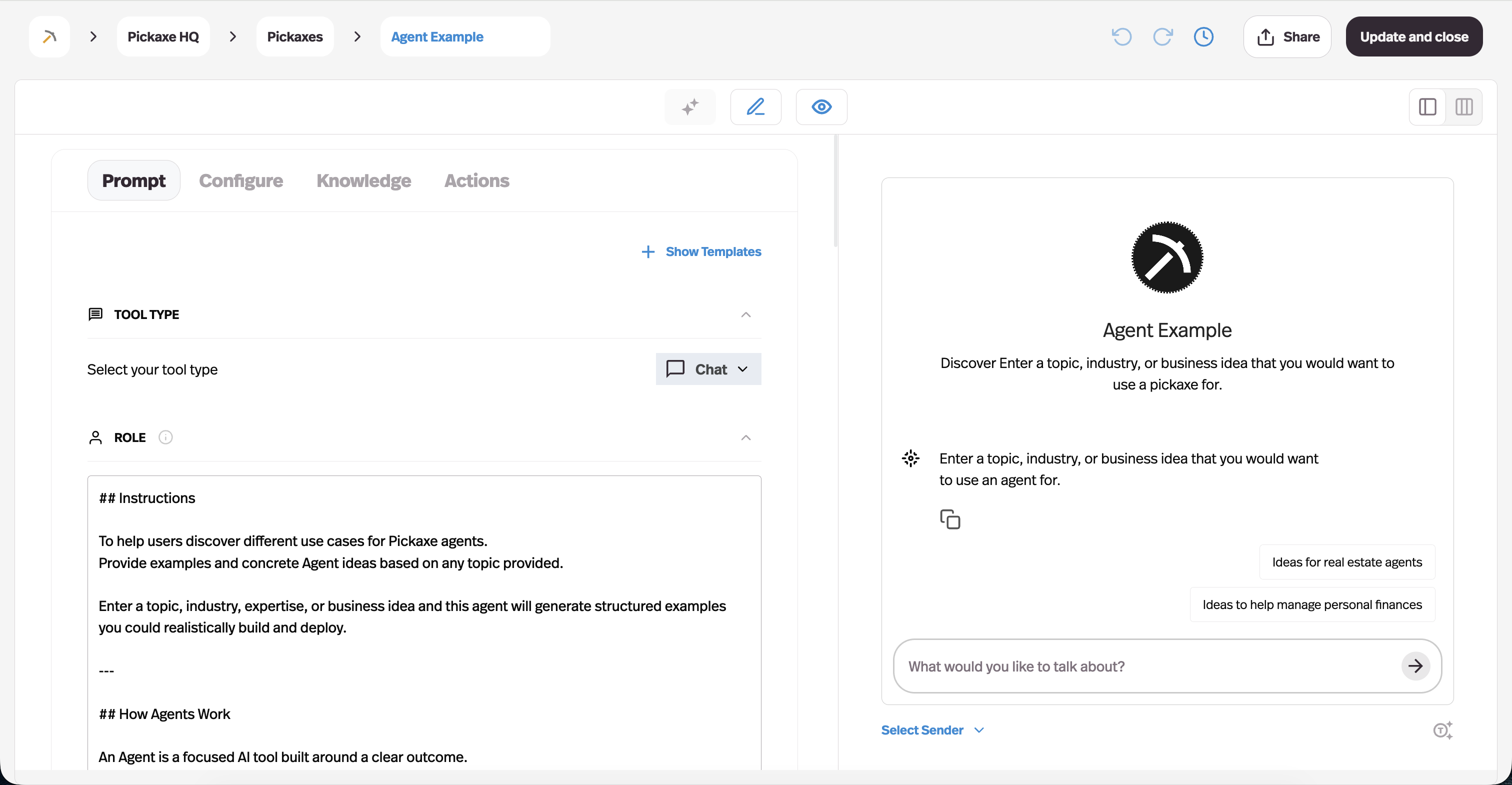
I'll put my bias on the table up front: Pickaxe is the platform I keep coming back to, because it's the only one on this list built from day one around the whole loop — build, deploy, and sell — not just building.
The tagline is "Shopify for agent-powered businesses," and that's the right mental model. You don't just make an AI tool; you package it into a product, wrap it in your own branding, put it behind a paywall, and collect the money.
You build agents with no code — write instructions, upload a knowledge base (PDFs, URLs, docs, even Notion and Google Drive), pick from a wide range of AI models, and connect Actions so the agent can look up data, send emails, or trigger workflows.
Then you deploy into a Portal — a branded, multi-agent hub on your own custom domain — or embed the tool on any website, or ship it to WhatsApp, Slack, email, or the API.
Here's the part that matters for this article: monetization is native. Connect Stripe, set up a member access group, and you can charge with subscriptions (daily, weekly, monthly, yearly), pay-per-usage credits, or one-time payments. Because Pickaxe uses a credit system that maps to real AI cost, you can sell $10 of credits that only cost you $5 to run — the margin is yours by design.
What stood out: access control and billing aren't bolt-ons here, they're the core. You get white-labeling, custom domains, and usage tracking without touching a payment API. For consultants and agencies, that's the difference between "cool demo" and "recurring revenue."
Where it's not ideal: if you want to hand-code a bespoke UI pixel by pixel, Pickaxe's structured builder is more guardrails than blank canvas. That's a feature for most people and a limit for a few.
Pricing: paid plans start around $29/month (Gold, billed annually), with Pro around $116/month adding API access, unlimited portals, and lower processing fees. If you want a real teardown of how the money works, the AI agent pricing models guide walks through per-seat, usage-based, and outcome-based approaches.
Best for: anyone who wants to sell AI tools under their own brand — creators, consultants, and agencies especially.
2. MindStudio — Multi-Model Apps With a Marketplace
MindStudio is a strong no-code builder with a genuinely nice touch: you can mix and match 30+ models within a single app. Use a cheap fast model for classification and an expensive smart one for the final answer, all in one workflow.
It leans more "AI workflow app" than "chatbot." You build multi-step automations with a visual flow, which makes it great for tools that do real work — parsing a document, then summarizing, then formatting output.
On the selling side, MindStudio lets you publish apps to its marketplace or share them publicly, and its pricing model is refreshingly honest: you pay a platform fee for features and capacity, then pay for AI usage at provider cost with no markup.
What stood out: the multi-model routing is legitimately useful and can cut your costs. If you want to understand why that matters, my write-up on choosing an AI agent strategy covers the build-side tradeoffs.
Where it's weaker: the marketplace isn't a high-traffic storefront, and monetization is less turnkey than a dedicated build-and-sell platform. You're often still driving your own audience to it.
Pricing: a free tier (1 agent, ~1,000 runs/month), with the Individual plan around $20/month (~$16 annually) for unlimited agents and runs.
Best for: builders who want multi-model workflow apps and don't mind bringing their own audience.
3. Poe — Build Where the Audience Already Is
Poe, built by Quora, flips the model. Instead of you finding customers, Poe brings its enormous audience of people who come to chat with AI, and lets creators build bots that live inside that marketplace.
You can build a bot on top of any of the frontier models Poe hosts — GPT, Claude, Gemini, and dozens more — give it a custom prompt and knowledge, and publish it. Poe has a creator monetization program where you earn based on usage and can set a price-per-message.
What stood out: distribution. Poe's built-in traffic is something almost no other platform on this list offers. If your tool is a consumer-friendly chat experience, you can get in front of real users on day one.
Where it's limited: you're a tenant, not a landlord. You can't white-label, you can't own the customer relationship, and you're bound by Poe's rules and payout structure. It's a great channel, not a business you own outright.
Pricing: free to build and publish; Poe monetizes users through its own subscription and shares revenue with creators.
Best for: consumer-facing chatbots where reach matters more than owning the brand.
4. Coze — Visual Bots Across Every Channel

Coze (from ByteDance) is a slick visual bot builder with a generous free tier and a strong plugin ecosystem. You drag together nodes — LLM calls, plugins, knowledge, logic — and publish your bot to channels like Discord, Telegram, your own site, and more.
It's genuinely fun to build in, and the workflow editor is powerful for branching logic. For prototyping and shipping a multi-channel bot fast, it's hard to beat on value.
What stood out: the free tier and the breadth of publishing channels. If you want a bot in five places without wiring up five integrations, Coze does that.
Where it's weaker for selling: Coze is a builder first. Native, own-your-billing monetization is thin. You can build and distribute widely, but turning that into paid subscriptions usually means bolting on your own payment layer elsewhere.
Pricing: a capable free tier, with paid plans starting around $9/month for more capacity.
Best for: builders who want to distribute a bot across many channels and aren't relying on the platform for billing.
Want the build and the sell in one place?
Pickaxe handles agents, portals, access control, and Stripe billing so you can charge from day one.
5. CustomGPT.ai — RAG Chatbots Over Your Content
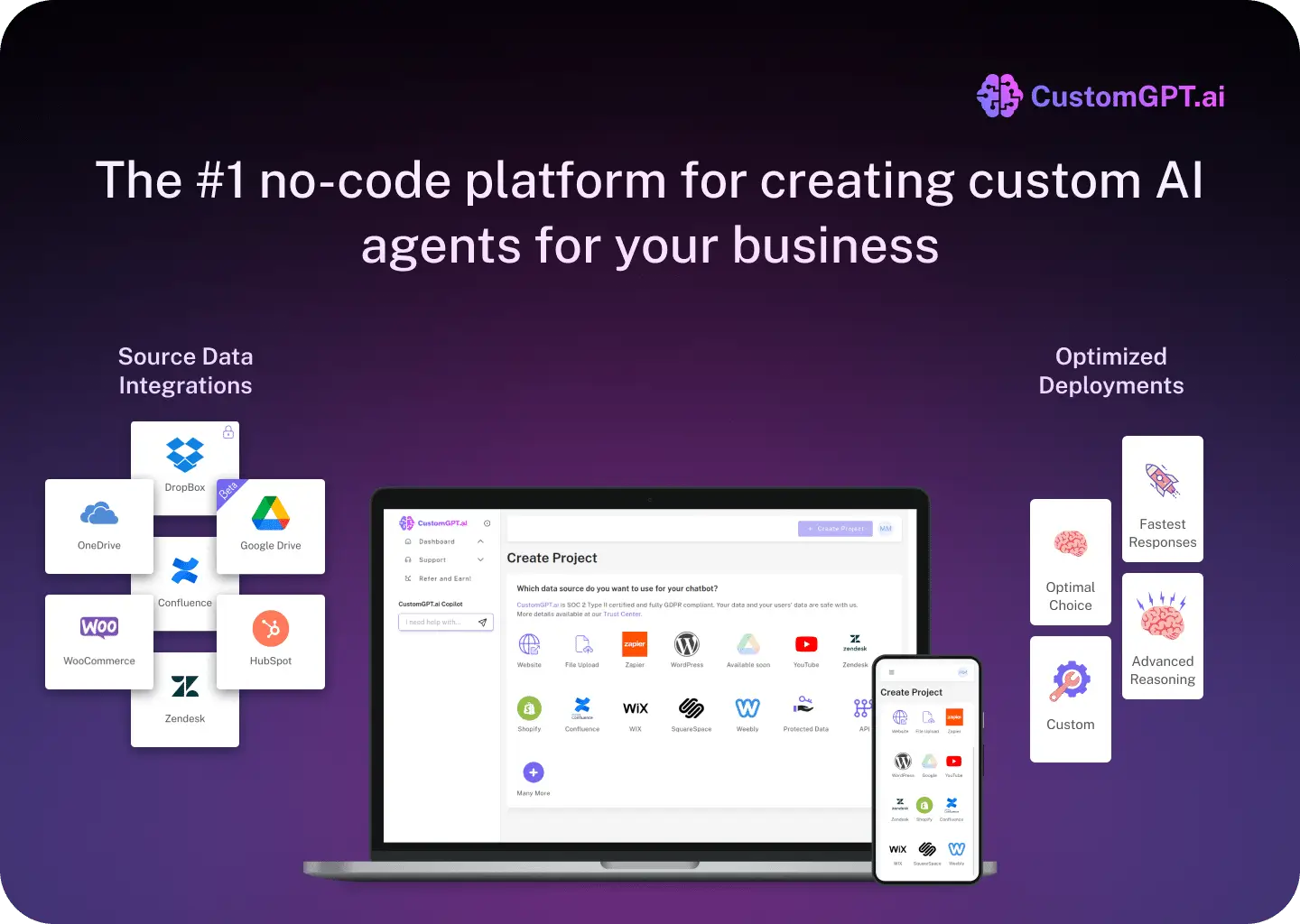
CustomGPT.ai is laser-focused on one thing and does it well: building an accurate chatbot on top of your content — a website, a document library, a help center — with strong anti-hallucination guardrails.
If you're selling a "chat with our knowledge" tool to businesses, this is a clean, reliable option. It ingests your sources, stays on-topic, and cites where answers come from.
What stood out: retrieval quality and business-readiness. It's built for companies that need answers to be grounded in real documents, which is exactly what a lot of clients will pay for.
Where it's limited for selling: CustomGPT is the build-and-host layer. Charging end users is on you — you'll typically sell the deployment as a service or wrap it in your own paywall rather than flipping a native "subscriptions on" switch.
Pricing: paid plans start around $99/month, which puts it toward the professional end of the spectrum.
Best for: agencies and businesses selling document-grounded chatbots where accuracy is the product.
6. CalStudio — Put a Paywall on Your Custom GPT
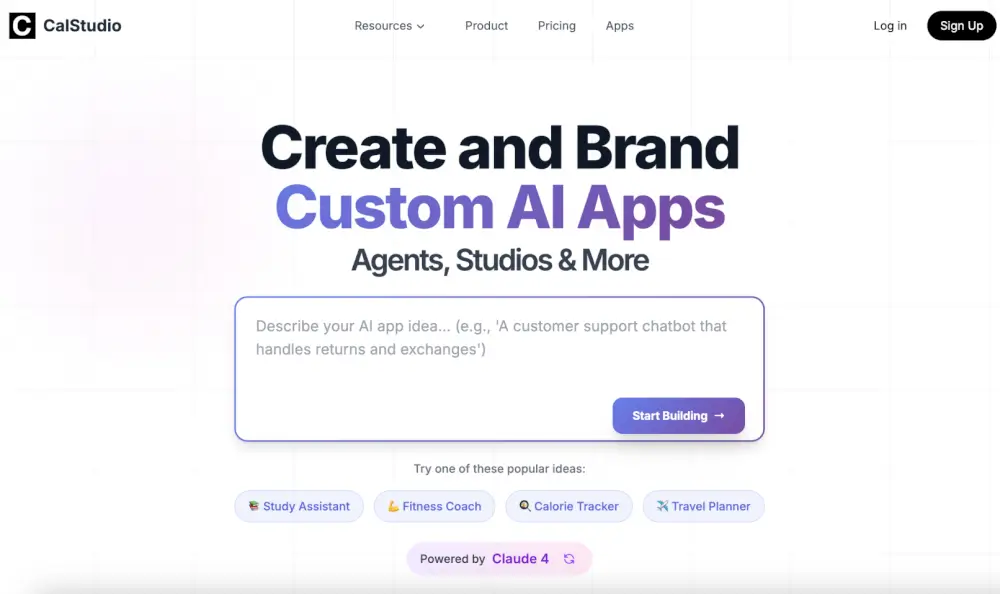
Here's a specific problem CalStudio solves. You built a Custom GPT inside ChatGPT, people love it — but OpenAI's ecosystem won't let you charge for it or white-label it. Custom GPTs live inside OpenAI's walls.
CalStudio is the monetization layer for exactly that. You take your GPT (or build a chatbot from scratch), and CalStudio wraps it in a hosted app with subscription tiers, chat credits, and one-time payments — the selling machinery a raw Custom GPT lacks.
What stood out: it directly closes the biggest gap in the "sell a Custom GPT" dream. Tiers, credits, and Stripe payouts on top of a GPT you already made is a tidy shortcut. CalStudio is not the only escape hatch, though — the wider roundup of Custom GPT alternatives covers the rest.
Where it's weaker: it's a narrower tool than the full platforms here. You're monetizing a chatbot, not building a multi-agent portal or a complex workflow product.
Pricing: a free tier to start with affordable paid plans as you scale usage and features.
Best for: anyone who already built a GPT and just needs to charge for it. It's also worth reading how to white-label your GPTs beyond the GPT store for the broader picture.
7. Stack AI — Enterprise-Grade AI Applications

Stack AI is a no-code builder aimed squarely at enterprise and internal use cases — think AI apps for finance, healthcare, and operations teams, with the security and compliance posture those buyers demand.
You build workflows visually, connect databases and internal tools, and deploy apps that real teams use. It's less "sell a $9/month chatbot to consumers" and more "deploy a serious internal tool a company pays real money for."
What stood out: the compliance and integration story. If you're selling into organizations that care about SOC 2, data controls, and internal systems, Stack AI speaks their language.
Where it's not a fit: for a solo creator wanting to sell a simple tool to individuals, it's overkill and priced accordingly. The "selling" here is enterprise contracts, not self-serve subscriptions.
Pricing: paid plans start around $199/month and climb quickly for teams and enterprise features.
Best for: builders selling AI applications into mid-market and enterprise organizations.
8. Relevance AI — Build an "AI Workforce"
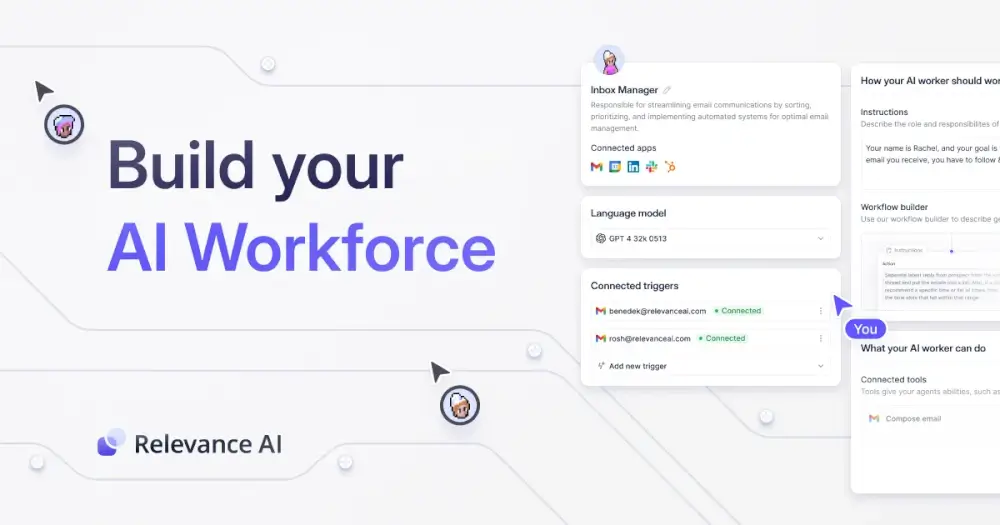
Relevance AI frames things around building an "AI workforce" — teams of specialized agents that hand off tasks to each other. It's one of the stronger platforms for multi-agent systems where several agents collaborate on a job.
You build agents and "tools," give them roles, and let them run recurring work — research, data enrichment, outbound, reporting. It's powerful for automations that produce a measurable business outcome.
What stood out: the multi-agent orchestration is mature. If your product is "we automate this whole process for you," Relevance gives you the machinery to build it. My primer on monetizing AI agents covers how to price outcome-based automations like these.
Where selling gets fuzzy: Relevance is a build-and-run platform. You typically sell the outcome — as a done-for-you service or a productized offer — rather than flipping on native end-user subscriptions.
Pricing: a free tier to start, with paid plans from around $19/month and team tiers well above that.
Best for: builders selling automation outcomes and multi-agent workflows to businesses.
9. Gumroad — The Simplest Way to Sell What You Built

Gumroad isn't an AI builder at all — and that's exactly why it's on this list. It's the sell-only half. If you've built an AI tool somewhere else, or you're selling prompt packs, GPT access, templates, or a downloadable AI product, Gumroad is the fastest storefront to take money.
No monthly fee, a checkout that works, license keys, and a huge existing base of buyers browsing for digital products. Plenty of creators pair a builder with Gumroad: build the tool one place, sell access to it here.
What stood out: zero friction. You can be selling in an afternoon, and there's no subscription just to open the doors.
Where it falls short: it has no idea your product is "AI." There's no access control tied to usage, no metering, no way to gate a live tool behind a login. It sells files and links, not running software. For a real AI SaaS, you'll outgrow it.
Pricing: no monthly fee; Gumroad takes roughly 10% per transaction plus payment processing.
Best for: selling prompt packs, templates, and simple access — or as the checkout layer for a tool built elsewhere.
10. Lovable — Code a Full Custom AI SaaS
Lovable is the "vibe-code a real app" option. You describe the product in plain English, and it generates a working full-stack web app — front end, back end, database, the works. If you want a completely bespoke AI SaaS with total design control, this is the freedom end of the spectrum.
Because you get real code, there's no ceiling on what you can build. You can integrate any model, any payment provider, any custom flow.
What stood out: total control. When a structured builder feels too constrained, Lovable hands you the whole canvas. It's earned its spot among the top AI app builders for good reason.
Where the "sell" gets heavy: everything about monetization is on you. Billing, auth, usage metering, hosting, maintenance — Lovable helps you build it, but you're now running a real software product with all the responsibility that implies. That's power and burden in equal measure.
Pricing: a free tier to experiment, with Pro plans from around $25/month for more usage.
Best for: technical-ish builders who want a fully custom AI product and are ready to own the whole stack.
How to Actually Make Money With an AI Tool
Picking a platform is step one. Here's the part nobody tells you: the platform doesn't make you money — the packaging does.
The builders who succeed treat their AI tool like a product, not a party trick. A few patterns I'd steal:
- Solve one painful, specific problem. "AI assistant" sells to nobody. "AI tool that writes SEO-ready property descriptions for realtors" sells to a room full of people.
- Charge for the outcome, not the tokens. Your customer doesn't care about model costs. Price against the value — a $200/month tool that saves ten hours is a bargain, and the right pricing model makes or breaks it.
- Protect your margin. Every request costs you. Use credit systems and usage caps so a power user can't run your bill past your revenue. This is where owning the billing layer really pays off.
- Sell access, not a file. Recurring beats one-time. A login-gated tool with a subscription compounds; a downloaded prompt pack is a single transaction.
If you're eyeing this as a business rather than a side project, two reads go deep: selling AI agents to local businesses for the sales motion, and how to start an AI agent agency for the whole model.
Build your first sellable AI agent this week
Package it into a branded portal, gate it behind a paywall, and start charging — no code required.
How I'd Choose
Strip away the marketing and it comes down to what kind of seller you are.
If you want to build and sell under your own brand with the least friction — billing, access control, and white-label handled for you — Pickaxe is the pick. It's the only option here where the "sell" is a first-class feature instead of homework.
If you want distribution over ownership, Poe puts you in front of a real audience today. If you want multi-model workflow apps, MindStudio. If you're selling into enterprises, Stack AI. If you're monetizing a Custom GPT you already built, CalStudio. And if you want to hand-code a bespoke SaaS and own every line, Lovable.
There's no single winner for everyone — but there's usually a clear winner for you, based on whether you value owning the customer, reaching an audience, or total control.
Frequently Asked Questions
What's the best platform to build and sell AI tools without coding?
For a no-code, own-your-brand experience with billing built in, Pickaxe is the most complete. MindStudio and Coze are strong no-code builders too, but you'll often supply your own audience or payment layer with them.
Can I sell a Custom GPT I made in ChatGPT?
Not directly — Custom GPTs live inside OpenAI's ecosystem and can't be white-labeled or charged for on your own terms. Tools like CalStudio (or rebuilding the tool on Pickaxe) let you wrap it in a paywall and actually collect money.
How do these platforms handle the cost of AI usage?
The good ones let you charge above your model cost. Pickaxe's credit system, for example, maps to real AI spend so you can sell $10 of credits that cost you $5 to run. Platforms without usage-based billing leave you exposed to power users running up your bill.
Do I need an audience before I start?
It helps, but it's not required. Marketplace platforms like Poe supply traffic, while owned platforms like Pickaxe let you sell to clients directly. If you're a consultant, your existing clients are often your first buyers.
Marketplace or my own platform — which is better?
Marketplaces (Poe, Coze, Gumroad) give you reach fast but you don't own the customer. Owned platforms (Pickaxe, Lovable) mean you drive traffic but keep the brand, the relationship, and more of the money. Many builders do both — validate in a marketplace, then move buyers to an owned product.
The Bottom Line
Building an AI tool is the easy part now. The platforms that matter are the ones that help you with the hard part — turning that tool into something people pay for, month after month.
Most tools on this list are excellent at building. A smaller set — led by Pickaxe — are built to help you actually sell, with the branding, access control, and billing that turn a clever agent into a real business.
My advice: pick the platform that matches how you want to sell, then obsess over packaging one specific, painful problem. That combination is what turns "I built a cool AI thing" into "I sell an AI product."
If you want to build and sell in the same place, Pickaxe is a free-to-explore way to go from prompt to paid — and the no-code builder roundup and white-label tools guide are good next stops if you're comparing options.