

If you run a recruiting or staffing agency in 2026, you already know the math doesn't work the way it used to.
Clients want candidates faster. The best talent is off the market within 10 days. And your recruiters are spending half their week on tasks that don't require human judgment — screening resumes, scheduling interviews, sending follow-up emails, updating ATS records.
That's the gap AI agents are filling right now. Not someday. Right now.
The AI recruitment market hit $8.16 billion in 2025 and is on track for $15.24 billion by 2030. According to Korn Ferry's 2026 TA trends report, 52% of talent acquisition leaders plan to deploy autonomous AI agents this year — systems that source, screen, and schedule without waiting for a human prompt at every step.
This article breaks down exactly how AI agents work inside recruiting and staffing agencies, where they create the most value, what the real risks are, and how to start using them without blowing up your candidate experience.
What AI Agents Actually Do in Recruiting (Beyond the Buzzwords)
Let's clear something up first. There's a difference between AI tools and AI agents.
An AI tool helps you do a task. You open it, give it input, get output. A resume parser is a tool. A chatbot is a tool.
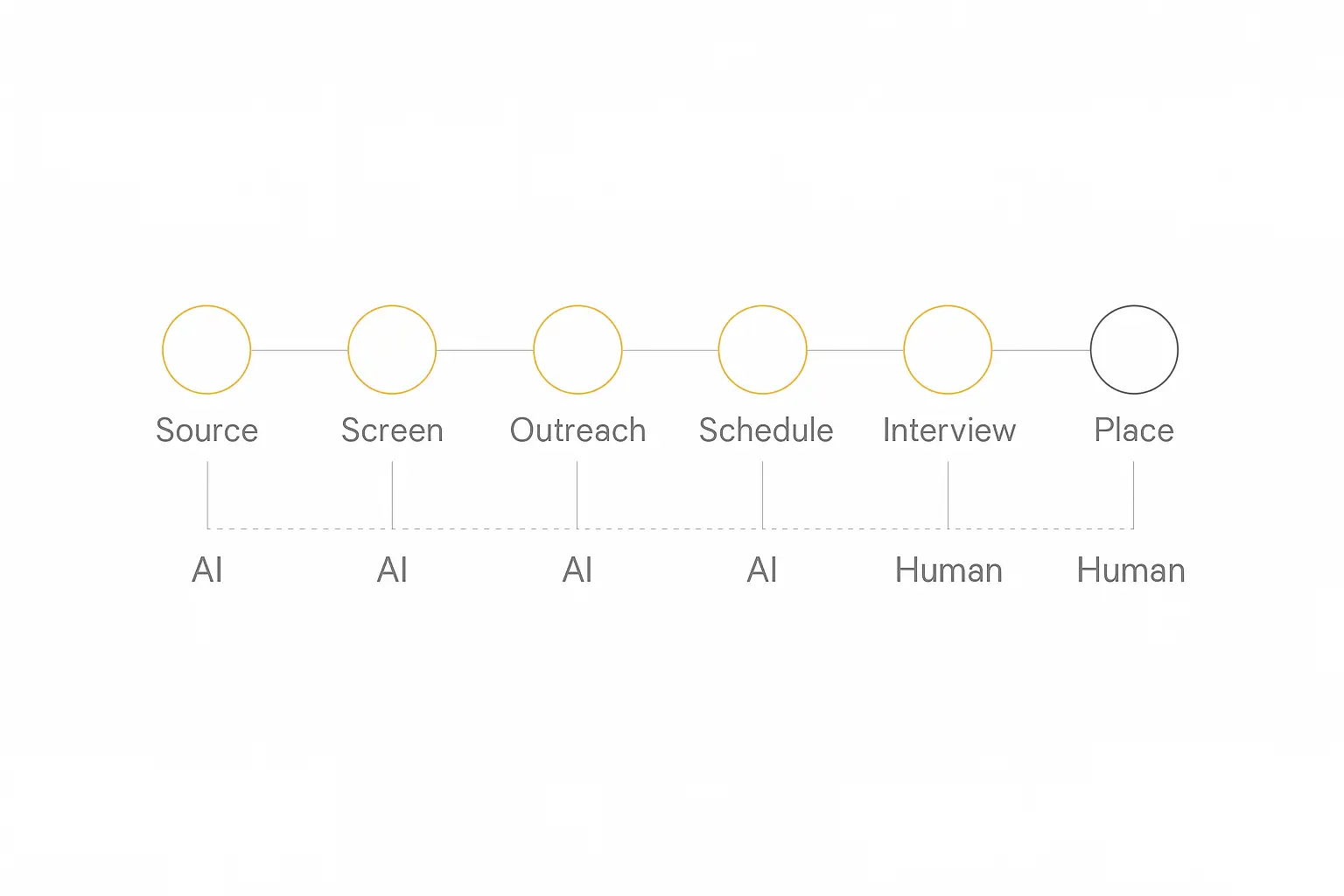
An AI agent owns a process end-to-end. You give it a goal — "find five qualified backend engineers in Austin who are open to contract work" — and it figures out the steps, executes them, and comes back with results. It sources candidates, screens their profiles, sends outreach, handles responses, and schedules interviews. Without you touching it between steps.
That's the shift happening in 2026. According to HeyMilo's research, agentic AI now handles roughly 80% of transactional recruitment tasks autonomously. The recruiter's role isn't disappearing — it's evolving from data processor to relationship architect.
The 7 High-Impact Use Cases for AI Agents in Staffing
Not every part of recruiting benefits equally from AI. Here's where agents create the most value, ranked by impact.
1. Candidate Sourcing at Scale
This is where AI agents shine brightest.
A human recruiter sourcing manually produces 2-3 qualified candidates per day. An AI agent scanning LinkedIn, job boards, GitHub profiles, and internal databases delivers 15-30 qualified candidates per day.
The headcount stays the same. The placements triple.
AI sourcing agents don't just keyword-match. The best ones use semantic search to understand that a "staff engineer at a fintech" is relevant when you're looking for a "senior backend developer with payments experience." They read between the lines of profiles and match on capabilities, not just titles.
2. Resume Screening and Ranking
82% of recruiters now use AI to review resumes. The reason is simple: a recruiter screening 200 resumes manually takes 8-10 hours. An AI agent does it in minutes and returns a ranked shortlist with explanations for each ranking.
The critical difference is consistency. Resume fatigue is real — the 150th resume a human reviews gets less attention than the 5th. AI agents evaluate candidate #200 with the same criteria as candidate #1.
That said, there are real risks here. Studies show AI screening tools can favor certain name patterns and demographic signals. I'll cover the bias question in detail below — it's not something you can ignore.
3. Automated Candidate Outreach
Passive candidates — the ones not actively job hunting — are often the best hires. But reaching them requires persistent, personalized outreach that most recruiters don't have time for.
AI agents handle multi-step outreach sequences: personalized initial messages, timed follow-ups, response handling, and warm handoffs to a recruiter when the candidate engages. The key is that each message is contextual — referencing the candidate's actual background, recent projects, or career trajectory.
This is where the line between helpful and creepy matters. The best outreach agents feel like a thoughtful recruiter reached out. The worst ones feel like spam with your name pasted in.
4. Interview Scheduling
Scheduling is the most absurdly time-consuming part of recruiting relative to the value it creates. Coordinating calendars across candidates, hiring managers, and interview panels is pure administrative friction.
AI scheduling agents integrate with calendar systems, propose times, handle rescheduling, send reminders, and manage the entire logistics chain. It's not glamorous, but agencies report it returns 1.5 days per week per recruiter to spend on actual recruiting.
5. AI Voice Agents for Screening Calls
AI voice agents are one of the more surprising developments in staffing. These are agents that actually call candidates, conduct structured screening interviews, and deliver evaluations to recruiters.
Companies like Famulor and Rebecca AI specialize in this space. The voice agent asks pre-defined screening questions, evaluates responses in real time, and generates a structured report with scores, red flags, and recommended next steps.
Is it weird? A little. But for high-volume roles where you need to screen 50+ candidates for basic qualifications, it's dramatically more efficient than a human making those calls one by one.
6. Candidate Engagement and Nurturing
The biggest leak in most agency pipelines isn't sourcing — it's the candidates who go cold between touchpoints. They applied, got screened, and then heard nothing for two weeks while the hiring manager was on vacation.
AI agents maintain continuous engagement: status updates, check-in messages, relevant job alerts, and re-engagement campaigns for candidates who went quiet. They keep your pipeline warm without requiring recruiters to manually manage hundreds of relationships.
7. Compliance Documentation and Reporting
Staffing agencies deal with mountains of compliance paperwork — I-9 verification, background check coordination, credential tracking, labor law compliance. For agencies staffing healthcare, finance, or government roles, this is a massive time sink.
AI agents can automate document collection, flag missing paperwork, track expiration dates on certifications, and generate compliance reports. This is unglamorous but high-ROI work that directly affects your ability to place candidates quickly.
The Real ROI Numbers: What Agencies Are Actually Seeing
Let's talk money. Because the pitch for AI in recruiting is only as good as the results.
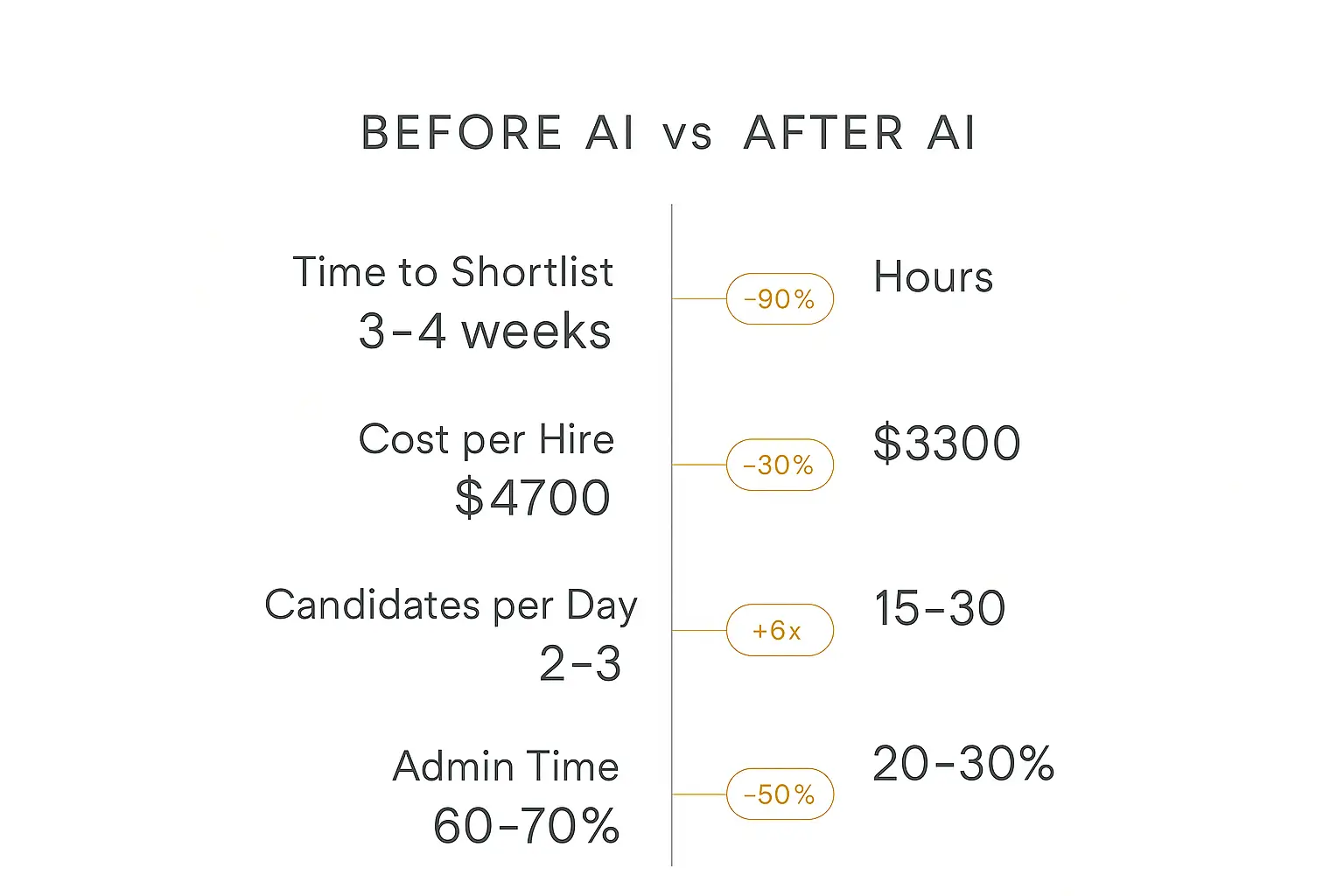
According to The Hire Hub's 2026 ROI analysis, agencies properly implementing AI recruitment tools see 300-500% ROI within the first year. For high-volume staffing, that number can hit 1,000-2,000%.
Here's what moves the needle most:
| Metric | Before AI | After AI | Improvement |
|---|---|---|---|
| Time to shortlist | 3-4 weeks | Hours to days | 75% faster |
| Cost per hire | $4,700 avg (SHRM) | ~$3,300 | 30% lower |
| Candidates sourced/day | 2-3 | 15-30 | 5-10x increase |
| Recruiter time on admin | 60-70% | 20-30% | 1.5 days/week saved |
| Placement rate | Baseline | +23% | Higher quality matches |
| Bad hire rate | Baseline | -30-40% | Better fit assessment |
The key metric to track is revenue per recruiter. If your recruiters are producing more placements at higher margins with the same headcount, AI is working. If they're just screening faster but still missing placements, the problem is downstream. For the adjacent consulting stack, see AI tools for HR consultants.
The Bias Problem: What You Can't Afford to Ignore
Here's where the honest conversation starts.
AI recruiting tools have a bias problem. Research shows that AI screening tools favor white-associated names 85% of the time and show significant gender bias. That's not a theoretical concern — it's measurable, documented, and increasingly litigated.
In 2026, the regulatory landscape is tightening fast:
- The EEOC has made AI bias a top enforcement priority, launching investigations into algorithmic fairness in employment
- Illinois amended its Human Rights Act to explicitly prohibit discriminatory AI use in hiring
- California's ADS Regulations (effective October 2025) bring AI-driven hiring decisions under the Fair Employment and Housing Act
- The Workday lawsuit — where a federal judge allowed age discrimination claims to proceed against AI-powered screening — is setting legal precedent
What this means for staffing agencies: you are liable for the AI tools you use. "The algorithm did it" is not a defense. Agencies need to:
- Audit their AI screening tools for disparate impact across protected classes
- Maintain meaningful human oversight — someone trained and empowered to override the AI
- Keep detailed records of AI-assisted hiring decisions for at least four years
- Provide alternative assessment paths for candidates who may be disadvantaged by automated systems
This isn't optional compliance theater. It's the law in an increasing number of jurisdictions, and the legal trend is clear: more regulation, not less.
How to Actually Implement AI Agents in Your Agency
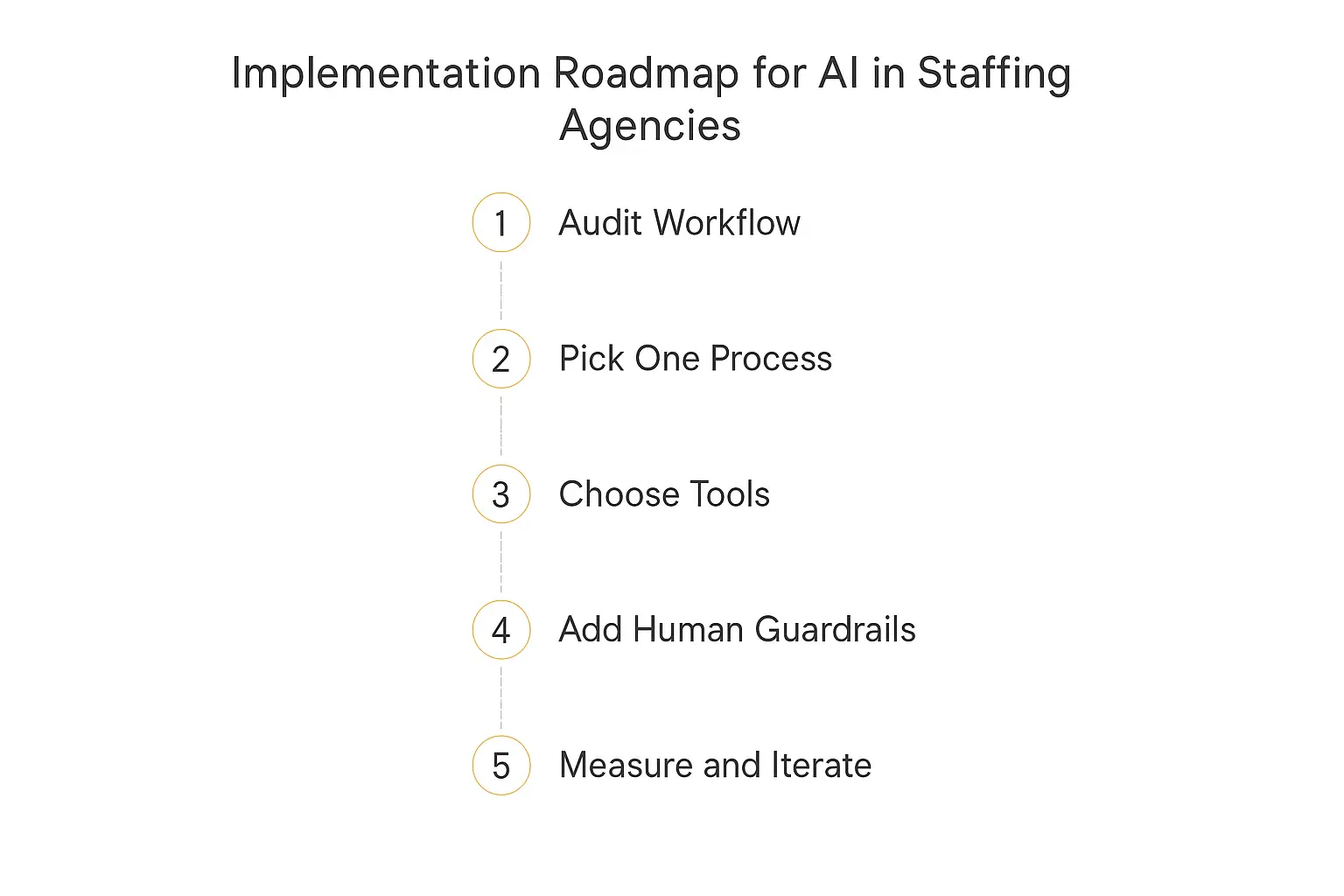
If you're convinced AI agents belong in your recruiting workflow (and you should be), here's the practical path forward.
Step 1: Audit Your Current Workflow
Before buying any tool, map where your recruiters actually spend their time. Use an AI workflow audit approach — track every hour for a week and categorize tasks as:
- Judgment work (candidate evaluation, client relationship, negotiation) — keep human
- Structured processing (resume screening, scheduling, data entry) — automate first
- Communication (outreach, follow-ups, status updates) — partially automate
Most agencies find that 40-60% of recruiter time is spent on structured processing. That's your automation target.
Step 2: Start With One High-Volume Workflow
Don't try to automate everything at once. Pick the workflow that's highest-volume and lowest-risk — typically resume screening or interview scheduling — and prove the ROI there before expanding.
A common mistake is starting with candidate outreach, which is higher-risk because bad outreach damages your brand. Get screening and scheduling working first, then move upstream to sourcing and outreach once you understand how the tools behave.
Step 3: Choose Your Tool Stack
You have two paths:
Path A: Specialized recruiting AI platforms. Tools like Recruiterflow, GoPerfect, Atlas, or Gem have purpose-built AI agents for recruiting workflows. They integrate with your existing ATS and handle the recruiting-specific logic out of the box.
Path B: Build custom agents on a platform. If your workflows are unique — maybe you specialize in a niche vertical, or you need agents that interact with candidates in specific ways — you can build custom AI agents on a no-code platform like Pickaxe. This gives you full control over the agent's behavior, knowledge base, and integrations.
The advantage of Path B is flexibility. You can build agents that know your specific industry, your client requirements, and your screening criteria. For example, a healthcare staffing agency could build a Pickaxe agent that screens for specific certifications, checks credential expiration dates, and handles state-by-state compliance requirements — things a generic recruiting AI won't do well.
Step 4: Set Up Human-in-the-Loop Guardrails
Every AI decision that affects a candidate's livelihood needs a human checkpoint. Period.
Design your workflow so that AI agents recommend and rank, but humans approve and reject. The AI narrows 500 applicants to 20. A recruiter reviews the 20 and selects 8 for interviews. The AI schedules the interviews. A recruiter conducts the final evaluation.
This isn't just about compliance. It's about quality. AI agents are excellent at processing volume and identifying patterns, but they're terrible at reading between the lines — the candidate who's overqualified on paper but perfect for the role because of something they mentioned in passing, or the one whose resume has gaps because they were caregiving for a family member.
Step 5: Measure and Iterate
Track these metrics monthly:
- Placements per recruiter (the ultimate output metric)
- Time to fill by role type
- Candidate satisfaction scores (are candidates having a good experience with your AI?)
- Diversity metrics at each funnel stage (is the AI introducing bias?)
- Recruiter time allocation (is admin time actually decreasing?)
If placements per recruiter aren't going up within 90 days, something is wrong with your implementation — not with the concept.
Build custom AI agents for your recruiting workflow — no code required.
Candidate intake, screening, compliance checks. Deploy as chat, WhatsApp, or API.
Building Custom Recruiting Agents With Pickaxe
For agencies that want more control than off-the-shelf tools provide, Pickaxe offers an interesting approach. Instead of fitting your workflow into someone else's product, you build agents that fit your exact process.
Here are three practical use cases I'd build:
Candidate Intake Agent
Build an agent that handles initial candidate interactions — collecting work history, availability, salary expectations, and role preferences through a conversational interface. Upload your standard intake questionnaire as the agent's knowledge base, connect it to your ATS via actions, and deploy it on your agency's website or via WhatsApp.
Candidates get a better experience than filling out a web form, and your recruiters get structured data in their ATS without manual data entry.
Client Job Brief Agent
Create an agent that helps clients define their job requirements. It asks the right questions — not just "what's the title?" but "what does a successful hire look like in 6 months?" and "what's the team culture like?" — and produces a structured job brief that your team can act on immediately.
Deploy this through a white-labeled portal branded to your agency. Clients see a professional, tech-forward experience. You get better job briefs without spending 30 minutes on a discovery call for every req.
Compliance Screening Agent
For agencies staffing regulated industries (healthcare, finance, government), build an agent that walks candidates through compliance requirements. It can verify certifications, check credential dates, explain licensure requirements by state, and flag any gaps before a recruiter spends time on a candidate who can't be placed.
Feed the agent your compliance documentation and regulatory references. Pickaxe's knowledge base handles the document processing, and you can update it as regulations change.
What the Best Agencies Are Getting Right
Based on what I've seen across the staffing industry in 2026, the agencies winning the AI race share a few patterns:
They specialize. Generalist agencies bolting on "AI capabilities" are getting crushed by agencies that go deep in specific verticals. An AI agent trained on healthcare staffing compliance will always outperform a generic one. Aqore's industry analysis is blunt: agencies that are demonstrably tech-enabled and specialized in high-margin verticals are thriving, while everyone else fights for scraps.
They keep humans in the relationship. The highest-performing teams use AI to handle volume — sourcing, screening, scheduling, data processing — but keep every candidate-facing interaction that matters human. The interview. The offer negotiation. The rejection call. Those are where your agency's reputation is built, and AI can't replicate genuine human empathy (yet).
They treat AI as a recruiter multiplier, not a recruiter replacement. The best metric isn't "how many recruiters did we cut?" It's "how many more placements is each recruiter making?" Korn Ferry's research shows successful recruiters in 2026 spend 60-70% of their time on relationship building — strategic work that was crowded out when they were drowning in admin.
They measure ruthlessly. Every AI tool gets a 90-day trial with clear KPIs. If it doesn't move placements-per-recruiter, candidate satisfaction, or time-to-fill in the right direction, it goes. No sunk-cost fallacy, no "we've invested too much to stop now."
Where AI Agents Still Fall Short
For balance, here's what AI agents genuinely can't do well in recruiting — at least not yet.
Culture fit assessment. AI can screen for skills, experience, and qualifications. It cannot assess whether a candidate will thrive in a specific team's culture. That requires the kind of contextual human judgment that comes from knowing the hiring manager, understanding the team dynamics, and reading the subtle signals in a conversation.
Navigating ambiguous requirements. When a client says they want a "rockstar" or someone with "startup energy," AI takes that literally. A good recruiter knows the client actually means "someone who's comfortable with ambiguity and won't quit when the roadmap changes monthly."
Candidate counseling. Helping a candidate evaluate competing offers, negotiate compensation, or make a career-defining decision — this is relationship work that builds your agency's reputation and generates referrals. Don't automate it.
Sensitive situations. Layoff-related hiring, confidential searches, delicate internal politics — these require discretion and emotional intelligence that AI lacks entirely.
Executive and senior-level recruiting. For roles where the candidate pool is small and relationships are everything, AI sourcing adds minimal value. You're not screening 500 resumes for a CFO position. You're calling the 8 people you already know.
The Future: What's Coming in 2027 and Beyond
Based on current trajectories, here's what I'd bet on for the next 12-18 months:
Fully autonomous recruiting cycles for commodity roles. For high-volume, low-complexity positions (warehouse workers, delivery drivers, retail associates), AI agents will handle the entire recruiting cycle — source to start date — with minimal human involvement. This is already happening at scale inside large staffing firms.
Real-time skills verification. Instead of trusting resumes, AI agents will verify skills through integrated assessment platforms — code challenges for developers, simulation exercises for customer service reps, portfolio analysis for designers. The resume becomes less relevant as skills become directly testable.
Predictive talent matching. AI agents won't just match candidates to open roles. They'll predict which candidates are likely to become available (based on job tenure, market signals, LinkedIn activity) and proactively build relationships before a role opens. This shifts agencies from reactive to predictive.
Multi-agent orchestration. Rather than one AI doing everything, expect specialized agents working in teams: a sourcing agent feeding candidates to a screening agent, which hands qualified candidates to a scheduling agent, which coordinates with a compliance agent. Each agent is purpose-built for one job and excellent at it. This is the multi-agent architecture pattern that's taking hold across every industry.
Want to build AI agents tailored to your staffing niche?
Pickaxe lets you create, deploy, and monetize custom agents without writing code.
Frequently Asked Questions
Will AI replace recruiters and staffing agencies?
No — but it will replace recruiters who don't use AI. The role is shifting from administrative processing to strategic relationship building. Agencies that combine AI efficiency with human judgment will outperform both pure-AI and pure-human approaches. Korn Ferry's data shows the highest-performing teams use AI for volume while keeping humans in charge of decisions.
How much does it cost to implement AI in a staffing agency?
AI recruiting platforms range from $50-500/month per recruiter seat. Enterprise solutions are typically custom-priced. Building custom agents on a platform like Pickaxe starts at $19/month. The ROI typically arrives within 90 days for screening automation and 6 months for full-pipeline AI. Agencies report 300-500% ROI in the first year.
Is AI recruiting legal? What about discrimination?
AI recruiting is legal, but it's increasingly regulated. The EEOC requires human oversight of AI hiring decisions. Illinois, California, New York City, and other jurisdictions have specific AI hiring laws. Your agency is liable for discriminatory outcomes whether a human or an algorithm made the decision. Legal compliance isn't optional — audit your tools and maintain human oversight at every stage.
What's the best AI recruiting tool for small staffing agencies?
For agencies with 5-15 recruiters, start with your ATS's built-in AI features (most major platforms have added them in 2026). If you need custom workflows, a no-code agent builder like Pickaxe gives you flexibility without requiring a dev team. For the highest ROI, focus AI on resume screening and scheduling first — those are the biggest time drains with the lowest implementation risk.
How do candidates feel about AI in recruiting?
It's mixed. Candidates appreciate faster response times and 24/7 availability. They don't appreciate feeling like they're talking to a machine during a process that's deeply personal. The consensus is clear: use AI behind the scenes for processing, but keep human touchpoints where they matter — interviews, offers, rejections, and career advice.
Can I build my own recruiting AI agents?
Yes. Platforms like Pickaxe let you build custom AI agents without coding. You can create agents for candidate intake, screening, compliance checks, and client-facing workflows, then deploy them as chat widgets on your site, WhatsApp bots, or white-labeled portals. If your agency has unique workflows — especially in specialized verticals — custom agents often outperform generic recruiting AI tools.
The Bottom Line
AI agents aren't coming to the staffing industry. They're here. 84% of talent acquisition leaders are planning AI adoption in 2026, and the agencies that move now will have a structural advantage over those who wait. Planning it and running it are two different things, and the distance between them is the AI adoption gap.
The pattern is consistent across every agency that's doing this well: automate the volume, humanize the relationships. Let AI agents handle the screening, scheduling, sourcing, and compliance paperwork. Let your recruiters spend their time where it actually matters — building relationships with candidates and clients that generate placements and referrals.
Start small. Pick one workflow. Measure the results. Scale what works.
If you want to build custom AI agents tailored to your agency's specific workflow — candidate intake bots, compliance screeners, client brief tools — Pickaxe lets you do that without writing a line of code. It's the fastest way to go from idea to deployed agent, and you can start building today.