

AI voice agents went from a gimmick to a genuine business tool faster than almost anyone predicted. I've been watching this space closely — and over the past few months, I looked into every major AI voice agent platform on the market to figure out which ones actually deliver on the promise of autonomous, human-sounding phone conversations.
The short version? The technology has hit a real inflection point in 2026. The voice AI agents market is projected to grow at a staggering 34.8% CAGR, reaching $47.5 billion by 2034. Production deployments grew 340% year-over-year across 500+ organizations. And Gartner is forecasting $80 billion in contact center labor cost savings this year alone.
But here's what most "top AI voice agents" lists won't tell you: these platforms are wildly different from each other. Some are developer-first API toolkits. Some are no-code builders designed for marketing agencies. Others are enterprise behemoths that require six-figure annual contracts and months-long implementations.
Picking the wrong one wastes months and budget. So I broke this down by what each platform actually excels at, what it costs in practice (not just the headline price), and who should use it. Let's get into it.
Quick Comparison: Top AI Voice Agents in 2026
Before we dive deep, here's the landscape at a glance:
| Platform | Best For | Starting Price | Latency | Key Strength |
|---|---|---|---|---|
| Vapi | Developers | $0.05/min + LLM costs | Sub-second | API flexibility |
| Retell AI | Production performance | $0.07/min | ~600ms | Lowest latency |
| Synthflow | No-code teams | $29/mo | <500ms | Visual builder |
| ElevenLabs | Voice quality | Free / $5/mo | Real-time | Best-in-class voices |
| Lindy | Workflow automation | Free / $49.99/mo | Real-time | Multi-agent orchestration |
| Bland AI | Enterprise scale | $299/mo + $0.09/min | Enterprise-grade | 1M+ concurrent calls |
| Voiceflow | Conversation design | Free / $60/editor/mo | Varies | Visual prototyping |
| PolyAI | Enterprise contact centers | ~$150K+/year | Optimized | 80%+ containment rate |
| Cognigy | Large-scale automation | Custom enterprise | Enterprise-grade | CCaaS integration |
| CloudTalk | SMB sales teams | $19/user/mo | Real-time | CRM integrations |
| Dialpad | Real-time coaching | $27/user/mo | Real-time | Live agent coaching |
| Sierra AI | Brand governance | ~$150K+/year | Multi-model | Brand-aligned voice |
Now let's break down each one in detail.
1. Vapi — Best Developer-First Voice AI Platform
If you're a developer who wants maximum control over every aspect of your voice agent, Vapi is the platform to start with. It's API-first, infinitely customizable, and gives you granular control over the entire voice pipeline.
What sets Vapi apart is the architecture. You can choose your own LLM (GPT-4, Claude, Gemini, or open-source models), your own voice provider (ElevenLabs, Azure, PlayHT), and your own telephony stack. The platform handles the orchestration — turn-taking, interruption detection, backchanneling — while you control the brains.
The Squads feature is particularly clever. It lets you chain multiple specialized agents inside a single call, so a receptionist agent can warm-transfer to a booking agent, which can then hand off to a support agent — all without the caller knowing they're talking to different AI systems.
Pricing
- Platform fee: $0.05/minute
- LLM, voice, and telephony costs: Billed separately (typically adds $0.20-0.28/min)
- Real-world total: ~$0.30-0.33/minute all-in
- Free trial: $10 in credits to start
What Stood Out
- Unmatched flexibility — choose every component of the voice stack
- Function calling mid-conversation lets agents check CRMs, book appointments, or trigger workflows in real time
- Knowledge base support (RAG) for uploading internal docs
- Sub-second latency when properly configured
What Could Be Better
- The layered pricing makes costs unpredictable until you've benchmarked your stack
- Non-technical teams are effectively locked out
- Documentation could be more beginner-friendly
Bottom line: Vapi is the power tool. If you have developers on staff and want to build exactly the voice agent you need, there's nothing more flexible. If you don't have developers, look further down this list.
2. Retell AI — Best for Production Performance
Retell AI has one obsession: latency. And it shows. With response times around 600ms — among the fastest in the industry — conversations with a Retell-powered agent feel genuinely natural. No awkward pauses, no robotic timing.
Retell sits in a sweet spot between developer flexibility and no-code accessibility. You get a drag-and-drop builder for simple flows, but the API is there when you need it. The post-call analysis is particularly impressive — it tracks outcomes, flags sentiment, and integrates directly with HubSpot and Slack.
For teams that need production-ready voice agents with SOC 2, HIPAA, and GDPR compliance out of the box, Retell is hard to beat.
Pricing
- Pay-as-you-go: $0.07/minute (no platform fee)
- At scale: ~$0.05/minute
- Phone numbers: $2-5/month
- No minimum commitment
What Stood Out
- ~600ms latency is the fastest I've seen in production
- Transparent per-minute pricing with no hidden fees
- SOC 2 Type II, HIPAA, and GDPR compliant
- Solid post-call analytics with sentiment tracking
What Could Be Better
- Per-minute costs can accumulate with high call volumes
- Requires some comfort with LLM configuration
- Fewer pre-built templates than no-code competitors
Bottom line: Retell is the Goldilocks option — flexible enough for developers, accessible enough for product teams, and fast enough for production. The transparent pricing is refreshing in a market full of hidden costs.
3. Synthflow — Best No-Code Voice Agent Platform
If you're an agency, marketing team, or business that wants to deploy voice agents without touching a single line of code, Synthflow is where I'd start. The visual conversation builder is genuinely intuitive, and you can go from zero to a working phone agent in a matter of days.
Synthflow has carved out a strong position in the agency and SMB market. The platform includes voice cloning, 50+ language support, and bring-your-own-carrier (BYOC) options — features that agencies love because they can white-label everything for clients.
The sub-500ms latency is impressive for a no-code tool. Most no-code platforms sacrifice performance for ease of use. Synthflow doesn't.
Pricing
- Starter: $29/month — 5,000 minutes included
- Growth: $99/month — 20,000 minutes
- Scale: $249/month — 60,000 minutes
- HIPAA support available on higher tiers
What Stood Out
- Genuinely no-code — non-technical team members can build and manage agents
- Sub-500ms response times rival developer-built solutions
- Voice cloning and BYOC for white-label deployments
- Transparent pay-as-you-go pricing
What Could Be Better
- Complex multi-step scenarios can hit platform limitations
- The logic blocks still require understanding of conversation flow design
- Opinionated patterns may frustrate teams wanting deep customization
If you're already building AI agents for clients using Pickaxe for chat and text-based interactions, Synthflow is a natural companion for adding phone capabilities. Build the AI logic and knowledge base in Pickaxe, deploy the voice interface through Synthflow.
Bottom line: Synthflow is the easiest way to get a production voice agent running without developers. Perfect for agencies and SMBs that need speed over customization.
4. ElevenLabs Conversational AI — Best Voice Quality
Nobody makes AI voices sound as good as ElevenLabs. That's not hyperbole — their text-to-speech technology produces voices with natural intonation, emotional inflection, and pacing that other platforms simply can't match. The company raised to an $11 billion valuation and is generating $330 million in annual recurring revenue. The quality speaks for itself.
ElevenLabs has expanded beyond pure TTS into full conversational AI agents. You can now build voice agents that handle real-time phone conversations — not just generate audio clips. The voice cloning is exceptional, supporting 90+ languages with emotional range that captures tone, pacing, and subtle inflection.
The key consideration: ElevenLabs excels at the voice layer, but it's not a full telephony platform. For complete phone agent functionality, you'll likely pair it with a platform like Vapi or Retell that handles the call orchestration.
Pricing
- Free: 10,000 credits/month
- Starter: $5/month — 30,000 credits
- Creator: $11/month — 100,000 credits
- Pro: $99/month — 500,000 credits
- Scale: $330/month — 2,000,000 credits
- HIPAA and PCI compliance available on higher tiers
What Stood Out
- Best-in-class voice quality — period
- Voice cloning that's indistinguishable from the original speaker
- 90+ language support with natural pronunciation
- Emotional inflection control for different conversation contexts
What Could Be Better
- Credit-based pricing is hard to forecast at scale
- Not a complete telephony stack on its own
- Compliance certifications are limited compared to enterprise platforms
Bottom line: If voice quality is your top priority — and for many brands, it should be — ElevenLabs is the gold standard. Pair it with a platform like Vapi for the full voice agent experience.
5. Lindy — Best for Workflow Automation
Lindy approaches voice AI differently from everyone else on this list. It's not just a voice agent — it's a full workflow automation platform that happens to have excellent voice capabilities.
The real power is in orchestration. With Lindy, your voice agent can simultaneously handle phone calls, trigger follow-up emails, update your CRM, create tasks in project management tools, and coordinate with other AI agents — all from a single drag-and-drop workflow builder. It supports 30+ languages, handles simultaneous calls, and automatically generates post-call summaries and logging.
For teams that need voice agents as part of a larger automated workflow (not just standalone phone answering), Lindy is the most capable option I've seen.
Pricing
- Free: 400 credits/month
- Pro: $49.99/month — 5,000 credits
- Business: $199.99/month — 20,000 credits
What Stood Out
- Multi-agent orchestration — voice agents working alongside email, CRM, and task agents
- Genuinely natural conversation quality
- Extensive template library for common workflows
- Automatic post-call logging and summaries
What Could Be Better
- Complex workflow logic requires understanding of automation concepts
- Credit consumption varies significantly depending on workflow complexity
- The sheer breadth of features can feel overwhelming initially
Bottom line: If your voice agent needs to do more than just answer the phone — if it needs to trigger actions, coordinate workflows, and work alongside other AI agents — Lindy is the platform that ties it all together.
6. Bland AI — Best for Enterprise Scale
Bland AI is built for organizations that need to handle massive call volumes. We're talking up to 1 million concurrent calls. That kind of scale isn't relevant for most businesses, but for large enterprises running contact centers, outbound campaigns, or multi-region operations, it's a differentiator.
The platform runs on a proprietary voice and model stack, which means Bland controls the entire pipeline from speech recognition to response generation to voice synthesis. Their Conversational Pathways feature gives you granular control over call routing, API triggers, and multi-step conversation flows. If you are assembling your own pipeline, our speech-to-text API comparison covers the recognition layer and the checks it needs before deployment.
The trade-off is transparency. Bland's pricing isn't straightforward, and the platform requires meaningful engineering involvement to deploy.
Pricing
- Build plan: $299/month
- Scale plan: $499/month
- Per-minute: $0.09/min base (real costs: $0.09-0.14/min with add-ons)
- Add-ons: Custom voices ($0.02/min), knowledge base ($0.01/min), call recording ($0.01/min)
- Enterprise: Custom pricing
What Stood Out
- Extreme concurrency — up to 1M simultaneous calls
- Full-stack proprietary infrastructure for maximum control
- Multi-region deployment and GDPR-friendly architecture
- Detailed call performance analytics and sentiment analysis
What Could Be Better
- Pricing opacity — add-ons push costs higher than the headline rate
- Requires engineering involvement for meaningful deployments
- May be overkill for businesses handling fewer than 10,000 calls/month
Bottom line: Bland AI is the heavy artillery. If you're running a contact center operation at serious scale, it delivers. For everyone else, lighter platforms will serve you better.
7. Voiceflow — Best for Conversation Design
Voiceflow takes a fundamentally different approach. It's a conversation design platform first, and a deployment tool second. Think of it as Figma for voice and chat agents — a collaborative workspace where designers, product managers, and developers can prototype, test, and iterate on conversation flows together.
The drag-and-drop canvas is best-in-class for visual conversation design. You can map out complex dialogue trees, test them in real time with your team, and ship them to production — all from the same interface. Voiceflow is also technology-agnostic, meaning you're not locked into a specific LLM, voice provider, or telephony stack.
The catch: Voiceflow handles the design and logic layer, but you'll need external infrastructure for actual phone calls and telephony. It's a design tool that connects to calling platforms, not a calling platform itself.
Pricing
- Free: Limited features for individuals
- Pro: $60/editor/month
- Business: $150/editor/month
- SOC 2 and ISO 27001 compliant
What Stood Out
- Best-in-class visual conversation design tools
- Real-time team collaboration on conversation flows
- Technology-agnostic — no vendor lock-in
- Fast prototyping (hours to days, not weeks)
What Could Be Better
- Not a full telephony solution — requires external calling infrastructure
- Per-editor pricing gets expensive for large teams
- More of a design tool than a production deployment platform
Bottom line: If your team needs to design complex conversation flows collaboratively before deploying them, Voiceflow is the best tool for that specific job. Pair it with a platform like Vapi or Retell for the actual voice infrastructure.
Build AI agents that go beyond voice
Pickaxe lets you create multi-modal AI agents with custom knowledge, actions, and deployment options.
8. PolyAI — Best for Enterprise Contact Centers
PolyAI is purpose-built for one thing: replacing or augmenting enterprise contact center agents. And they're exceptionally good at it. Their voice agents consistently achieve 80%+ containment rates, meaning four out of five calls are fully resolved without human intervention.

What makes PolyAI different from the developer platforms is the domain-specific pre-training. Their models are trained on massive datasets of real contact center conversations, so they understand the patterns, edge cases, and emotional dynamics of customer service calls out of the box.
A Forrester study found that companies deploying PolyAI achieved 331-391% three-year ROI, saving $10.3 million in agent labor costs over three years with a payback period of under six months.
Pricing
- Enterprise-only: Typically ~$150,000+/year minimum
- Custom pricing based on call volume and complexity
- Implementation support included
What Stood Out
- 80%+ containment rates — the highest I've seen
- Pre-trained on real contact center data, not generic conversations
- Multilingual support for global operations
- SOC 2 compliant with strong human handoff capabilities
What Could Be Better
- $150K+ annual minimum puts it out of reach for SMBs
- Custom pricing makes comparison shopping difficult
- Longer implementation cycles than self-service platforms
Bottom line: If you're running a contact center with 50+ agents and handling hundreds of thousands of calls, PolyAI is the enterprise-grade solution that actually delivers on the ROI promise. The numbers back it up.
9. Cognigy — Best for Contact Center Automation
Cognigy goes after the same enterprise contact center market as PolyAI, but with a different angle: deep integration with existing CCaaS (Contact Center as a Service) infrastructure. If your company already runs on Avaya, Amazon Connect, Genesys, or similar platforms, Cognigy plugs directly into that stack.
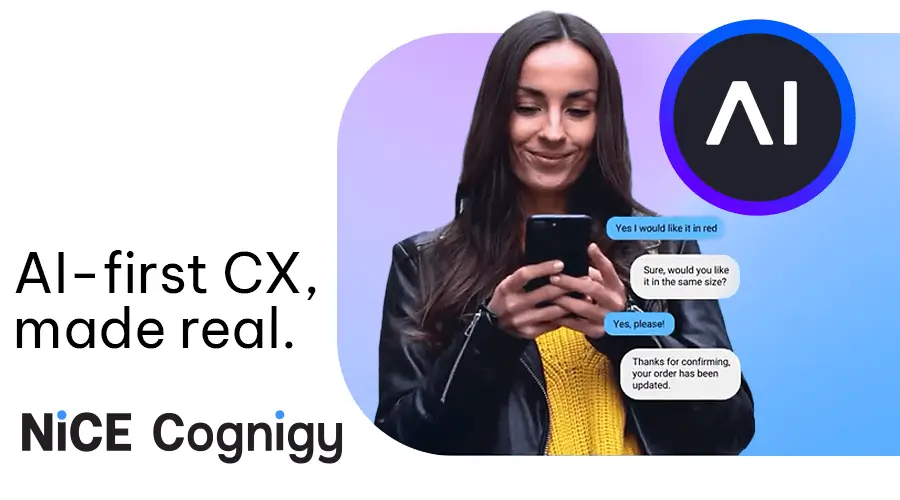
The AI Agent Manager is a visual builder that lets operations teams design complex multi-step conversation flows with agentic reasoning capabilities. The agents can handle branching logic, context switching, and multi-turn conversations that would trip up simpler platforms.
Cognigy is built for teams with IT departments, operations teams, and existing contact center infrastructure. It's not a startup-friendly platform — and it doesn't try to be.
Pricing
- Custom enterprise pricing (not publicly available)
- Typically requires enterprise sales engagement
- Implementation involves IT and operations collaboration
What Stood Out
- Seamless integration with Avaya, Amazon Connect, and Genesys
- Agentic reasoning for complex multi-step interactions
- Comprehensive analytics and insights dashboard
- Production-ready for large contact center environments
What Could Be Better
- Not suited for solo builders or small teams
- Significant learning curve and implementation timeline
- Requires IT and operations collaboration for deployment
Bottom line: Cognigy is the right choice when you have existing contact center infrastructure and need an AI layer that integrates natively rather than replacing everything. Enterprise-grade through and through.
10. CloudTalk — Best for SMB Sales Teams
CloudTalk is what happens when you build a voice AI platform specifically for sales teams. While the enterprise players focus on contact centers and custom deployments, CloudTalk targets growing businesses that need intelligent calling capabilities without the six-figure price tag.
The platform combines AI-powered call handling with a full business phone system — voicemail, call routing, IVR, call recording, and analytics. The AI layer adds real-time transcription, smart call routing, and automated post-call summaries that log directly to your CRM.
For SMB sales teams using HubSpot, Salesforce, or Pipedrive, CloudTalk integrates natively and starts working immediately. No developer required.
Pricing
- Starter: $19/user/month
- Essential: $29/user/month
- Expert: $49/user/month
- Custom: Enterprise pricing
What Stood Out
- Native CRM integrations (HubSpot, Salesforce, Pipedrive) that actually work
- Affordable per-seat pricing for growing teams
- AI-powered call summaries and sentiment analysis
- International numbers in 160+ countries
What Could Be Better
- AI features are less advanced than dedicated voice AI platforms
- Not designed for fully autonomous agent conversations
- Best for augmenting human sales teams, not replacing them
CloudTalk works well alongside AI agent platforms like Pickaxe. You can use Pickaxe to build an AI onboarding agent that qualifies leads through chat, then hand off warm prospects to your sales team on CloudTalk for the human conversation that closes the deal.
Bottom line: If you're a sales team that wants AI to make your human reps more effective (rather than replacing them), CloudTalk is the most practical option at a price that makes sense for growing businesses.
11. Dialpad — Best for Real-Time Sales Coaching
Dialpad takes a unique approach to voice AI. Instead of building autonomous agents that replace humans, it builds AI that makes human agents better in real time. Their AI Live Coach displays suggested responses, relevant information, and coaching cues on the rep's screen as the call happens.
The backbone is DialpadGPT, their proprietary language model trained specifically on business conversations. It powers real-time transcription, automatic call summaries (AI Recaps), performance scoring (AI Scorecards), and customer satisfaction prediction (AI CSAT). According to Dialpad, the Live Coach feature reduces call wrap-up time by 50%.
Pricing
- Standard: $27/user/month
- Pro: $35/user/month
- Enterprise: Custom pricing (99.9% uptime SLA, SSO included)
What Stood Out
- Real-time coaching cues are a genuine productivity multiplier
- Proprietary DialpadGPT model purpose-built for business conversations
- AI Scorecards automate quality management across the team
- Unified voice, messaging, and video in one platform
What Could Be Better
- The integrated approach may be overkill if you only need voice AI
- Not designed for fully autonomous AI agents
- Best value when you use the full communications suite
Bottom line: Dialpad is the best choice for sales and support organizations that want AI to amplify their human teams. The real-time coaching and automated quality management are genuinely powerful for team productivity.
12. Sierra AI — Best for Brand-Aligned Voice Experience
Sierra AI is the most opinionated platform on this list — and that's by design. It's built for brands that need their AI voice agent to sound, behave, and enforce policies exactly like their best human agent.

The key differentiator is brand governance. Sierra's multi-model architecture lets you tune agent behavior down to specific phrases, tone, and policy guardrails. If your brand voice is warm and casual, the agent sounds warm and casual. If it's formal and precise, the agent adapts accordingly. The platform also includes built-in action capabilities — agents can process returns, update subscriptions, and make changes in backend systems.
Sierra works across voice and digital channels, making it a true omnichannel solution for brands that need consistency everywhere.
Pricing
- Enterprise-only: ~$150,000+/year minimum
- Custom pricing tied to deployment scope
- Implementation support and ongoing optimization included
What Stood Out
- Unmatched brand alignment and tone control
- Multi-model architecture for different conversation types
- Built-in policy guardrails and governance controls
- Action-oriented agents that can make changes in backend systems
What Could Be Better
- High starting cost puts it out of reach for most businesses
- Complex setup requiring significant collaboration
- Some reported bugs compared to more focused competitors
Bottom line: Sierra is for established brands that consider their customer experience a core competitive advantage and want AI voice agents that maintain that standard. The price tag reflects the level of customization and governance you get.
The Real Cost of AI Voice Agents
Let's talk about what these platforms actually cost in practice, because the headline prices can be misleading.
Most AI voice agent platforms quote a base per-minute rate, but the real cost includes LLM inference, text-to-speech, speech-to-text, and telephony fees. Here's a realistic breakdown:
| Cost Component | Typical Range | Notes |
|---|---|---|
| Platform fee | $0.05 - $0.09/min | The advertised rate |
| LLM inference | $0.05 - $0.15/min | Depends on model choice |
| Text-to-speech | $0.03 - $0.10/min | ElevenLabs is premium; Azure is budget |
| Speech-to-text | $0.01 - $0.04/min | Deepgram and Whisper are common |
| Telephony | $0.01 - $0.03/min | Twilio or built-in |
| Total all-in | $0.15 - $0.40/min | Varies significantly by stack |
Compare that to a human agent at $7-12 per call (per Teneo.ai data), and the economics are compelling. Even at the high end ($0.40/min), a 5-minute AI call costs $2.00 versus $7-12 for a human. That's a 70-85% cost reduction.
As Aakash Gupta noted on X, the voice AI agent market hit $47 billion in 2025 and is tracking toward $89 billion by 2028 — and the real bottleneck isn't latency anymore, it's getting businesses to actually deploy.
How to Choose the Right AI Voice Agent
After looking at all twelve platforms, here's the framework I'd use:
For Startups and SMBs
Start with Synthflow (no-code, fast deployment) or Retell AI (if you have some technical capability). Both offer transparent pricing and low barriers to entry. For sales teams specifically, CloudTalk gives you the best CRM integration at an affordable per-seat price.
For Developers and Technical Teams
Vapi gives you maximum control and flexibility. Pair it with ElevenLabs for voice quality that sounds genuinely human. If you need conversation design collaboration, add Voiceflow to the mix.
For Enterprise Contact Centers
PolyAI for highest containment rates and proven ROI. Cognigy if you need deep integration with existing CCaaS infrastructure. Bland AI if raw scale (1M+ concurrent calls) is your primary requirement.
For Brand-Conscious Companies
Sierra AI for maximum brand governance and tone control. Dialpad if you want AI to augment human agents rather than replace them.
For Workflow-Heavy Use Cases
Lindy when your voice agent needs to be part of a larger automation ecosystem — triggering emails, updating CRMs, coordinating with other AI agents.
Pairing Voice Agents with AI Chat Agents
Here's something I think most businesses miss: voice AI is just one channel. The best customer experiences in 2026 combine voice agents with chat agents, email agents, and workflow automation.
Consider this: a prospect visits your website and interacts with an AI chat agent built on Pickaxe. The agent qualifies them, answers their initial questions, and determines they're ready for a deeper conversation. It schedules a call — and when that call happens, a voice agent picks up with full context from the chat interaction.
This kind of multi-channel AI orchestration is where the real value lives. No single platform does everything perfectly, but the right combination creates an experience that feels seamless to the customer.
With Pickaxe, you can build the chat and text-based side of this equation — client onboarding agents, white-labeled AI tools for clients, and knowledge-based assistants — then connect them to voice platforms through Actions and automation tools like n8n or Make.
If you're running an AI agent agency, offering both chat and voice capabilities is a serious competitive advantage. Most agencies only do one or the other. Doing both — with the right AI platform stack — puts you in a different category entirely.
The Bottom Line
AI voice agents in 2026 have crossed the threshold from "cool demo" to "legitimate business tool." With 80% of businesses planning to integrate AI voice technology into customer service this year, and per-call costs dropping from $7-12 (human) to $0.40 (AI), the economic case is becoming impossible to ignore.
My picks for most businesses:
- Best overall: Retell AI (performance + price + accessibility)
- Best for non-technical teams: Synthflow
- Best voice quality: ElevenLabs
- Best for developers: Vapi
- Best for enterprise: PolyAI
- Best value for sales teams: CloudTalk
The technology is ready. The economics work. The question isn't whether to adopt AI voice agents — it's which platform fits your specific use case and budget.
And if you're looking to build the complete picture — chat agents, voice agents, and workflow automation working together — Pickaxe has a free tier that lets you start building the chat and knowledge-base side of your AI stack today. Pair it with any of the voice platforms above, and you've got a genuinely powerful multi-channel AI operation.