

Here's a stat that caught my attention: 63% of independent RIAs now use AI tools in their practice, according to a 2026 Schwab study. That's more than doubled since 2023. And a Cambridge report puts overall AI adoption in financial services at 81%.
But here's the thing -- only 1 in 10 advisors are fully integrating AI into their strategy. Most are using it for notetaking and email drafts. Maybe a little meeting prep. That's it.
The advisors who are actually pulling ahead are doing something different. They're building a connected stack where AI handles the repetitive work across their entire workflow -- from meeting prep to tax analysis to client onboarding. The firms doing this are saving 10-19 hours per week, which works out to roughly $5,700 in billable time. And 68% of advisors expect AI to be transformative to financial advice within three years.
I looked into the tools that are making a real difference for advisory practices right now. Not every AI chatbot with "finance" in the tagline -- just the platforms that solve real problems advisors face every week. Here are the 15 best AI tools for financial advisors in 2026, organized by what they actually do for your practice.
Quick Comparison: Top 15 AI Tools for Financial Advisors
Before we dig into each one, here's the overview so you can skip to what's most relevant.
| Tool | Category | Best For | Starting Price |
|---|---|---|---|
| Zocks | Meeting Intelligence | AI notetaking without recording | $80/mo |
| Jump AI | Meeting Intelligence | AI meeting prep + follow-up | $75/user/mo |
| Pulse360 | Client Communication | Agendas, summaries, deliverables | Contact for pricing |
| RightCapital | Financial Planning | Tax projections & Roth modeling | $125/mo |
| eMoney Advisor | Financial Planning | AI-powered plan generation | Premium (contact) |
| Holistiplan | Tax Planning | AI tax return analysis | $149/mo |
| FP Alpha | Estate & Insurance | Estate document analysis | $1,790/yr |
| Nitrogen | Risk Analysis | Risk scoring & agentic AI | $245/mo |
| VRGL | Portfolio Analysis | Prospect portfolio teardowns | Contact for pricing |
| Orion | Advisor Platform | Enterprise all-in-one AI | Custom pricing |
| Kwanti | Portfolio Analytics | Analytics & proposals | Free trial |
| Wealthbox | CRM | AI-powered advisor CRM | $59/user/mo |
| Claude | General AI | Deep reasoning & document analysis | Free / $20/mo |
| Perplexity | Research | Cited real-time research | Free / $20/mo |
| Pickaxe | Custom AI Agents | Building client-facing AI tools | $29/mo |
Meeting Intelligence & Communication
If there's one area where AI has already proven its value for advisors, it's meetings. The average advisor spends hours each week on meeting prep, notetaking, and follow-up. These three tools attack that problem from different angles.
1. Zocks -- The #1 AI Notetaker Built for Financial Advisors
Zocks is purpose-built for financial advisors, and it shows. Unlike generic meeting transcription tools, Zocks was designed from the ground up for wealth management conversations -- it understands the terminology, the compliance requirements, and the workflows that matter to your practice.
What stood out to me most: Zocks doesn't record your meetings. It only stores the notes it generates, not raw audio or video. That's a huge deal in financial services where clients are sharing sensitive financial details. You get the value of AI notetaking without the compliance headache of storing recordings.
Key features:
- Generates structured meeting notes tuned for financial planning conversations
- Saves an average of 45 minutes per meeting on documentation
- Integrates with Holistiplan and eMoney (both on this list)
- SOC 2 Type II certified -- critical for advisory firms handling sensitive client data
- Used by over 5,000+ financial advisory firms
Pricing: $80-$130/month depending on your plan tier.
Strength: The no-recording approach solves the compliance problem that keeps many advisory firms from adopting AI notetakers at all. This is the tool I'd recommend first if compliance is your biggest concern.
Limitation: It's narrowly focused on meeting notes. You won't get the broader meeting prep or follow-up automation that tools like Jump or Pulse360 offer. But it does its one job extremely well.
2. Jump AI -- AI Meeting Prep and Follow-Up
Jump AI takes a different approach than Zocks. Instead of just capturing what happens in the meeting, it focuses on what happens before and after -- the prep work and the follow-through.

Before each client meeting, Jump pulls data from your CRM, portfolio management system, tax records, and estate documents to generate a comprehensive pre-meeting briefing. You walk into every meeting already knowing the key talking points, recent account changes, and open action items.
Key features:
- AI-generated pre-meeting briefings that pull from CRM, portfolio, tax, and estate data
- Generates proposals and talking points automatically
- Post-meeting follow-up with action items and next steps
- Connects across your existing tech stack to create a unified view
Pricing: $75-$175/user/month depending on features and integrations.
Strength: The pre-meeting briefing is genuinely valuable. Walking into a review meeting with a synthesized view of the client's entire financial picture -- portfolio performance, tax situation, estate status -- saves significant prep time and makes you look incredibly prepared.
Limitation: The value scales with how many data sources you connect. If you're running a lean tech stack with just one or two tools, you won't get as much out of Jump's data aggregation. Advisors with a deeper integration ecosystem see the biggest returns.
3. Pulse360 -- Client Communication and Deliverables
Pulse360 sits in the space between meeting tools and client communication platforms. It's focused on the documents and deliverables that come out of your client interactions -- agendas, meeting summaries, reports, and follow-up communications.
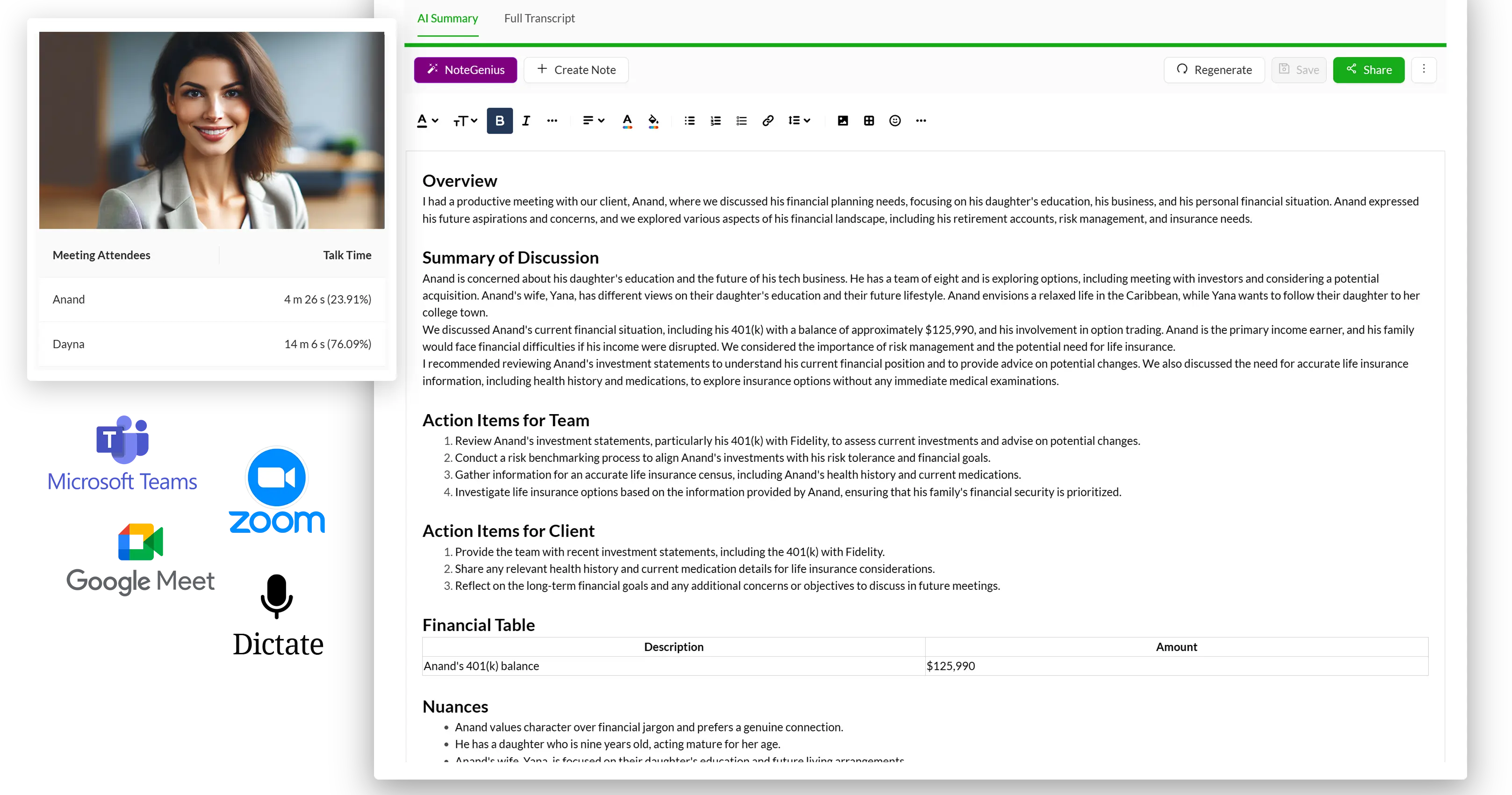
Their NoteGenius AI feature handles the heavy lifting of turning raw meeting notes into polished client deliverables. And their template framework means you can standardize how your firm communicates without every advisor reinventing the wheel.
Key features:
- NoteGenius AI for transforming meeting notes into polished deliverables
- Template framework for agendas, summaries, and client reports
- Cuts meeting prep time from 50+ minutes to about 25 minutes
- Standardizes communication across your firm
Pricing: Contact Pulse360 for current pricing details.
Strength: The template system is where Pulse360 really shines. If you're running a multi-advisor firm and you want consistency in how client communications look and feel, this tool gives you that without requiring everyone to start from scratch.
Limitation: It's a communication and deliverables tool, not a planning or analysis tool. You'll still need something else for the actual financial planning work. Think of it as the layer that sits between your planning tools and your clients.
If you're interested in how other professional services are tackling these same meeting and communication challenges, I covered similar tools in my breakdown of AI tools for consultants.
Financial Planning & Analysis
This is where the tools get more specialized -- and where the real time savings stack up. Financial planning used to mean hours of manual data entry, scenario modeling, and report generation. These four tools are compressing that work dramatically.
4. RightCapital -- AI-Driven Financial Planning
RightCapital has been a strong financial planning platform for a while, but their recent AI additions are what earned them a spot on this list. Their AI-driven analytics layer adds intelligence to what was already a solid planning engine.
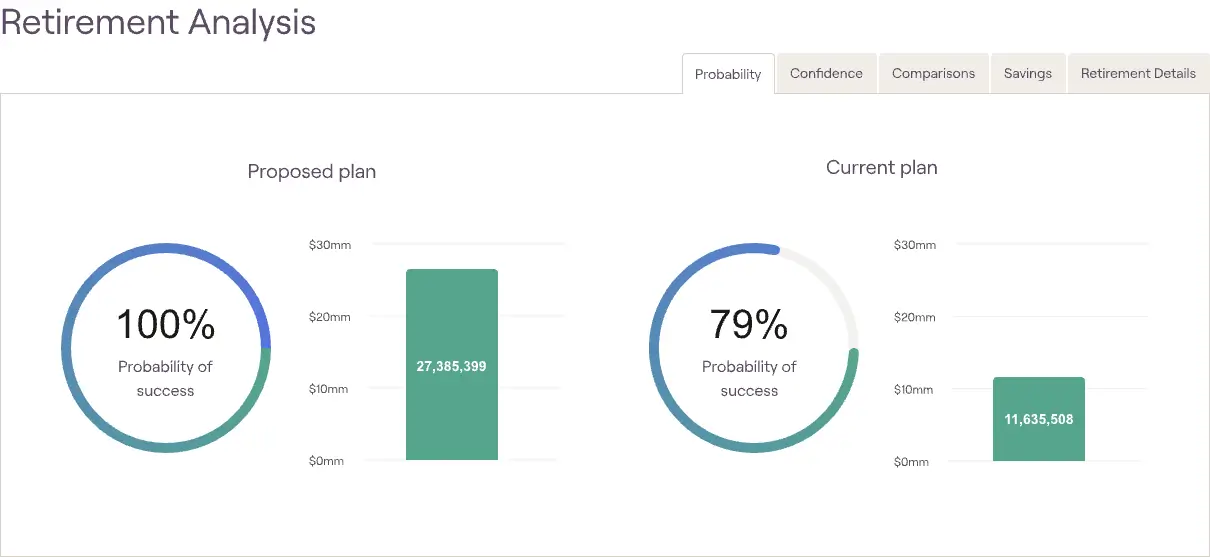
Where I think RightCapital really excels is in Roth conversion modeling, Social Security optimization, and tax projections. These are the complex, multi-variable analyses that used to take advisors hours to run through manually. RightCapital's AI can surface optimal strategies and show clients exactly how different scenarios play out.
Key features:
- AI-driven Roth conversion modeling and optimization
- Social Security claiming strategy analysis
- Tax projection and planning tools
- RightPay -- AI-powered analytics for fee transparency
- Clean, modern interface that clients actually understand
Pricing: $125-$150/month. Positioned well for independent and fee-only advisors.
Strength: The tax planning and Roth conversion tools are best-in-class. If you're a fee-only advisor focused on retirement planning and tax optimization, RightCapital gives you the analytical horsepower to model complex scenarios quickly and present them clearly.
Limitation: If you need deep estate planning or insurance analysis, you'll want to pair RightCapital with a specialist tool like FP Alpha. It's strong on the core financial planning side but not as deep in adjacent planning disciplines.
5. eMoney Advisor -- CoPlanner AI for Instant Plan Generation
eMoney Advisor made a big move with their CoPlanner AI feature. The pitch is straightforward: generate personalized financial plans in seconds instead of hours. And based on what I've seen, it delivers on that promise.

The numbers back it up -- eMoney reports a 48% reduction in plan-building time with CoPlanner. For advisors who are building multiple plans per week, that's hours you're getting back.
Key features:
- CoPlanner AI generates personalized financial plans in seconds
- Account aggregation pulls client data from multiple sources automatically
- Decision Center for real-time scenario modeling with clients during meetings
- Deep integration with the broader Fidelity ecosystem
- 48% reduction in plan-building time
Pricing: Premium pricing (contact eMoney directly). This is positioned for established practices, not advisors just getting started.
Strength: The Decision Center is a game-changer for live client meetings. Being able to model "what if" scenarios in real time while sitting across from a client builds trust and drives decisions in a way that sending a report days later never can.
Limitation: It's the most expensive planning platform on this list. If you're a solo advisor or small firm watching every dollar, the price tag may be hard to justify until you have enough clients to spread that cost across. Also, the Fidelity ecosystem tie-in is a strength if you're already there, but can feel limiting if you're not.
6. Holistiplan -- AI Tax Planning in Under 60 Seconds
Holistiplan does one thing better than almost anyone: it reads client tax returns and surfaces planning opportunities. Upload a 1040, and in under 60 seconds you have a detailed analysis of what's going on and where the opportunities are.

That simplicity is why Holistiplan has captured 39% market share in tax planning for advisors and grown to over 50,000 users. It's not trying to be a full financial planning platform. It's a specialist tool that does its job exceptionally well.
Key features:
- Upload a tax return, get AI-powered analysis in under 60 seconds
- Surfaces tax planning opportunities you might have missed
- Integrates with Zocks (tool #1 on this list) for seamless meeting-to-analysis workflow
- 39% market share in advisor tax planning tools
- 50,000+ users across the advisory industry
Pricing: $149/month or $1,499/year.
Strength: Speed and clarity. There's nothing else on the market that takes a raw tax return and produces actionable planning insights this fast. It's the kind of tool that pays for itself after one or two client tax situations where you catch something you would have otherwise missed.
Limitation: It's tax planning only. For a complete planning view you'll need to pair it with a broader financial planning tool. But that's by design -- Holistiplan integrates cleanly with most major planning platforms. The combination of Holistiplan for tax analysis and RightCapital or eMoney for broader planning is a popular stack for good reason.
7. FP Alpha -- AI Estate and Insurance Planning
FP Alpha covers the planning disciplines that other tools tend to overlook: estates, insurance, trusts, and the other complex documents that most advisors handle with a combination of manual review and gut instinct.
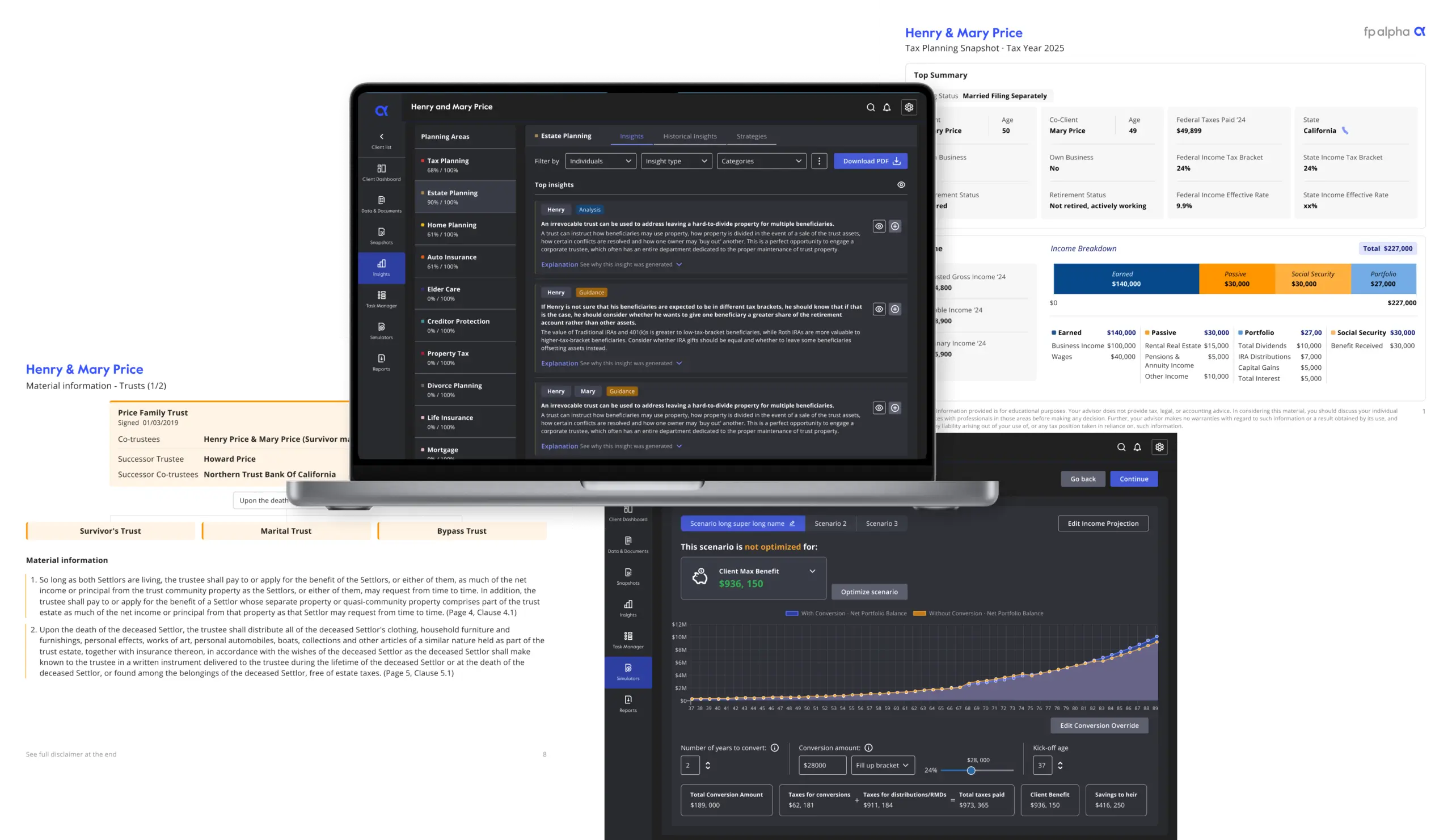
Upload a will, trust, power of attorney, or insurance policy, and FP Alpha's AI reads the document, identifies gaps, and generates actionable recommendations. It covers 16 planning disciplines, which makes it one of the broadest specialized planning tools available.
Key features:
- AI reads wills, trusts, POAs, and insurance policies
- Covers 16 planning disciplines in a single platform
- Identifies gaps and opportunities in estate and insurance plans
- Generates client-ready reports with specific recommendations
Pricing: $1,995/year for the all-in-one package or $1,790/year for estate-only.
Strength: Nothing else on the market gives you this depth across estate and insurance planning with AI. If you're an advisor who wants to deliver comprehensive financial planning -- not just investments and retirement -- FP Alpha fills a critical gap that most other tools ignore.
Limitation: The annual pricing is a commitment, and the ROI depends on how many clients have complex estate situations. If your practice is mostly straightforward retirement planning, you may not use it enough to justify the cost. But for practices serving high-net-worth clients with complex estate needs, it's invaluable.
The combination of tools we've covered so far -- meeting intelligence, tax planning, financial planning, and estate analysis -- forms the core of what I'd call a modern AI-powered advisory stack. Similar to what I've seen happening in legal practices adopting AI, the advisors getting the most out of these tools are the ones connecting them into workflows rather than using them in isolation.
Want to build AI tools your clients actually use?
Pickaxe lets financial advisors create custom AI agents for client intake, onboarding, and portfolio Q&A -- no coding required.
Portfolio, Risk & Investment Analysis
If meeting tools and planning software are where most advisors start with AI, portfolio and risk analysis is where the more advanced firms are gaining an edge. These tools bring institutional-grade analysis to independent advisors who don't have a team of analysts behind them.
8. Nitrogen (Formerly Riskalyze) -- Risk Number and Agentic AI
Nitrogen, which many advisors will remember as Riskalyze, has been a staple in advisory practices for years. Their Risk Number -- a 1-99 scale that quantifies a client's risk tolerance -- is used by over 30,000 advisors and has become the industry standard for risk profiling.

But the big news in 2026 is Nucleus, their new agentic AI engine. This is where Nitrogen shifts from being a risk assessment tool to being an AI-powered advisory assistant. Nucleus can set risk targets, send questionnaires to clients, generate investment proposals, and draft meeting talking points -- all autonomously.
Key features:
- Risk Number (1-99 scale) -- the industry-standard risk tolerance metric
- Nucleus agentic AI engine that automates risk assessment workflows
- Generates investment proposals aligned with client risk profiles
- Drafts meeting talking points based on portfolio and risk analysis
- 30,000+ advisors on the platform
Pricing: $245-$400+/month depending on features and firm size.
Strength: The combination of an established risk profiling methodology with agentic AI is powerful. The Risk Number already gives you credibility with clients. Nucleus adds the automation layer that turns that data into action -- proposals, talking points, and follow-ups -- without manual work.
Limitation: The pricing adds up quickly for multi-advisor firms. And if you're already deep in another portfolio management ecosystem, adding Nitrogen means another integration to manage. The value is clearest for firms that make risk-based investing central to their client conversations.
9. VRGL -- AI Portfolio Analysis for Prospects
VRGL solves a very specific problem: when a prospect walks in with a portfolio from another advisor, how do you quickly and credibly analyze what they have?

VRGL delivers institutional-grade analysis across performance, risk, fees, taxes, and diversification. And they do it fast. Advisors using VRGL report a 75% reduction in portfolio analysis time for prospect portfolios. Even more impressive: firms using VRGL see a 30% increase in conversion rates from prospect to client.
Key features:
- Institutional-grade portfolio analysis across performance, risk, fees, taxes, and diversification
- 75% reduction in time spent analyzing prospect portfolios
- 30% increase in prospect-to-client conversion rates
- Generates professional reports you can present in prospect meetings
- Identifies specific improvement opportunities compared to your proposed approach
Pricing: Contact VRGL for current pricing.
Strength: This is a direct revenue tool, not just a time-saver. If VRGL helps you convert even one or two additional prospects per quarter into clients, the ROI is obvious. The quality of the analysis also sets the tone for the relationship -- prospects see you as thorough and data-driven from the first meeting.
Limitation: VRGL is a prospect conversion tool, not a client management tool. Once you've won the client, you'll need other tools for ongoing portfolio management and reporting. Think of it as the front door of your practice -- incredibly effective at what it does, but focused on one stage of the client lifecycle.
If you're thinking about how to measure the actual ROI of tools like VRGL, I put together a guide on measuring AI agent ROI that covers the frameworks that work for professional services.
10. Orion Denali AI -- Enterprise Advisor Platform
Orion is the enterprise play on this list. Their Denali AI platform pulls data across portfolio management, financial planning, CRM, and reporting into a single AI-powered command center for large advisory firms.
What makes Orion interesting is the breadth. Instead of being great at one thing, it's trying to be the AI layer across your entire practice. Report Assistant, Query Studio, and their Service Bot each tackle different parts of the workflow -- from generating client reports to answering ad hoc questions about your book of business.
Key features:
- Denali AI engine spans portfolio management, planning, CRM, and reporting
- Report Assistant for AI-generated client reports
- Query Studio for natural language queries across your practice data
- Service Bot for automated client service tasks
- Mobile app for on-the-go access to AI features
Pricing: Custom enterprise pricing. Contact Orion directly.
Strength: If you're a larger firm that wants to consolidate your tech stack and add an AI layer across everything, Orion's breadth is a real advantage. The Query Studio feature -- asking questions about your practice in plain English and getting instant answers -- is particularly powerful for firm leaders who need quick insights.
Limitation: The enterprise approach means enterprise complexity. This isn't a tool you sign up for on a Tuesday and start using Wednesday. Implementation takes time, training is required, and the full value only emerges when you've connected your data sources. Not ideal for solo advisors or small firms who want something they can deploy quickly.
11. Kwanti -- Portfolio Analytics and Proposal Generation
Kwanti is the most accessible portfolio analytics tool on this list. It handles portfolio analytics, stress testing, model management, and proposal generation without the complexity or price tag of the enterprise platforms.
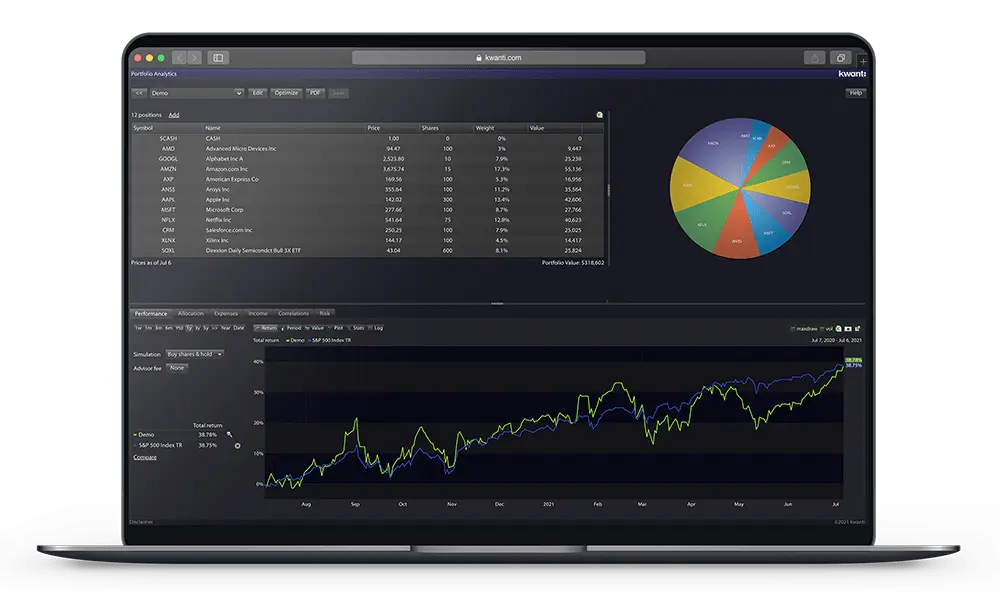
They're building AI-powered natural language queries into the platform, which will let you ask questions about portfolios and models in plain English instead of navigating through dashboards. It's still being developed, but the direction is promising.
Key features:
- Portfolio analytics with stress testing and scenario analysis
- Model management for building and maintaining investment models
- Proposal generation for prospect and client meetings
- AI-powered natural language queries (in development)
- Free 30-day trial to test before committing
Pricing: Free 30-day trial available. Contact Kwanti for subscription pricing.
Strength: Kwanti is the best option for advisors who want solid portfolio analytics without the overhead of an enterprise platform. The free trial means you can actually test it with real scenarios before spending anything. For solo advisors or small firms, that's a big deal.
Limitation: It's not as deep as Nitrogen for risk analysis or as broad as Orion for practice management. The AI features are still catching up to some of the more established competitors. But for the price point, it's hard to argue with the value.
CRM & Practice Management
Your CRM is the hub of your practice. Everything flows through it -- client data, meeting notes, tasks, workflows. An AI-powered CRM doesn't just store information; it acts on it.
12. Wealthbox -- The #1 Rated Advisor CRM with AI Agents
Wealthbox has been the #1 rated advisor CRM on G2 for good reason -- it's clean, modern, and actually pleasant to use. But the AI features they've been rolling out in 2025 and 2026 are what make it stand out right now.
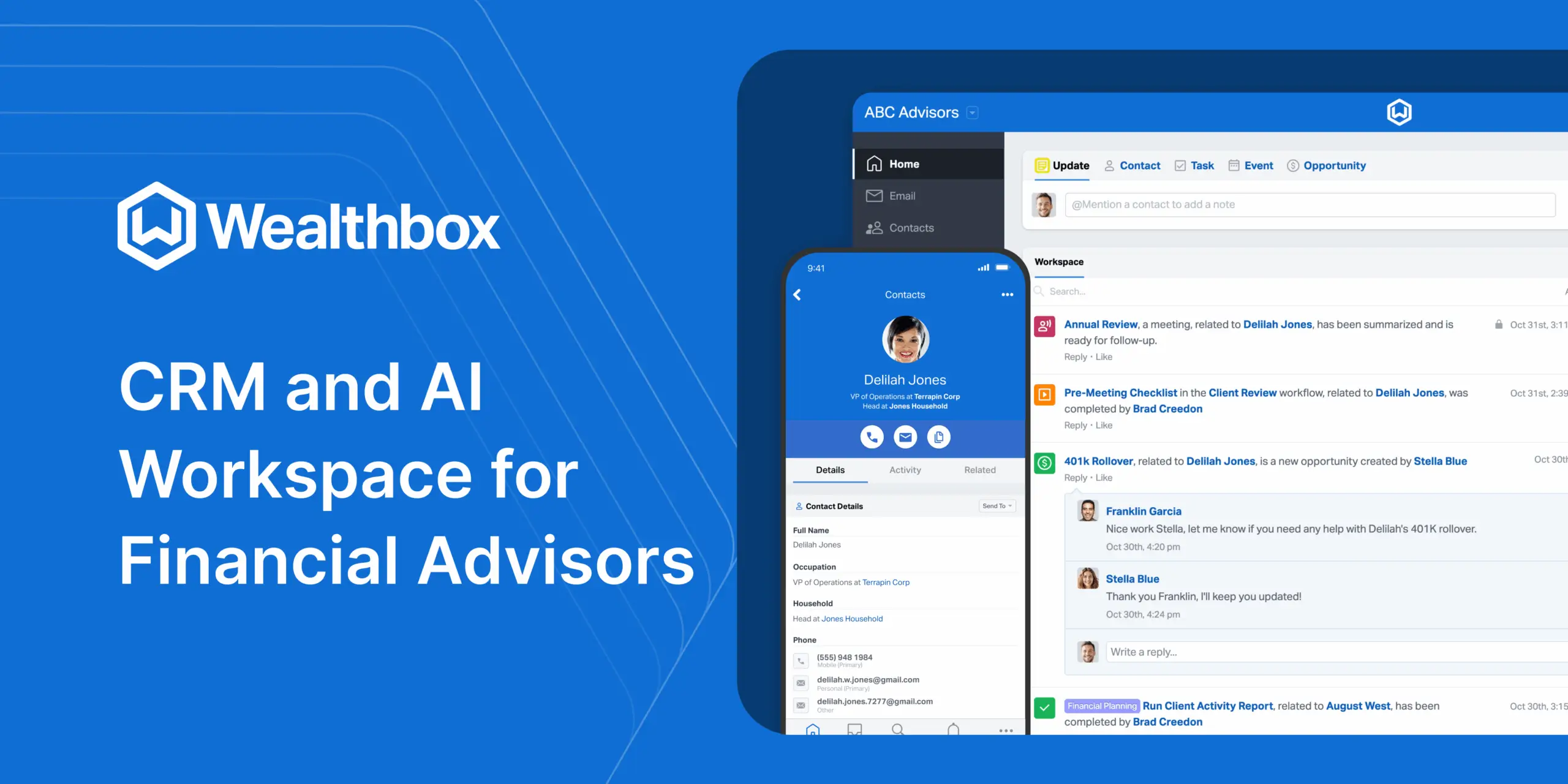
The big addition is AI Agents -- autonomous background processes that handle tasks without your input. Think of them as digital assistants that monitor your CRM data and take action when certain conditions are met. Pair those with Playbooks (multi-step automated workflows) and the AI Assistant (a conversational interface for your CRM), and you've got a CRM that actually reduces your workload instead of adding to it.
Key features:
- AI Agents that run autonomous background processes in your CRM
- Playbooks for building multi-step automated workflows
- AI Assistant for conversational CRM queries and commands
- AI Notetaker add-on for automated meeting documentation ($49/user/mo)
- #1 rated advisor CRM on G2
Pricing: Plans start at $59/user/month. AI Notetaker add-on is an additional $49/user/month.
Strength: Wealthbox nails the balance between power and usability. The AI Agents concept is genuinely forward-thinking for the CRM space -- instead of you remembering to check things and trigger workflows, the system does it for you. If you're curious about what AI agents are and how they work, Wealthbox is a great real-world example of agents operating inside a business tool.
Limitation: The AI features add cost on top of the base CRM price. The Notetaker add-on at $49/user/month means you could be spending $100+/user/month for the full AI CRM experience. If you're already using Zocks or another meeting tool, the Notetaker add-on might be redundant.
Build AI agents your clients interact with directly
Create intake forms, FAQ bots, and onboarding assistants that work 24/7 -- deploy them on your website, WhatsApp, or client portal.
Research & General AI
Every tool above is built specifically for financial advisors. But some of the most valuable AI tools in your stack won't be industry-specific at all. These general-purpose platforms handle the research, analysis, and thinking work that doesn't fit neatly into any one category.
13. Claude -- Deep Reasoning for Complex Financial Analysis
Claude is the AI I'd recommend for the deep thinking work that financial advisors do. When you need to process a 200-page regulatory document, analyze a complex estate plan, or think through multi-step financial scenarios, Claude's extended thinking capability is built for exactly that.

Where Claude stands apart from other general AI tools is its ability to handle long, dense documents without losing the thread. Upload a client's trust documents, tax returns, and financial statements, and Claude can synthesize across all of them to surface insights you might miss reviewing each document separately.
Key features:
- Extended thinking for multi-step financial scenario analysis
- Handles long documents (regulatory filings, trust documents, financial statements) with strong accuracy
- Nuanced reasoning on complex tax, estate, and retirement planning questions
- Excellent at summarizing dense material into clear client communications
- Strong at code and data analysis for advisors who work with spreadsheets
Pricing: Free tier available. Pro plan at $20/month.
Strength: The depth of reasoning is unmatched for complex financial analysis. When you're working through a Roth conversion strategy that involves multiple accounts, tax brackets, and time horizons, Claude can think through the layers in a way that simpler chatbots can't. It's also excellent at turning your analysis into plain-English explanations for clients.
Limitation: Claude doesn't have real-time market data or live financial feeds. It's a reasoning and analysis tool, not a research tool. For real-time information, pair it with Perplexity (next on this list). Also, like any general AI, you need to verify its output against your professional knowledge -- it's a thinking partner, not a replacement for your expertise.
I did a detailed comparison of Claude and other AI reasoning tools in my roundup of top ChatGPT alternatives if you want to go deeper on which general-purpose AI fits your workflow best.
14. Perplexity -- Cited Research for Market Intelligence
Perplexity is the research counterpart to Claude's deep reasoning. While Claude is best at thinking through complex problems, Perplexity is best at finding current information and citing its sources.
For financial advisors, that means real-time market data, regulatory updates, competitor research, and industry trends -- with every claim backed by a source link. No hallucinated statistics, no fabricated citations. You can verify everything Perplexity tells you.
Key features:
- Real-time research with cited sources on every claim
- Market data, regulatory updates, and industry news
- Competitor research for understanding what other firms are doing
- Source verification built into every response
- Clean interface that's fast to use for quick research queries
Pricing: Free tier available. Pro plan at $20/month.
Strength: The citation model is perfect for a regulated industry. When you tell a client something about a new tax law or market trend, you can point to the exact source. Perplexity makes it easy to do the kind of quick, verified research that used to require digging through multiple news sites and regulatory databases.
Limitation: It's a research tool, not an analysis tool. Perplexity will find you the data, but it won't do the deep reasoning about what that data means for your specific client's situation. That's where Claude picks up. The combination of Perplexity for research and Claude for analysis is an incredibly powerful pair.
For more general-purpose AI tools that can boost your productivity across your practice, check out my list of AI productivity tools.
Client-Facing AI Agents
Every tool we've covered so far is for the advisor. This last one is different -- it's about building AI tools that your clients interact with directly.
15. Pickaxe -- Build Client-Facing AI Agents Without Code
Pickaxe is a no-code platform for building, deploying, and monetizing custom AI agents. Think of it as Shopify for agent-powered businesses -- instead of building an online store, you're building AI agents that serve your clients.
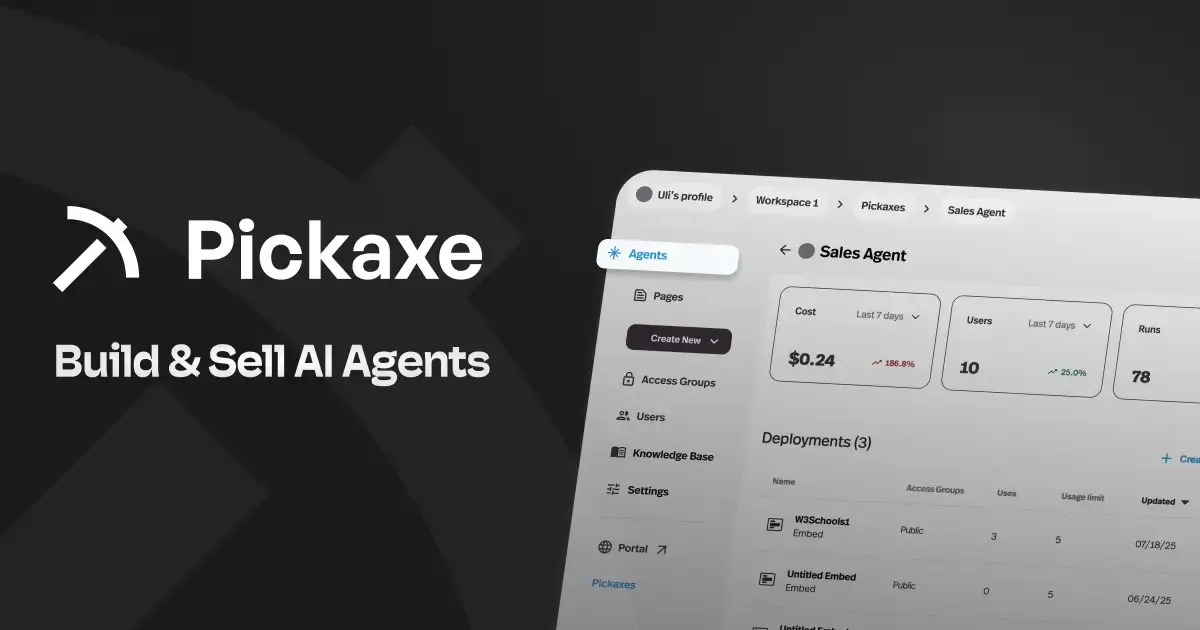
For financial advisors, this opens up possibilities that none of the other tools on this list offer. Instead of just using AI internally, you can create AI-powered experiences that your clients use directly:
- Client intake agents that gather financial information before the first meeting -- replacing long PDF forms with an intelligent conversation
- FAQ agents that answer common client questions about their accounts, your firm's process, or general financial concepts -- 24/7, without you being available
- Portfolio explainer agents that help clients understand their investment strategy in plain language
- Onboarding assistants that walk new clients through account setup, document submission, and next steps
- Financial literacy tools that educate clients on topics relevant to their situation
Pickaxe is model-agnostic, meaning you choose which AI model powers your agents. You connect your firm's knowledge base so agents give accurate, firm-specific answers. And the platform includes Actions that let agents connect to external tools and services.
Key features:
- No-code builder for creating custom AI agents
- Knowledge Base for training agents on your firm's specific information
- Deploy via portals, website embeds, WhatsApp, Slack, email, or API
- Built-in monetization -- charge clients for premium AI tools via subscriptions or pay-per-use
- SOC2, GDPR, and CCPA compliant -- critical for financial services
- Actions system for connecting agents to external tools and data sources
Pricing: Plans start at $29/month (Gold tier).
Strength: Pickaxe is the only tool on this list that lets you create client-facing AI experiences. Every other tool is about making the advisor more efficient. Pickaxe is about making your practice more scalable -- clients get instant, intelligent responses without waiting for you. And the compliance certifications (SOC2, GDPR, CCPA) mean you can deploy client-facing agents with confidence in a regulated industry.
Limitation: You need to invest time in building and training your agents. The platform is no-code, so you don't need technical skills, but you do need to think through what your clients actually need and build agents that deliver real value. The payoff is worth it, but it's not plug-and-play like some of the other tools on this list.
If you're curious about the broader trend of building AI tools for clients, I wrote about white-labeling AI for clients and how professional services firms are turning AI into a client deliverable.
How I'd Stack These Tools
Fifteen tools is a lot. Nobody needs all of them. Here's how I'd think about building your stack based on your firm's size and priorities.
Solo Advisor (Just Getting Started with AI)
Start here: Zocks + Claude + Holistiplan
Zocks handles your meeting documentation. Claude handles your thinking and analysis work. Holistiplan handles tax planning. Total cost: roughly $250-$300/month. That's a tight, high-impact stack that covers the biggest time sinks without overwhelming you with tools.
If you want to add one more, Perplexity Pro at $20/month gives you cited research for market intelligence and regulatory updates. Hard to beat that value.
Small Firm (3-10 Advisors)
Build on the foundation: Zocks + Wealthbox + RightCapital + Holistiplan + Perplexity + Pickaxe
At this size, you need a CRM that scales. Wealthbox's AI Agents and Playbooks help you systematize workflows across multiple advisors. RightCapital gives everyone consistent planning tools. Holistiplan is the tax specialist. Perplexity keeps the team current on market developments.
Add Pickaxe to build client-facing AI agents that handle intake, FAQs, and onboarding across your client base. At $29/month, it's one of the cheapest tools on this list but one of the highest leverage -- a single intake agent can save hours of administrative work per week across your firm.
Enterprise Firm (10+ Advisors)
Go deep: Orion or eMoney as the backbone + Nitrogen + FP Alpha + VRGL + Jump AI + Pickaxe
Larger firms benefit from the enterprise platforms that tie everything together. Orion's Denali AI or eMoney's CoPlanner give you the integrated planning and portfolio management layer. Layer on Nitrogen for risk profiling, FP Alpha for estate planning, and VRGL for prospect conversion.
Jump AI's meeting prep becomes even more valuable at scale because it's pulling from more data sources across your broader tech stack. And Pickaxe lets you build a suite of client-facing AI agents that represent your brand consistently across thousands of client interactions.
The Common Thread
Regardless of firm size, the biggest mistake I see is using these tools in isolation. The real power comes from connecting them. Zocks meeting notes should flow into Wealthbox. Holistiplan's tax analysis should inform RightCapital's planning scenarios. VRGL's prospect analysis should feed Nitrogen's risk profiles.
The firms that treat their AI stack as a connected system rather than a collection of individual tools are the ones seeing the 10-19 hours per week in time savings that the industry research points to.
Frequently Asked Questions
What's the best AI tool for financial advisors just starting out?
Zocks and Claude are where I'd start. Zocks eliminates the biggest time sink most advisors face -- meeting documentation -- at $80-$130/month. Claude gives you a powerful thinking partner for analysis, document review, and client communications at $20/month or less. Together they cost under $150/month and immediately impact the two activities that consume most of an advisor's day.
If you add one more, Holistiplan at $149/month gives you AI-powered tax planning that clients notice. A three-tool stack of Zocks + Claude + Holistiplan costs roughly $250-$300/month and covers the highest-value use cases.
How much should advisors budget for AI tools?
Based on the tools in this roundup, a solo advisor can build a strong AI stack for $200-$500/month. A small firm should budget $300-$800/month plus per-user CRM costs. Enterprise firms with full platform implementations are looking at $1,000-$5,000+/month depending on firm size and the platforms they choose.
The key metric: if AI tools save you 10-19 hours per week (as industry research suggests is achievable), that's roughly $5,700/month in billable time. Even the most expensive stack on this list pays for itself many times over if you're actually using the tools and reinvesting the saved time into client-facing activities.
Are AI tools for financial advisors SEC-compliant?
The tools on this list generally take compliance seriously, but compliance is ultimately your responsibility as the advisor. Here's what to look for:
- SOC 2 certification -- Zocks, Pickaxe, and several others have this
- No recording policies -- Zocks specifically doesn't store audio, only notes
- Data handling practices -- understand where client data goes and who can access it
- Audit trails -- make sure the tool logs what AI generated vs. what you modified
The SEC hasn't issued specific regulations for AI tool usage by advisors, but existing record-keeping and supervision rules apply. If AI generates a client communication, you're responsible for reviewing it before sending. If AI produces a financial plan, you're responsible for verifying the analysis. Treat AI output as a draft that requires your professional review -- that's both the compliant and the prudent approach.
Will AI replace financial advisors?
No. And I say that without hesitation.
AI is exceptional at processing data, identifying patterns, and automating repetitive tasks. It's terrible at the things that actually make a great financial advisor: building trust, understanding a client's fears and goals, navigating family dynamics, and providing the emotional steadiness that keeps clients from panic-selling during a downturn.
What AI will do is raise the bar for what clients expect. When AI can produce a basic financial plan in seconds (eMoney's CoPlanner already does this), clients will expect their advisor to go deeper. The advisors who thrive will be the ones who use AI to handle the analytical and administrative work so they can spend more time on the relationship and strategic thinking that no AI can replicate.
The real threat isn't AI replacing advisors. It's AI-equipped advisors replacing advisors who don't use AI.
Can I build custom AI tools for my advisory practice?
Yes -- and you don't need to write code to do it. Pickaxe lets financial advisors build custom AI agents that handle client intake, FAQ responses, onboarding, portfolio explanations, and more. You train the agent on your firm's knowledge base, choose your AI model, and deploy it on your website, client portal, WhatsApp, Slack, or via API.
The platform is SOC2, GDPR, and CCPA compliant, so you can deploy client-facing agents in a regulated environment. Plans start at $29/month. You can also monetize your agents -- some advisors charge clients for premium AI tools as an additional revenue stream.
The Bottom Line
The gap between advisors who use AI well and those who don't is widening fast. 63% of RIAs are using AI now, but only 1 in 10 are fully integrating it. That means there's still a massive opportunity for advisors who build a connected AI stack instead of just dabbling with a chatbot.
The tools exist. The ROI is clear. The question is whether you'll be in the 10% who go all in or the 90% who are still using AI to draft emails and wondering what all the fuss is about.
My suggestion: pick two or three tools from this list, start with the ones that address your biggest time sinks, and build from there. Every hour AI saves you is an hour you can spend with clients -- and that's where the real value of your practice lives.
And if you want to take it a step further and build AI agents that your clients interact with directly -- client intake bots, FAQ agents, onboarding assistants -- Pickaxe starts at $29/month and lets you deploy without writing a single line of code.