

Ask a finance team what their worst week is and nobody says "the week we set strategy."
They say the last week of the month. The one where three people are matching bank lines to invoices in a spreadsheet, someone is chasing a customer who swears they paid, and the forecast everybody agreed on two weeks ago is already wrong.
That week is why AI agents for finance teams is one of the few AI categories where the pitch and the pain line up almost exactly. The work is high-volume, rule-shaped, repetitive, and it has an answer that can be checked — which is a much better fit for an agent than "write me a strategy memo."
It's also a category with a spectacular amount of noise around it. Nearly every accounting vendor rebranded its rules engine as "agentic" in the last eighteen months, and most of the case studies you'll read have no numerator, no denominator, and no date.
So this is the version I'd want if I ran a finance function or built for one. Three jobs worth doing — accounts receivable, reconciliation, and forecasting — in the order I'd actually do them, what each one genuinely automates, where the agent has to stop, and the control layer that decides whether your auditor signs off or sends you back to the start.
I'll be direct about the ceiling too. One of these three is much worse than the marketing suggests, and it's the one everybody wants to build first.
Why AI agents for finance teams actually fit the work
Most departments hand an agent work with no verifiable answer. Marketing copy is good or bad by taste. A support reply is fine until someone complains.
Finance is different in one important way: there is usually a right answer, and it's sitting in another system.
A payment either matches an invoice or it doesn't. A subledger either ties to the general ledger or it's off by an amount you can name. An aging bucket is a fact, not an opinion.
That matters because the failure mode of language models is confident wrongness. When the output can be checked against a ledger, you get a cheap, automatic way to catch it. When it can't — as in a forecast narrative — you don't, and that's exactly where the risk concentrates.
The second thing finance has going for it is volume with variation. Pure rules engines have been available for twenty years and they still cap out, because real remittance data is messy: a customer pays four invoices with one wire, deducts a discount you didn't authorize, and references a PO number in a format nobody agreed to.
Rules break on the variation. That gap — too varied for a rule, too repetitive for a person — is the actual territory of an agent, and it's the clearest example I know of the difference between an agent and a workflow automation.
The honest state of adoption in 2026
Two things are true at once, and most articles only tell you one of them.
The first is that finance is adopting fast. Gartner projected that 90% of finance functions would deploy at least one AI-enabled technology solution by 2026 — while also predicting that fewer than 10% would see headcount decrease, which is a detail worth holding onto when you write the business case.
Deloitte's State of AI in the Enterprise research points the same direction, with agentic usage scaling quickly and a majority of large-company North American CFOs naming AI agent integration as a top transformation priority.
The second truth is that most of it isn't in production. A Deloitte Center for Controllership poll of more than 3,300 finance and accounting professionals found that while 80.5% expected AI agents to become standard tools within five years, only 13.5% were actually using them — and 7.6% didn't know what an AI agent was.
The same poll named the real blocker, and it isn't capability. Trust was the single biggest barrier at 21.3%, ahead of integration at 20.1% and skills at 13.5%. Only 2.7% said they'd trust fully autonomous AI decision-making, while 59.7% said they'd trust agents inside a defined framework with humans handling the complex calls.
That last number is the design brief for this entire article. Finance teams aren't asking for autonomy. They're asking for a bounded assistant with an audit trail.
Then there's the third number, the uncomfortable one. Gartner predicts that over 40% of agentic AI projects will be canceled by the end of 2027, citing escalating costs, unclear value, and inadequate risk controls — and in the same release coined "agent washing" for vendors rebranding assistants, RPA and chatbots as agentic, estimating that only about 130 of the thousands of self-described agentic vendors were the real thing.
Finance is squarely in the blast radius of that. If you're evaluating a tool, the question that separates a real agent from a rebranded rules engine is simple: when the input goes off-script, does it decide, or does it stop?
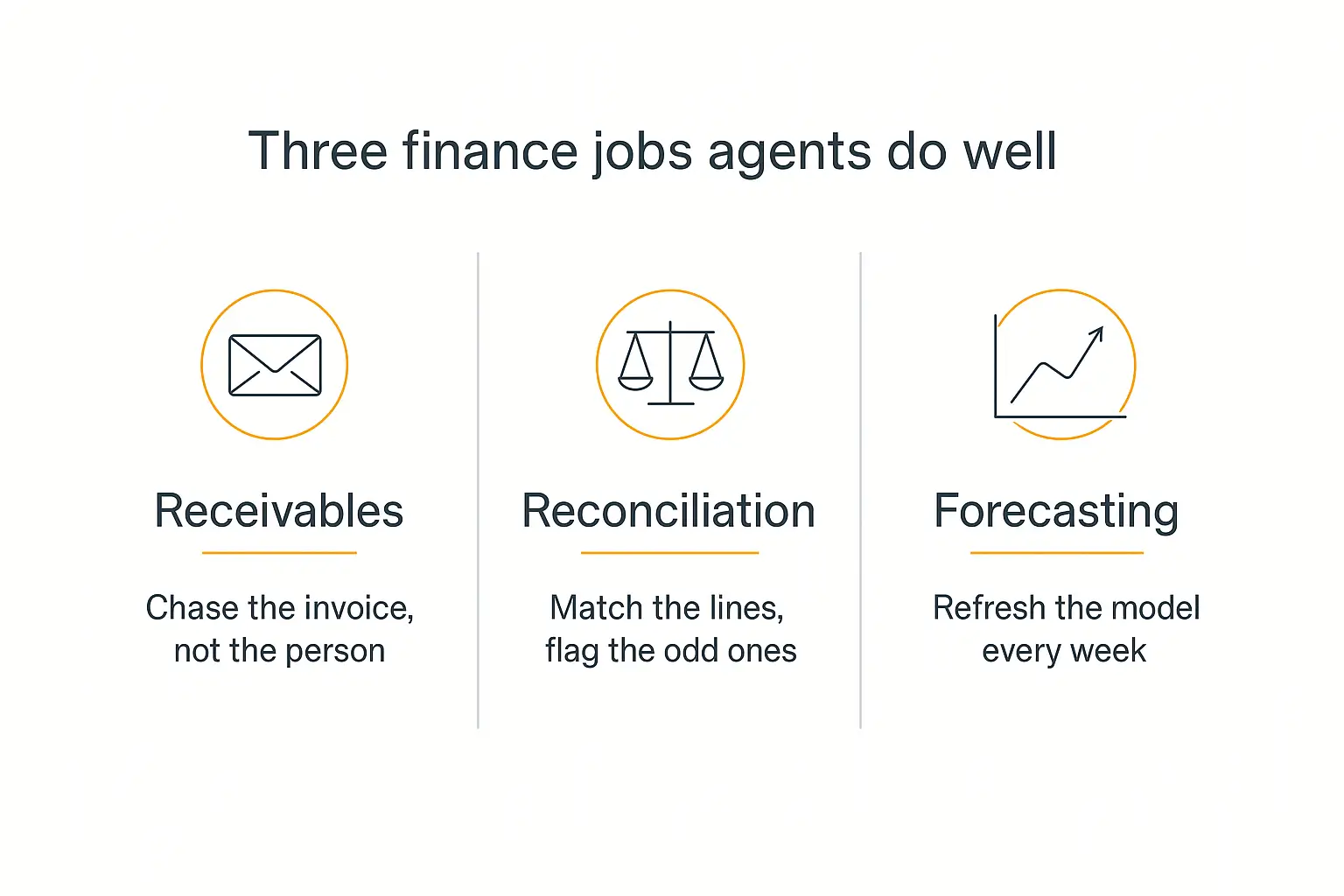
The three jobs worth starting with
I'd rank them by how fast they pay back and how easy they are to verify — which, conveniently, is the same order.
| Job | What the agent does | Verifiable? | Payback | Risk if wrong |
|---|---|---|---|---|
| Accounts receivable | Prioritizes the aging, drafts and sends the chase, applies cash, escalates | Yes — the invoice is paid or it isn't | Weeks | Low to medium — an awkward email to a customer |
| Reconciliation & close | Matches lines, isolates exceptions, drafts journal entries with support | Yes — it ties or it doesn't | One or two cycles | Medium — caught by review if you gate posting |
| Forecasting | Refreshes drivers, updates the rolling forecast, narrates variance | Only in hindsight | Quarters | High — a wrong number nobody can check until later |
Almost everyone wants to start at the bottom of that table, because forecasting is the part of finance that feels strategic and the demos are seductive.
Start at the top instead. AR gives you a number you can put in front of a CFO in six weeks, and it teaches your team what the agent is bad at while the stakes are still an email.
Job one: accounts receivable, the one that pays for itself
Collections is the clearest agent-shaped job in the whole finance function, because it's four tasks that are individually simple and collectively nobody's full-time role.
What an AR agent actually does
It reads the aging and decides who to chase. Not "everyone past 30 days" — that's the rules engine you already have. A useful agent weighs invoice value, the customer's payment history, whether there's an open dispute, and what they said in their last reply.
A customer who pays reliably on day 38 every single month does not need a day-31 reminder. Sending one costs you goodwill and buys you nothing. That judgment is the whole difference.
It drafts the message in the right register. A first nudge to a strategic account and a fourth notice to a serial late payer are not the same email, and the tone ladder is exactly the kind of thing a model handles well and a template handles badly.
It applies the cash. This is the unglamorous one and it's where the hours actually are. Native ERP cash-application modules typically match on exact criteria and stall out in the 40–60% range on messy remittance; vendors selling AI matching claim 90%+ straight-through rates by handling partial payments, bundled wires, unauthorized deductions and free-text references.
Treat those vendor numbers as directional rather than gospel — they're self-reported and rarely dated — but the mechanism is real, and the delta between exact-match and semantic-match is where the labour goes.
It escalates. The agent works the ladder and then hands off. That handoff point is a business decision, not a technical one, and you should set it before you build anything.
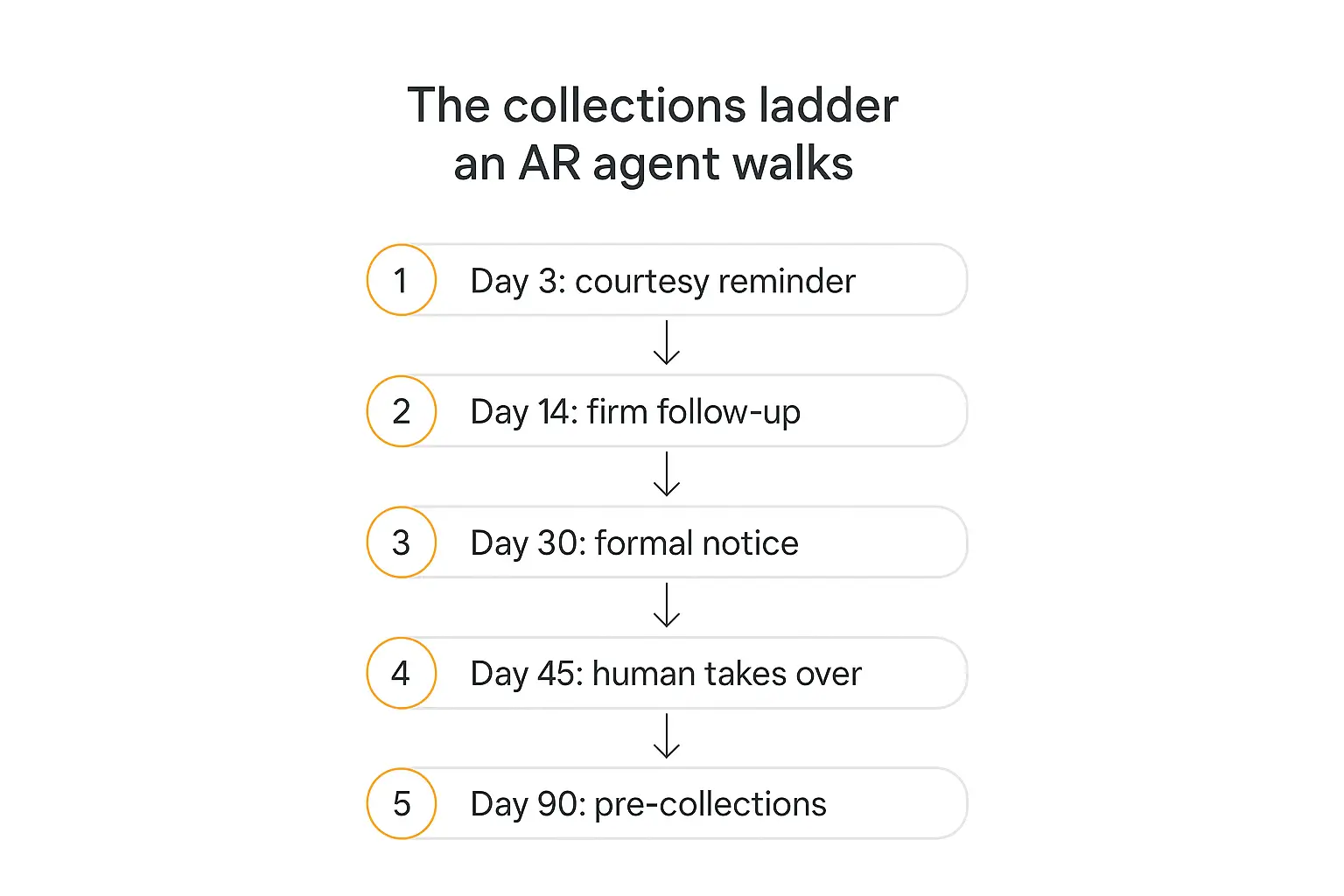
The ladder, and where the human takes over
Five stages covers most B2B situations, and the standard shape is: a courtesy reminder just past due, a firmer follow-up around day 14 to 21, a formal notice at 30, a final demand between 45 and 60, and a pre-collections notice by 90.
My strong recommendation: the agent owns stages one through three, and a person owns everything after that.
The reason isn't technical. By day 45 the conversation has usually stopped being about the invoice and started being about the relationship — a dispute, a cash problem at their end, a contract question. Those are conversations where an agent's confident, well-written email can do real damage.
This is the practical version of the human-in-the-loop pattern: don't decide it globally, decide it per stage, and put the boundary where the cost of being wrong jumps.
What the numbers actually look like
The commonly cited figure across AR automation vendors is roughly a 20–30% reduction in days sales outstanding, with collection efficiency improving by a similar margin. Billtrust has published study findings in the same range.
I'd hold that loosely. Almost every published DSO number in this category comes from a vendor with a stake in it, the baselines are rarely stated, and companies that adopt AR automation are usually also fixing their invoicing process at the same time.
What I'd actually promise a CFO is narrower and more defensible: the agent gives you consistent, timely, prioritized follow-up on every invoice instead of on the ones someone got to. In most small finance teams that alone moves DSO, because the honest baseline isn't a well-run collections process — it's a collections process that happens when the controller has a free afternoon.
Model the return yourself rather than borrowing a case study. Our guide to measuring AI agent ROI has the formulas, but for AR the arithmetic is unusually simple: a five-day DSO improvement on $2M of monthly revenue frees roughly $330K of working capital, permanently.
Job two: reconciliation and the close
If AR is the job with the fastest payback, reconciliation is the one your team will thank you for personally.
The work splits into three parts, and only two of them should be automated.
Matching
Thousands of lines, two sources, one question: which of these are the same transaction? An agent does this well because it can handle the near-misses that break exact matching — a $2 bank fee, a one-day timing difference, a description that got truncated by the bank feed.
This is the part where the reported gains are most believable, because the output is trivially checkable. It ties or it doesn't.
Exception handling
The remaining few percent that didn't match is where the actual expertise lives. Here the agent's job is not to resolve the exception — it's to present it well: what it is, what it might be, what evidence it pulled, and what it recommends.
A good exception queue turns an hour of digging into a two-minute decision. That's a much bigger win than it sounds, and it's a far safer one than letting the agent resolve anything itself.
Journal entries — draft, never post
This is the single most important rule in the article, so I'll put it plainly.
The agent drafts the journal entry. A person approves and posts it. Always.
In well-governed deployments this is exactly how it works: the agent proposes the entry with its supporting data attached, and a designated reviewer approves and posts it through the normal workflow, preserving segregation of duties.
Accruals and prepaid amortization are where this matters most, because the agent is making a judgment call about timing and amount, and those judgments are precisely what an auditor will sample.
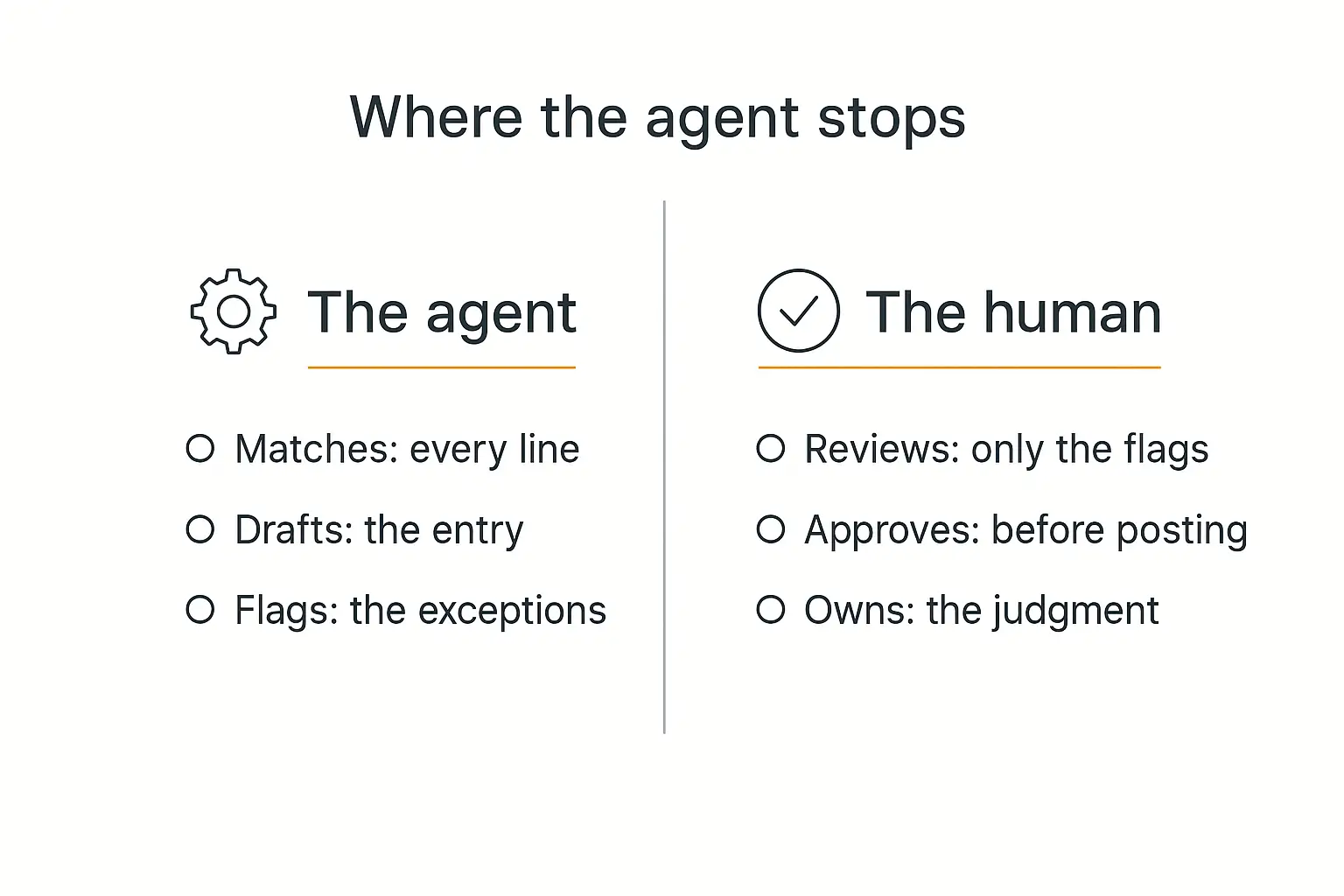
You lose almost nothing by gating the post step. The hours were never in clicking "post" — they were in the matching and the evidence-gathering that came before it.
What you gain is that your control environment survives contact with your auditor, which brings us to the part most build guides skip entirely.
Job three: forecasting, and the honest ceiling
This is the one everybody demos and the one I'd build last.
Not because it doesn't work — parts of it work very well — but because the parts that work and the parts that don't look identical on the screen, and finance is the worst possible department in which to be confidently wrong.
What genuinely works
Turning a quarterly ritual into a weekly refresh. The real constraint on rolling forecasts has never been the maths. It's that re-pulling actuals, re-mapping the drivers and rebuilding the deck takes two people three days, so nobody does it monthly. An agent collapses the gathering step, and that alone changes the cadence.
Variance narration. Give a model the actuals, the plan, and the driver tree, and ask it to explain the top five variances. It's fast, it's reasonable, and — crucially — a human can check every claim against the numbers in about ten minutes.
Scenario setup. "Rebuild this at 85% of plan headcount and 12-month churn" is a tedious afternoon that becomes a prompt.
What doesn't
Numerical reasoning is the weak spot, and its failures are quiet. A model will produce a confidently formatted figure that's wrong in a way that passes a surface-level review, which is the worst possible failure mode for a number that ends up in a board deck.
Retrieval doesn't rescue it either, and the benchmark numbers are sobering. In FinanceBench, a financial question-answering benchmark built on real filings, GPT-4-Turbo paired with a retrieval system incorrectly answered or refused 81% of questions — and the authors concluded that every model they examined showed hallucination weaknesses limiting enterprise suitability.
Models have improved since that paper, but the shape of the failure hasn't: when the number isn't in the retrieved context, the model doesn't say "I couldn't find it." It answers anyway.
And an agent cannot know what isn't in the data. It doesn't know the enterprise deal slipping to next quarter, the price increase that goes live in March, or the customer whose CFO just left. Those are the things that actually move a forecast, and they live in someone's head or a Slack thread.
How I'd scope it
Use the agent for assembly and explanation, not for the number.
Let it pull the actuals, refresh the driver inputs, flag every variance over a threshold, draft the commentary, and prepare the pack. Let a human own the forecast itself.
That's not a compromise — it's roughly what a good FP&A analyst spends their week doing anyway, and about 70% of it is assembly. Automate the assembly and you've given a small team a much bigger one, without asking anybody to trust a number they can't check.
If you want the general version of this reasoning, it maps directly onto the five levels of agent autonomy: AR belongs around level three, reconciliation at two to three, and forecasting stays at one or two for a long time.
The control layer nobody budgets for
Here's where most finance agent projects quietly die. Not in the build — in the review six weeks later.
As of 2026 no regulator has issued AI-specific guidance for internal control over financial reporting. The SEC's Financial Reporting Manual doesn't address it, and there's no PCAOB standard written for agents — AS 2201 says what it always said. That sounds like freedom. It isn't.
It means your existing framework applies unchanged, and an agent that touches the ledger is a system with logical access to financial records — which puts it inside ICFR scope whether or not anybody called it that in the project kickoff.
Four things make the difference between an agent that survives an audit and one that doesn't.
1. The agent gets its own identity. Not the controller's login. Not a shared API key. Its own service account, with its own scope, so the log can answer "was that the agent or a person?" — which is the first question anyone will ask.
2. Its permissions are narrower than the human's. Read the subledger, read the bank feed, write to a draft queue. Not post. Not approve. Not change a vendor's bank details, ever — that's the single highest-value fraud target in the whole function and it should be structurally impossible for an agent to touch.
3. Every action produces a reviewable record. The input data it saw, the logic or rule it applied, the output it produced, and who approved it, with a timestamp. If your agent can't answer "why did you propose this entry?" with the actual source lines, it isn't ready for the close.
4. Approvals happen before the effect, not after. A queue a human clears is a control. A daily email summarising what already happened is not.
None of this is exotic. It maps onto the control principles your team already works from — the COSO framework asks the same questions of an agent that it asks of a new hire. Treat the agent as a preparer whose work gets reviewed before it posts, and most of the governance questions answer themselves.
Our AI agent compliance checklist covers the broader regulatory picture, and the security risks piece goes deeper on credential scope and shadow deployments — both worth reading before you connect anything to a general ledger.
The data problem that decides everything
I want to be blunt about this because it's the reason most of these projects underdeliver, and no vendor will lead with it.
An agent will not fix your plumbing. It will produce wrong answers faster.
If your chart of accounts has 400 accounts and nobody can say what six of them are for, if your actuals live across four systems that disagree, if half your customers are duplicated in the CRM under two spellings — the agent inherits all of it.
Deloitte's controllership poll put integration as the second-biggest barrier at 20.1%, right behind trust. In my experience those two are the same problem wearing different hats: people don't trust the output because the inputs were never clean, and they were right not to.
Three checks before you build anything:
- Can you name the system of record for each number? If two systems disagree about revenue, decide which one wins before an agent has to.
- Is the data reachable by API? An agent that needs someone to export a CSV every Monday is a person with extra steps.
- Is the chart of accounts something a stranger could read? That's roughly the test, because the model is a stranger.
The good news: this is one to two weeks of unglamorous work, and it makes every subsequent AI project in the business easier. Our AI workflow audit checklist is a reasonable structure for it.
Buy a point solution or build your own?
Both, usually — and the split is cleaner than people expect.
Buy where the integration is the product. Cash application, AP invoice capture, and bank reconciliation are deep, boring, well-solved problems where a specialist vendor has spent years on ERP connectors and remittance formats you've never seen. You will not out-build that, and you shouldn't try.
Build where the knowledge is yours. The agent that answers "what's our revenue recognition treatment for a mid-term upgrade?" or "which of these deductions are we contractually allowed to reject?" cannot be bought, because the answer lives in your contracts, your policy memos, and three people's heads.
That second category is bigger than most teams realise, and it's where a custom agent earns its keep — an internal finance assistant sitting on your policies, your contract terms, and your close checklist, available to the whole team instead of just the person who knows.
It's also the category with the best ratio of effort to value, because you're not building integrations. You're building context.
How I'd build the first one
Concretely, here's the shape of a first finance agent I'd actually ship — an internal close-and-policy assistant, because it's useful in week one and it can't break anything.
Give it the knowledge. On Pickaxe that means loading the Knowledge Base with your close checklist, revenue recognition policy, the chart of accounts with descriptions, your standard contract terms, and last quarter's close notes. Daily auto-refresh keeps it current as those documents change — the mechanics are in our guide to adding a knowledge base without the jargon.
Write the instructions like a policy, not a prompt. Say what it is (a finance operations assistant for the accounting team), what it must always do (cite the source document for every policy answer), and what it must never do (guess at a treatment it can't find, or state a number it didn't read from a source).
Use the Model Reminder for the rule that matters most on every single message. Mine would be: if you cannot cite a source, say you don't know and name who to ask.
Connect two Actions, not eight. Start with a read-only pull from your accounting system and a lookup against the aging report. Pickaxe supports a wide set of integrations plus Make, Zapier and n8n via MCP, but the discipline that matters is keeping the count low — four actions is the practical ceiling before an agent starts picking the wrong tool.
Keep every write behind a person. If it drafts a dunning email, it drafts into a queue. If it proposes an entry, it proposes. Nothing the agent does should be irreversible without a click from a human.
Deploy it where the team already is. A Portal for the finance team behind a member access group, or a Slack deployment so it answers in the channel where the questions already get asked. That last one matters more than it sounds — an internal tool that requires opening a new tab gets used for two weeks.
Then extend outward. Once the assistant is trusted, the AR drafting agent is a much smaller step, because the knowledge, the access model and the review habit are already in place.
What to measure
Pick the metrics before you build, or you'll end up defending the project with anecdotes.
| Job | Primary metric | Guardrail metric |
|---|---|---|
| Accounts receivable | DSO, and % of invoices touched on time | Customer complaints per 100 messages sent |
| Cash application | Straight-through match rate | Mismatches found downstream |
| Reconciliation | Days to close; exception queue size | Entries rejected at review |
| Forecasting | Forecast refresh frequency | Corrections made after review |
| Internal assistant | Questions answered per week | % of answers with a citation |
The guardrail column is the one people skip and the one that saves the project. A rising rejection rate at review is the earliest signal that the agent has drifted, and it shows up weeks before anyone would notice in the primary number.
Watch the cost side too. Finance agents read a lot of context, and context is the expensive part — the token economics piece covers how that bill actually accumulates, and model routing is the usual fix once volume is real.
A 90-day sequence that works
- Weeks 1–2: fix the plumbing. Name the system of record for each number. Document the chart of accounts. Get API access sorted. Unglamorous, non-negotiable.
- Weeks 3–4: ship the internal assistant. Knowledge Base, policy documents, no write access. Low risk, immediate use, and it teaches your team what good prompting looks like.
- Weeks 5–8: AR drafting into a queue. The agent prioritizes the aging and drafts stages one through three. A person still hits send. Measure the rejection rate.
- Weeks 9–10: let it send stage one. Only stage one, only after the rejection rate has been low for two weeks. This is the first real autonomy step and it should feel almost boring by the time you take it.
- Weeks 11–13: reconciliation matching and the exception queue. Matching and exception presentation only. Journal entries stay drafted, never posted.
Forecasting isn't on that list on purpose. Revisit it at month six, once you've watched the agent be wrong a few times and know what its wrongness looks like.
Frequently asked questions
Will AI agents replace our finance team?
Not on the evidence so far. Gartner's own projection paired 90% AI deployment in finance functions by 2026 with fewer than 10% seeing headcount decrease, and Deloitte's CFO research has consistently found the large majority reporting no reductions from adoption.
What changes is the mix. The matching, chasing and assembling shrinks; the reviewing, deciding and explaining grows. The realistic pitch to a CFO is capacity, not headcount.
Can an AI agent post journal entries by itself?
Technically yes. Don't. Drafting with human approval keeps segregation of duties intact and costs you almost nothing in time saved, because the effort was never in the posting.
Is this SOX-compliant?
It can be. There's no AI-specific standard as of 2026, which means your existing ICFR framework applies as-is. An agent with its own identity, scoped permissions, a complete audit trail and human approval before any posting fits inside a normal control environment. One sharing a person's credentials and posting autonomously does not.
What about our data going to a model provider?
Ask three questions of any vendor: is our data used for training, where is it processed, and what's the retention period. Then check whether the platform is model-agnostic, because "we use the best model" is only true until the provider you're locked into raises its price or deprecates the version you validated against.
How do we tell a real agent from a rebranded rules engine?
Give it an off-script input in the demo. A partial payment with a wrong PO number, an email that says "we already paid this — see attached." A rules engine returns nothing or the wrong thing. An agent reasons about it, or tells you it can't and hands off. That single test filters most of the market.
Where to start with AI agents for finance teams
If you take one thing from this: build the boring one first.
The internal finance assistant that answers policy questions with a citation is unglamorous, ships in a week, and can't damage anything. It's also the thing that makes every later agent possible, because it's where your team learns what the model is good at, where it lies, and how much they can trust it.
The teams that get burned are the ones that start with the forecast — the highest-stakes, least-verifiable job — and conclude that agents don't work in finance when the first number turns out to be confidently wrong.
Agents do work in finance. They work best exactly where the work is repetitive, the answer is checkable, and a person still owns the decision that matters.
If you want to build one, Pickaxe handles the parts that usually stall these projects — the Knowledge Base your policies live in, Actions to reach your accounting stack, access groups so only finance sees it, and deployment into Slack or a branded Portal where your team already works. Start with the assistant, keep the human on the approve button, and expand once the rejection rate tells you it's earned it.