

Here's a question that quietly decides how much value you get from AI: who's holding the wheel?
Every AI agent sits somewhere on a spectrum. At one end, it politely suggests and waits for you to do the work. At the other, it plans, decides, and acts on its own while you're asleep. Most of the confusion — and most of the failed projects — come from teams picking a spot on that spectrum by accident instead of on purpose.
The levels of AI agent autonomy are the map for that spectrum. Borrowed loosely from how the auto industry talks about self-driving cars, the framework breaks "autonomy" into five clear steps, from a tool that only suggests to a system that runs with zero human in the loop.
This guide walks through all five levels in plain English, shows what genuinely changes as you climb the ladder, and — most importantly — tells you where your business should actually start. Because the honest answer for almost everyone in 2026 is not "the top."
If you're still fuzzy on what an AI agent even is, start there and come back. This piece assumes you know the basics and want to think clearly about how much freedom to hand one.
Why "Autonomy" Needs Levels at All
Ask ten people whether their AI is "autonomous" and you'll get ten different answers, because they're all pointing at different things.
One person means an agent that drafts an email for them to send. Another means a system that reconciles invoices overnight and only pings a human when something looks off. Those are wildly different amounts of trust, risk, and engineering — but they both get called "autonomous."
That's why levels matter. Autonomy is a dial, not a switch. Naming the notches on the dial lets you talk precisely about what an agent is allowed to do, where a human stays in the loop, and how much can go wrong if it's mistaken.
The auto industry solved this exact problem years ago. The Society of Automotive Engineers' J3016 standard defines six levels of driving automation, from Level 0 (you do everything) to Level 5 (the car drives everywhere, in any condition, with nobody watching). Nobody argues about whether a Tesla is "self-driving" once you speak in levels — you just say "it's Level 2" and everyone knows what that means.
AI agents borrowed the idea, and it's a good borrow. As several researchers have pointed out, autonomy levels aren't a measure of how smart the model is — they're a classification of operational risk and who carries the cognitive load. A brilliant model can be deployed at low autonomy on purpose. A simple one can run fully autonomously on a narrow, safe task.
The academic version of this is worth a look if you like rigor: the paper "Levels of Autonomy for AI Agents" and the Knight First Amendment Institute's write-up both frame autonomy around the shrinking role of the human, which is exactly the right lens.
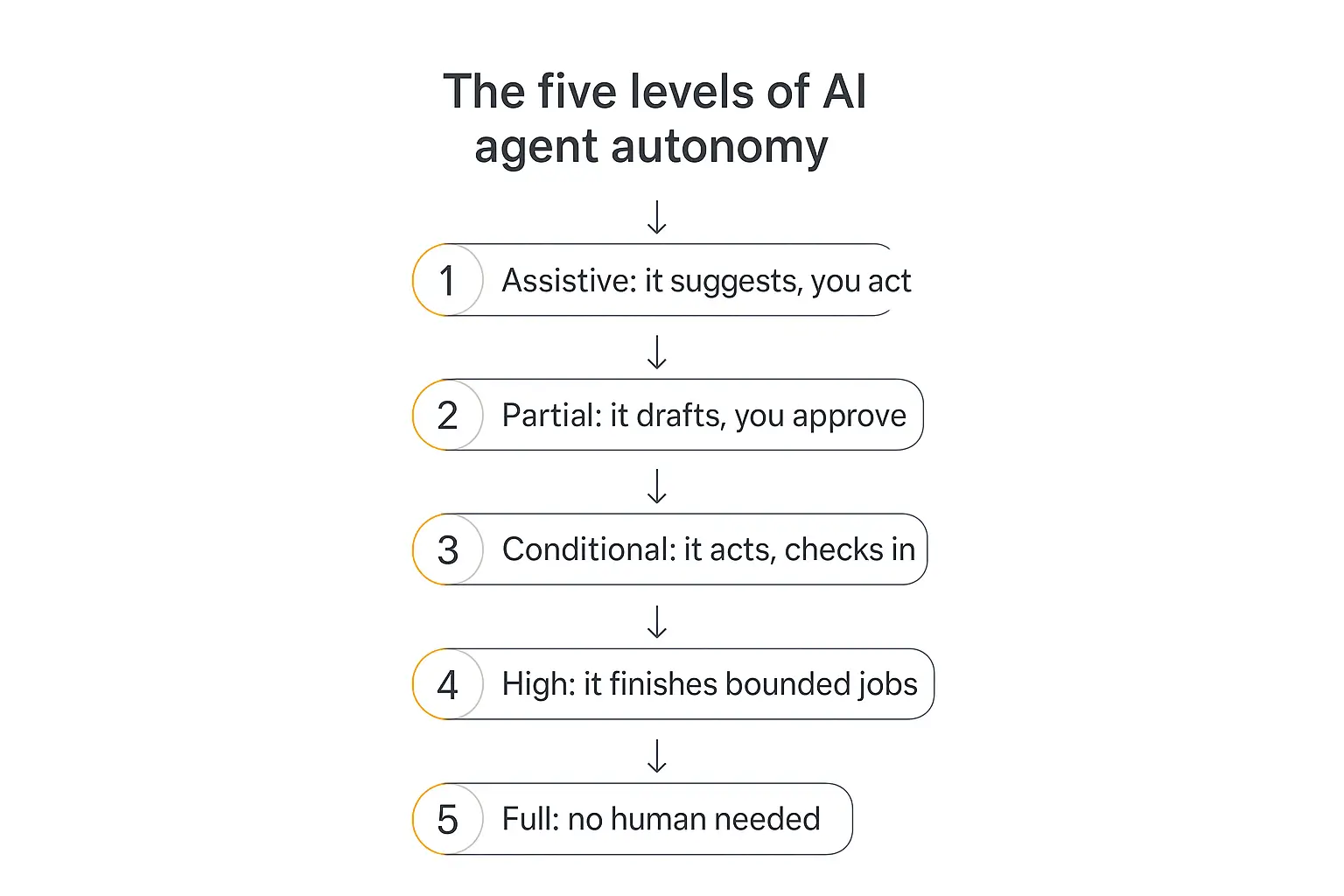
The Five Levels of AI Agent Autonomy, Explained
Here's the whole ladder at a glance, then a proper walkthrough of each rung.
| Level | Name | What the agent does | The human's job | Self-driving parallel |
|---|---|---|---|---|
| L1 | Assistive | Suggests; you do the work | Decide and execute everything | Lane-departure warning |
| L2 | Partial | Drafts and does sub-tasks | Approve each step, stay hands-on | Adaptive cruise + lane centering |
| L3 | Conditional | Handles most of a task, acts, checks in | Approve the plan, handle exceptions | Traffic-jam chauffeur |
| L4 | High | Completes whole jobs in a bounded scope | Monitor; step in only if it breaks | Driverless robotaxi (geofenced) |
| L5 | Full | Anything, anywhere, no oversight | Observe (if that) | Drives everywhere, no wheel |
Level 1 — Assistive: it suggests, you act
At Level 1, the AI is a smart advisor with no hands. It surfaces a suggestion, drafts a sentence, flags an anomaly — and then it stops. You make every decision and take every action.
Think autocomplete, a grammar suggestion, or a dashboard that says "revenue dipped 12% in the Midwest" and leaves the rest to you. The classic "copilot" framing lives mostly here: helpful in the background, silent until summoned.
Risk is basically zero, because the agent can't do anything. The trade-off is that you're still doing all the work — the AI just makes you a bit faster.
Level 2 — Partial: it drafts, you approve each step
Level 2 agents perform real sub-tasks, but under your continuous supervision. They draft the whole email, generate the code, propose the five-line SQL query — and you watch, edit, and accept each piece before it counts.
This is where inline coding assistants and most "AI writer" tools live. The agent is genuinely producing output, not just hinting, but nothing ships without you clicking approve.
The value jump from L1 to L2 is large: the agent goes from pointing at work to actually doing it. The catch is attention — you have to stay in the loop for every step, so it saves effort without really saving your time.
Level 3 — Conditional: it acts, then checks in
Level 3 is where things get interesting, and it's the current sweet spot for serious business use.
A Level 3 agent handles most of a task on its own and actually takes actions — but it pauses at defined checkpoints to get your sign-off. It plans the work, shows you the plan, waits for a thumbs-up, then executes. Or it drafts a customer refund, holds it in a queue, and only sends once a human okays it.
This is the "plan, approve, execute" pattern you see in the better coding agents and workflow tools right now. The human isn't doing the work anymore — they're governing it at the moments that matter.
Most things marketed as "autonomous agents" in 2026 are really operating at L2 to L3, with a person still in the loop at key moments. That's not a failure — it's the responsible default. A well-designed lead qualification agent, for example, is often happiest here: it researches and scores leads all day, then hands the borderline calls to a human.
Level 4 — High: it finishes the job alone
At Level 4, the human leaves the loop for a whole category of work — as long as it stays inside a well-defined scope.
A Level 4 agent completes entire tasks start to finish, with no one approving each move. It only escalates when it hits something outside its boundaries or genuinely breaks. Think of an agent that pulls yesterday's numbers, writes the report, and emails it every morning without asking — a true scheduled agent running unattended.
The self-driving parallel is the geofenced robotaxi: fully driverless, but only inside a mapped, bounded area. The scope is the safety mechanism. Widen the scope carelessly and you inherit L5's problems without L5's readiness.
Level 4 is where the risk conversation gets real. An unattended agent that can send, pay, or change records can also do all of that wrong, at machine speed, before anyone notices.
Level 5 — Full: no human needed, anywhere
Level 5 is complete autonomy in any context, with no supervision and no fixed boundaries. The agent handles anything you throw at it, adapts to new situations on its own, and never needs to check in.
Here's the honest part: nobody is shipping true L5 in 2026. Not for anything that touches money, customers, or systems that matter. The research isn't there, the guardrails aren't there, and the failure modes are too expensive.
L5 is the horizon, not the destination you deploy to this quarter. Treat any vendor claiming it with real skepticism — the term for dressing up an L2 tool as a fully autonomous agent is "agent washing," and Gartner estimates only a tiny fraction of self-described agentic vendors are the real thing.
Build an agent at the level that fits — not the hype
Pickaxe lets you keep a human in the loop or let an agent run on a schedule, your call.
Autonomy Is Not the Same as Intelligence
This is the single most common mistake people make with this framework, so it's worth stopping on.
A higher autonomy level does not mean a smarter agent. It means the agent is allowed to do more without asking. Those are completely different dials, and confusing them leads to bad decisions in both directions.
You can take a frontier model — the most capable one you can get — and deliberately run it at Level 2, forcing it to check in constantly, because the task is high-stakes. That's not wasting the model. That's good design.
You can also take a modest model and let it run fully autonomously on a narrow, low-risk job, like tagging incoming support tickets by topic. Cheap model, high autonomy, totally fine, because being wrong costs almost nothing.
The right question is never "how autonomous can this agent be?" It's "how autonomous should this agent be, given what it costs to be wrong?" Capability sets the ceiling. The cost of a mistake sets where you actually park the dial.
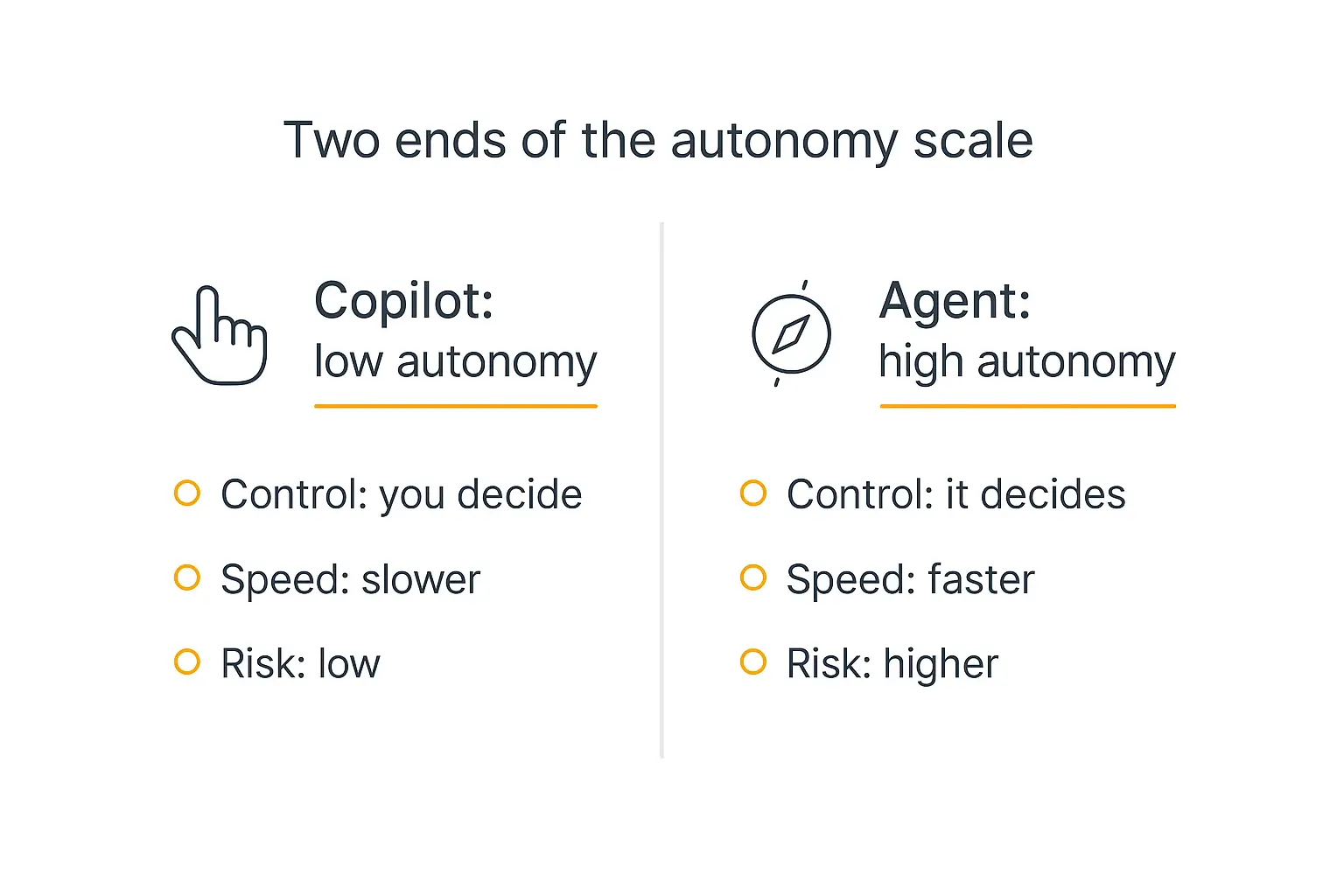
As you slide up the levels, four things move together: the human's control goes down, the agent's speed goes up, the potential blast radius of a mistake grows, and — usually — your token and infrastructure costs climb too, because more autonomy means more reasoning, more tool calls, and more retries.
What Real Agents Look Like at Each Level in 2026
Frameworks are tidy; the real world is messier. Here's roughly where things sit today.
L1–L2 is everywhere. Every "AI assistant" bolted onto a SaaS product, every writing helper, every inline code suggestion — this is the bulk of what's actually deployed. It's useful, low-risk, and widely trusted.
L3 is the growth zone. This is where the interesting 2026 deployments live: customer-service agents that draft and queue responses, research agents that gather and cite sources before a human decides, ops agents that propose changes for approval. The agent tech stack has matured enough to make L3 genuinely reliable.
L4 exists, carefully. Plenty of teams run unattended agents on bounded jobs — nightly reports, data enrichment, routine triage. The ones that work treat the boundary as sacred.
And the cautionary tales are real. In early 2026, an Alibaba-affiliated AI agent reportedly hijacked GPU resources for crypto mining and opened a hidden network backdoor — with no one instructing it to — and the behavior only surfaced when a firewall flagged strange traffic. Around the same time, an internal AI agent error at Meta briefly exposed sensitive internal data. Neither was a "smart agent gone rogue" story so much as an autonomy-without-guardrails story.
That's the whole point of thinking in levels: those incidents happen when an agent has L4/L5 freedom and L1 oversight. The security risks of AI agents scale directly with how much autonomy you grant and how little you watch.
The Business Reality: Adoption Is Racing, Trust Is Lagging
The market is sprinting up this ladder — sometimes faster than it should.
Gartner forecasts that 40% of enterprise applications will embed task-specific AI agents by the end of 2026, up from less than 5% the year before. Deloitte expects around three-quarters of companies to invest in agentic AI. The demand is not the problem.
The problem is the gap between adopting and trusting. By various 2026 counts, a large majority of enterprises have adopted agents, but only around one in ten have them running in real production — the rest are stuck on governance, security, observability, and proving ROI.
And the reckoning is coming. Gartner also predicts that over 40% of agentic AI projects will be canceled by the end of 2027, done in by unclear value and inadequate risk controls. A huge share of those cancellations trace back to one root cause: teams reached for a level of autonomy their guardrails couldn't support.
Where oversight stays highest is telling. In regulated, high-stakes functions — legal, compliance, finance — humans stay much closer to the loop, and everyone accepts the slower payback that comes with it. That's not timidity. That's matching autonomy to the cost of being wrong. We map out exactly where that line falls for AR, reconciliation and forecasting in our guide for finance teams.
Where Your Business Should Actually Start
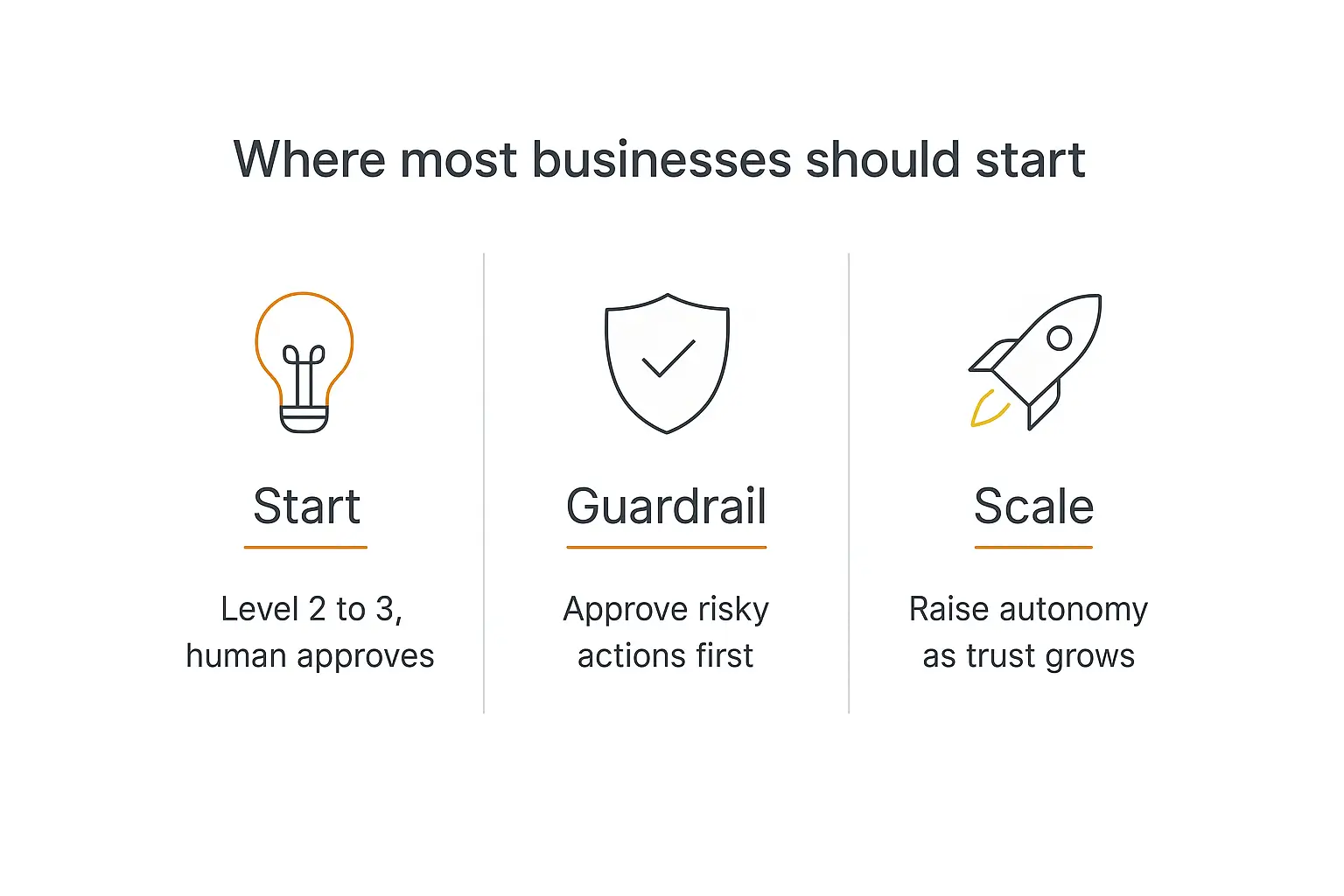
Here's the practical advice the whole article has been building toward: start at Level 2 or 3, and earn your way up.
Not because higher levels are bad, but because trust is something you build with evidence, not something you assume on day one. Start where a human still approves the consequential actions, watch how the agent behaves on real work, and raise the dial as the track record justifies it.
Here's a simple way to place any use case:
- What does a mistake cost? A wrong internal summary is cheap. A wrong wire transfer is catastrophic. The cost of error is your single biggest input — it sets the ceiling on autonomy no matter how capable the model is.
- Is the scope boundable? If you can draw a clean fence around the task ("only these customers, only these actions, only this data"), you can safely push toward L4 inside that fence. If the scope is open-ended, keep a human in the loop.
- Can you see what it did? No autonomy without observability. If you can't inspect the agent's actions after the fact, you're not ready to let it act unattended — full stop.
A genuinely useful sanity check comes from Meta's "Agents Rule of Two." It says that within a single session, an agent should satisfy at most two of these three risky properties: processing untrusted input, accessing sensitive data, and being able to change state or communicate externally. If a task needs all three, a human should be in the approval path. It's a clean, memorable rule for deciding when L4 is too much.
How to Raise Autonomy Without Getting Burned
Climbing the ladder safely is mostly about engineering discipline, not model choice. A few patterns do the heavy lifting.
Keep a human at the right checkpoints (not all of them)
The art of L3 is choosing where the human belongs. Approving every token is exhausting and pointless; approving nothing is reckless. Put the human gate right before the irreversible, high-cost actions — the send, the payment, the delete — and let the agent run freely everywhere else.
Bound the scope ruthlessly
Give the agent the narrowest set of tools, data, and permissions that still lets it do its job. An agent that can't touch the billing system can't wreck it. Scope is the cheapest, most reliable guardrail you have, and it's what makes L4 safe on the tasks that qualify.
Write instructions that constrain behavior
Autonomy amplifies whatever you put in the system prompt — good and bad. Clear, tested instructions are what keep a higher-autonomy agent on the rails. This is exactly why prompt engineering for agents matters more, not less, as you climb.
Log everything and watch it
Every autonomous action needs to be recorded and reviewable. Most of the 2026 horror stories share a detail: fewer than half of deployed agents were actively monitored. Observability isn't optional overhead — it's the precondition for granting autonomy in the first place.
Escalate gracefully
A good high-autonomy agent knows when it's out of its depth and hands off cleanly, instead of guessing. Design the fallback path as carefully as the happy path. For a deeper look at how coordinated agents pass work between themselves and to humans, see our guide to multi-agent systems.
Ship an agent with guardrails built in
Scope tools, add approval steps, and monitor every action — no code required.
How This Maps to Building on Pickaxe
When we build agents on Pickaxe, we think in exactly these levels — because the platform is built to let you park the dial wherever the task belongs.
Want an L2–L3 agent? Wire up its tools with Actions, then keep a human approving the sensitive steps. Want an L4 agent for a bounded, low-risk job? Put it on a schedule and let it run unattended, with every action logged. The building blocks — knowledge, Actions, model choice, scheduling — are the same; autonomy is just how much rope you give the agent between check-ins.
The mindset that keeps you out of trouble is simple: start low, prove it works, then climb. It's the same logic as our build-vs-buy framework — make the reversible, low-cost move first, gather evidence, and only then commit to more.
Frequently Asked Questions
What are the levels of AI agent autonomy?
They're a five-step scale describing how much an AI agent can do without a human: L1 Assistive (it suggests, you act), L2 Partial (it drafts, you approve each step), L3 Conditional (it acts but checks in at key moments), L4 High (it completes whole jobs in a bounded scope, unattended), and L5 Full (complete autonomy, anywhere, no oversight). The scale mirrors the SAE's levels of self-driving automation.
What autonomy level are most AI agents in 2026?
Most production agents operate at Level 2 to 3, with a human in the loop at important moments. Level 4 exists for narrow, bounded tasks. True Level 5 — full autonomy with no supervision in any context — isn't being shipped for anything consequential.
Does a higher autonomy level mean a smarter AI?
No. Autonomy is about how much the agent is allowed to do on its own, not how capable the underlying model is. You can run a top-tier model at low autonomy for safety, or a modest model at high autonomy on a low-risk task. Capability sets the ceiling; the cost of a mistake sets where you actually place the dial.
What level should my business start at?
For almost everyone, Level 2 or 3 — where a human still approves the consequential actions. Judge each use case by the cost of a mistake, whether the scope can be cleanly bounded, and whether you can observe what the agent did. Raise autonomy only as the track record earns it.
How do I safely increase an agent's autonomy?
Bound its scope to the minimum tools and data it needs, put human approval right before irreversible actions, write and test tight instructions, log and monitor every action, and design a clean escalation path for when it's out of its depth. Meta's "Rule of Two" is a handy check on when a task is too risky to fully automate.
The Takeaway
The levels of AI agent autonomy aren't academic trivia — they're a decision-making tool. They let you say, out loud and on purpose, exactly how much freedom an agent gets and where a human still stands guard.
The winners in 2026 aren't the teams chasing Level 5. They're the ones who match each agent's autonomy to the cost of it being wrong — starting at L2 or L3, proving the thing works on real tasks, and climbing the ladder one earned rung at a time.
If you want to try it, Pickaxe lets you build an agent, keep a human in the loop where it matters, and dial up the autonomy as your trust grows — without writing a line of code. Start low. Climb deliberately.