

The most useful AI data analysis tools answer a question you can check, using data the person asking is allowed to see. A beautiful chart is a weak substitute for knowing what counted as revenue, which customers were excluded, and when the underlying records last changed.
I looked into five options for consultants and client teams: Julius, Hex, ThoughtSpot Spotter, Power BI Copilot, and Databricks Genie. My recommendation starts with the client's existing data environment and the person who will own the definitions after handoff.
This is a documentation-based comparison, checked October 30, 2026, rather than a benchmark or a claim that I ran these products against production client data. The walkthroughs and acceptance tests below are proposals you can adapt.
How I choose AI data analysis tools for client work
Start with the question and the data boundary. An uploaded spreadsheet, a shared analytics workspace, and a governed warehouse create different responsibilities, even when their chat interfaces look similar.
For a one-off question, I would first consider a file-oriented analysis workspace. When an analyst needs to inspect and maintain the work, I would favor an environment that keeps the conversation close to the analytical project.
For employees asking questions across established company metrics, the existing BI or warehouse environment deserves the first look. Moving data into another product creates work that a nicer prompt box might never repay.
Here is my shortlist by delivery job. These are fit judgments, not measured accuracy rankings; a tool's appearance in this table does not certify that your particular configuration is ready for unattended client access.
| Tool | Where I would start | Handoff question | Cost to verify |
|---|---|---|---|
| Julius | Files and bounded exploratory questions | Can the recipient reproduce the answer safely? | Plan, credits, storage, team controls |
| Hex | Analyst-owned exploration and reusable apps | Who owns the project and connection permissions? | Roles, AI credits, compute |
| ThoughtSpot Spotter | Business questions over modeled analytics | Are business meaning and security configured? | Analytics versus embedded agreement |
| Power BI Copilot | A client already operating Power BI | Which Copilot surface and semantic model? | Licenses, capacity, regional eligibility |
| Databricks Genie | A client already governing data in Databricks | Who maintains agent context and evaluations? | Compute and applicable AI usage terms |
I would reject a universal “cheapest per question” league table here. Seats, credits, warehouse execution, and capacity describe different things, and an ambiguous question can consume several attempts before it produces a useful answer.
Before opening a trial, write a brief specifying the source, the permitted audience, the decision the answer supports, and who will resolve disagreements. Our AI workflow audit checklist is a useful starting point for deciding whether this question deserves a new tool at all.
1. Julius: my starting point for a bounded file question
I would shortlist Julius when a consultant has a defined dataset and wants to explore it conversationally, without building a full reporting environment first.

Official Julius social preview, captured from its current website. This is vendor imagery, not evidence of a client analysis.
The current Julius quickstart describes uploading files, asking questions in plain language, and generating visualizations. Its connector documentation also covers querying databases and warehouses directly, so describing it as exclusively a CSV chatbot would miss part of the product.
My proposed first job would be a cleaned campaign export with an agreed reporting period. Ask for spend and qualified leads by channel, then ask it to explain the joins, missing values, and denominator before requesting a chart.
That second request is where I would spend my evaluation time. A correct-looking cost-per-lead number can hide duplicate lead rows, a mix of account time zones, or a spend field imported as text.
What I would check before handing it to a client
I would ask the client to repeat the question using different business language. “Which source was most efficient?” should trigger a definition of efficiency rather than an unexplained switch from qualified leads to all leads.
For a connected database, I would use a dedicated read-only role and a limited reporting view. A prompt that says “do not access other clients” is not a substitute for enforcing that boundary in the data system.
Sharing deserves a deliberate choice. Julius documents private access and public replays, and says that full-chat PDF, DOCX, or Jupyter Notebook export is no longer available; generated downloadable documents are a separate output. Check the current sharing and download behavior before promising a particular client deliverable.
Pricing and fit
The live Julius pricing page lists Plus at $20 USD per month on monthly billing, with 2,000 monthly credits, as checked October 30. Annual billing is a separate offer; credits should not be translated into a guaranteed number of completed analyses.
My verdict: shortlist Julius for quick, bounded exploration when someone can review the result. I would require an explicit reproducibility and sharing check before treating a conversation as a maintained client analytics product.
2. Hex: my pick when an analyst will own the work
Hex is the option I would examine when the question is conversational but the deliverable still needs an analyst who can inspect, improve, and maintain the underlying analysis.

Official Hex social preview. The image represents the platform rather than a measured result from this comparison.
Hex Threads lets users ask questions over semantic models and warehouse tables, prioritizing endorsed assets. The documentation also describes access to the underlying project, which makes the route from a conversation to inspectable work particularly relevant to an analyst-led service.
My proposed job here would be investigating why a software client's expansion revenue changed. The analyst should first define expansion, exclude currency effects if appropriate, and separate new customer revenue from changes within existing accounts.
I would then ask a business user to explore segments in a Thread while the analyst reviews the resulting work. The useful handoff is a shared interpretation of the metric, plus an owner who can fix the project when the source schema changes.
Permissions affect the experience
Hex says starting Threads requires an Explorer role or higher, and that recipients need appropriate connection access to view shared results. It also says only the creator can continue the original agent conversation; access to someone else's Thread should not be mistaken for ownership of that conversation. See the Threads access and sharing rules.
That distinction changes a client demo. I would have the actual recipient open the shared work and start their own question, rather than assuming the creator's successful session proves that the recipient can use it.
The broader Hex permissions guide explains that project grants can be additive, while roles and access to assets can restrict what a user can do. Review effective access across groups, not just the setting on one project.
Pricing and fit
Hex pricing separates roles, AI credit grants, and compute options. I would price the creators, question askers, and viewers separately, then confirm credit replenishment and any compute add-ons in the proposed agreement.
My verdict: Hex belongs near the top of an analyst-owned shortlist. The tradeoff is that someone still needs to curate the assets, understand sharing, and maintain the analysis after the initial conversation succeeds.
3. ThoughtSpot Spotter: my shortlist for shared business meaning
I would consider ThoughtSpot Spotter when many business users need to ask related questions over a common analytics model, and the organization is prepared to maintain that model.
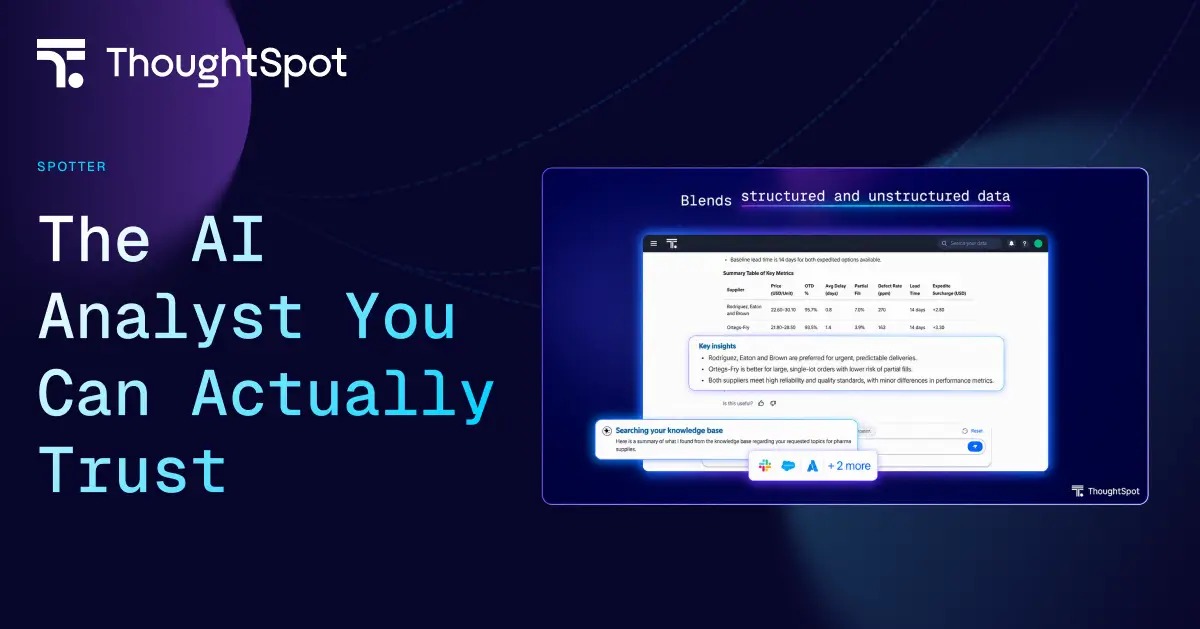
Official ThoughtSpot Spotter promotional image. Vendor trust language is a product claim, not an independent accuracy finding.
The current Spotter product page presents it as an AI analyst. I would evaluate that promise through the quality of the configured business context, rather than taking the title as evidence that it replaces an analyst.
ThoughtSpot's production context documentation distinguishes instructions, model semantics, memory, and external knowledge. It places row-level and column-level security beneath those context sources, which is the separation I want to see in a governed deployment.
My proposed use case is a regional sales organization asking about pipeline and conversion. Before any demo, I would define whether pipeline means all open opportunities, only qualified opportunities, or a probability-weighted amount.
Then I would give two regional managers the same question under different accounts. Each should receive a result consistent with their allowed territory, with a clear explanation of the scope used.
The limitation is ownership of meaning
A shared analytics model has value only if someone owns changes to it. When sales operations changes a stage definition, an old answer can remain internally consistent while becoming unsuitable for today's decision.
I would therefore include a definition review in the handoff. Pick a disputed metric, agree on its meaning with the business owner, document the exclusions, and test the question again after a controlled change.
I would also ask what happens when the question is outside the modeled domain. A useful system should make the boundary clear instead of producing a confident general explanation that sounds as though it came from company records.
Pricing and fit
The current ThoughtSpot pricing page distinguishes analytics offerings and embedded delivery. Request a quote for the actual audience, deployment, and expected workload; do not assume an internal analytics agreement covers a customer-facing resale arrangement.
My verdict: shortlist Spotter when repeated business questions justify maintaining shared semantics. For a consultant answering one question on a small export, I would first examine whether the setup and ownership burden is proportionate.
4. Power BI Copilot: start here if Power BI already owns the metrics
When a client already trusts a Power BI semantic model, I would evaluate Copilot there before creating a second place to define the same revenue or retention metric.
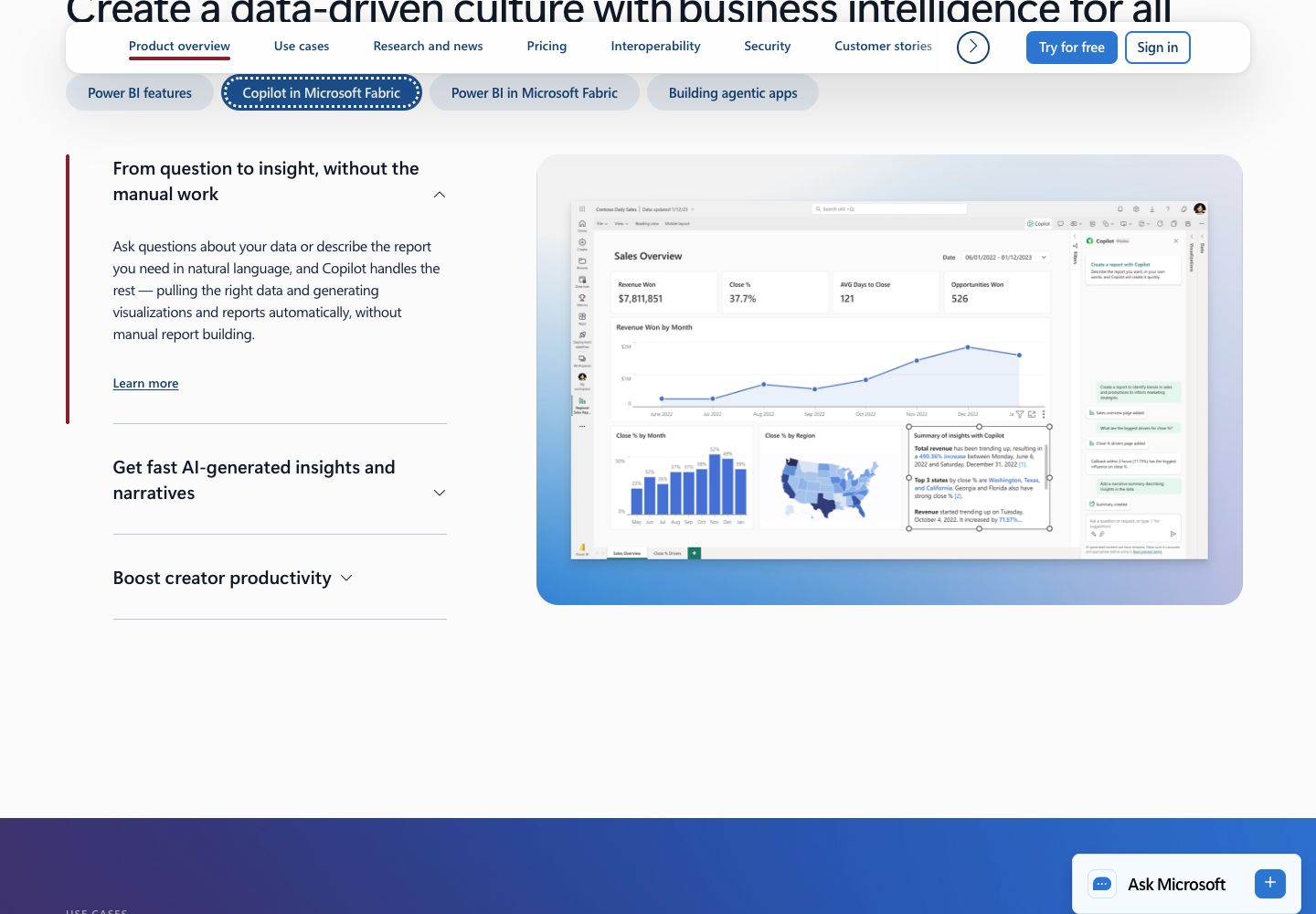
Official Microsoft Power BI imagery. Licensing and availability depend on the chosen Copilot experience.
Microsoft documents report-scoped, standalone, and app-scoped experiences, with different availability states. The current Copilot overview marks the report pane generally available and the standalone and app experiences as preview, checked October 30.
That means “we have Copilot” is not enough detail for a proposal. Name the surface the client will open, the reports or models it can use, and the experience you actually intend to support.
My proposed job is a distributor asking why margin changed by product family. I would start with the approved margin measure and ask for the period, currency treatment, and treatment of returns before comparing segments.
If the user asks about a metric that is missing, I would want the answer to disclose the gap. A generic explanation of margin drivers should not be mistaken for an analysis of that distributor's records.
Preparation and prerequisites
Microsoft's Prepare data for AI guidance covers configuring the model to improve Copilot's understanding, including instructions and verified-answer workflows. That preparation is work the client needs an owner for, even when the chat experience feels simple.
For the pilot, I would keep an approved report open alongside the conversation. Reconcile the same period, filters, and measure, then change one of those inputs and check whether the explanation follows the change.
Pricing and fit
The requirements documentation calls for paid Fabric F2 or higher, or Power BI Premium P1 or higher, plus supported regional and admin settings. Trial capacity and free SKUs do not satisfy those prerequisites.
I would verify licensing and capacity together, using the client's region and actual experience. A per-user Power BI price alone is not an all-in quote for Copilot.
My verdict: Power BI Copilot is a sensible first evaluation for a Power BI client with maintained metrics. It becomes a weaker shortcut when the underlying model is disorganized or nobody owns the definitions.
5. Databricks Genie: start with the client's governed data platform
I would shortlist Databricks Genie when the client already operates Databricks and wants business users to ask questions against data governed there.

Official Databricks Genie product imagery. The comparison uses the current Genie Agent terminology.
Databricks now distinguishes Genie One, Genie Agents, and Genie Code. Its Genie overview describes One as the business-user entry point and Agents as domain-specific environments configured with trusted data and business rules.
For this comparison, the important piece is the configured Genie Agent, formerly called a Genie Space. I would scope the first one to a particular business domain instead of giving the client an undifferentiated invitation to ask anything.
The setup guide requires Unity Catalog data and a pro or serverless SQL warehouse. It distinguishes the embedded compute credentials used for warehouse access from data access, which is evaluated using each end user's Unity Catalog permissions.
Why evaluation belongs in the buying decision
The feature I would examine closely is the documented benchmark workflow. It lets a team compare answers to a maintained test set instead of relying solely on successful demonstration questions.
My proposed scenario is an operations team investigating delayed orders. Establish the definition of late, the relevant date field, and how partially fulfilled orders count, then create differently worded questions that should produce consistent results.
A passing test is only evidence about that test set and configuration. It does not establish that every future question, access path, or new source will behave correctly.
I would keep the tests separate from the instructions used to teach the agent. Databricks explicitly distinguishes benchmark questions from context used to improve answers in its Genie Agent concepts guide.
Pricing and fit
I would request the current terms for the intended Genie experience and cloud, alongside the SQL execution costs and any applicable AI usage charges. A free interface offer, if available to that account, would not by itself establish that warehouse queries are free.
My verdict: Genie is a strong candidate to evaluate within an existing Databricks environment. I would not introduce an entire data platform just to avoid reviewing a small spreadsheet analysis.
The pilot I would run with AI data analysis tools
Use the same business question, approved answer, and permissions for every shortlisted tool. Otherwise you are comparing different datasets and preparation effort rather than the quality of the handoff.
Here is a proposed twelve-case pilot, not a reported experiment. Start with four question types and repeat each under an analyst account, a client account, and an account that should not have access.
- Known answer: reproduce an approved metric for an agreed period and reconcile the result.
- Ambiguous language: ask for the “best customers” without defining best, then examine whether the system clarifies or declares its assumption.
- Missing or stale data: remove a required field or use an old snapshot and require an explicit limitation.
- Boundary request: ask for another client's results and verify that access is denied by the underlying system.
For each case, save the original question, the identity used, source timestamp, assumptions, generated query or method where available, and the reviewed result. Record what the person had to correct before the answer was usable.
A successful denial is a success for the permissions test. A convincing answer based on unauthorized data is a failure, even if the arithmetic is perfect.
I would treat unresolved access failures as a stop condition and require business-owner review of correctness failures. Our guide to building an AI agent evaluation set explains how to keep regression checks useful as a system changes.
Can I hand the result to a non-analyst client?
Client readiness has two parts: the client can use the interface, and the service still has an accountable owner. Reducing the number of clicks does not resolve a disagreement about whether refunds belong in net revenue.
I would attach a short answer receipt to important outputs: question, metric definition, date range, filters, source freshness, method, caveats, and owner. This is a proposed delivery standard, not a claim that every tool automatically generates those fields.
A read-only pilot is a useful place to start. Keep write actions such as updating a CRM, issuing a refund, or changing a forecast outside the initial analytics permission boundary.
Pickaxe can provide a branded client-facing agent interface, with Actions connecting to an external service and portals organizing access. Those capabilities are described in the Actions documentation and portal documentation; they do not establish a native connection to every analytics product in this list.
For a Pickaxe implementation, I would put approved analytical queries behind a service that authenticates the user, enforces client scope, and returns a limited result. The agent can explain that result, while the service remains responsible for permissions and calculations.
That is a proposed architecture requiring implementation and testing. Uploading database rows to a knowledge base is not enough to guarantee exact aggregation across the complete dataset; review our knowledge base guide and Actions and MCP integration guide for the separate responsibilities.
I would also define the escalation route. If the answer changes after a source refresh or conflicts with an approved report, the client should know who will investigate and what evidence to provide.
Give clients a clear place to ask.
Build a focused agent around a reviewed service and explicit access rules.
What I would put in the cost estimate
I would price the complete path from a question to a reviewed answer. Include subscriptions, the roles allowed to ask questions, AI consumption, query compute or capacity, and the time required to maintain definitions and resolve failures.
Then estimate a realistic workload. As a hypothetical example, twenty clients asking ten questions each creates two hundred initial questions; clarification turns, reruns, and analyst review add work beyond that starting count.
Do not multiply that count by another vendor's credit price. A credit in one product is not a standard unit of computation, and a question that causes several queries can cost more than a simple lookup.
Ask each vendor which limits apply to the actual plan, how overages behave, whether external users require different terms, and how query execution is billed. Keep currency, billing interval, region, and account-specific offers visible on the quote.
I would make maintenance a separate line item: metric ownership, access reviews, source changes, and evaluation updates. Our AI services pricing guide is useful for packaging that ongoing responsibility into a service.
Questions I would settle before choosing
Which tool is best for a consultant with a spreadsheet?
I would start by evaluating Julius on a cleaned, bounded dataset with a known answer. If an analyst needs to maintain a reusable analytical project, I would also examine Hex; the ownership model matters more than how quickly either creates the first chart.
Can these tools answer questions directly from a CRM?
Verify the exact connector and authentication route for the selected product and plan. If a CRM export or ingestion pipeline sits between the source and the tool, disclose the refresh schedule and missing fields instead of calling the result live CRM access.
Can a non-technical client use them without supervision?
That is an acceptance question for your deployment, not a universal feature claim. I would require passing scope tests, maintained definitions, clear freshness indicators, and an escalation owner before expanding beyond a bounded pilot.
Where does Pickaxe fit?
I would use Pickaxe when a branded agent is the right client interface and there is a reviewed service behind the questions. I would keep the calculation and authorization boundary explicit, then compare the complete delivery cost with giving the client access to an existing analytics platform.
My first step would be to choose one question the client already cares about and write down its approved answer. Run the pilot, inspect what failed, and expand access only when the client can understand both the answer and its limits.