

Mercury 3 AI agents deserve a test on your actual workflow before they deserve a model switch. I looked through Inception's launch, API documentation, and current access routes to work out what a consultant should check before putting this diffusion LLM in front of a client.
Inception released Mercury 3 on October 19, 2026, reporting generation throughput of 1,068 tokens per second on NVIDIA GPUs. That is a vendor measurement, and it leaves several practical questions unanswered: when does a usable answer arrive, does the right action happen, and what does an accepted job cost?
My recommendation is to start with a bounded, reversible task where model waiting time matters. The checklist below uses a fictional agency briefing assistant; its test cases, timing examples, budgets, and release gates are proposals, not results from a production deployment.
Mercury 3 AI agents: the adoption checklist
The assistant in this guide reads an approved service brief, asks for missing requirements, and prepares a draft follow-up task. A person approves any external message, and the assistant cannot change an account or commit to a price.
That small contract makes the switch assessable. A longer answer or a faster animation cannot compensate for a follow-up assigned to the wrong client.
On small screens, scroll the table horizontally to read every column.
| Check | Evidence to collect | Reason to hold the switch |
|---|---|---|
| 1. Access and interface | Exact route, model ID, supported request | The real app requires an unsupported input |
| 2. First usable answer | Timestamp of stable, useful content | Only the full-output throughput improves |
| 3. Complete workflow | Accepted outcome and elapsed time | Tool waits or retries erase the gain |
| 4. Calls and structured data | Validated arguments and destination result | A valid object causes the wrong action |
| 5. Long context | Correct evidence across document variants | Old or irrelevant context changes the answer |
| 6. Cost after promotion | All attempts and accepted-task denominator | The business case depends on free credits |
| 7. Data and rollback | Agreed handling and a tested fallback | Client data or recovery has no owner |
Keep a copy of this table beside the client's acceptance criteria. A failed gate should create a specific next action, such as fixing a parser or obtaining written data-handling terms, rather than a vague verdict about the whole model.
What a diffusion LLM changes
Autoregressive generation builds text sequentially. Diffusion language models predict and refine multiple tokens in parallel, giving the serving system another way to trade computation, quality, and speed.
The original Mercury research paper describes this approach for Mercury Coder. It is useful architecture background, but its earlier model results are not a Mercury 3 benchmark.
The useful business question is where parallel generation shortens the client's wait. A large draft may benefit differently from a short classification, and an agent that repeatedly waits on a remote database may spend little of its time generating text.
I would also resist treating every product with Mercury in its name as interchangeable. The current model documentation separates Mercury 3, Mercury Voice, Mercury Decide, and the edit models, with different interfaces and purposes.
Choose the job before choosing the member of the family. A release about a chat model does not establish that the same endpoint supplies speech recognition, embeddings, or an entire phone-agent stack.
1. Confirm the access route and request contract
As checked on October 22, 2026, Inception documents mercury-3 on its chat completions endpoint, with text input, a 1M-token context window, and up to 131,072 output tokens. These are documented capacity limits, not guarantees about accurate retrieval or comfortable response time at maximum size.
The launch names Inception's API, OpenRouter, Baseten, and Vercel as access routes. Vercel also has a current Mercury 3 listing; each intermediary still adds its own account, routing, billing, and operational context.
Write down the exact route your application will use. A successful playground conversation establishes much less than a successful request from the SDK, streaming parser, and authentication setup used by the deployed service.
- Verify the model identifier and endpoint with a harmless synthetic request.
- Check system messages, tool definitions, response fields, and cancellation behavior.
- Record explicit settings instead of relying on inherited defaults.
- Keep the old model configuration available for a controlled comparison.
Inception documents instant, low, medium, and high reasoning effort, with Mercury 3 defaulting to low when omitted. Use the reasoning settings deliberately; an unspecified default can make an otherwise careful comparison difficult to interpret.
For the briefing assistant, I would begin with one explicit effort level and a fixed output contract. Changing the prompt, route, model, and reasoning policy together would hide which change caused an improvement or regression.
2. Measure the first usable answer
A network event is not necessarily an answer the user can use. Define whether your clock stops at the first visible text, a complete sentence, a validated object, or the first safe phrase that a voice system can speak.
Inception's streaming documentation distinguishes ordinary block-by-block streaming from a diffusion visualization mode that exposes evolving text. Intermediate revisions need different display handling from stable content.
For a chat assistant, inspect how the interface appends blocks and handles empty chunks. For a voice assistant, inspect the boundary where text is handed to speech synthesis, because speaking a provisional phrase can create a confusing correction.
I would record request start, first stable content, first useful sentence, and final output separately. The user may care most about the useful sentence even when an engineer initially reports time to first byte.
Keep answer length and requested detail comparable. A model that produces a much shorter answer can appear faster while omitting the client's required explanation.
Test interruptions too: cancel a request, submit a replacement question, and confirm that late content does not appear in the new conversation turn. This checks the complete experience without assuming that a different decoding method automatically requires a different interface.
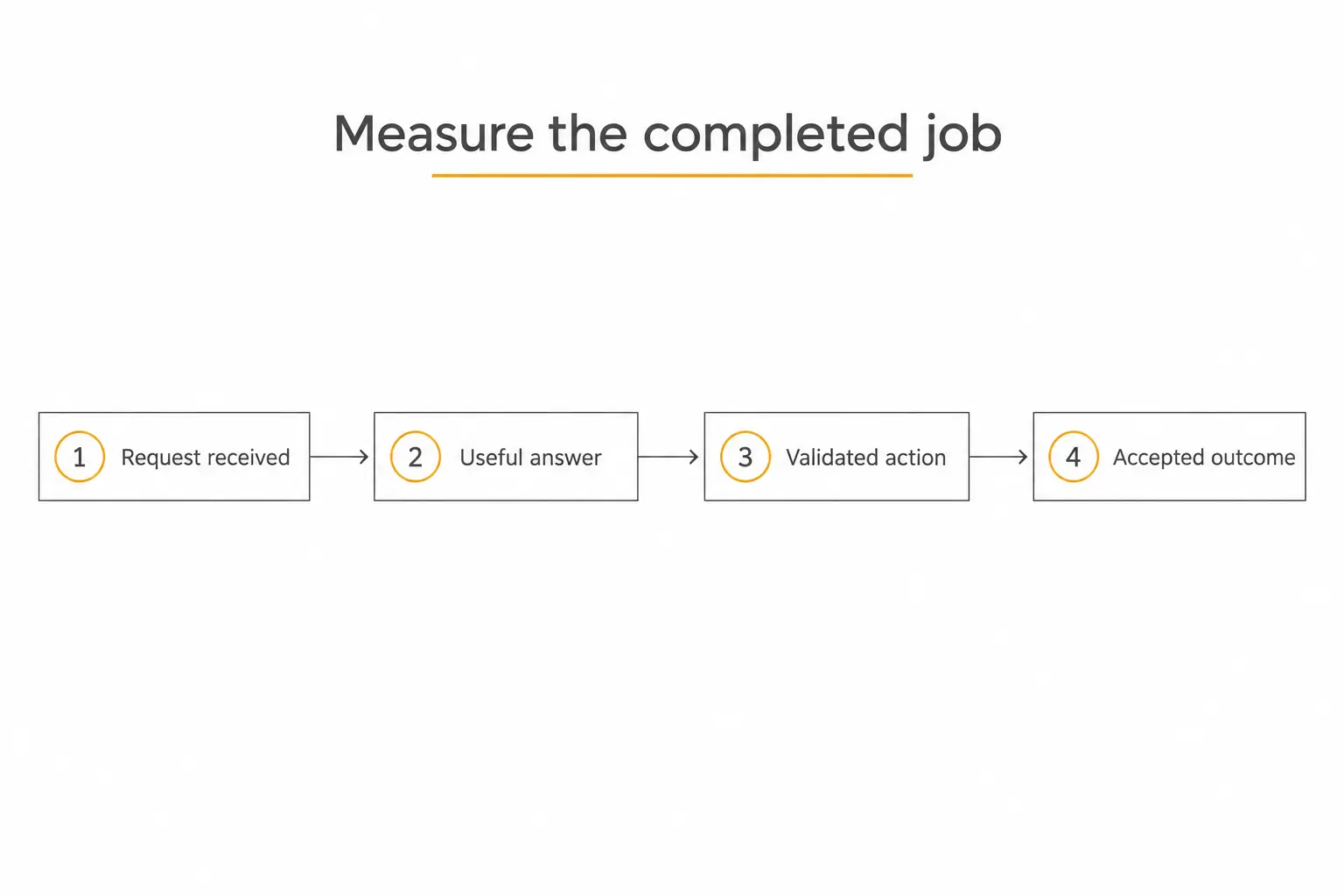
3. Time the completed Mercury 3 AI agents workflow
A model call occupies only part of an agent's path. Retrieval, external services, validation, approval, retries, and the final write can dominate the elapsed time.
Consider hypothetical arithmetic: a job spends four seconds waiting on models and six seconds on everything else. Halving model time reduces the job from ten seconds to eight, a 20% reduction overall, assuming every other step stays the same.
Those numbers are illustrative, not Mercury measurements. Their purpose is to show why a large decoding improvement can produce a smaller customer-visible improvement.
Instrument the complete path with a shared job identifier. Our guide to LLM observability tools explains how traces help connect model calls to tool operations and failures.
- Start: The service receives the user's request.
- Model work: Include every decision and synthesis call.
- External work: Include retrieval, tools, and application validation.
- Finish: The accepted result exists and the user sees its accurate status.
For the fictional assistant, a completed job means a correct draft follow-up exists in the test destination and the answer describes it honestly. “I created your task” with no matching record is a failed job, however quickly the text arrived.
Separate interactive processing from human waiting when reporting results. Keep both timestamps, but do not credit a model change with a faster approval that happened because a reviewer was available sooner.
4. Verify tool calls and structured outputs
Mercury 3 supports tool calling, including parallel calls, according to Inception's Tool Use guide. The application executes returned functions and sends results back; the model's request is only one part of the action.
The structured-output guide shows JSON-schema constraints. A response that conforms to a schema can still contain the wrong client identifier, an unsupported promise, or a fabricated source.
I would check three layers independently: parseability, business validity, and the observed destination result. Keep authorization in application logic so a plausible argument cannot expand the assistant's permission.
For example, a draft task can require a permitted client ID, a nonempty service summary, and an explicit status. The test should reject an unknown client, preserve missing information as missing, and verify the task belongs to the correct test account.
Parallel calls need their own cases. Independent read-only lookups may be suitable for parallel execution, while a dependent write must wait for the lookup that establishes its valid target.
Simulate a timeout after a destination accepts a request. Retrying that request should not create a duplicate record; use an application-owned operation identifier and destination behavior that supports safe retrying.
The model does not become responsible for transaction semantics just because it can request a function. Our AI agent evals guide develops the distinction between a convincing transcript and a verified outcome.
5. Test long context with conflicting evidence
The advertised context window gives you room to supply material. It does not settle whether the assistant selects the right passage, handles conflicting versions, or notices that an answer is absent.
For the proposed pilot, create a synthetic service handbook with a current policy, an explicitly superseded policy, and irrelevant material. Move the current policy between the beginning, middle, and end while preserving the expected answer.
Then ask a question whose answer is genuinely missing. An assistant that confidently fills the gap has failed the task even if its answer is well written and fully formatted.
I would record the source passage used, policy version, answer, and abstention behavior. That makes it possible to distinguish a retrieval failure from a model that received the right evidence and ignored it.
Our knowledge-base guide explains source preparation and retrieval. A model switch should reuse the same approved evidence set before you separately evaluate a larger-context strategy.
Inception's API FAQ says Mercury 3 accepts text and that the API has no embeddings endpoint. A document workflow therefore still needs its appropriate extraction and retrieval components; do not assume an image or scanned document becomes readable merely because its text would fit.
6. Price accepted tasks at the standard rate
On October 22, Inception's model rate card lists the following USD prices per million tokens. The launch offer has no end date stated on that page, so I would budget the standard rate and treat the promotion as temporary savings.
| Meter | Standard | Launch offer |
|---|---|---|
| Uncached input / 1M tokens | $0.20 | $0.10 |
| Cached input / 1M tokens | $0.02 | $0.01 |
| Output / 1M tokens | $0.70 | $0.35 |
These are token usage rates, not a monthly software subscription or an all-inclusive client service price. Check the chosen route's fees, currency, applicable taxes, and account terms separately.
Suppose a fictional job consumes 10,000 uncached input tokens and 2,000 total output tokens across all its calls. Its model charge would be $0.0034 at standard rates: $0.002 input plus $0.0014 output; the listed launch rates halve that to $0.0017.
This arithmetic assumes no cache hits and excludes tools, hosting, retries beyond those token totals, and human review. It is an explanation of the meters, not a forecast of what your job will consume.
Inception's usage documentation includes reasoning tokens inside completion totals and cached tokens inside prompt totals. Subtract cached input from total input before applying the uncached rate, and do not add either nested count to its parent again.
For a release decision, divide the full trial cost by accepted tasks, counting failed attempts in the numerator. Our agent token economics guide provides the wider budgeting context; use current route-specific rates for this experiment.
7. Resolve data handling and rollback before client traffic
The public Inception privacy policy includes model improvement among its processing purposes and describes retention based on need. The API FAQ says custom arrangements, including zero-retention configurations, are handled case by case.
I would not turn those pages into a universal no-training or zero-retention promise. Get the terms that apply to the actual account and route, then have the client's responsible owner decide whether the proposed data flow is acceptable.
Map the path from the application through any gateway to the model provider and back to your logs. Include support access, failure traces, cached material, and the destination system, because removing a prompt from one dashboard does not establish deletion everywhere.
Start the evaluation with synthetic data. Before using real client material, decide which fields are necessary, which can be removed, who can access the records, and how deletion requests reach each relevant system.
Prepare rollback as an executable configuration change. Preserve the previous model, prompt, tool contract, and application version together so returning to the old route does not leave a new parser expecting different fields.
If a write may already have completed, reconcile the destination before retrying on another model. Changing providers does not undo an external action or make repeating it safe.
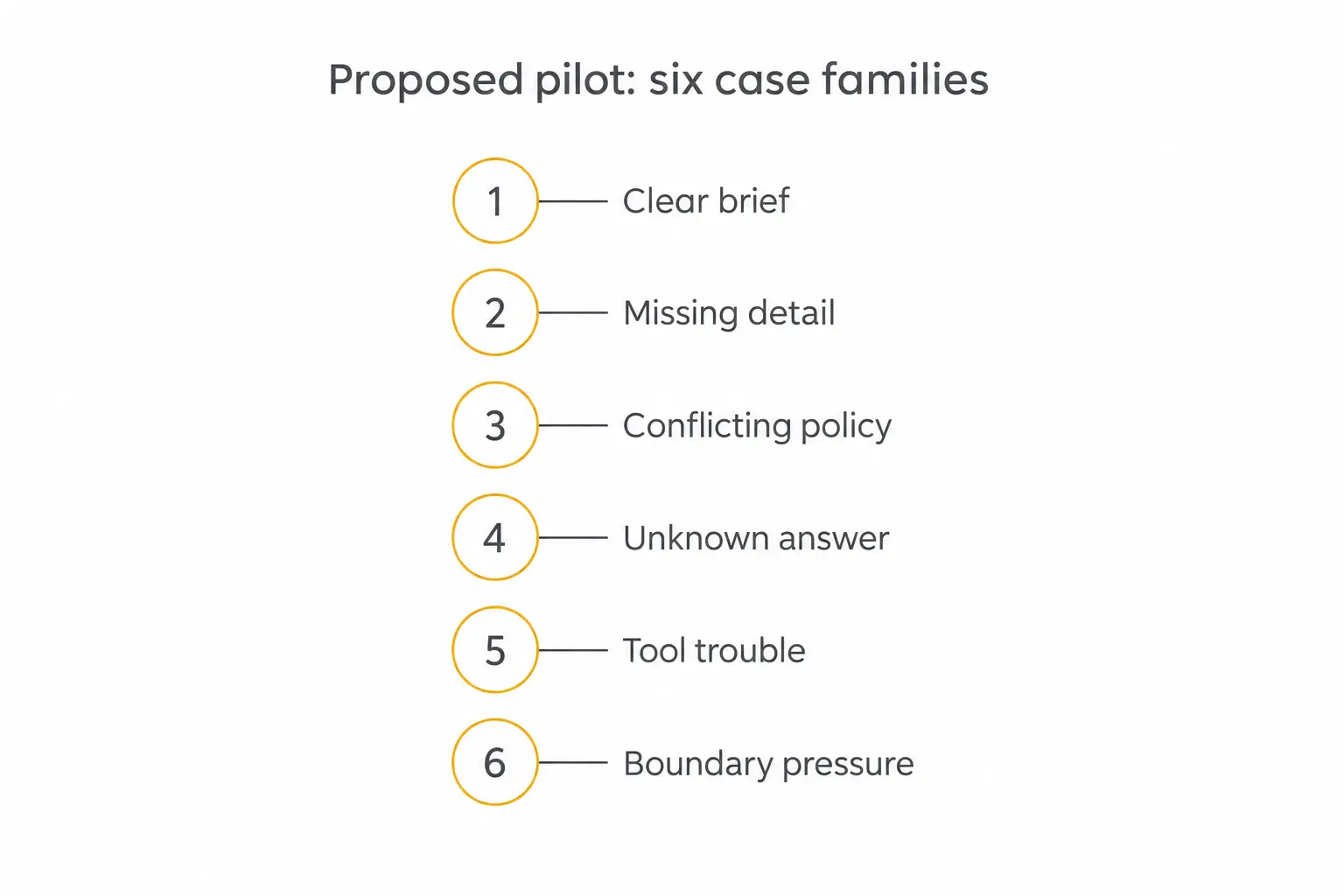
A synthetic pilot you can actually review
I would begin with a proposed pack of 24 cases, four from each family below. This is a manageable design example, not a statistical claim that 24 cases can certify a production system.
- Clear brief: All required information is present.
- Missing detail: A necessary field needs a follow-up question.
- Conflicting policy: An old document disagrees with the current one.
- Unknown answer: Approved sources cannot resolve the request.
- Tool trouble: A lookup fails or a write's result is uncertain.
- Boundary pressure: A request tries to exceed the allowed client or action.
Run the incumbent and candidate with the same inputs and tool fixtures. Repeat cases to expose variability, alternate model order, and separate warm-cache from cold-cache observations.
Inception does not document bit-exact reproducibility or a seed parameter for this endpoint in its sampling FAQ. Save the exact settings and all attempts instead of presenting one successful run as representative.
Have a reviewer score the result without seeing the model label where practical. When the reviewer and automated checker disagree, preserve the disagreement and resolve the expected behavior before scoring another batch.
Reserve new cases for a later check so prompt changes are not judged only on examples used to write them. A small pilot should reveal the next uncertainty, not manufacture an impressive success percentage.
Give your agent a clear job
Build around approved knowledge and check the outcome in Preview.
Keep a release record with separate decisions
A useful release record has a row for each case and attempt, with input version, model route, effort setting, source version, clock timestamps, usage, validation result, and destination evidence. Redact sensitive fields rather than copying unrestricted conversations into a spreadsheet.
Record speed, quality, cost, and permission failures separately. Averaging them into a single star rating can hide a critical failure behind excellent throughput.
For the fictional assistant, my proposed gate would require no cross-client disclosures, no unauthorized writes, and no false claims of completed actions in the reviewed test pack. Passing that pack would justify a limited next stage, not establish a zero failure rate in the real world.
Agree on the ordinary quality and waiting-time targets with the client before running the comparison. If the candidate misses one, specify whether to adjust the application, narrow the task, or retain the incumbent.
Our agent architecture patterns guide helps identify whether a simpler fixed sequence can solve the job. Sometimes the strongest release decision is to remove a model decision entirely.
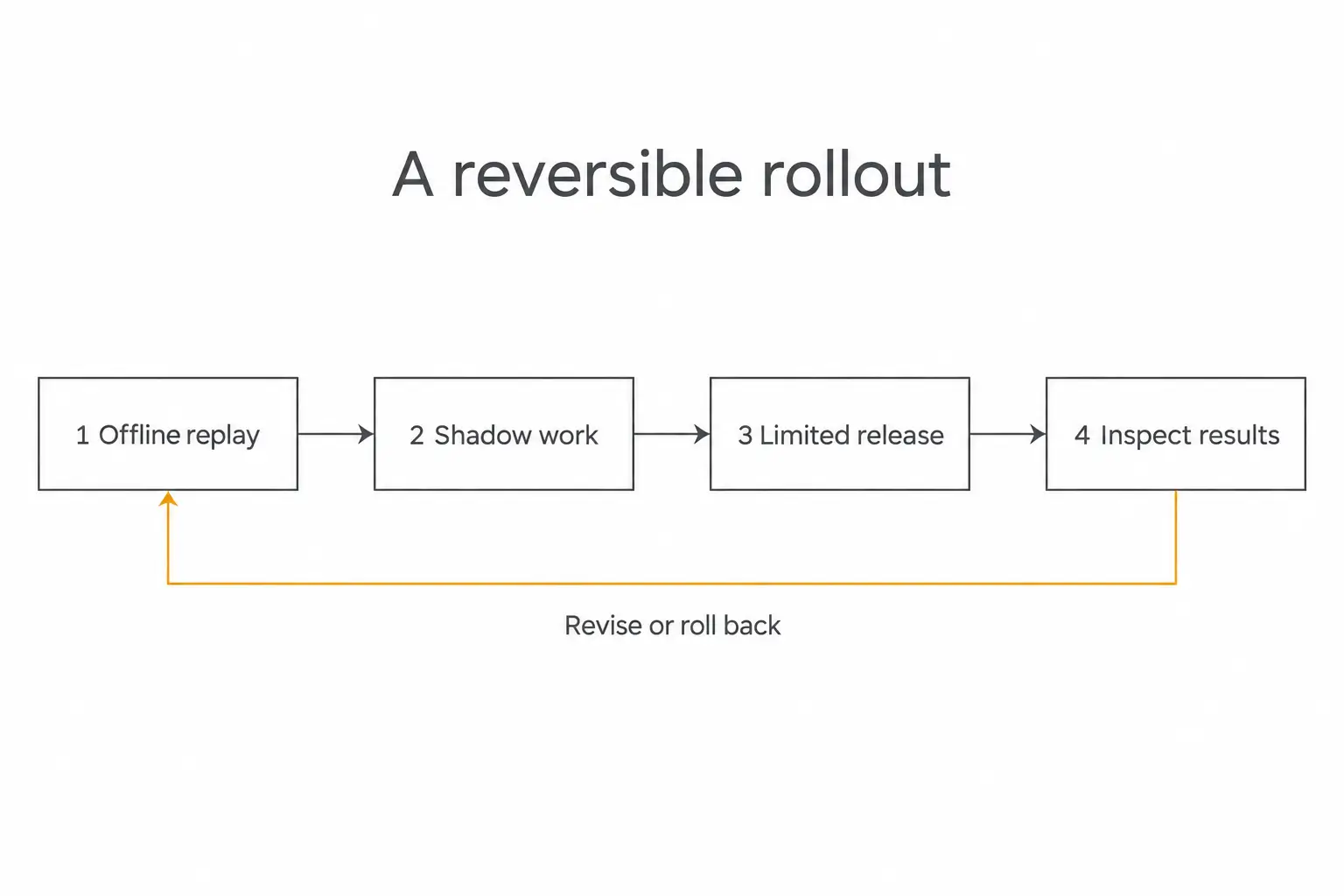
Roll out one bounded job, then inspect it
Start with offline replay, then shadow work that cannot write to a real destination. Check whether shadow traffic itself sends data to a new provider before enabling it.
Next, expose a limited approved task with a known owner, a spending limit, and a way to stop new jobs. Keep consequential writes behind the same authorization boundary you tested.
Inception publishes separate request, input-token, and output-token limits on its rate-limit page. Test expected bursts and recovery on your account; a fast individual response does not guarantee your busiest period will avoid throttling.
Inspect tail latency and rejected jobs as well as typical outcomes. A client who receives an occasional very slow answer experiences a different service from the one described by a favorable average.
Keep the rollout narrow until the failure handling is boring and explainable. If Mercury is useful for only one step, our model routing guide offers a way to think about assigning work by capability without switching the whole service at once.
Where Pickaxe fits in this decision
Pickaxe is useful when the deliverable is a client-ready AI service with instructions, knowledge, actions, and a place for people to use it. Its current Agent Builder brings those components together in Build, with Preview for testing.
For an agency, that keeps attention on the service: the approved sources, what the agent may do, and what the client receives. Portals provide branded multi-agent delivery with access groups, while the Actions documentation covers connections to tools, APIs, and other agents.
Mercury 3 native availability in Pickaxe was not verified for this article. I found no Mercury entry in the public model catalog checked on October 22, and OpenAI-compatible API support elsewhere does not establish that it is selectable in your workspace.
A custom service exposed through an Action is a possible engineering design to evaluate separately. It adds its own credentials, latency, data path, and maintenance; this guide does not claim a ready-made Mercury connector or an automatic fallback configuration.
If you are already delivering a working Pickaxe service, keep it running on a verified supported model while evaluating Mercury outside the client path. The value of an evaluation is a better service decision, even when the answer is to keep the current configuration.
Questions I would ask before switching
Does high token throughput mean a better voice agent?
It can help one part of the path, but the complete experience includes speech recognition, useful-answer timing, tool waits, speech synthesis, and interruption handling. Measure the time to a safe spoken response in the actual stack.
Is the launch offer the price I should quote a client?
I would quote against a budget that survives the standard rates, then treat the promotion as savings. Include the rest of the service cost and recheck the exact route before making a commercial commitment.
Can I remove retrieval because the context window is large?
Only if your own evaluation shows the alternative meets the task. Source freshness, permissions, irrelevant material, and answer grounding still need deliberate handling, even when all documents fit.
Should I migrate everything at once?
I would choose a reversible task first and preserve the incumbent. A narrow success can justify expansion; a failed gate can justify keeping the current route without discarding the useful parts of the experiment.
What this guide verified
I checked the primary launch, production API documentation, rate card, general privacy policy, access listings, and current Pickaxe documentation on October 22, 2026. This is a source-based adoption guide, not a benchmark of paid Mercury requests.
The proposal separates documented features, vendor performance claims, and our own suggested evaluation steps. It does not reuse an earlier Mercury model's results as evidence for Mercury 3 or transfer a gateway's availability claim to Pickaxe.
One documentation detail illustrates why checking the whole request matters: the API FAQ's MCP explanation still contains an older model identifier. Use the current model and tool-use pages to verify your request rather than pasting a mixed-version example unchanged.
Keep the evidence packet with the implementation: dated sources, selected settings, test inputs, observed failures, cost totals, and the release decision. That packet makes a future model change faster to assess without depending on memory.
My recommendation
Evaluate Mercury 3 when a bounded agent job spends meaningful time waiting on generation and you can verify the outcome. Start with synthetic cases, explicit settings, standard-rate economics, and a destination result you can inspect.
Expand only when the candidate improves the service on the criteria the client accepted. Retain the current model when tool failures, weak grounding, uncertain data terms, or an unsupported integration outweigh the speed gain.
If you want to build the service around that evaluation, start with Pickaxe and a supported model. Define the job and its acceptance checks first; that work stays useful as the model choices change.