

A chief AI officer should make the company's AI decisions clearer: what deserves funding, what must change before deployment, and who answers for the result. If the job description mainly asks someone to keep up with new tools, I would narrow the assignment before hiring an executive.
I looked through current research, role descriptions, and governance guidance to build the hiring process I would use. The useful starting point is a written mandate with actual authority and evidence the business can inspect.
The charter, interview exercise, scorecard, and schedules below are my proposed templates. The service-firm example is fictional; none of its outcomes or hiring thresholds are presented as research findings.
What a chief AI officer should own
A chief AI officer, or CAIO, coordinates how the business chooses, introduces, governs, and measures AI. My expectation would be ownership of the decision process across departments, with named specialists still responsible for engineering, security, finance, and the work itself.
IBM's overview of the role covers strategy, technology oversight, team leadership, governance, and education. That breadth helps explain why simply promoting the strongest prompt writer can leave major gaps.
The work should leave a small set of useful records: a prioritized portfolio, an agreed budget, a register of deployed systems, acceptance evidence, and decisions to expand, change, or stop an initiative. A leader should be able to explain those records without a vendor presentation.
In a smaller business, an existing executive can hold this mandate. In a company building AI into its core product, a dedicated leader might need substantial technical and product authority.
Define the business problem before the reporting line. Our AI strategy consulting playbook describes assessment and prioritization work; the CAIO question is who keeps making those decisions after the assessment ends.
When your business needs a chief AI officer
I would start by examining unresolved decisions from actual projects. Are departments buying overlapping products?
Does a pilot stall because nobody can authorize the next step? Is somebody accountable for adoption but unable to change the workflow?
Those are leadership problems worth investigating. A growing list of AI subscriptions, on its own, could be a procurement cleanup rather than an executive vacancy.
IBM's November 17, 2026 study announcement reports that only 18% of surveyed AI leaders have full control over AI investment decisions. Its sample includes 1,667 executives across 33 geographies and 20 industries, surveyed from April to June 2026.
IBM uses “CAIOs” collectively for that broader group, including data-and-AI chiefs, heads of AI, and equivalent leaders. This vendor-sponsored, self-reported research does not establish how common dedicated CAIO titles are among small businesses, or prove that hiring one causes better returns.
I would consider a dedicated mandate when important AI choices repeatedly cross departmental boundaries and the current leadership structure cannot resolve them. Before recruiting, ask whether clearer delegation to an existing leader would solve the same problem.
The test is concrete: identify the blocked decision, its business consequence, the authority needed, and how often similar decisions recur. If those answers remain vague, commission a bounded assessment first.
Choose an existing leader, fractional executive, or full-time hire
These arrangements solve different workload and authority problems. I would choose based on recurring decisions, delivery demands, and required availability, rather than a universal employee-count threshold.
| Arrangement | Useful when | Condition to check |
|---|---|---|
| Existing executive with AI mandate | Scope is bounded and leadership has capacity | Other responsibilities and budget permit the work |
| Project consultant or agency | A defined assessment or implementation needs delivery | Someone internal owns ongoing decisions |
| Fractional CAIO | Recurring executive decisions need ownership part of the week | Delegated authority, coverage, and continuity are explicit |
| Full-time CAIO or equivalent | Cross-company leadership and management fill a sustained role | The business funds the team and authority behind the title |
A fractional appointment can work when a company needs senior judgment regularly but does not have a full-time executive workload. The contract still needs operating responsibilities, access to decision-makers, and an escalation route between scheduled meetings.
An implementation agency can be excellent at building a particular service. That does not automatically give it authority to choose the client's investment portfolio or approve sensitive data use.
I would revisit the arrangement when the backlog, team size, or consequences change. A successful temporary mandate should make the eventual internal owner easier to appoint, with records that transfer cleanly.
For the underlying diagnosis, use the AI workflow audit to identify work worth changing before turning a coordination problem into a permanent position.
Write a mandate before opening the job
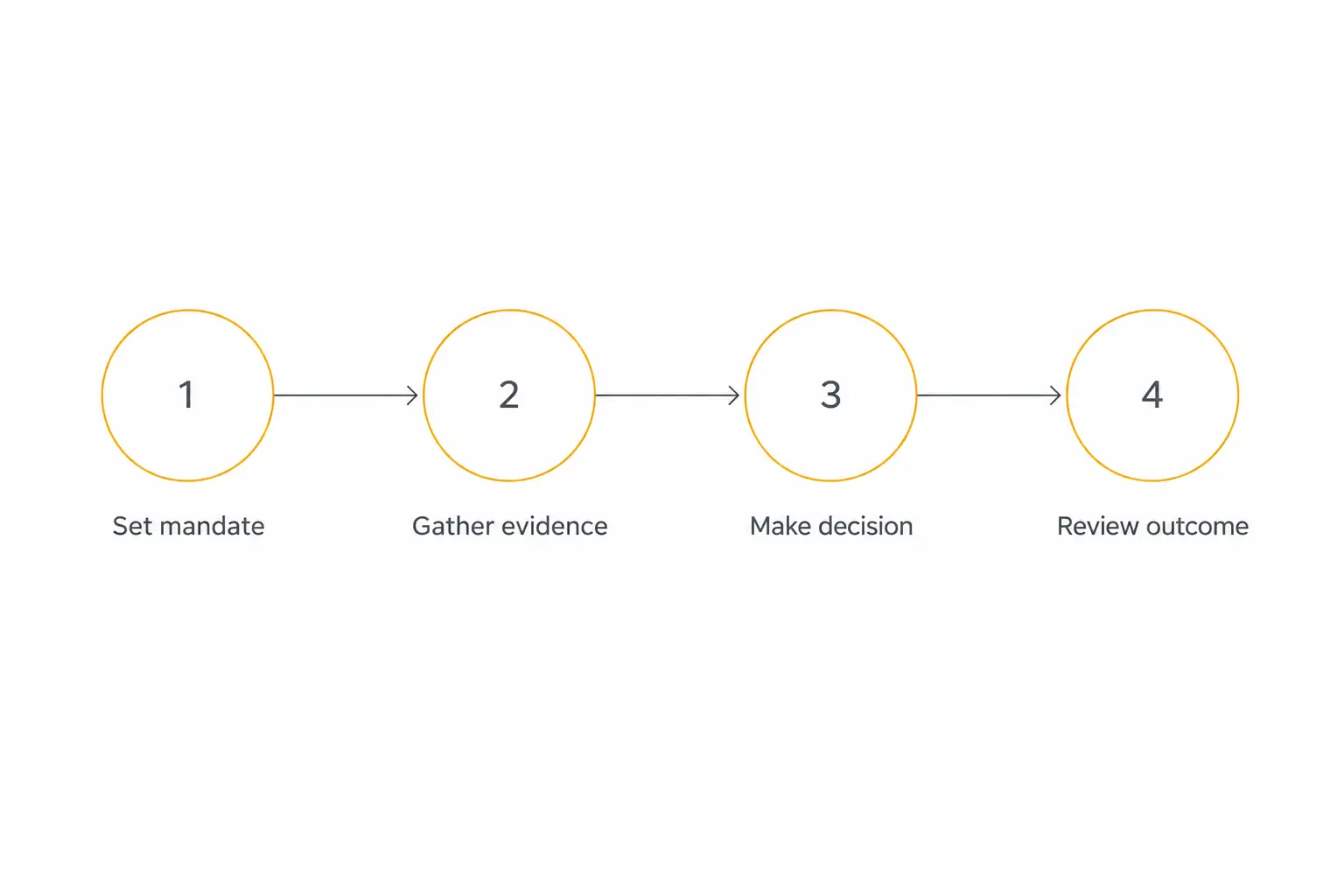
My first hiring artifact would be a short charter signed off by the sponsor and the leaders whose decisions it affects. A title without this agreement invites overlapping responsibilities and arguments after spending begins.
The charter should describe the business outcomes in scope, the decisions delegated to the role, the resources available, and the decisions reserved to other officers. Include what happens when those people disagree.
- Purpose: improve selected workflows while meeting agreed quality and operating requirements.
- Scope: name the departments, systems, customers, and excluded uses.
- Authority: specify budget discretion, launch gates, vendor selection, and pause rights.
- Resources: name committed delivery capacity and access to domain experts.
- Evidence: define the records leadership will review.
- Review: set a date to expand, revise, renew, or end the mandate.
For every authority statement, add a boundary. For example, a CAIO may approve a pilot within an agreed spending envelope while finance retains contract-signing authority and security retains its deployment requirements.
A useful question for the sponsor is: “What decision can this person make that nobody can make reliably today?” Ask the affected department head the same question separately.
If their answers conflict, resolve that before recruitment. Candidates should be able to assess a real job, including constraints, rather than discover after joining that their principal responsibility is persuading people who can ignore them.
Separate executive coordination from specialist approval
I would use an explicit decision table instead of saying the CAIO “owns everything AI.” The coordination role needs enough reach to resolve tradeoffs while preserving the expertise and authority of other functions.
The NIST AI RMF Core calls for documented responsibilities, clear communication, executive accountability, and defined human oversight. It is voluntary guidance, not a requirement to create a particular job title.
| Decision | CAIO contribution | Other owner to name |
|---|---|---|
| Which workflow to fund | Compare evidence and recommend portfolio allocation | Budget holder authorizes spending |
| Whether the output is usable | Require acceptance evidence | Workflow owner defines the standard |
| Whether data and access are appropriate | Coordinate requirements and record unresolved issues | Security, privacy, and legal specialists as applicable |
| Whether to expand or stop | Lead evidence review and exercise delegated pause rights | Sponsor resolves reserved decisions |
These are proposed allocations, not a standard organizational chart. A company can delegate differently, but everyone should know which arrangement applies.
The CIO might own the technology estate, the CTO product engineering, and the data leader source quality. The CAIO should help connect those responsibilities to business priorities without becoming a second approval path for every routine technical change.
Also name an operational deputy. When a system needs pausing, the business needs someone available with the access and authority to act.
Build the job description around deliverables
A good description gives candidates enough context to decide whether their experience fits. I would replace broad demands to “transform the business” with outcomes and constraints they can discuss in an interview.
There is no single organizational pattern to copy. Deloitte UK's June 1, 2026 announcement, for example, places its first UK CAIO on the UK Executive with a remit across client services and internal operations.
That is one firm's appointment, not evidence that every company needs the same reporting line. Use your own mandate to write the opening paragraph.
Proposed role brief: Lead the selection, governance, and measured rollout of AI across the workflows named in the charter. Maintain the investment portfolio, coordinate delivery owners, and present evidence-based expand, revise, or stop recommendations to the sponsor.
Then list the first deliverables: an inventory, a prioritized pilot brief, an agreed responsibility map, a baseline, and a review process. State which teams already exist and which hires the candidate would be authorized to make.
Publish the working arrangement, location requirements, compensation structure, reporting relationship, and interview process with the opening. Those specifics are more useful than asking for mastery of every model family or an arbitrary number of years in a young job category.
Look for judgment across business, delivery, and risk
I would assess candidates against the work they will actually do. Deep model knowledge helps, but a leader also needs to explain a weak business case, negotiate operating changes, and tell a sponsor when the evidence does not support expansion.
Ask for an anonymized decision record from a previous initiative, subject to confidentiality. What was uncertain, what did they decide, who disagreed, and what happened when assumptions changed?
For technical judgment, ask how they would check an agent that produces plausible answers from the wrong source. A strong answer should address source quality, evaluation, permissions, monitoring, and recovery, while acknowledging which specialists would implement those controls.
For commercial judgment, ask how they separate potential capacity from realized financial benefit. Faster drafting can be useful even when it does not remove a cost or create additional sales.
For organizational judgment, ask who inherits review work and exceptions. Our AI change management guide explains why the changed task, practice time, and support route belong in the operating plan.
References should come from people who observed these decisions, including a delivery partner and a business owner where available. A polished conference talk tells you much less about whether a candidate can handle a stalled rollout.
Use interview questions that expose tradeoffs
I would give every candidate the same core questions, then ask for the evidence behind their answers. Consistency makes the discussion easier to compare without pretending that executive hiring can be reduced to a perfect numerical ranking.
- Which AI initiative did you stop? Ask what evidence changed the decision and how the sponsor responded.
- What did the original business case miss? Listen for integration, review, maintenance, and organizational costs.
- Who could overrule your launch recommendation? Ask how disagreement was recorded and resolved.
- How did a workflow change after deployment? Seek a concrete before-and-after account of responsibility.
- What happened when the system was unavailable? Ask about fallback ownership and recovery.
- Which decision would you refuse to make alone? Look for appropriate specialist involvement.
Follow up on vague success stories. “Adoption improved” needs a defined eligible population and an observation period; “we saved money” needs a cost category and someone willing to confirm the calculation.
I would also describe an internal disagreement honestly. If finance wants savings and a department head wants faster service, ask the candidate to make the tradeoff visible before choosing a metric.
Be wary of certainty that arrives before discovery. A strong candidate can explain what they would inspect next and what finding would change their recommendation.
Give finalists a bounded hiring exercise
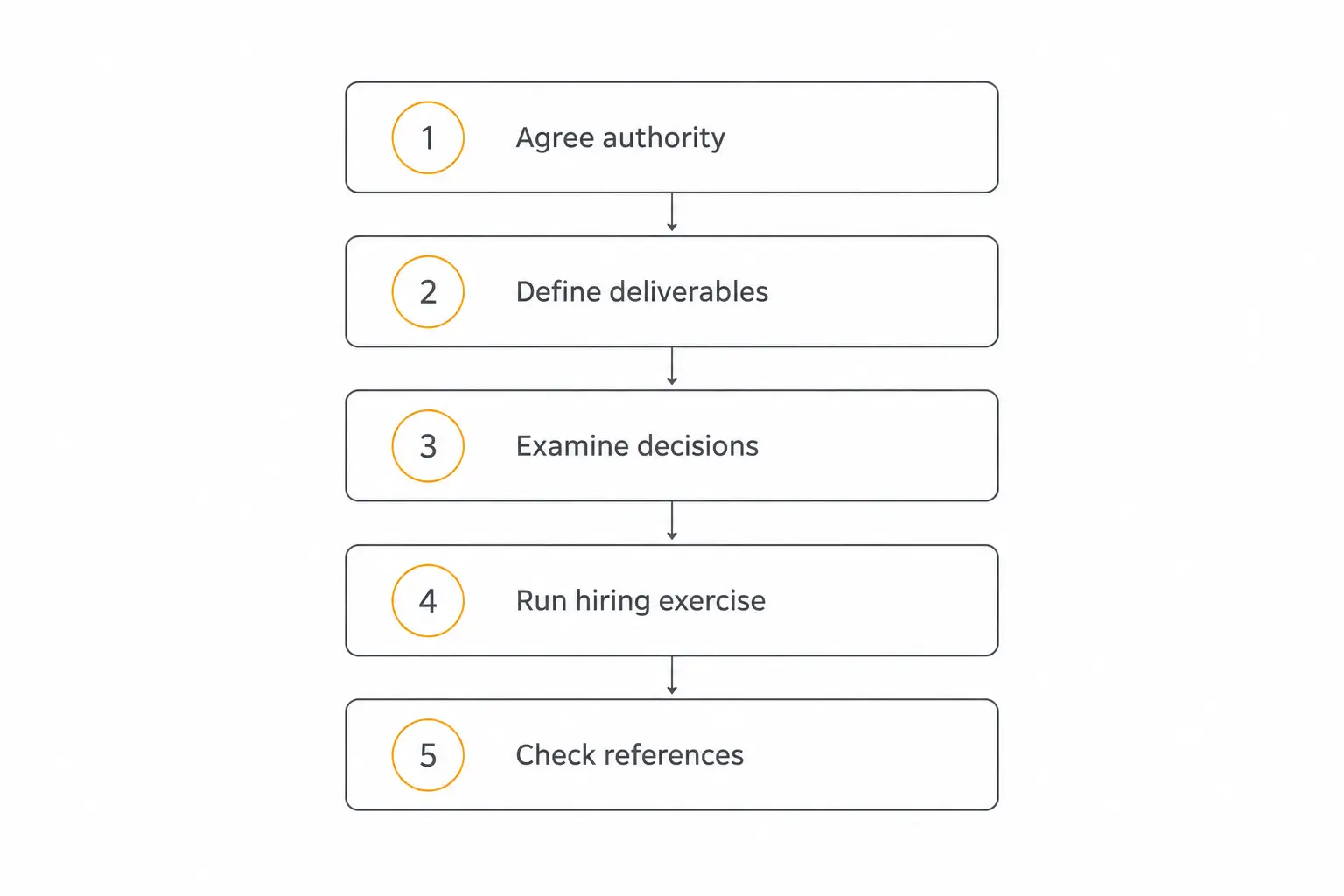
My proposed exercise uses fictional materials: a workflow description, conflicting stakeholder requests, a short vendor proposal, a cost sheet, and a handful of example outputs. Give each finalist the same pack and compensate substantial preparation work.
Ask for a short decision memo and discussion, not a production build or unpaid strategy for a live client. The exercise should reveal judgment within a clearly stated time limit.
The memo should identify the workflow worth pursuing, the missing evidence, the proposed owner, and the conditions for a limited pilot. It should also state what the candidate would defer.
During the discussion, introduce a change: the supposedly approved policy document is outdated, or the vendor cannot meet the required retention setting. Ask what decision changes and who needs to be involved.
The strongest response may be to pause. Do not reward a confident launch plan when the supplied evidence makes that plan indefensible.
The OECD AI Principles connect accountability with traceability and ongoing risk management. My exercise applies that general idea by asking candidates to leave a decision trail another person can inspect; it is not an OECD hiring test or certification.
Preserve candidate privacy and explain who will see their work. Evaluate the reasoning against the job's mandate rather than whether the candidate selected your preferred vendor.
Score the role with evidence and shared outcomes
I would use a small scorecard with an owner, definition, baseline, and review date for each measure. Avoid rewarding the number of tools bought, agents launched, or employees attending a demonstration.
| Dimension | Evidence to inspect | Question to ask |
|---|---|---|
| Business outcome | Accepted work and total operating cost | Did eligible work improve against the baseline? |
| Quality and control | Evaluations, incidents, exceptions, and permission checks | Are important failures detected and handled? |
| Adoption | Eligible users completing the changed task | Can people use the workflow successfully? |
| Portfolio judgment | Funding changes and recorded stop decisions | Does evidence change resource allocation? |
| Continuity | Named owners and a rehearsed fallback | Can the business operate without this individual? |
Choose thresholds with the workflow owner before running the pilot. A customer-facing policy answer and an internal brainstorming assistant should not inherit the same acceptance standard.
Our AI agent ROI guide explains the distinction between possible time savings and realized benefits. For this role, finance should review the claimed benefit while the workflow owner verifies service quality.
Some outcomes are shared with other executives. Record the dependencies rather than attributing every gain or delay to one person.
Also score the quality of decisions under uncertainty. A documented decision to stop an unsuitable project can be valuable leadership even when it reduces the count of deployed AI systems.
Set a first-90-days plan with decision gates
The following is a proposed planning sequence, not a promise that every organization can deploy safely within a quarter. Adjust the pace to the workflow, approvals, and evidence available.
Days 1 to 30: establish the facts
Inventory current AI use, vendor commitments, source owners, and unresolved decisions. Interview the people doing the work and reconcile the sponsor's goals with actual operating constraints.
The exit gate is an agreed mandate and a shortlist with reasons to pursue or defer each item. Missing baseline data should remain visible rather than becoming an optimistic estimate.
Days 31 to 60: prepare one bounded pilot
Choose a workflow, define eligible work, gather representative examples, and assign delivery and review owners. Establish the fallback and clarify what the system may change.
For a limited internal assistant, Pickaxe can provide a branded Portal containing the agent and guidance Pages. That is a delivery option to evaluate against the brief; it does not establish the client's governance or prove the pilot is ready.
Days 61 to 90: inspect and decide
Run only within the approved boundaries, review accepted work and exceptions, and compare observed costs with the business case. Decide whether to expand, revise, continue gathering evidence, or stop.
Microsoft's Copilot adoption resources distinguish support for leaders, champions, users, and administrators. I would make similarly explicit assignments for this pilot rather than make the new executive everyone's permanent help desk.
Apply the mandate to a fictional service firm
Imagine a service firm with separate support and advisory teams. Support wants faster policy answers, advisory wants draft client summaries, and finance wants to understand growing software spend.
I would first assign an existing sponsor and a fractional AI leader to a bounded discovery mandate, provided they have enough authority and availability. This example does not establish that fractional leadership is always the cheapest option.
The first decision is to pilot policy-answer drafts for an internal support group. Client summaries remain deferred until the team can establish which client information may be used and how review will work.
In Pickaxe, I would keep the initial agent focused on approved knowledge and make people responsible for sending final answers. Adding Actions to update a customer record would create another permission and recovery decision, so that addition belongs in a later approved scope.
The fractional leader leaves a decision register, source-owner list, pilot evidence, and a recommendation about ongoing leadership capacity. The sponsor then decides whether existing management can carry the work or a permanent role is justified.
For the fractional agreement itself, I would specify availability, delegated decisions, escalation coverage, conflicts of interest, handover materials, and an end condition. Buying advice from someone who also sells implementation requires a clear separation between vendor recommendations and purchasing approval.
The result to buy is continuity of good decisions. A recurring meeting without usable records or follow-through would not satisfy this mandate.
Give one pilot a clear home.
Build a focused agent and organize its guidance in a branded Pickaxe Portal.
Questions to settle before making an offer
Does the CAIO have to report to the CEO?
I would choose the reporting line that provides access to the decisions and resources in the charter. Reporting to the CEO can help with cross-company tradeoffs, but the label alone does not create authority.
Can our CTO do the job?
Possibly, if the CTO has the business remit, capacity, and relationships required. Write down which existing duties will change; adding AI responsibility to an already overloaded role does not create more time.
Does the candidate need to code?
The required technical depth depends on the portfolio. I would require enough understanding to challenge architecture, evaluation, and operating assumptions, while explicitly assigning hands-on delivery where needed.
How much should we budget?
Get current quotes for the specific location and scope, including benefits or contract overhead, delivery staff, tools, and transition. I would compare total operating cost and authority offered rather than publish a universal salary or fractional-retainer range.
How do we know when fractional support should end?
Use the agreed review gate: the work has become a sustained full-time leadership role, an internal owner can carry it, or the mandate no longer justifies continuing. Require handover of records and open decisions in each case.
Start with the decision you cannot make today
Before hiring, write one unresolved AI decision on a page. Add its business consequence, evidence needed, current owner, and the authority required to resolve it.
Use that page to choose the smallest leadership arrangement that can carry the mandate reliably. Then interview for the judgment, delivery discipline, and organizational work the arrangement actually requires.
A clear charter makes a good candidate more effective and a weak fit easier to spot. The next step is agreeing who can make the decision and what evidence the business will accept.