
The idea of a personal super-agent — a single AI that knows your projects, manages your inbox, monitors your deployments, follows up with your team, and gets smarter the longer it runs — stopped being science fiction sometime around January 2026.
Two open-source projects are leading the charge to make it real: Hermes Agent and OpenClaw. Both are free. Both run on your own hardware. Both promise to be the always-on AI backbone that connects to everything in your digital life and actually does things instead of just chatting.
But they represent fundamentally different philosophies about what personal AI infrastructure should look like — and choosing the wrong foundation now means migrating later.
I've been deep in OpenClaw for months — we use it as the AI engine powering Pickaxe, and I've deployed it across our entire business. When Hermes launched in February, I spent a couple of weeks running it side-by-side to understand what the hype was about.
Here's the honest breakdown for anyone building their personal agent infrastructure in 2026.
The 30-Second Version
If you're in a hurry:
- OpenClaw is a gateway platform — it sits between you and your agents, managing routing, permissions, channels, and 5,700+ community-built skills. It's built in TypeScript, has 345,000+ GitHub stars (making it GitHub's most-starred software project), and excels at breadth of integration and team operations.
- Hermes Agent is a learning-first agent — built by Nous Research in Python, it autonomously creates and refines its own skills from experience. Since its February 2026 launch, it's hit 64,000+ GitHub stars and excels at deep personalization and self-improvement over time.
OpenClaw wins on ecosystem breadth and channel coverage. Hermes wins on autonomous learning and security defaults. The right choice depends entirely on what kind of personal AI infrastructure you're building.
What Is Personal Super-Agent Infrastructure, Anyway?
Before we compare, let's define what we're actually talking about.
A personal super-agent isn't a chatbot. It's not an assistant you open in a browser tab when you need something. It's infrastructure — a persistent AI layer that sits between you and your digital life, running 24/7 on your own hardware.
Think of it like your own private operating system for AI. It:
- Triages your inbox every morning before you wake up
- Monitors your deployments and Slacks you when something breaks
- Creates tasks from meeting notes and follows up when they're overdue
- Tracks competitors and surfaces changes you'd want to know about
- Remembers everything — your preferences, your projects, your team, your decisions from three weeks ago
- Gets better over time as it learns your patterns and builds reusable skills
Both OpenClaw and Hermes can do all of this. The question is how they do it, and what trade-offs come with each approach. That's what matters when you're choosing the foundation you'll build on for the next year or more.
Architecture: Gateway vs Learning Loop
This is the fundamental difference, and everything else flows from it.
OpenClaw's Gateway Model
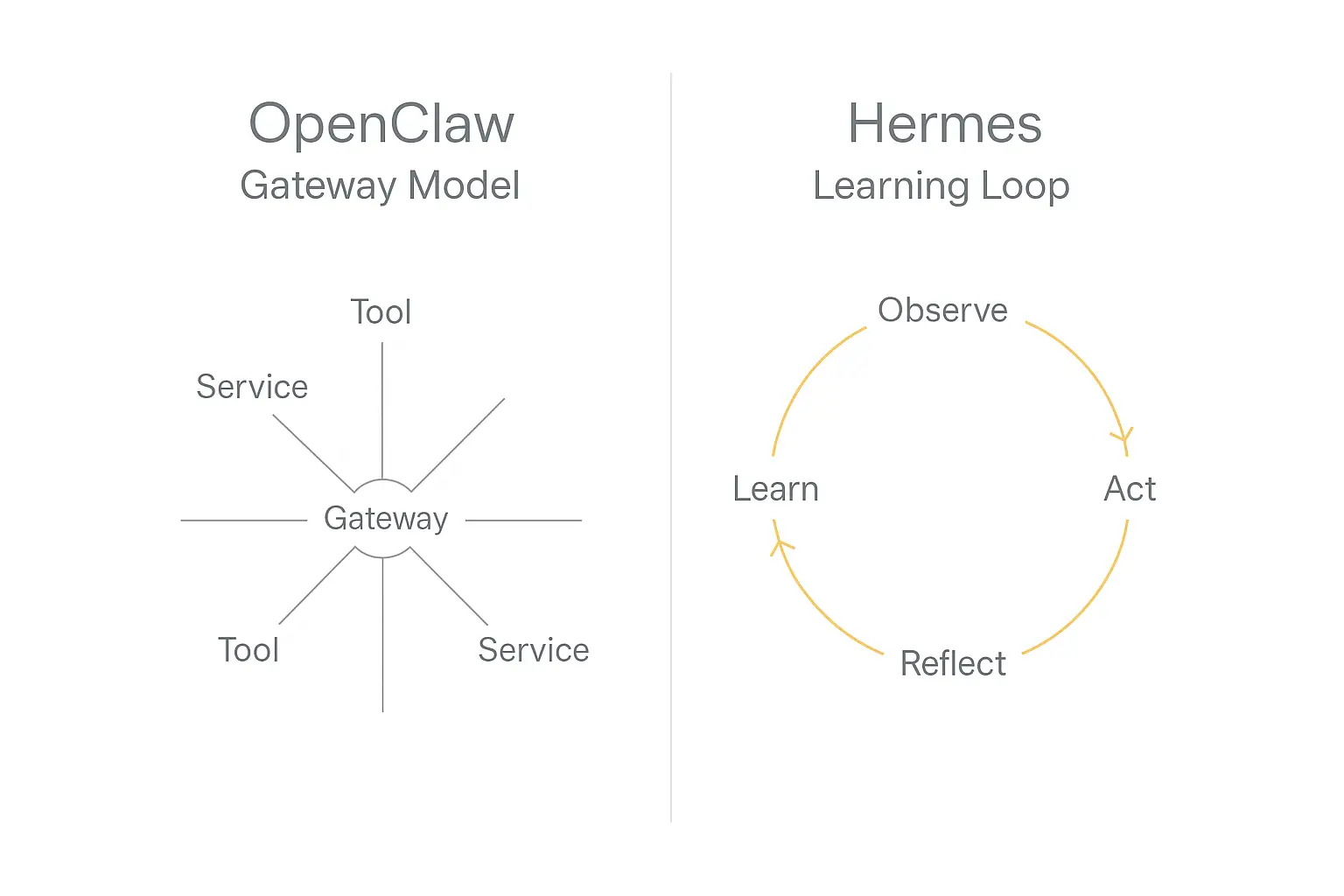
OpenClaw — the project that one developer built solo and turned into GitHub's fastest-growing repository ever — is organized around a central gateway. A persistent process routes messages from 50+ messaging platforms into a ReAct-loop brain. Think of it as a control tower. Messages come in from Telegram, Discord, Slack, WhatsApp, email, or any other channel. The gateway figures out what skill to dispatch, manages the conversation state, and sends the response back.
Its memory system uses Markdown files — SOUL.md for persona, MEMORY.md for persistent notes, USER.md for user profiles — searchable via SQLite. It's straightforward and human-readable, which makes debugging easy.
The Heartbeat cron system lets it run background tasks on a schedule — checking deployments, triaging email, monitoring metrics — even when nobody's talking to it.
Hermes Agent's Learning Loop
Hermes Agent is built around a completely different idea: do, learn, improve. Every 15 tasks, the agent evaluates its own performance, extracts reusable patterns, writes new skill files, and loads them for similar future problems.
Skills aren't static things you write and maintain. They're created autonomously by the agent, refined during use, and compounded across sessions. The longer Hermes runs, the better it gets — without you touching anything.
Its memory is a four-layer system: session history, user profiling via Honcho dialectic modeling, FTS5 full-text search with LLM summarization, and procedural memory. It's more sophisticated than OpenClaw's approach, with token-efficient hot/cold separation between prompt and archival storage.
Where OpenClaw says "here are 5,700 skills you can install," Hermes says "I'll build the skills myself."
The Comparison Table
| Feature | OpenClaw | Hermes Agent |
|---|---|---|
| Language | TypeScript / Node.js | Python |
| GitHub Stars | 345,000+ | 64,000+ |
| Core Philosophy | Breadth of integration | Depth of learning |
| Skills | 5,700+ on ClawHub (human-authored) | Auto-generated, self-refined from experience |
| Messaging Channels | 50+ (Telegram, Discord, Slack, WhatsApp, QQ, LINE, Feishu, Teams, etc.) | 7 core (Telegram, Discord, Slack, WhatsApp, Signal, Email, CLI) |
| Memory System | Markdown files + SQLite search | 4-layer: session history, user profiling, FTS5, procedural memory |
| User Modeling | Basic (USER.md) | Honcho dialectic modeling — builds deepening model of who you are |
| Self-Improvement | No (skills are static) | Yes (autonomous skill creation + refinement every 15 tasks) |
| LLM Support | 200+ via OpenRouter, OpenAI, Anthropic, Ollama | 200+ via Nous Portal, OpenRouter, z.ai, Kimi, MiniMax, OpenAI, Ollama |
| Deployment | Local, Docker. One-liner install via npx openclaw |
Local, Docker (read-only root), SSH, Daytona, Singularity, Modal serverless |
| Background Tasks | Yes (Heartbeat cron) | Yes (cron scheduling + isolated subagents) |
| MCP Support | Yes | Yes (+ MCP Server Mode) |
| Security | Multiple CVEs in 2026 (patched). 1,467 malicious skills flagged on ClawHub | No major incidents. Built-in prompt injection scanning, credential filtering, read-only root filesystem |
| License | MIT (free) | MIT (free) |
| Cost | $0 + LLM API costs ($2-65/mo) + optional VPS (~$5/mo) | $0 + LLM API costs ($2-65/mo) + optional VPS (~$5/mo) |
Where OpenClaw Wins as Super-Agent Infrastructure
1. Ecosystem and Community Scale
There's no sugarcoating this: OpenClaw has the bigger ecosystem by a massive margin. 345,000+ GitHub stars. 247,000+ developers in the community. 5,700+ skills on ClawHub covering everything from Linear integration to invoice processing to social media scheduling.
When you need a pre-built integration, odds are someone in the OpenClaw community already built it. That matters enormously when you're trying to get something working today, not next week.
2. Channel Coverage
OpenClaw supports 50+ messaging platforms. Telegram, Discord, Slack, WhatsApp — those are table stakes. But it also supports QQ, LINE, Feishu, Microsoft Teams, and dozens of others. If you need to reach users across regional platforms, OpenClaw has no real competition here.
Hermes covers 7 core channels. That's enough for most Western-market use cases, but if you need LINE for Japanese users or QQ for Chinese users, OpenClaw is the only option.
3. Time to Value
OpenClaw is ready in 5-30 minutes. Run npx openclaw, connect your messaging app, browse ClawHub for the skills you need, and you're operational. The pre-built skill library means you're not starting from scratch.
Hermes requires more patience. The self-improvement loop is powerful, but it needs time to build up its skill base. The first week with Hermes is noticeably less capable than the tenth week. If you need something working immediately for a well-defined workflow, OpenClaw gets you there faster. We dug into where that loop holds up and where the 2026 research says it still breaks in self-improving AI agents.
4. Team and Multi-Agent Operations
OpenClaw's gateway architecture is naturally suited to team environments. Multiple agents, shared state, coordinated channel management. If you're deploying agents for a team or organization, OpenClaw's infrastructure handles the complexity.
Where Hermes Wins as Super-Agent Infrastructure
1. Self-Improving Skills (The Killer Feature for Personal Agents)
This is the headline feature, and it's genuinely impressive. Hermes doesn't just execute tasks — it learns from them. Every 15 tasks, the agent evaluates what worked, extracts patterns, and writes new skill files that it loads for future use.
In practice, this means Hermes gets noticeably better over weeks and months. A task that took three attempts in week one gets done perfectly in week four because the agent built and refined a skill for it. No human intervention required.
For personal super-agent infrastructure, this is the most compelling argument for Hermes. Your agent should compound in value the way a great employee does — learning your shorthand, anticipating your needs, handling edge cases it fumbled last month. As one developer put it, "hermes feels fundamentally better than every other agent." It does this by design.
OpenClaw skills are static. They work the same on day one as day one hundred. That's a feature if you want predictability, but a real limitation if you're building a personal agent that's supposed to evolve with you.
2. Security
This is a big one, and I say this as someone who's bet our business on OpenClaw.
OpenClaw has had a rough 2026 on the security front. Multiple critical CVEs — including token exfiltration (CVE-2026-25253, CVSS 8.8), prompt injection vulnerabilities, and even remote code execution. Snyk flagged 1,467 malicious skills on ClawHub and identified 40,000+ insecure instances in the wild. One viral tweet captured the mood perfectly — a developer told their OpenClaw to "confirm before acting" and watched it speedrun-delete their entire inbox. They had to physically run to their Mac mini to stop it.
Patches are available for all of these, and the team has been responsive. But it's a reminder that a fast-growing open-source project with a community skill marketplace has a large attack surface.
Hermes takes a conservative-by-default approach: read-only root filesystems, dropped capabilities, namespace isolation, built-in prompt injection scanning, and credential filtering. No major public incidents reported as of April 2026.
If security is your primary concern — especially in enterprise or regulated environments — Hermes has the edge right now.
3. Deployment Flexibility
Hermes offers six deployment backends: local, Docker (with hardened read-only root), SSH, Daytona, Singularity, and Modal serverless. That last one is significant — Modal serverless means near-zero idle cost. Your agent only costs money when it's actually doing something.
OpenClaw is primarily local or Docker. Straightforward, but less flexible if you want serverless or need to run in specialized environments.
4. Deep Personalization
Hermes builds an explicit model of who you are using Honcho dialectic modeling. It's not just storing your preferences in a file — it's building a multi-dimensional understanding of your communication style, decision patterns, project context, and working habits.
Over time, Hermes feels less like a tool and more like a colleague who actually knows you. If the whole point of personal super-agent infrastructure is having an AI that deeply understands your context, Hermes is architecturally designed for exactly that. OpenClaw's user profiling is functional but basic by comparison.
Want to build agents without the infrastructure headaches?
Pickaxe handles the agent infrastructure so you can focus on what your AI actually does — not how it runs.
The Security Question (Let's Be Honest)
I want to spend a moment on this because it matters.
At Pickaxe, we use OpenClaw as our AI engine. When you enable OpenClaw in your Pickaxe workspace, every agent runs as an independent instance with isolated, sandboxed environments. Each end user gets their own container. No data leaks between users. No shared state.
That sandboxing layer is something we built on top of OpenClaw specifically because we knew the base project's security model wasn't sufficient for production business use. The CVEs that have hit OpenClaw's open-source release don't apply to Pickaxe's deployment because we run it differently.
But if you're running vanilla OpenClaw on your own infrastructure, you need to stay on top of patches. Pin your versions. Be selective about which ClawHub skills you install. Don't assume community skills are safe just because they're popular.
Hermes doesn't have this problem — yet. It's newer, smaller, and has made security a core design principle from day one. Whether that holds as the project scales remains to be seen.
When to Build Your Super-Agent on OpenClaw
OpenClaw is the right foundation when:
- You need something working today. The pre-built skill library and one-liner install mean you can go from zero to operational in under an hour.
- You're deploying across many channels. 50+ platform support is unmatched.
- Your workflows are well-defined. If you know exactly what your agent needs to do and just need it to do it reliably, static skills are a feature, not a limitation.
- You're building for a team. The gateway architecture handles multi-agent, multi-user, multi-channel operations cleanly.
- You want to build a business around AI agents. This is where Pickaxe comes in. OpenClaw gives you the engine. Pickaxe gives you the business infrastructure — white-labeling, monetization, access control, multi-channel deployment, and compliance (SOC2, GDPR, CCPA).
When to Build Your Super-Agent on Hermes
Hermes is the right foundation when:
- You want an agent that improves over time. The self-improving learning loop is genuinely unique. If you're playing the long game, Hermes compounds its value in a way OpenClaw doesn't.
- Security is non-negotiable. Hardened defaults, prompt injection scanning, credential filtering, read-only root. If you're in a regulated industry or just paranoid (which is healthy), Hermes has better defaults.
- You need deep personalization. The Honcho user modeling creates a richer understanding of you than OpenClaw's file-based approach.
- You want serverless deployment. Modal integration means pay-per-use with near-zero idle cost. Great for cost-sensitive deployments.
- You're a Python shop. If your team lives in Python, Hermes will feel more natural than OpenClaw's TypeScript.
The Hybrid Stack (What the Smartest Builders Are Doing)
Here's something most comparison articles won't tell you: the best personal super-agent infrastructure might not be one or the other.
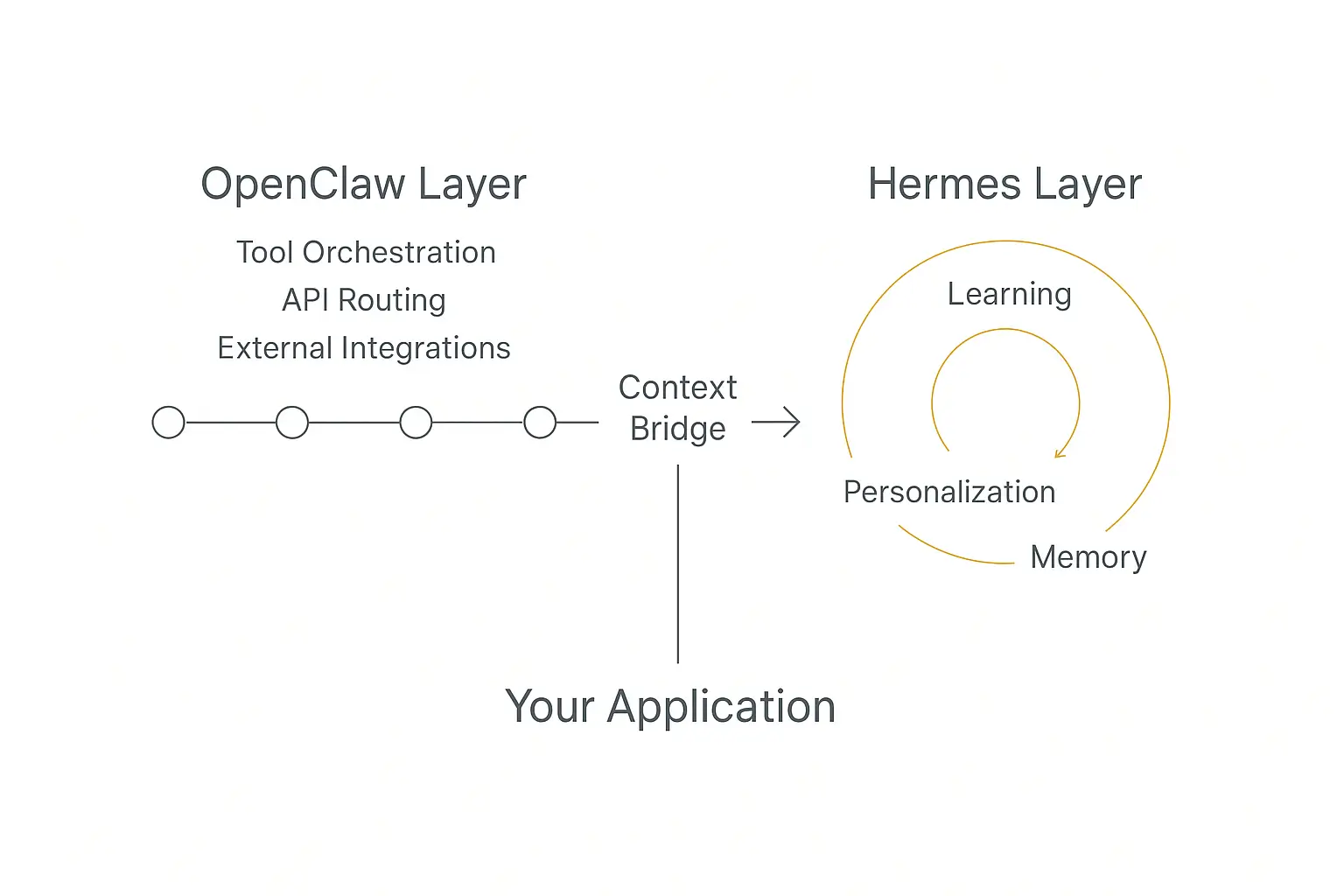
A growing number of developers are running both. OpenClaw as the operational backbone — handling channel routing, team workflows, and pre-built integrations. Hermes as the personal learning layer — building deep context about you, auto-generating skills, and handling the tasks where adaptability matters more than ecosystem breadth. Both support MCP, so they share tools and context seamlessly.
Hermes even includes a hermes claw migrate command that imports OpenClaw configurations — persona files, memory entries, skills, messaging configs, and API keys. The projects are more complementary than competitive.
But if you're building AI agents as a business — deploying them for clients, charging for access, white-labeling the experience — neither Hermes nor vanilla OpenClaw gives you that infrastructure out of the box.
That's the gap Pickaxe fills.
From Personal Super-Agent to Business: Where Pickaxe Fits In
Both OpenClaw and Hermes are powerful engines for personal super-agent infrastructure. But here's the natural next question: once you've built an AI agent that manages your workflow, how do you build ones that manage your clients' workflows — and charge for it?
That's a different problem. An engine isn't a business.
If you want to:
- Deploy agents to clients through branded portals, website embeds, Slack, WhatsApp, or email
- Charge for access with subscriptions, pay-per-usage, or one-time payments via Stripe
- White-label everything — your brand, your domain, your pricing
- Control access with public and member groups
- Build without code using a visual agent builder
- Stay compliant with SOC2, GDPR, and CCPA
Then you need something on top of the engine. Pickaxe runs OpenClaw under the hood and adds the entire business layer.
Every agent you build on Pickaxe with OpenClaw enabled gives each end user their own isolated instance with web browsing, PDF creation, code execution, and multi-model support. You get the power of OpenClaw with none of the infrastructure headaches.
Think of it this way:
- OpenClaw = powerful open-source engine
- Hermes = powerful open-source engine with a learning loop
- Pickaxe = the platform that turns either engine into a deployable, monetizable business
We're the Shopify for agent-powered businesses. You don't need to understand gateway architectures or learning loops. You need to build an agent, deploy it to clients, and get paid.
What's Next for Both Projects
The AI agent space is moving incredibly fast. Here's what we're watching:
OpenClaw is in a fascinating transition. Peter Steinberger joined OpenAI, and the project is moving to a foundation to stay open and independent. The immediate focus is hardening security (the CVEs were a wake-up call), expanding managed deployment options, and improving ClawHub skill vetting.
Hermes Agent went from v0.1.0 to v0.8.0 in two months. The v0.6.0 update alone pulled 526K+ views on X. The MiniMax AI partnership is bringing more resources. And the community vibe is telling — developers like Dan Wahlin are reporting that Hermes feels immediately impressive out of the box. The Hermes Agent Community on X has 4.7K members and growing. It may not catch OpenClaw's star count, but the developer energy is palpable.
Both projects support MCP (Model Context Protocol), which means the interoperability story will only get better. A future where Hermes agents and OpenClaw agents talk to each other through standardized protocols isn't hypothetical — it's already happening.
The Bottom Line
We're in the early days of personal super-agent infrastructure. The people building this layer now — choosing their foundation, setting up their always-on AI backbone, letting it learn their patterns and workflows — are going to have a compounding advantage over the next few years.
There is no "winner" in the Hermes vs OpenClaw debate. There's only the right foundation for what you need your super-agent to do.
Choose OpenClaw if you want the broadest ecosystem, fastest time-to-value, and the most pre-built integrations for your personal infrastructure. Choose it especially if you plan to turn your personal agent expertise into a business — paired with Pickaxe, you get the full stack from engine to monetization.
Choose Hermes if you want a personal agent that genuinely improves over time, builds a deep model of who you are, and prioritizes security by default. If you're playing the long game on personal AI, Hermes's learning loop is the most compelling architecture out there.
Choose both if you want operational breadth and personal depth. Run OpenClaw for your tool integrations and channel coverage. Run Hermes as your personal learning layer. They're more complementary than competitive.
And if you want to skip the infrastructure entirely and just build, deploy, and sell AI agents to clients — Pickaxe has a free tier that lets you get started today. We handle the engine. You handle the business.
The AI agent landscape in 2026 isn't about picking the one perfect tool. It's about building the personal AI infrastructure that compounds in value the longer it runs. Now you have the information to choose your foundation.