

GPT-6.1 Sol vs Claude Opus 5.5 sounds like a clean head-to-head. Add Gemini 3.8 Flash and it looks like a three-way race.
It is not. These models occupy different price and product positions, expose different tools, and can spend very different numbers of tokens to finish the same job.
That is good news if you are building an AI agent. You do not need one universal winner.
You need the least expensive model that clears your quality bar for each kind of work, plus a reliable fallback when it does not.
I reviewed the current provider documentation, rate cards, model cards, and the most relevant comparison pages on October 2, 2026. I did not run a private benchmark, and I will not turn three vendor launch charts into a fake neutral leaderboard.
This guide separates verified specifications from vendor claims, works through comparable cost examples, and gives you a 12-task pilot you can run on your own agent.
GPT-6.1 Sol vs Claude Opus 5.5: the short answer
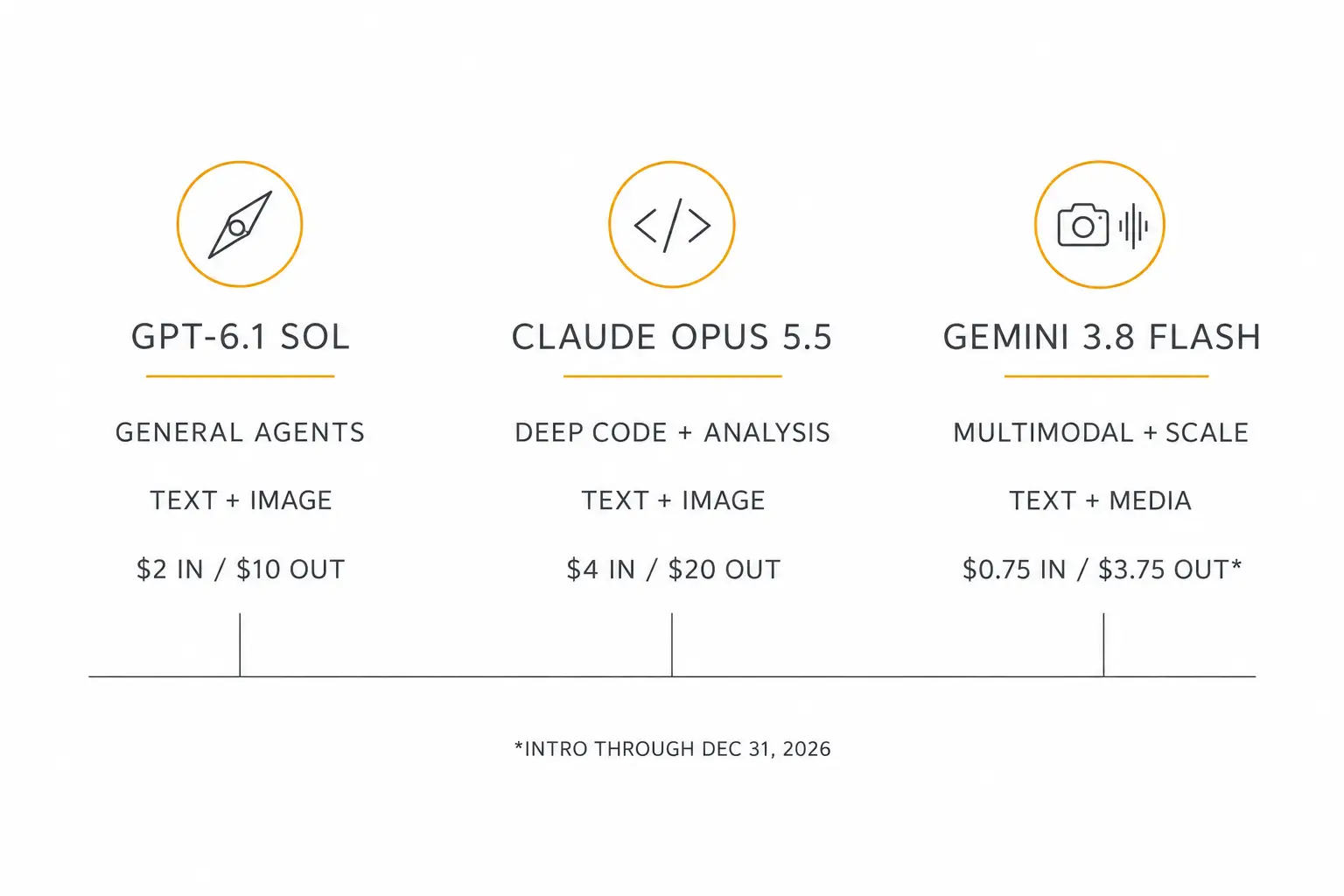
Start with GPT-6.1 Sol when you want a balanced generalist for complex text-and-image work, computer use, and a broad first-party tool surface. At $2 per million input tokens and $10 per million output tokens for requests up to 272K input tokens, it sits in the middle of this group on price.
OpenAI describes it as near-Astra performance for less money, but that is a vendor positioning statement, not a guarantee for your workload. The current model page lists a 1.05M-token context window, 128K maximum output, five reasoning-effort settings, and tools ranging from web search and file search to computer use and MCP.
Start with Claude Opus 5.5 when the expensive failure is a bad code change, a weak multi-step analysis, or a long agent run that needs careful judgment. Anthropic positions it for long-running agentic coding and knowledge work.
The official specifications put it at $4 input and $20 output per million tokens with a 1M context window and 128K maximum output. That is twice Sol's standard short-context token rate, so it must win more often or require less correction to be cheaper per successful task.
Start with Gemini 3.8 Flash when you need native video, audio, or PDF input, or when volume makes unit economics decisive. The stable Gemini API model page lists a 1,048,576-token input limit, 65,536-token output limit, low-to-high thinking levels, search grounding, code execution, function calling, and computer use in preview.
Its introductory standard rate is $0.75 input and $3.75 output per million tokens through December 31, 2026. The rate card says those rates double on January 1, 2027.
My default recommendation is not to crown one model. Use Sol as the balanced candidate, Opus as the quality challenger for difficult text-and-code tasks, and Gemini as the cost and multimodal challenger.
Then route each task to the winner your own evidence identifies.
First, what about Gemini 4 Argon?
Google announced Gemini 4 Argon on September 30, two days before this comparison. That sounds like it should make Gemini 3.8 Flash obsolete.
It does not, at least not yet.
Google's Argon announcement says the model is rolling out first to trusted cyber defenders through the Fairwind Program and other trusted testers. Google says broader availability for developers, enterprises, and consumers will come later.
The production Gemini API catalog still marks gemini-3.8-flash as stable and generally available.
So the honest comparison today is not "Why ignore Google's newest model?" It is "Which model can I actually put behind an agent now?" Argon belongs on your watchlist. It does not belong in a production bake-off until your account can select it and you can confirm its final terms, limits, and behavior.
These are not three versions of the same product
Claude Opus 5.5 is a premium model in Anthropic's lineup. GPT-6.1 Sol is OpenAI's cost-conscious step below Astra.
Gemini 3.8 Flash is Google's high-throughput Flash model, not its gated new frontier model. Comparing only their names creates the false impression that each vendor placed the same kind of product in the race.
The products around the models differ too. An API model is not the same thing as ChatGPT, Claude, or the Gemini app.
Consumer subscriptions, usage windows, API tokens, search calls, and priority-processing charges are different meters. A $20 subscription tells you almost nothing about the marginal cost of 100,000 automated agent runs.
The table below sticks to current standard API terms. Prices are per million tokens and were checked October 2, 2026.
| Specification | GPT-6.1 Sol | Claude Opus 5.5 | Gemini 3.8 Flash |
|---|---|---|---|
| Model ID | gpt-6.1-sol | claude-opus-5-5 | gemini-3.8-flash |
| Released | Sep. 29, 2026 | Sep. 22, 2026 | Sep. 2, 2026 |
| Standard input | $2 up to 272K input | $4 | $0.75 through Dec. 31 |
| Standard output | $10 up to 272K input | $20 | $3.75 through Dec. 31 |
| Cached input | $0.10 up to 272K input | $0.20 cache read | $0.075 plus storage through Dec. 31 |
| Context window | 1,050,000 | 1,000,000 | 1,048,576 |
| Maximum output | 128,000 | 128,000 | 65,536 |
| Native input | Text, image | Text, image | Text, image, video, audio, PDF |
| Thinking control | Low to max | Adaptive, low to max effort | Low, medium, high |
The release dates and OpenAI details come from the OpenAI changelog and model page. Anthropic's date, capabilities, cache prices, and model ID come from its Opus 5.5 documentation.
Google's limits and modalities come from its stable model page, while the temporary prices and January increase come from the Gemini Developer API rate card.
This table still does not tell you which model is cheapest. It tells you what each provider charges for token volume.
The number you need is cost per accepted result.
What GPT-6.1 Sol is best at
The Sol specifications list the broadest first-party tool surface of this group. Through the Responses API it can use web search, file search, image generation, code interpreter, a hosted shell, apply patch, skills, computer use, MCP, and tool search.
Function calling and structured output are supported. Tool calling requires Responses rather than Chat Completions.
That makes Sol a strong baseline for mixed agents. A single workflow can inspect a screenshot, search a knowledge base, call a business tool, and return schema-valid output without you stitching together a separate vendor for every step.
OpenAI also lists US and EU data residency, though Fast mode is not available with EU data residency.
The tradeoff starts at the edges. Sol accepts text and images, not native audio or video.
It cannot use none or minimal reasoning, so even a trivial job starts at low effort. And the attractive $2 and $10 rates have a boundary: when input exceeds 272K tokens, the OpenAI price table charges $4 input and $15 output for the entire long-context request.
If your current agent already uses OpenAI's Responses API, Sol is the lowest-friction candidate here. But do not assume an upgrade from an older Sol is a drop-in behavior change.
Re-run tool-choice, structured-output, refusal, and completion tests at the exact reasoning effort you plan to ship. Our earlier GPT-6 Astra analysis explains why model scores and agent-scaffold performance are not the same thing.
What Claude Opus 5.5 is best at
Anthropic calls Opus 5.5 a model for long-running agentic coding and knowledge work. Its launch announcement says it performs at the level of the more expensive Fable 5.1 on most work and costs 40% less to run than Opus 5.
Those are Anthropic's claims, but the product position is clear: Opus is the option to test when quality and judgment matter more than the lowest list price.
The Opus overview confirms text and image inputs and text output. Its adaptive thinking is always on, while the effort parameter controls depth.
The standard Claude API price stays $4 input and $20 output across the documented 1M window. Cache reads cost $0.20 per million tokens, 5-minute writes cost $5, and 1-hour writes cost $8.
Batch processing discounts input and output by 50%.
Anthropic also offers Fast mode as a research preview on its first-party API. The company says it can deliver up to 2.5 times more output tokens per second, specifically not 2.5 times faster time to first token.
The price rises to $8 input and $40 output, and the option is not available on partner clouds. That distinction matters for an interactive agent: faster generation after the first token may feel different from a shorter wait before anything appears.
The Opus migration guidance belongs in a test plan. Anthropic says thinking cannot be disabled, forced tool use returns an error, thinking blocks are bound to the model and conversation, and an older computer-use tool version is rejected on the Claude API and Google Cloud.
A model can be excellent and still break your orchestrator because one response shape or forced-tool assumption changed.
What Gemini 3.8 Flash is best at
Gemini 3.8 Flash is the obvious first candidate when the raw input is a call recording, a product demo, a PDF, a set of images, or a mixture of all four. Google's Flash model page lists text, image, video, audio, and PDF as native inputs.
Sol and Opus list text and image.
It is also the price outlier. The Google rate card lists $0.75 input and $3.75 output through December 31.
Batch and Flex are $0.375 and $1.875. Priority is $1.35 and $6.75.
Context-cache tokens cost $0.075 at standard priority, plus $0.50 per million cached tokens per hour of storage. Google Search and Maps grounding have separate allowances and per-query pricing after those allowances.
Two caveats prevent the cheap rate from settling the question. First, Google's latest-model guide says 3.8 Flash works harder on complex tasks and may consume more tokens as it reasons, calls tools, and verifies its work.
The rate card explicitly says output prices include thinking tokens. Second, the introductory price doubles on January 1, 2027.
A workload that only looks economical during a three-month promotion is not a stable architecture.
The Flash specifications cap output at 65,536 tokens, half the other two models' documented 128K. Most customer-facing agents should not emit anything close to either ceiling, but long code generation or large structured exports can expose the difference.
Run the pilot on a real agent
Build a focused Pickaxe agent, keep the workflow fixed, and compare models on the cases your customers actually send.
GPT-6.1 Sol vs Claude Opus 5.5 on cost
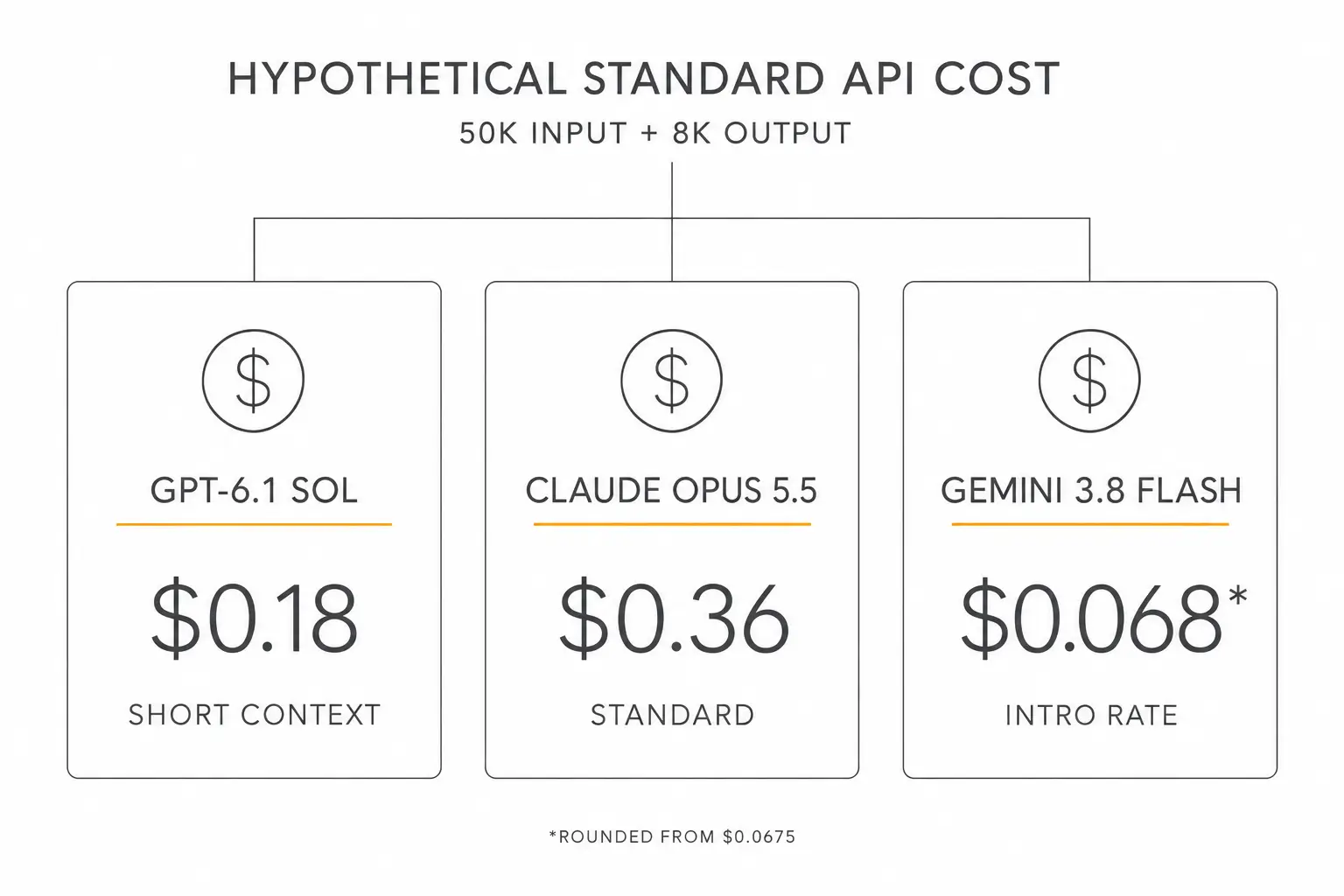
Using the standard OpenAI, Anthropic, and Google rate cards, here is a comparable hypothetical request: 50,000 uncached input tokens and 8,000 output tokens, with no tools, retries, cache storage, residency uplift, or negotiated discount.
- GPT-6.1 Sol: 0.05 × $2 plus 0.008 × $10 equals $0.18.
- Claude Opus 5.5: 0.05 × $4 plus 0.008 × $20 equals $0.36.
- Gemini 3.8 Flash: 0.05 × $0.75 plus 0.008 × $3.75 equals $0.0675, or about $0.068.
At the January Google rates, the same Gemini arithmetic becomes $0.135. It remains below Sol's list-price example, but the gap narrows from roughly 62% to 25%.
Now make it a long-context job: 400,000 uncached input tokens and 20,000 output tokens. Sol crosses its 272K price threshold, so its long-context rates apply to the whole request.
- GPT-6.1 Sol: 0.4 × $4 plus 0.02 × $15 equals $1.90.
- Claude Opus 5.5: 0.4 × $4 plus 0.02 × $20 equals $2.00.
- Gemini 3.8 Flash: 0.4 × $0.75 plus 0.02 × $3.75 equals $0.375 at the introductory rate, then $0.75 from January.
Those are transparent budget examples, not measured Pickaxe jobs. If Gemini needs three attempts while Opus passes once, the apparent bargain can disappear.
If Opus writes twice as many tokens, its task cost can grow beyond the simple rate multiple. If a repeated 100K-token prefix hits a cache, the ranking can change again.
Track input, cached input, output, thinking or reasoning tokens where exposed, tool charges, retry count, and human correction minutes for every evaluated task. That is the method behind our guide to AI agent token economics.
Why I am not giving you a benchmark winner
The Sol launch announcement emphasizes improved coding performance and lower task costs. Google's Flash model card highlights software-engineering efficiency.
Putting provider-reported scores in adjacent cells can look precise without establishing a real-world lead. Vendors may use different scaffolds, revisions, effort settings, and cost boundaries.
Anthropic publishes strong Opus 5.5 coding and knowledge-work results. OpenAI publishes strong Sol cost-per-task comparisons.
Google publishes strong Flash efficiency results. Each company selected the evidence that best explains its release.
The independent picture is narrower. The Artificial Analysis comparison checked October 2 reports Opus 5.5 at 58 and Sol at 52 on its Intelligence Index, with both configured at max effort.
That is one composite index under specified settings, not a deployment verdict. It does not isolate your customer workflow, and its max-effort result should not be mistaken for the behavior or cost of each model at its default effort.
I found no independent, same-harness result covering all three exact models. The missing evidence is the point.
When models are this new, the best comparison is the one you can reproduce on the work you already understand.
Use a 12-task pilot instead of a leaderboard
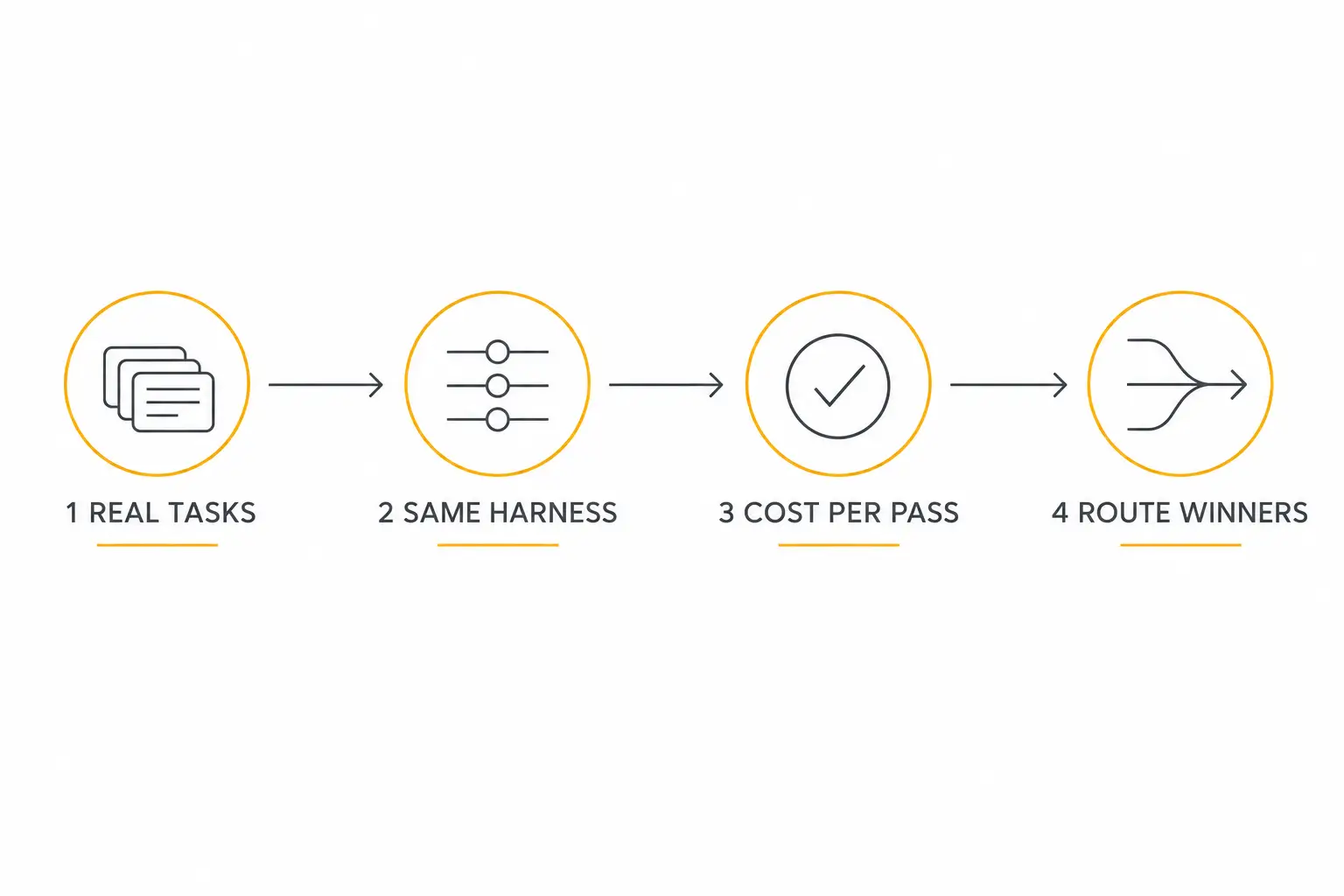
A small pilot can be more decision-useful than 500 synthetic prompts if the cases represent where your agent succeeds, fails, and costs money. Start with twelve tasks:
- Three routine successes. Common jobs the current agent handles well. A replacement must not regress them.
- Three costly failures. Real or carefully anonymized cases that required a retry, refund, escalation, or manual rewrite.
- Two tool-use chains. One happy path and one case where a tool fails or returns incomplete data.
- Two ambiguity cases. The model should ask a focused question rather than guess.
- One long-context case. Use a genuinely large source set and plant facts at different depths.
- One multimodal case. Include the audio, video, PDF, image, or screenshot input your product actually receives.
Keep the system prompt, tools, tool descriptions, source files, output schema, retry policy, and stop conditions fixed. Run each model at the effort level you could afford in production.
Repeat nondeterministic cases at least three times. If native modalities differ, score both the direct route and the preprocessing route you would really deploy.
For each run, capture:
- Accepted result, rejected result, or human escalation
- Correct tool choice and valid arguments
- Schema validity and citation support
- End-to-end latency, including tools and retries
- Input, cached input, output, and reasoning token counts
- Provider and tool charges
- Human correction minutes
Turn those observations into two gates. The quality gate asks whether the model passes every must-not-fail case and improves enough expensive failures.
The economics gate asks what one accepted result costs after retries and review.
If a model does not clear the quality gate, its low token rate is irrelevant. If two models clear it, route to the cheaper one.
Our comparison of LLM evaluation tools can help you keep this test repeatable as prompts and models change.
The best architecture is usually routing, not replacement
Suppose Gemini passes routine extraction and video intake, Sol handles general tool use, and Opus is the only model that reliably repairs a complex codebase. Sending every request to Opus wastes money.
Sending every request to Gemini wastes the quality advantage you just measured. Sending everything to Sol ignores two clear specialist wins.
A simple router can use observable features before it calls a model:
- Audio or video input goes to Gemini.
- Large coding migrations or previously failed code tasks go to Opus.
- Mixed business-tool workflows start on Sol.
- Low-confidence or failed runs escalate to the model that won the matching pilot category.
Keep the first version boring. Rules are easier to audit than a routing model, and they tell you whether routing creates enough value to justify more machinery.
Log the decision, model version, effort, cost, and outcome so you can revise the rule when prices or behavior change.
Do not let the fallback create an invisible retry spiral. Cap attempts, preserve the original input, and record whether the fallback actually rescued the job.
A model that succeeds only after another model has summarized the problem is part of a two-model workflow, not a solo winner. The full implementation pattern is in our AI model routing guide.
Before switching, I would check these five deployment traps. Each can change the outcome of an otherwise promising pilot.
1. Reasoning settings are part of the model
Sol at low effort is not Sol at max. Opus has always-on adaptive thinking. Gemini pricing bills thinking tokens as output and warns that difficult jobs may consume more of them.
Save the effort setting with every result and compare settings your budget can sustain.
2. A million-token window is not a target
All three accept around one million tokens, but stuffing the window can increase cost, latency, and distraction. The Sol price rules also impose a threshold at 272K input.
Retrieval, caching, and compaction can beat brute-force context even when the model technically accepts the file pile.
3. Built-in tools have their own economics
Web search, Maps grounding, code execution, computer use, and hosted environments can carry per-call fees or separate limits. A model-token comparison that ignores tools is incomplete for an agent whose main job is using tools.
4. Cloud and region availability differ
The Opus availability list includes partner clouds, while its Fast mode documentation restricts that feature to the first-party API. The Sol model page supports EU data residency but excludes Fast mode there.
The Gemini tiers have different data-use terms. Confirm the actual endpoint, region, retention policy, and contract your product will use.
5. Aliases move
gpt-6.1-sol, claude-opus-5-5, and gemini-3.8-flash are current identifiers, not permanent facts. Pin versions where the provider permits it, record the returned model version, and keep a regression set ready for alias changes.
A silent behavior shift is more expensive than a visible price increase.
My recommendation for an AI agent
If you need one model to begin the evaluation, I would begin with GPT-6.1 Sol. It offers the most balanced combination of cost, output headroom, computer use, and first-party tools for a general agent.
That is a starting hypothesis, not a universal winner.
I would put Claude Opus 5.5 against the hardest coding and knowledge-work cases. At twice Sol's short-context token rate, it needs to reduce failures, retries, or review time.
If it does, pay the premium only on those routes.
I would put Gemini 3.8 Flash against every multimodal and high-volume case. Its native video and audio inputs are a real architectural advantage, and its current introductory rates are compelling.
I would budget the January 2027 prices from day one so the pilot does not approve a temporary business model.
Then I would route. A generalist default, a quality escalation, and a multimodal volume path are more resilient than a single vendor bet.
Re-run the 12 tasks whenever a model alias, prompt, tool, or rate changes.
Finally, I would keep Gemini 4 Argon outside the production matrix until broad API access arrives. Announced capability is not deployable capability.
When Argon becomes selectable, add it as a fourth candidate under the same harness instead of trusting a launch chart.
If you want to run the pilot yourself, you can build the same agent in Pickaxe, use the model comparison page to choose a supported model while keeping the agent's instructions and knowledge fixed, and start on the free tier.
The useful question is not which lab won September. It is which model completes each job at an acceptable quality, cost, latency, and level of supervision.
Measure that, route accordingly, and the next frontier release becomes an evaluation update instead of an architecture crisis.