

The best LLM evaluation tools do not tell you whether an AI agent is good. They give your team a repeatable place to define good, run the same difficult cases again, and see exactly what changed.
I compared six current tools by where that repeatable work lives. DeepEval puts it beside Python tests. Promptfoo uses a configuration-first CLI. Ragas specializes in retrieval. Braintrust connects production traces to shared experiments. Inspect AI is built for rigorous model and sandboxed-agent evaluations. MLflow fits teams that already treat experiments, datasets, and models as one lifecycle.
This is a documentation-based comparison checked September 18, 2026, not a controlled product benchmark. The 30-case pilot and cost arithmetic below are illustrative planning examples, not Pickaxe customer results.
LLM evaluation tools: the quick comparison
The category looks crowded because a Python library, a hosted quality platform, a RAG metric package, and a frontier-model benchmark harness can all call themselves an evaluation tool. They are not interchangeable.
| Tool | Best fit | Source of truth | License or entry point | Validate first |
|---|---|---|---|---|
| DeepEval | Python teams building application regression tests | Pytest-style code and local datasets | Apache 2.0 | Whether built-in metrics match your failure taxonomy |
| Promptfoo | Prompt matrices, CI checks, and red teaming | YAML or JavaScript configuration | MIT | How generated attacks map to your actual threat model |
| Ragas | RAG and retrieval pipelines | Metric definitions plus evaluation datasets | Apache 2.0 | Judge and embedding cost per dataset run |
| Braintrust | Shared trace-to-test quality loop | Hosted datasets, experiments, scorers, and traces | Starter $0 platform fee | Processed data, score volume, and retention separately |
| Inspect AI | Model, safety, coding, and sandboxed-agent evaluations | Python tasks, solvers, scorers, and logs | MIT | Whether your product team needs a simpler review surface |
| MLflow | Teams already using an ML experiment lifecycle | Tracking server, datasets, runs, traces, and feedback | Apache 2.0 self-hosted | Operational overhead for a greenfield app team |
Open-source license cost is only one line in the budget. Model calls for judges, embeddings, synthetic cases, storage, hosting, and human review still cost money. A score, a trace, a gigabyte, and a model token are different meters.
What an LLM evaluation tool can and cannot do
An evaluation tool can store cases, call your application, run deterministic assertions, ask a model to grade subjective behavior, compare versions, and preserve results. The strongest products also let a bad production trace become a new regression case.
It cannot decide what failure means for your client. A generic helpfulness score will not know that a support agent must ask for an order number before issuing a return label, or that a research agent must cite the paragraph that supports a number.
That is why I would pair this comparison with our guide to building an AI agent eval test set. The tool is the runner and record. The dataset, acceptance contract, and release decision remain your responsibility.
Hamel Husain made the same distinction in a July 2026 X post, emphasizing issue discovery as the most important part of the workflow. I take that as useful practitioner guidance, not proof that one product wins.
How I ranked these LLM evaluation tools
I did not award points for having the longest metric menu. A metric is useful only when it detects a failure the team recognizes, produces evidence someone can inspect, and can run often enough to influence a release.
I used six practical questions:
- Application fit: does the tool evaluate a complete agent, retrieval system, or product behavior instead of only a foundation model?
- Deterministic checks: can ordinary code catch format, tool-call, and policy violations before an expensive judge runs?
- Human review: can a domain expert inspect disagreements without reverse-engineering a notebook?
- Release workflow: can the team compare a candidate with a baseline and fail CI when a protected behavior regresses?
- Data control: where do prompts, traces, labels, and outputs travel, and how portable are they?
- Cost legibility: can the team estimate model, storage, score, and operating costs without pretending unlike units are equal?
I also excluded general benchmark leaderboards as a primary use case. MMLU or a coding benchmark may help choose a base model, but it cannot prove that your intake agent follows this client's refund policy.
1. DeepEval: best for Python-native regression tests
I would start with DeepEval when the team already trusts pytest and wants AI quality checks to behave like application tests rather than a separate analytics project.

The current DeepEval documentation describes pytest-style assertions, end-to-end and component evaluation, trajectory evaluation for agents, synthetic data, and more than 50 ready-to-use metrics. The project is Apache 2.0 licensed.
The local-first shape is the attraction. A developer can define an input, expected behavior, and metric beside the application, run it in CI, and review the failed case with the same code revision that produced it.
What stands out: agent evaluation is not limited to the final answer. DeepEval can score a complete trajectory or a component such as a retriever, tool call, or planner. That matters when the final response looks reasonable even though the agent took an unsafe path.
What to watch: the metric catalog can tempt a team to start with generic hallucination or relevance scores before reading its own failures. Treat built-in metrics as candidates. Calibrate them against human-labeled examples and keep deterministic rules for anything code can settle.
DeepEval and Confident AI are related but not identical. The official FAQ says DeepEval runs locally as an open-source framework, while the optional Confident AI platform adds shared reports, datasets, observability, and monitoring.
Choose DeepEval when: your application is Python-first, your team wants evals in code review, and a pytest-shaped release gate feels natural.
2. Promptfoo: best for configuration-first testing and red teaming
Promptfoo is the clearest fit when you want to compare many prompts and model providers from a declarative configuration, then add adversarial tests to the same delivery workflow.
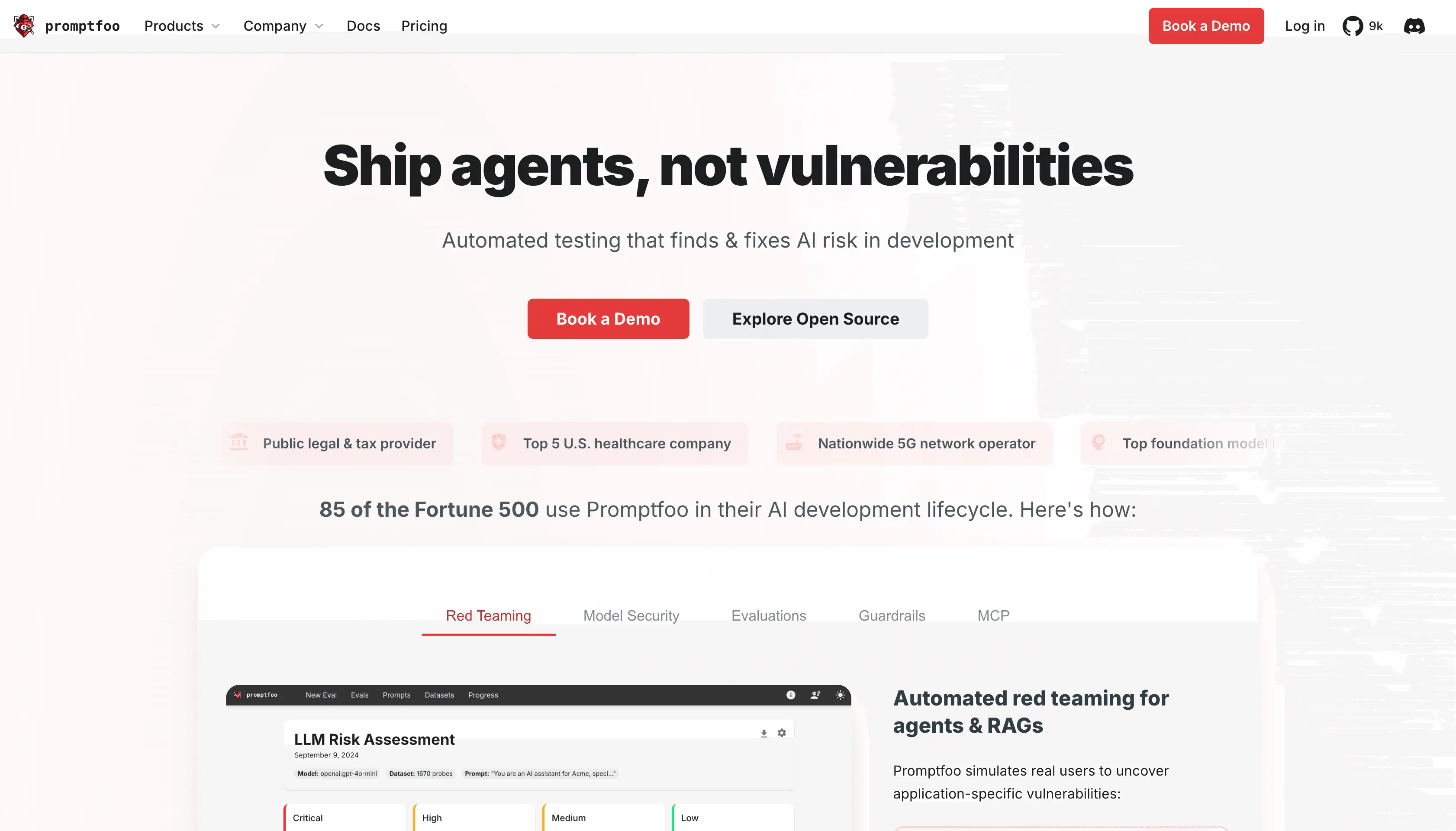
The getting-started guide creates a configuration with prompts, providers, tests, and assertions, runs it from the CLI, and opens a local comparison view. The repository remains available under the MIT license.
What stands out: Promptfoo treats security testing as a first-class sibling to quality evaluation. Its red-team documentation covers prompt injection, data leakage, excessive agency, unsafe tool use, jailbreaks, and custom policy violations.
The CI documentation keeps ordinary evals and red-team scans as distinct workflows. That separation is sensible. A prompt can pass expected-answer tests while still exposing a dangerous route through a tool or retrieved document.
What to watch: hundreds of generated attacks do not automatically equal coverage. Map each attack family to a real trust boundary, inspect failures, and add your own cases for the data and actions the agent actually controls.
There is also a current ownership qualification. OpenAI announced on March 9, 2026 that it planned to acquire Promptfoo, subject to closing conditions, and said it would continue the open-source project. That announcement is not evidence that the transaction has closed, so I would verify current governance during procurement.
Choose Promptfoo when: your team likes YAML or JavaScript configuration, compares multiple model providers, and wants regression testing plus a serious red-team lane.
3. Ragas: best for retrieval and RAG evaluation
Ragas is the specialist I would choose when the question is not merely whether an answer sounds right, but whether retrieval found the evidence the generator needed.

The current Ragas metric catalog includes context precision, context recall, noise sensitivity, faithfulness, response relevancy, tool-call accuracy, and agent-goal accuracy. The project is Apache 2.0 licensed.
What stands out: Ragas keeps retrieval quality visible. A single final-answer score can hide whether a model answered from good context, ignored good context, or received the wrong documents and guessed.
The original RAGAS paper introduced reference-free measures for RAG dimensions. That can reduce the amount of gold-answer writing needed to explore a system, but reference-free does not mean judgment-free.
What to watch: several metrics call an LLM, embeddings model, or both. The evaluation reference makes those dependencies configurable. Record the exact judge, embedding model, prompt, and version so a score change is not mistaken for an application change.
I would also validate the metric against a small human-labeled slice. If a legal researcher considers a passage insufficient evidence but the faithfulness metric passes it, the metric needs work before it can block releases.
Choose Ragas when: retrieval is a major part of the system and you need to separate document selection, grounding, and final-answer quality.
4. Braintrust: best for a shared production-to-evaluation loop
Braintrust is my platform pick when several people need one loop from a production failure to a dataset row, an experiment, a scored comparison, and a release decision.
The agent evaluation overview describes nested spans for tool calls and retrieval, trace-level scoring, experiment comparisons, and promoting a failed production trace into a dataset. That continuity is what separates it from a folder of scripts nobody outside engineering can navigate.
What stands out: the trace and the test use a connected data model. The team can inspect which step regressed instead of seeing one red aggregate number.
The pricing needs careful reading. On September 18, 2026, the official pricing page listed Starter at a $0 platform fee with $10 of model credits, 1 GB of processed data, 10,000 scores, and 14-day retention. Pro was $249 per month with $100 of model credits, 5 GB of processed data, 50,000 scores, and 30-day retention.
Those allowances are not one bundle called evaluations. Processed data, scores, model credits, and longer retention have separate overage rules. Measure a representative multi-step job before forecasting cost.
What to watch: hosted convenience can pull prompts, labels, traces, and experiment history into one vendor. Check export paths, region, retention, access control, and whether a client permits its data to leave the application environment.
Choose Braintrust when: collaboration and the production-failure-to-regression-test loop matter more than keeping every eval artifact in a local repository.
5. Inspect AI: best for rigorous model and sandboxed-agent evaluations
Inspect AI belongs on a different shortlist from most application dashboards. I would use it for model behavior, safety, coding, tool use, and agents that need controlled environments.
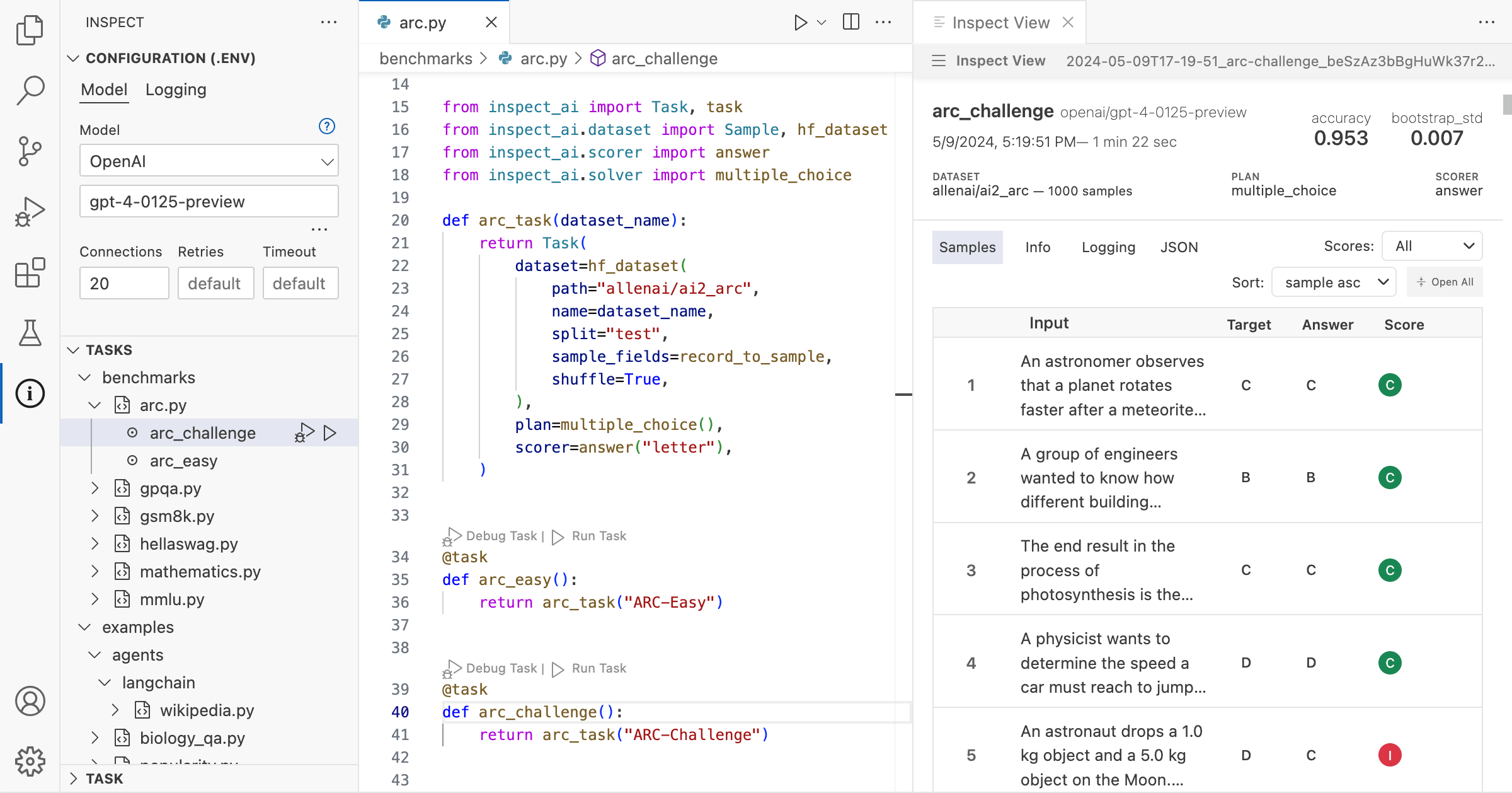
The official Inspect documentation says the framework is developed by the UK AI Security Institute and Meridian Labs. It provides composable datasets, agents, tools, scorers, a web viewer, more than 200 pre-built evaluations, and sandbox backends including Docker and Kubernetes.
The framework also supports external agents such as Claude Code, Codex CLI, and Gemini CLI. The API and CLI reference exposes tasks, scorers, review, approvals, logs, traces, and sandboxes. The repository uses the MIT license.
What stands out: Inspect treats the environment as part of the evaluation. A coding agent can be judged on files changed, commands run, tool calls, and task completion inside a controlled sandbox, not just on its final chat message.
What to watch: rigor creates setup work. A product manager who needs to label 40 customer-support traces may find Inspect less direct than a hosted annotation queue or a simple local review app.
I would not choose it because the pre-built evaluation count is large. I would choose it when the task itself needs reproducible tools, sandboxes, solver behavior, or model-level comparison.
Choose Inspect AI when: the system acts inside an environment and you need a serious experimental harness rather than only a response grader.
6. MLflow: best for teams already running an ML lifecycle
MLflow is the pragmatic choice when evaluation should live beside existing experiments, datasets, models, lineage, and production traces instead of creating a new LLM-only island.
The current GenAI evaluation documentation covers evaluation datasets, human feedback, built-in and custom scorers, LLM judges, tracing, and production monitoring. The self-hosted project is Apache 2.0 licensed.
What stands out: evaluation results can share the same experiment record and governance structure as the rest of a machine-learning program. That helps when an AI feature combines a retriever, a classifier, a prompt, and an LLM rather than existing as a single model call.
The self-hosting guide shows a local starting point with SQLite and local artifact storage, then documents production options such as Docker Compose and Kubernetes. That is genuine control, but somebody still owns the server, upgrades, backups, and access policies.
What to watch: MLflow can be too much platform for a two-person agency testing one support agent. A focused library may reach the first useful failure report faster.
For an organization already using MLflow, the calculation changes. Reusing identity, storage, experiment history, and governance may be cheaper than buying an easier standalone tool that creates another system of record.
Choose MLflow when: your team already uses MLflow or needs LLM evaluation to sit inside a broader ML and GenAI lifecycle.
A 30-case pilot for choosing between two finalists
Do not migrate a full evaluation program to compare tools. Run two finalists against the same small, difficult dataset and compare the work they remove.
For an illustrative client-support agent, I would prepare 30 cases:
- 10 common questions with approved source passages
- 6 ambiguous questions where the agent should ask for clarification
- 6 tool-use cases with expected tool names and argument constraints
- 4 refusal or escalation cases
- 4 production failures that have already surprised the team
Use three scorer types. First, deterministic assertions check JSON shape, required citations, permitted tool arguments, and prohibited phrases. Second, one narrow model judge scores a genuinely subjective criterion such as whether the answer resolves the user's stated need. Third, a domain expert reviews every failure and every disagreement between the first two scorer types.
Run the current agent and one candidate change through both tools. Do not compare only the final pass rate. Time how long it takes to add a case, inspect a failed trajectory, correct a label, compare versions, export results, and wire one protected behavior into CI.
The winner is the tool your team can keep using after the pilot excitement is gone.
Calculate evaluation cost without comparing unlike meters
Suppose the 30-case pilot runs a baseline and a candidate three times each to expose nondeterminism. That is 180 application runs. If one subjective judge scores two criteria per run, the pilot creates 360 judge calls, before retries or synthetic test generation.
That arithmetic is hypothetical, but it reveals the real questions:
- What does one complete application run cost?
- How many model calls does each metric make?
- Does a platform charge per score, trace, span, unit, seat, or stored gigabyte?
- How long must raw prompts and labels remain available?
- Who reviews disagreements, and how many minutes does that take?
A free framework may create a larger model bill than a paid platform if it runs five judges over every case. A hosted tool may be economical at pilot scale but expensive when online scoring touches millions of traces. Measure the actual workflow rather than converting unlike meters into a fake monthly ranking.
Match the tool to the system you are evaluating
For a Python application with a small engineering team, start with DeepEval. For a model-and-prompt matrix or a security-heavy agent, start with Promptfoo. For a retrieval product, add Ragas before buying a broad platform.
Choose Braintrust when the shared production feedback loop is the problem. Choose Inspect AI when the environment and agent trajectory are part of the experiment. Choose MLflow when evaluation belongs inside an established ML program.
You may combine tools, but nominate one source of truth for release quality. A common design is a local framework for regression tests plus an observability or hosted platform for production sampling. Our LLM observability tools comparison covers that second loop in more detail.
For a no-code agent, first ask what the builder exposes. Pickaxe lets you build, deploy, and monetize agents through branded portals, while a separate evaluation framework may need an API wrapper or exported conversations. Start with the behaviors you can observe and reproduce, then add infrastructure only where it changes a decision.
A practical deployment plan
Week one should produce a useful dataset, not a perfect platform. Read real or realistic traces, label the dominant failure modes, and write deterministic checks for the easy ones.
Week two should compare a baseline with one meaningful change, such as a revised prompt, a new model, or a knowledge-base update. If the tool cannot explain a regression on that change, it has not earned a wider rollout.
Week three should connect evaluation to delivery. Run the protected regression set when prompts, models, tools, or retrieval settings change. Keep a separate challenge set so experiments do not rewrite the release bar.
Week four should close the production loop. Sample failures and low-confidence cases, review them with the domain owner, and promote confirmed new failure modes into the test set. Pair that process with prelaunch agent testing and debugging and a risk-based human approval design.
Build the agent before you build the lab
Create a focused Pickaxe agent, collect real cases, then add the evaluation loop its risks justify.
Avoid the LLM-as-judge trap
A judge model is useful when the failure is subjective and frequent enough to justify automation. It is not an oracle.
Shreya Shankar framed the problem directly in a 2024 X post: if one unreliable model checks another, who validates the validator? Her question is the right procurement filter for every product promising automatic quality scores.
Keep the judge narrow. Ask whether a cited paragraph supports a claim, not whether the whole answer is good. Compare the judge with human labels. Track false positives and false negatives. Version the judge prompt and model. Recalibrate after the application or user population changes.
Use code for facts code can settle. Did the output parse? Did the agent call the permitted tool? Did it include a source URL? Did it ask for confirmation before an irreversible action? Deterministic checks are cheap, explainable, and stable.
Then use human review for consequence and taste. A score can prioritize a queue, but the domain owner should decide whether a failure blocks launch.
My recommendation
For most small Python teams, I would begin with DeepEval because it makes the release suite feel like software testing. If security testing and provider comparisons are central, I would begin with Promptfoo. Ragas is the first specialist I would add for a retrieval-heavy system.
Move to Braintrust when shared datasets, production traces, and review workflows become the bottleneck. Use Inspect AI for rigorous model or sandboxed-agent experiments. Reuse MLflow when the organization already has an ML lifecycle worth preserving.
The important decision is not which logo wins. It is whether the tool helps your team turn one real failure into a case that stays fixed. Build that loop before buying a dashboard, and the rest of the feature matrix becomes much easier to judge.
If you want to start with a focused no-code agent, Pickaxe has a free tier. Define the job, deploy it to a small audience, collect the cases that matter, and let those failures tell you which evaluation tool you actually need.