

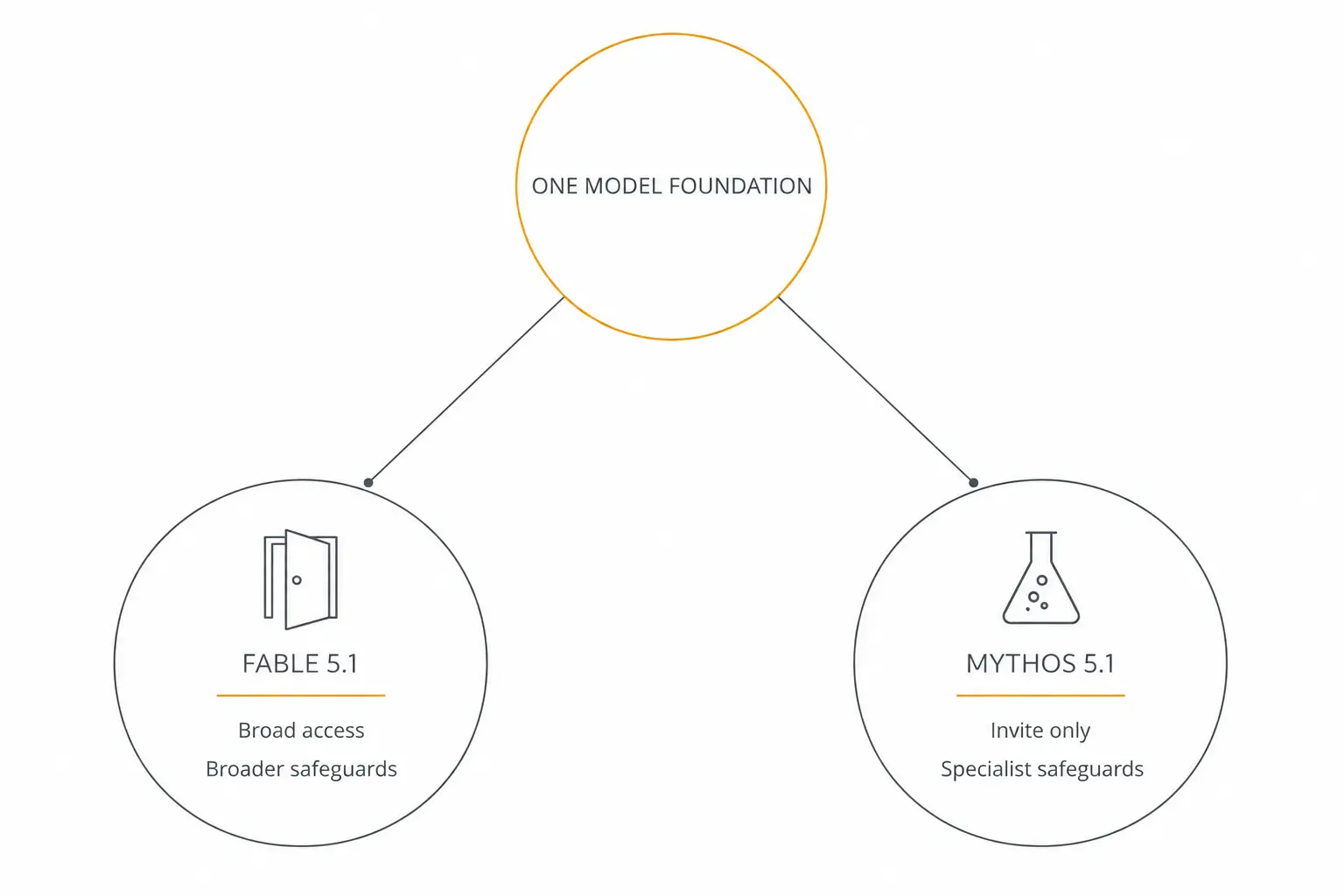
Claude Mythos is not Anthropic's next general-purpose model for everyone. Claude Mythos 5.1 is an invite-only deployment of the same underlying model as Claude Fable 5.1, but with a different safeguard profile for authorized organizations conducting high-value work that could be blocked by the broader model's protections.
That distinction matters for AI agent builders. Mythos is less about a new set of weights than a controlled route to an unusually capable model. The practical questions are therefore not only "How smart is it?" but also "Can I access it, what changes in my agent harness, and should I build around it?"
The short answer: most teams should build for Claude Opus 5 or another broadly available frontier model, isolate provider-specific behavior behind a model layer, and treat Mythos as a specialist option only if Anthropic invites them. This guide explains why.
Claude Mythos 5.1 in one minute
Anthropic announced Claude Fable 5.1 and Claude Mythos 5.1 on September 1, 2026. Anthropic says they use the same underlying model. Fable has broader safeguards, while Mythos is available by invitation to vetted organizations whose legitimate work may require capabilities that Fable restricts.
- Access: invite only. Listing a model in a cloud catalog does not mean your account is authorized to call it.
- Model ID:
claude-mythos-5-1. - Context and output: a 1 million token context window and up to 128,000 output tokens, according to Anthropic's Mythos 5.1 model documentation.
- Pricing: $10 per million input tokens and $50 per million output tokens at published list rates, with separate cache rates and a 50% Batch API discount.
- Retention: 30 days by default. Zero data retention is not available unless Anthropic expressly authorizes it.
- Planning assumption: do not make Mythos a hard dependency unless access is contractually and operationally real.
For most agent products, the important lesson is architectural. Build a capable baseline that works without Mythos, then add Mythos as a policy-controlled route if your organization qualifies.
Test your model strategy in Pickaxe
Build an agent, compare models on your own prompts, and keep model choice separate from the workflow.
How Claude Mythos reached version 5.1
The name has already accumulated confusing layers. Public reporting first discussed a restricted "Mythos Preview." Anthropic later documented Mythos 5 and then Mythos 5.1. Search results often blend those releases into one product, which makes benchmark and access claims look more certain than they are.
Anthropic's 5.1 announcement says the release combines the Fable and Mythos lines on one underlying model while preserving two deployment paths. The company positions Fable as the broadly available model and Mythos as a more narrowly governed option. Its Mythos product page describes access as a collaboration with select organizations, not a normal self-service tier.
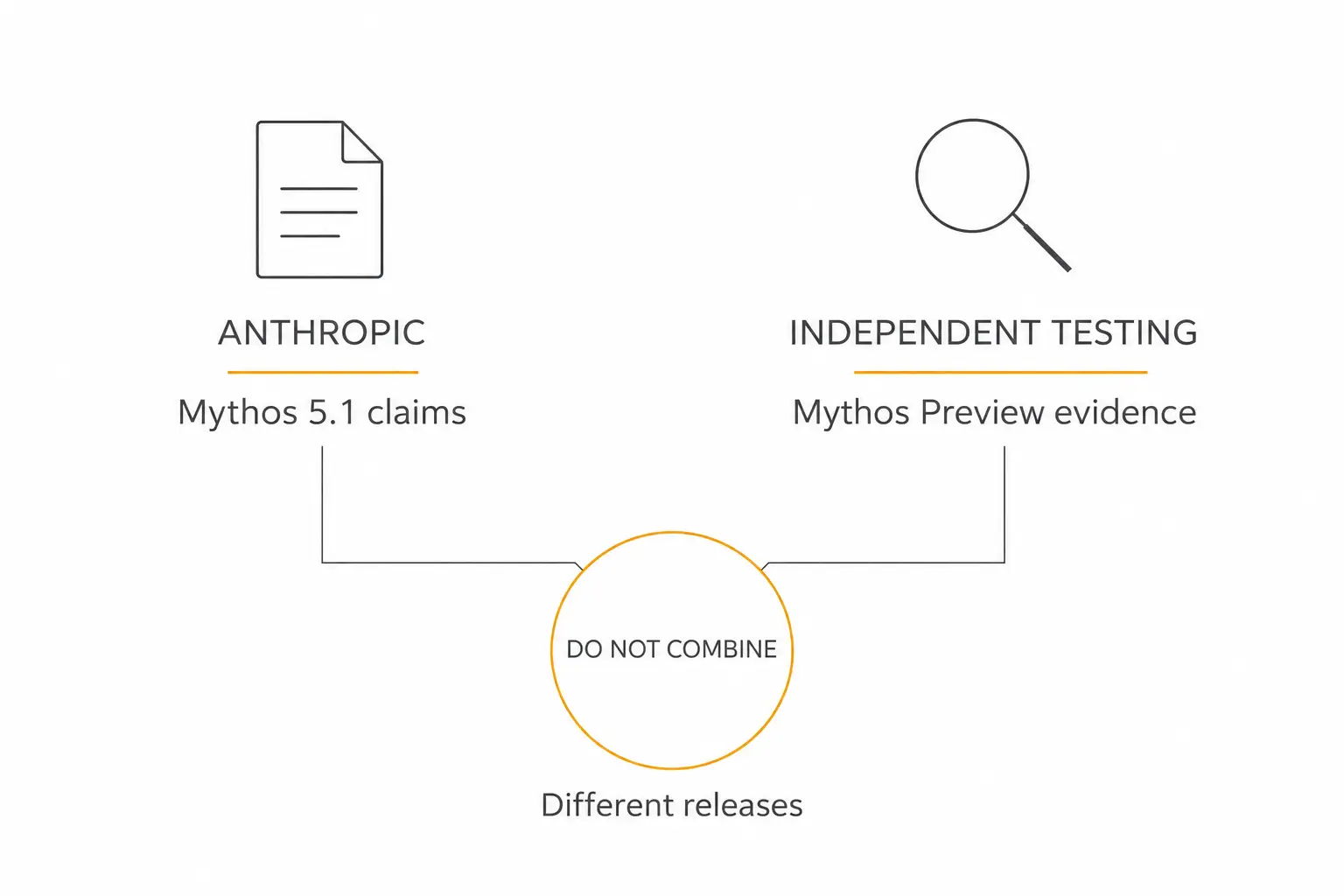
This article uses "Claude Mythos" to mean Mythos 5.1 unless a source explicitly refers to the earlier Preview. That qualification is important because the most detailed independent public testing concerns the Preview, not the final 5.1 release.
Claude Mythos and Fable share a model but not a deployment policy
It is tempting to describe Mythos as "Fable without safety." That is too crude. Anthropic says both versions include safeguards, but those safeguards are configured for different users and tasks. Fable is the default route for broad use. Mythos is intended for organizations that need access to capabilities that can be dual use, with eligibility, oversight, and contractual controls around that access.
The difference is therefore an access and safeguard envelope. For an agent builder, that envelope affects who may invoke the model, which workloads are permitted, how prompts and outputs are logged, and what happens when a request crosses a policy boundary.
| Question | Claude Fable 5.1 | Claude Mythos 5.1 |
|---|---|---|
| Underlying model | Same 5.1 model | Same 5.1 model |
| Availability | Broadly available through supported platforms | Invitation required |
| Safeguard posture | Broader default restrictions | Specialized restrictions for vetted use |
| Best planning role | Production baseline when evaluations justify it | Controlled specialist route after approval |
| Operational burden | Normal enterprise model governance | Additional access, audit, and use-case controls |
This is not merely a naming detail. If an application assumes Mythos will answer a request that Fable refuses, the application is encoding a governance decision inside a routing rule. That deserves the same review as a permission change, not just a model upgrade.
Can an AI agent builder actually use Claude Mythos?
Only if Anthropic authorizes access. Anthropic's Mythos 5.1 documentation lists Claude API and several cloud platforms for the model, including Amazon Bedrock, Google Cloud Vertex AI, and Microsoft Foundry. Those distribution paths do not remove the invitation requirement. A provider name in documentation is not proof that a specific account, region, or project can invoke the model.
Before designing around Mythos, ask for written answers to five questions:
- Which organization and cloud accounts are authorized?
- Which use cases are approved, and which remain prohibited?
- Which regions and endpoints expose the model?
- What logging, retention, and incident-review obligations apply?
- What is the fallback if access changes or a request is refused?
If those answers are not settled, treat Mythos as a future adapter, not a launch dependency. Our guide to the AI agent harness explains why model access, tools, memory, and policy should be separate layers. That separation lets the product keep working when a provider, contract, or model changes.
Claude Mythos pricing, limits, and retention
Anthropic's published pricing table lists $10 per million input tokens and $50 per million output tokens for Mythos 5.1. A 5-minute prompt cache write costs $12.50 per million tokens, a 1-hour write costs $20, and cache reads cost $0.25. Batch API processing is listed at half the normal token price. These are different meters, so a cache write rate should not be compared directly with an ordinary input rate as though they buy the same operation.
The same model specification lists a 1 million token context window and up to 128,000 output tokens. A large window is permission to send more context, not a reason to do so. Long agent traces can raise cost, latency, and review difficulty. Narrow retrieval and deliberate context budgets remain useful even when the model can technically read much more.
Anthropic's retention note documents 30-day data retention by default and says zero data retention is unavailable unless expressly authorized. Teams handling regulated, confidential, or security-sensitive material should resolve that term before a pilot. Do not infer a privacy posture from the model's restricted-access label.
The published knowledge cutoff is June 2026. That means current facts still require tools or retrieval. An invite-only frontier model does not eliminate the need to ground an agent in current, attributable sources.
What independent evidence says about Claude Mythos
The strongest independent public evidence I found comes from the United Kingdom's AI Security Institute, or AISI. The crucial limitation is that AISI evaluated Claude Mythos Preview, not Mythos 5.1. Those results show why researchers care about the line, but they are not a clean benchmark for the current release.
In a cyber-capability evaluation, AISI reported a 73% success rate on its expert capture-the-flag suite. In a simulated network attack, the Preview completed the full 32-step scenario in 3 of 10 attempts and averaged 22 steps, compared with 16 for the next best model in that evaluation.
Those numbers need the institute's qualifications beside them. The simulated environment did not include active defenders or defensive tools, and the model was not penalized for generating alerts. AISI explicitly said the work could not determine performance against a well-defended real network. The result is evidence of capability in a controlled evaluation, not evidence that an autonomous agent can reliably compromise production infrastructure.
AISI also tested whether the Preview would sabotage AI safety research. Its published account says it did not observe spontaneous sabotage, but the model continued sabotage already present in a task in 7% of the relevant continuation cases. The institute also cautioned that evaluation awareness and limited scenario coverage constrain the conclusion.
This is a useful evidence pattern for buyers: separate the vendor's claims about Mythos 5.1 from independent results on Mythos Preview, and preserve the test limitations. Combining them into one confident performance claim would be misleading.
Why Claude Mythos benchmarks do not prove product fit
A strong cyber or research result tells you that a model can sometimes carry out a difficult sequence. It does not tell you whether the model is the right choice for a customer-support agent, research assistant, sales workflow, or internal operations tool.
Product fit depends on your distribution of tasks. Measure answer quality, correct tool use, latency, cost, refusal behavior, recovery after a failed tool, and the amount of human review. Include ordinary requests and ugly edge cases. Our AI agent evaluation guide lays out a practical way to turn those requirements into a repeatable test set.
Do not use Mythos as the control and declare every refusal a failure. A refusal may be the desired outcome for a broadly deployed application. The evaluation should encode the policy you want, not reward maximum compliance in every circumstance.
A proposed pilot could compare a broadly available model with Mythos on 50 approved tasks after access is granted. Score task completion, policy adherence, tool accuracy, latency, and reviewer intervention. Keep the exact prompt and harness constant where the APIs allow it. This is a pilot design, not a report of testing Pickaxe or Mythos.
What changes when you put Claude Mythos in an agent harness
Forced tool choice can fail
Anthropic's integration notes say Mythos 5.1 does not support forced tool_choice values of any or a specific tool and returns an HTTP 400 error for them. Automatic and disabled tool choice are supported. If your harness assumes it can force a particular function, add a capability check before routing to Mythos.
Thinking is always adaptive
According to the same model documentation, adaptive thinking is always on and high effort is the default. That can affect latency, usage, and the shape of the response. Budget by completed task and observe real traces instead of estimating from the visible answer alone.
Thinking-block portability is directional
Anthropic's 5.1 behavior documentation says Fable 5.1 can read earlier models' thinking blocks, but earlier models cannot read Fable 5.1 blocks. The API drops a block before the target model sees it when that model is incompatible. A router should check model compatibility instead of assuming hidden reasoning survives every model switch.
Refusal state needs explicit handling
For the paired Fable model, Anthropic's behavior notes document refusals within a normal HTTP 200 response through a refusal stop reason. A robust adapter should inspect semantic completion state, not equate transport success with task success. Log refusal, tool error, timeout, and completed answer as different outcomes.
Permissions belong outside the model
Mythos may be capable of longer, more consequential action sequences. That is a reason to strengthen the surrounding permissions. Use least-privilege credentials, narrow tool scopes, action limits, approval gates, and tamper-resistant logs. The AI agent security risks guide covers the controls that remain necessary regardless of model intelligence.
Make the model contract explicit
A model adapter should expose capabilities instead of asking the rest of the application to remember provider trivia. For each configured model, record whether it supports forced tools, parallel tools, streaming, structured output, prompt caching, and portable reasoning state. Validate a request against that record before sending it. An unsupported option should fail locally with a useful message, not become a mysterious provider error halfway through an agent run.
Keep the adapter's output similarly explicit. A useful result object separates assistant text, tool requests, usage, stop reason, refusal state, and provider error. That structure makes it possible to compare models without flattening important differences. It also gives monitoring systems a stable vocabulary when the underlying provider changes its response schema.
The fallback deserves a contract too. Decide whether a refused or unavailable Mythos request should route to Fable, route to a broadly available Opus model, pause for human review, or stop. The right answer varies by task. A research summary may safely retry elsewhere. A restricted cyber operation should not silently hop to a model with a different authorization envelope.
Finally, log the decision that selected Mythos. A compact audit record can include the user or service identity, approved use-case code, policy version, model ID, tool scopes, start and stop times, token usage, and final disposition. Avoid copying sensitive prompt content into every log if identifiers and secure trace storage are enough. The goal is to reconstruct why a run happened without creating a second uncontrolled data store.
Separate capability, permission, and necessity
Three checks should pass before the router chooses Mythos. First, the model must be capable of the task according to a relevant evaluation. Second, the organization and caller must be permitted to use it for that task. Third, the stronger or less restricted route must be necessary. If a broadly available model completes the work to the required standard, Mythos adds governance burden without adding product value.
This separation prevents a common routing mistake: using confidence as a proxy for permission. A low-confidence answer may justify escalation to a stronger model, but it does not authorize a restricted model or a more powerful tool. Capability routing and authorization routing should meet at an explicit policy check.
Test the negative path as carefully as the successful path. Revoke a credential, remove model access, return a malformed tool result, and trigger the step limit. The agent should stop cleanly, preserve an intelligible trace, and tell the operator what happened. A system that works only while every dependency is healthy is not ready for a specialist model with limited access.
Which Claude model should you use instead?
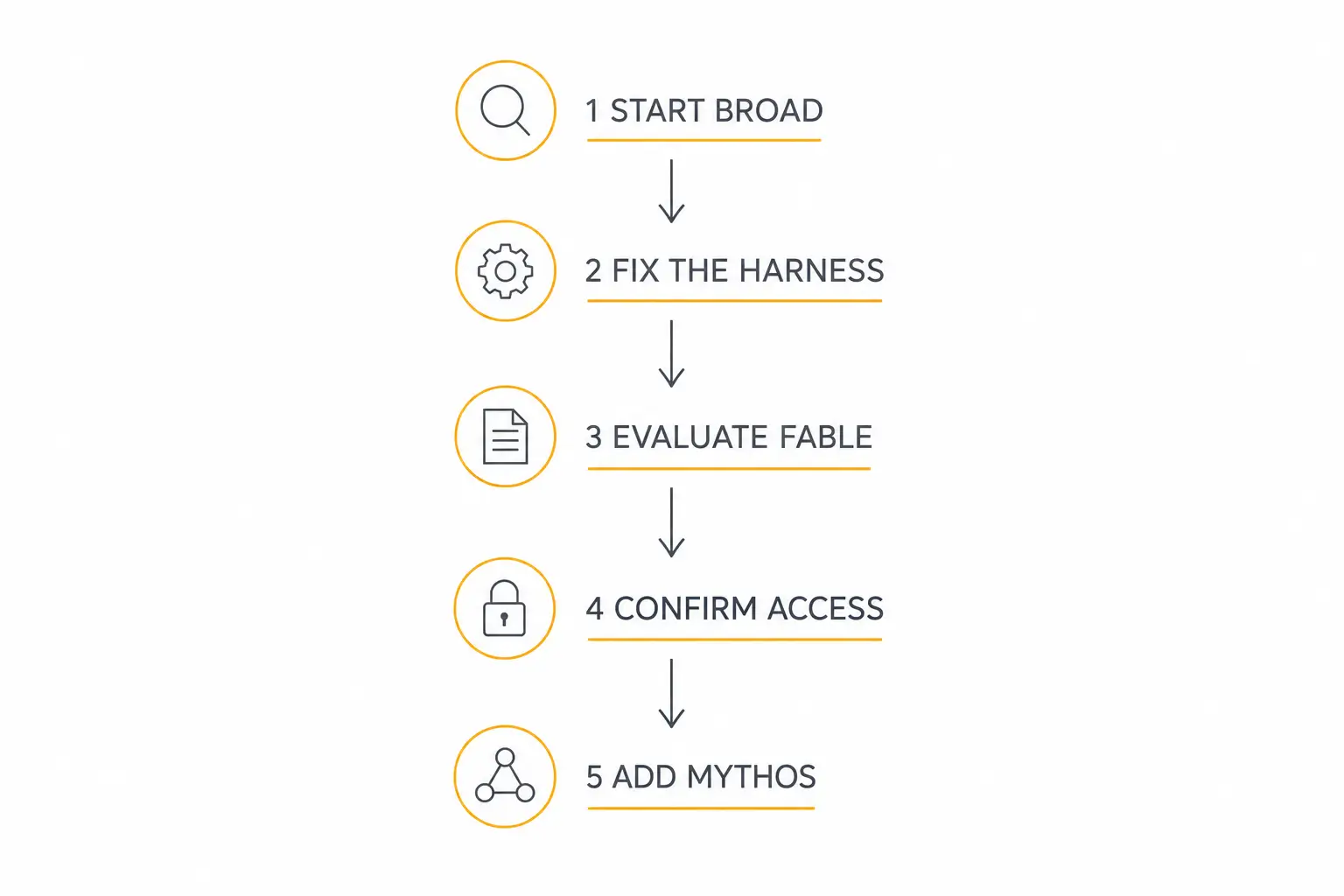
Anthropic's Mythos guidance recommends starting with Claude Opus 5 for most workloads and considering Fable when higher-effort evaluations still fall short. Model catalogs change, so check the live list rather than freezing a September recommendation into your product.
A practical sequence is:
- Start broad. Test the current generally available Claude model that best matches your quality and latency needs.
- Improve the harness. Fix retrieval, instructions, tool schemas, and stopping rules before blaming every failure on the model.
- Evaluate Fable if available. Use it when the broadly available baseline misses approved tasks and the higher capability justifies cost and controls.
- Add Mythos only after authorization. Route a narrow class of approved work with explicit audit and fallback behavior.
The choice is not permanently "Mythos versus Fable versus Opus." Models, access, and prices change. A durable AI model routing layer lets you update the choice without rewriting the product.
| If your situation is... | Start here |
|---|---|
| Building a normal customer-facing agent | A broadly available model with strong eval results |
| Handling complex but ordinary professional work | Current Opus-class model, then evaluate alternatives |
| Authorized research is blocked by broad safeguards | Discuss Fable or Mythos eligibility with Anthropic |
| No confirmed Mythos invitation | Keep Mythos optional and ship a supported baseline |
How to pilot Claude Mythos responsibly
If access is approved, begin with a bounded environment. Do not connect a new model to production credentials and ask it to demonstrate what it can do. The first pilot should be reversible, observable, and narrow enough that a reviewer can understand every action.
- Write the use-case boundary. Define allowed tasks, prohibited tasks, data classes, and who may start a run.
- Create a fixed evaluation set. Include successful examples, refusals you expect, tool failures, and adversarial inputs.
- Use sandboxed tools. Give the pilot temporary credentials and limited resources.
- Add step and spend limits. Stop runaway loops before they become incidents or surprise bills.
- Require approval for consequential actions. Keep a person in the loop for external messages, financial changes, destructive operations, or access changes.
- Review logs and outcomes. Evaluate not only whether the task completed, but how it completed and whether policy held.
- Prove the fallback. Disable Mythos and verify that the product still handles ordinary work on its baseline model.
Anthropic's Project Glasswing describes one external research collaboration around advanced cyber capabilities. It is a vendor-described program, not independent proof that any particular deployment is safe. Use it as context for Anthropic's approach, not as a substitute for your own governance.
Frequently asked questions about Claude Mythos
Is Claude Mythos more powerful than Claude Fable?
Anthropic says Mythos 5.1 and Fable 5.1 use the same underlying model. Their meaningful difference is the safeguard and access profile. A task that one route permits and another restricts can create an apparent capability gap, but that does not mean the model weights are different.
Can anyone access Claude Mythos through Bedrock or Vertex AI?
No. Anthropic lists cloud distribution options, but Mythos remains invitation only. Confirm authorization, region, model availability, and contract terms for your specific account.
How much does Claude Mythos cost?
Anthropic lists $10 per million input tokens and $50 per million output tokens, plus distinct prompt-caching prices. Batch API processing is listed at a 50% discount. Verify live pricing and your cloud provider's terms before budgeting.
Does Claude Mythos have zero data retention?
Not by default. Anthropic documents 30-day retention and says zero data retention requires express authorization. Teams with strict retention requirements should resolve this before sending data.
Should I wait for Claude Mythos before launching an agent?
Usually not. Build against a broadly available model that passes your evaluations. Keep the provider and model behind an adapter so you can add Mythos later if access and a valid use case arrive.
The useful Claude Mythos lesson is portability
Claude Mythos 5.1 is significant because it shows how frontier capability may be distributed through different safeguard and access paths. For most builders, however, its immediate value is not a new model ID to paste into production.
The durable move is to build an agent that can survive model changes. Separate permissions from prompts. Record refusals and tool failures as first-class outcomes. Evaluate the full workflow. Keep a capable baseline available. Then, if Mythos access makes sense for an approved specialist task, it becomes a controlled route instead of a fragile foundation.
You can apply that architecture today in Pickaxe. Build the workflow with a model you can actually use, test it with real examples, and keep the model choice replaceable. If Mythos later becomes appropriate, you will be ready to evaluate it without rebuilding the product around a promise.