

Agentic process automation does not make robotic process automation obsolete. It changes where reasoning belongs in a process, while RPA still handles the exact steps that should not improvise.
I reviewed current vendor documentation, an academic comparison, risk guidance, and the pages already ranking for this question. The best architecture is usually a hybrid: an agent interprets the messy case, deterministic software executes bounded actions, and a person approves the decisions whose consequences justify the interruption.
This guide gives you a step-level way to choose. Instead of asking whether a whole workflow is “RPA” or “agentic,” you will split it into interpret, decide, execute, and verify, then assign each job to the cheapest reliable control.
Agentic process automation vs RPA: the short answer
Use RPA for stable, repeatable execution. Use agentic automation where the correct next step depends on context, unstructured inputs, or an exception that was not practical to enumerate in advance.
| Question | RPA | Agentic process automation | Hybrid |
|---|---|---|---|
| What drives the next step? | Predefined rules | Context and a goal | Agent proposes, policy routes |
| Best input | Structured and predictable | Ambiguous or unstructured | Mixed documents and records |
| Execution style | Deterministic | Probabilistic | Reasoning plus bounded actions |
| Typical failure | Script breaks on change | Agent chooses a wrong path | Bad handoff or weak control |
| Best control | Validation and retries | Evals, permissions, and limits | Policy gates and end-to-end traces |
UiPath's current agents-versus-robots documentation uses almost the same boundary: agents are probabilistic and adaptive, while robots are deterministic and rule-based. That is useful current vendor terminology, not independent proof that any one platform will fit your process.
A controlled study comparing UiPath RPA with Anthropic Computer Use across data entry, monitoring, and document extraction found the same tradeoff. Its published abstract reports that RPA was faster and more reliable in repetitive, stable environments, while the agent needed less development effort and adapted more flexibly to dynamic interfaces. It is one study across three task classes, not a universal benchmark.
What RPA still does exceptionally well
RPA is software that follows a known sequence across applications, often by interacting with the user interface the way a person would. Its strength is not intelligence. Its strength is repeatable execution with a small decision surface.
Think about copying approved values from one system to another, downloading a standard report every morning, reconciling fields against explicit rules, or submitting a form whose inputs have already been validated. If the path is stable and the correct answer can be written as rules, adding a language model can increase cost and uncertainty without increasing value.
RPA also reaches systems that may never offer a clean API. A robot can operate a legacy desktop application, an internal portal, or a mainframe interface after the upstream process has decided exactly what should happen.
The limitation is brittleness, not uselessness. A renamed field, unexpected dialog, changed screen layout, or new exception can stop the bot. Traditional automation then routes the case to a person or waits for somebody to update the script.
That makes maintenance part of the cost model. Count not only licenses and build hours, but also break-fix work, manual exception handling, monitoring, and the delay between a process change and a repaired automation.
What agentic process automation changes
Agentic process automation gives a software agent a goal, context, tools, and bounded authority. The agent can interpret what it sees, decide which permitted step comes next, use a tool, inspect the result, and adjust when the path varies.
That is different from adding one AI classification step to a fixed flow. Intelligent process automation may read an invoice or label an email while the surrounding workflow stays predefined. An agentic process can choose among paths at runtime, request missing information, or escalate when its authority ends.
Automation Anywhere's current agentic workflow guide makes an important distinction: tool calling happens inside a step, while orchestration manages state, dependencies, governance, and handoffs across the process. I agree with that boundary. A chatbot that can call one API is not automatically a production process.
Reasoning expands the automation envelope, but it also expands the failure surface. The agent can misunderstand a policy, choose the wrong tool, pass unsafe arguments, lose context during a long run, or produce an answer that looks plausible without being supported.
NIST's Generative AI Profile calls out confabulation, privacy, information security, automation bias, unreliable decision-making, and the need to monitor and recover from errors. That is why agentic automation needs controls beyond the exception queue used for a normal bot.
Agentic process automation vs RPA, side by side
| Dimension | RPA | Agentic process automation | Design implication |
|---|---|---|---|
| Objective | Execute a specified task | Reach a defined outcome | Make the goal and stop conditions explicit |
| Path | Fixed or rule-branched | Selected from context at runtime | Log why each path was chosen |
| Data | Structured fields | Documents, language, and mixed context | Preserve source evidence |
| Change tolerance | Low outside coded variation | Higher within the tested task boundary | Do not confuse adaptation with correctness |
| Precision | High on a valid script | Variable by task and model | Keep exact execution deterministic |
| Exceptions | Stop, retry, or route | Interpret, replan, or escalate | Define escalation before deployment |
| Testing | Expected paths and interface states | Cases, trajectories, tool calls, and outcomes | Version the eval set with the process |
| Control | Rules and permissions | Rules, permissions, evals, and runtime limits | Policy must sit outside the prompt |
| Best role | Reliable executor | Interpreter and coordinator | Combine rather than replace by default |
The biggest mistake is comparing only happy-path capability. Ask what happens when the invoice has no purchase order, the customer uses a synonym, the source system times out, or the agent is unsure which record is authoritative.
The answer determines whether the design is production automation or a polished demo.
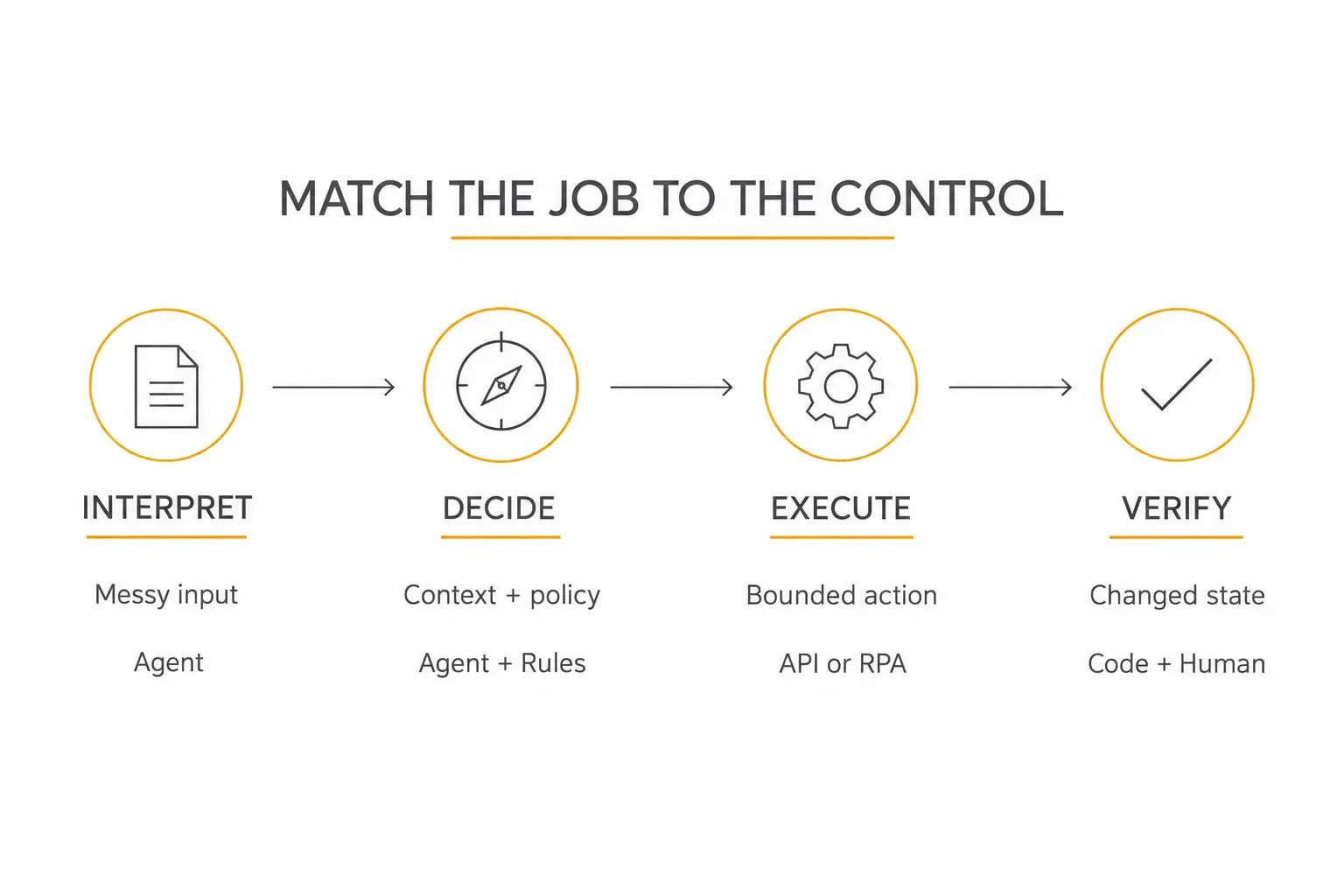
Break the workflow into four jobs
A whole process rarely belongs to one technology. I get a clearer architecture by labeling every step as interpret, decide, execute, or verify.
1. Interpret
Interpretation turns messy input into usable context. Examples include reading a customer email, extracting meaning from a contract clause, recognizing why two records disagree, or identifying what information is missing.
This is the natural agentic zone when language and context matter. The output should include the source evidence and a confidence or uncertainty signal, not only a conclusion.
2. Decide
Decision chooses the next permitted path. Some decisions are deterministic, such as “amount over $5,000 requires director approval.” Others require contextual judgment, such as whether a discrepancy is a harmless formatting difference or a material conflict.
Use rules for decisions rules can settle. Use an agent for bounded ambiguity, then recheck high-consequence outputs through deterministic policy or a qualified person.
3. Execute
Execution changes the world: send the email, update the CRM, create the purchase order, move money, delete data, or submit the form. This is where precision and permissions matter more than fluent reasoning.
Prefer a direct API when one exists. Use RPA when a legacy user interface is the only practical surface. Give the agent a narrow tool with validated arguments instead of unrestricted access to the entire application.
4. Verify
Verification confirms that the intended outcome occurred and that the evidence is complete. It may compare before and after state, reconcile totals, check a receipt, or send a small sample to a reviewer.
Verification should not rely only on the same model that made the decision. Use code, system records, an independent review step, or a separately calibrated evaluator when the consequence warrants it.
When RPA still wins
Choose RPA or ordinary deterministic automation when the path is known, the input is structured, and variation is both rare and costly. High volume makes this fit even stronger because small differences in latency and model cost compound.
- Scheduled extraction: log into a stable portal, download a report, validate the file, and place it in a governed location.
- System-of-record updates: enter approved values into a legacy application that lacks an API.
- Rule-based reconciliation: compare fields and route exact mismatches to a queue.
- Regulatory forms: populate a fixed template from already verified data.
- Repeatable provisioning: create accounts and permissions from an approved request.
Do not add an agent merely because the process has exceptions. If each exception can be described with stable rules and the rule set is manageable, deterministic branching may still be cheaper to operate and easier to audit.
Also keep RPA when the existing bot works. Modernization should solve a measured problem, not satisfy a vocabulary trend.
When agentic automation earns its place
Agentic automation fits when the process cannot move without interpreting context and the number of realistic paths makes a complete rules tree impractical. The value comes from absorbing the long tail of variation, not from replacing a fast bot on its happy path.
- Exception triage: read the case, gather evidence across systems, and recommend the next action.
- Document-heavy intake: identify intent, missing items, contradictions, and the correct route.
- Cross-system coordination: choose tools based on what earlier steps returned.
- Customer requests: understand natural language, clarify ambiguity, and draft a response or bounded action.
- Investigations: assemble evidence and adapt the search as new facts appear.
A good candidate still needs a clear goal, usable tools, observable outcomes, and a safe stopping point. “Handle operations” is not a scope. “Classify inbound vendor requests, gather the matching records, and draft the next action for approval” is much closer.
Before building, use an AI workflow audit to measure volume, exception types, handoffs, risk, and current cost. Agentic technology cannot rescue a process whose owner, policy, or outcome is undefined.
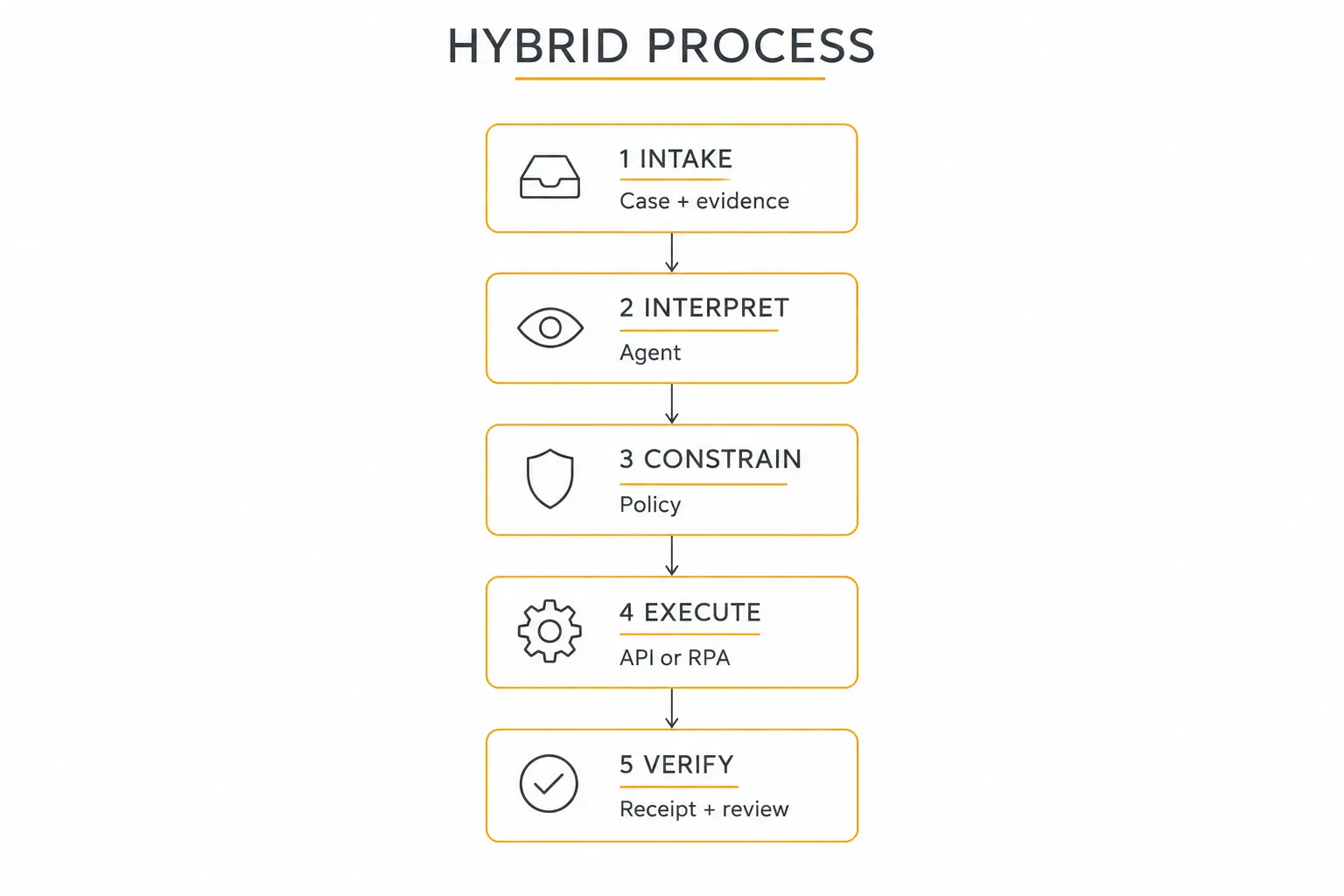
The hybrid architecture I would build first
For most client processes, I would not start by replacing the RPA estate. I would place an agent around the brittle boundary where people currently read, decide, and repair exceptions.
- Intake captures the case. Store the original request, attachments, identity, and system state.
- The agent interprets. It extracts facts, cites evidence, identifies uncertainty, and proposes a path.
- Policy constrains the proposal. Deterministic rules allow, deny, or require approval based on action, amount, data class, and reversibility.
- APIs or RPA execute. The executor receives narrow, validated parameters and returns a receipt.
- Verification closes the loop. Confirm the changed state, record the decision, and route anomalies to a person.
This separation makes failures easier to diagnose. If the wrong invoice was paid, you can ask whether interpretation selected the wrong record, policy allowed too much, execution changed the wrong system, or verification failed to catch it.
It also lets you improve one layer without rebuilding everything. A better model can replace the interpreter while the approved bot and policy engine stay stable.
Pickaxe can cover the no-code reasoning and customer-facing layer of a smaller version of this design. Ground the agent with a Knowledge Base, connect bounded operations through Actions, and use Preview to test realistic cases. Keep irreversible execution behind the external system's permissions and approval controls rather than claiming a prompt is a policy engine.
Put approval gates around consequences, not around “the AI”
Blanket approval sounds safe, but it creates queues and rubber-stamping. Gate the action according to consequence, reversibility, evidence quality, and who is accountable.
AWS's Agentic AI Lens offers a practical baseline: read-only work can run autonomously, low-risk writes may need one reviewer, and financial transactions, deletion, or external communication deserve stricter approval defined by policy. It also recommends making deterministic logic authoritative when an LLM contributes to classification.
| Gate | Use when | Example | Evidence shown |
|---|---|---|---|
| Notify after | Low impact and easy to reverse | Tag an internal record | Action receipt |
| Confirm before | Moderate impact with a clear choice | Create a support ticket | Summary and proposed fields |
| Human commits | Voice, money, or customer consequence | Send a negotiated response | Draft, sources, and diff |
| Qualified review | Legal, financial, clinical, or safety duty | Approve a regulated decision | Full case and accountable reviewer |
Microsoft's human-in-the-loop runbook adds a valuable rule: the reviewer needs a small review unit, source evidence, and a visible change. An “Approve” button without enough context transfers responsibility more than it controls risk.
For a deeper treatment of escalation, progressive autonomy, and approval fatigue, use our human-in-the-loop agent guide.
A worked example: accounts-payable exceptions
Imagine a team receives invoices by email, matches them to purchase orders, enters approved items into a legacy ERP, and chases people when something does not line up. The existing bot handles clean invoices but sends every exception to a shared queue.
Keep RPA for the clean path. It already downloads the attachment, reads approved fields, checks the required values, and enters a matched invoice reliably.
Add an agent at the exception boundary. It can read the invoice, purchase order, receiving note, and policy, then classify the discrepancy as missing receipt, price variance, duplicate, tax issue, or unknown. It should cite the fields and documents behind that classification.
Keep policy deterministic. A rule can allow a small approved tolerance, block a suspected duplicate, require a named approver above a threshold, and deny any vendor-bank change outside the verified supplier process.
Let RPA execute only the approved result. The bot receives a bounded instruction such as “post invoice 4817 against PO 2209 with approval record A193,” not a natural-language request to “fix the invoice.”
Verify through the ERP receipt and reconciliation. If the transaction identifier, amount, or status differs from the approved proposal, stop and escalate.
This example is illustrative. I did not run it as a production benchmark. Its purpose is to show that the agent earns its place by reducing manual exception interpretation while rules and RPA retain precise control of money and records.
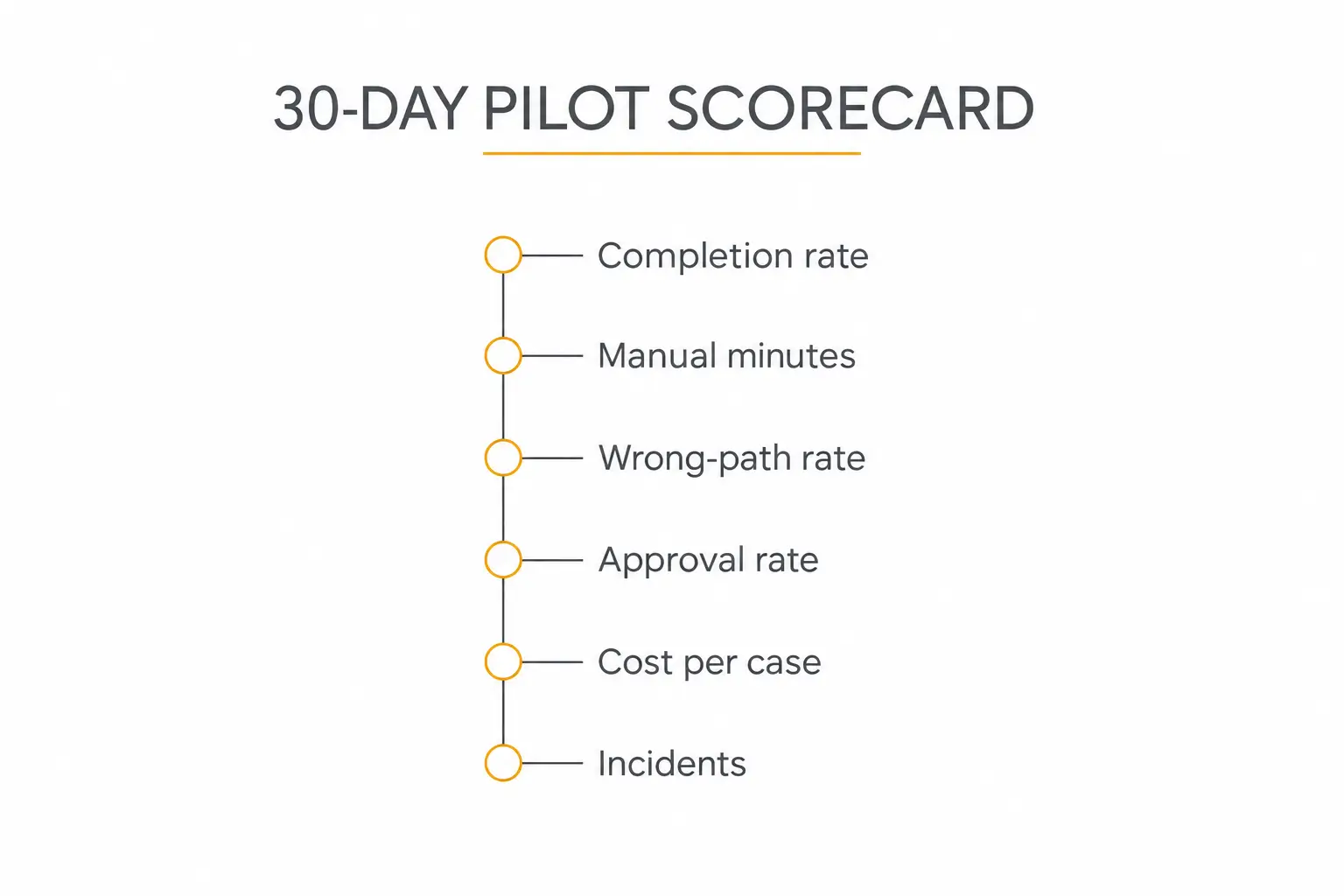
Run a 30-day agentic process automation pilot
Do not begin with the largest end-to-end process. Choose one exception-heavy slice with a known owner, measurable outcomes, reversible actions, and enough weekly cases to learn.
Week 1: map and label
Collect 30 to 50 representative cases, including normal work, recurring exceptions, rare high-risk cases, and failures from the current process. Label the expected interpretation, decision, allowed action, required approval, and verification evidence.
Use the architecture questions in our agents versus agentic workflows guide to decide which steps need judgment and which should remain fixed.
Week 2: shadow the current process
Let the agent propose a path without executing it. Compare its proposal with the human outcome, record disagreements, and turn every meaningful failure into a regression case.
Inspect the trajectory, not only the final response. Our agent testing guide covers tool-call tests, traces, adversarial cases, and staged rollout.
Week 3: permit low-risk actions
Allow a narrow set of reversible actions through validated tools. Keep customer communication, financial changes, deletion, and sensitive system-of-record writes behind approval.
Set hard limits for records changed, money affected, retries, run duration, tool scope, and escalation. A pilot should fail closed when it reaches a boundary.
Week 4: compare the operating system, not the demo
Measure completion rate, manual minutes per case, exception resolution, wrong-path rate, approval rate, reviewer time, rework, latency, model and tool cost, and incidents. Segment the results by case type because averages can hide the exact exceptions you hoped to solve.
Also measure how quickly the team can explain a failure and add a test. After launch, connect the same measures to an agent analytics loop instead of watching only total runs.
Calculate cost without pretending unlike meters are equal
RPA cost usually combines software, infrastructure, bot development, monitoring, and maintenance. Agentic cost adds model tokens, retrieval, tool calls, evals, traces, review, and the variability of longer or retried runs.
Use one cost-per-completed-case formula:
(platform + infrastructure + model + tool + review + maintenance + rework) ÷ verified completed cases
For an illustrative pilot, suppose the current process handles 1,000 cases a month, 200 become exceptions, and each exception takes 12 human minutes. If the hybrid resolves 120 of those exceptions but creates 20 new reviews that take four minutes each, the gross manual time changes from 2,400 minutes to 1,040 minutes.
That arithmetic is hypothetical, not a customer result. It still shows why “automation rate” is insufficient. A design can automate more steps while increasing review time, rework, or incident risk.
Keep unlike vendor meters separate. A bot license, model token, platform action, retained trace, and human approval minute are different costs with different scaling behavior.
Prototype the reasoning layer without a rebuild
Use Pickaxe to test a focused agent against real cases before connecting bounded actions.
How to migrate without a rip-and-replace project
Start with the exception log, not the vendor catalog. Group failures by cause: unstructured input, missing context, policy ambiguity, interface change, unavailable system, or genuinely accountable judgment.
Next, protect the stable core. Keep the RPA steps that already execute predictable work, and expose them to the new orchestration layer as narrow capabilities with explicit inputs and receipts.
Add the agent in shadow mode around one high-volume exception family. Require evidence, record its proposed route, and compare it with the current team before granting any write access.
Then move autonomy one action at a time. Each action needs a permission boundary, validation, timeout, retry rule, idempotency plan, approval policy, rollback path, and trace.
Finally, retire old branches only after the hybrid proves it can handle their real cases. Do not delete the fallback while the pilot is still learning the shape of failure.
Ethan Mollick noted in an April 7, 2026 X post that agentic work patterns are still in flux and could center human augmentation rather than replacement. That is the right posture for migration: redesign the work around better division of judgment and execution, not a target percentage of people removed.
Frequently asked questions
Will agentic process automation replace RPA?
Not across the board. Agents are better at interpretation, contextual decisions, and variable paths. RPA remains better for stable, deterministic execution, especially against legacy interfaces. Current UiPath and Automation Anywhere product architectures both combine agents, robots, APIs, and people, although those sources are vendor descriptions rather than independent performance evidence.
What is the difference between intelligent process automation and agentic process automation?
Intelligent process automation usually adds AI capabilities such as document extraction or classification to a workflow whose path is still predefined. Agentic process automation lets an agent select or revise the path at runtime within a bounded goal and policy.
Is agentic automation more expensive than RPA?
It depends on the work. Agentic automation adds variable model, evaluation, monitoring, and review costs, but it may reduce manual exception handling and brittle rule maintenance. Compare verified cost per completed case for the same process slice.
Can a no-code team build agentic process automation?
A no-code team can prototype and deploy a bounded reasoning layer with a platform such as Pickaxe. Complex orchestration, high-risk writes, identity, rollback, and enterprise governance still need deliberate system design, even when the agent itself is no-code.
What process should I pilot first?
Pick a process slice with frequent exceptions, clear ownership, measurable outcomes, reversible actions, and enough cases to evaluate. Avoid the most regulated or irreversible workflow as the first live test.
The bottom line
Agentic process automation is not RPA with a smarter label. It introduces probabilistic interpretation and runtime decisions into work that previously needed a person or a sprawling rules tree.
That flexibility is valuable only when the rest of the system becomes more disciplined. Give agents bounded goals and narrow tools. Keep exact execution deterministic. Gate consequences with policy. Verify the changed state. Preserve evidence for every handoff.
If you already have RPA, modernize the exception boundary before replacing the stable core. If you are starting fresh, design the hybrid from the beginning. And if you want to test the reasoning layer without writing code, Pickaxe has a free tier for building a focused agent and putting real cases through it.