

LFM3 local AI agents are worth evaluating when a client has one repeatable job that should keep working on their own hardware. I would start with a narrowly scoped assistant that reads an approved local document and drafts a checklist, rather than moving an entire client workflow overnight.
Liquid AI announced LFM3 on October 27, 2026. Its launch announcement positions the family around specialized intelligence, with downloadable weights for local deployment.
I checked the announcement, model card, runtime releases, and license. Here are the seven checks I would put between an interesting launch and a client commitment, plus a proposed pilot you can adapt.
Sources checked October 29, 2026. This is a documentation-based adoption guide, not a hands-on benchmark. The pilot and acceptance criteria below are proposed examples.
Where LFM3 local AI agents fit
The useful question is whether a small local model can handle your specific task within your device, quality, and support constraints. “Runs locally” is only the beginning of that decision.
The official LFM3-1.7B model card describes a text-only model with 1.73 billion parameters and a 256K-token input-plus-output context window. This article focuses on that checkpoint; the family name does not make every variant interchangeable.
My starting use case would be a field-service assistant on a technician's laptop. It receives a typed fault description, retrieves passages from an approved local service manual, and drafts a troubleshooting checklist with source references.
It cannot order parts, message customers, or change equipment settings. A technician reviews the result and follows the organization's normal service procedure.
That scope gives local inference a concrete reason to exist: a useful draft when connectivity is unreliable. It also makes failure observable, because each suggested step should trace back to a known document.
Liquid's production model documentation recommends retrieval or search for knowledge-heavy work and says the model is not recommended for agentic coding or complex multi-step reasoning. I would treat that warning as a design constraint.
In its October 27 X announcement, Liquid AI frames the release around choosing a model for a use case, customizing it, and running it on-device. That is vendor positioning, not independent proof that a client deployment will succeed.
Our guide to the agent harness explains the surrounding work: state, tool execution, retries, and permissions. A downloaded model still needs that application layer.
1. Verify the runtime, checkpoint, and tool format together
A model file opening successfully is a smoke test, not an agent compatibility test. Record the exact model revision, quantization, runtime version, operating system, and hardware before evaluating anything else.
Liquid lists separate GGUF, MLX, ONNX, and GPU-oriented checkpoint paths on the model card. Pick the artifact intended for your runtime rather than assuming a conversion for another backend behaves identically.
The llama.cpp LFM3 support change was merged October 27. Its author reports text/chat, tool-call, and structured-output conformance checks, while noting that video support would come later.
That is evidence of an implementation path. It does not establish performance or correctness for the particular build installed on your client's laptop.
There is also a launch-specific platform caveat: Ollama v0.40.12's release notes say LFM3 and d1 2B are supported on Apple hardware in that release, with Linux and Windows support coming soon. Check the release you actually plan to deploy before promising those platforms.
For an Apple pilot on that documented release, the listed entry command is ollama run lfm3. I have not run it for this article, and a chat response would still leave the rest of this checklist unproven.
I would save a small compatibility record alongside the project:
- Device model, available memory, OS build, and inference backend.
- Runtime release or commit, exact model artifact, and file checksum.
- Quantization, chat template revision, context allocation, and generation settings.
- Tool parser version, allowed tool schemas, and a known-good conversation fixture.
Then exercise a full round trip: the assistant requests a document lookup, the application validates and executes it, and the assistant uses the returned passage correctly. Include a tool error so you can see how the loop recovers.
Liquid's tool-use documentation says LFM3 changed from the earlier LFM2/LFM2.5 format to a superset of qwen3_coder. Reusing an old parser without checking that change is an avoidable integration risk.
Evidence to keep: one successful tool transcript, one failed-tool transcript, and the complete compatibility record. If those cannot be reproduced after restarting the device, stop here.
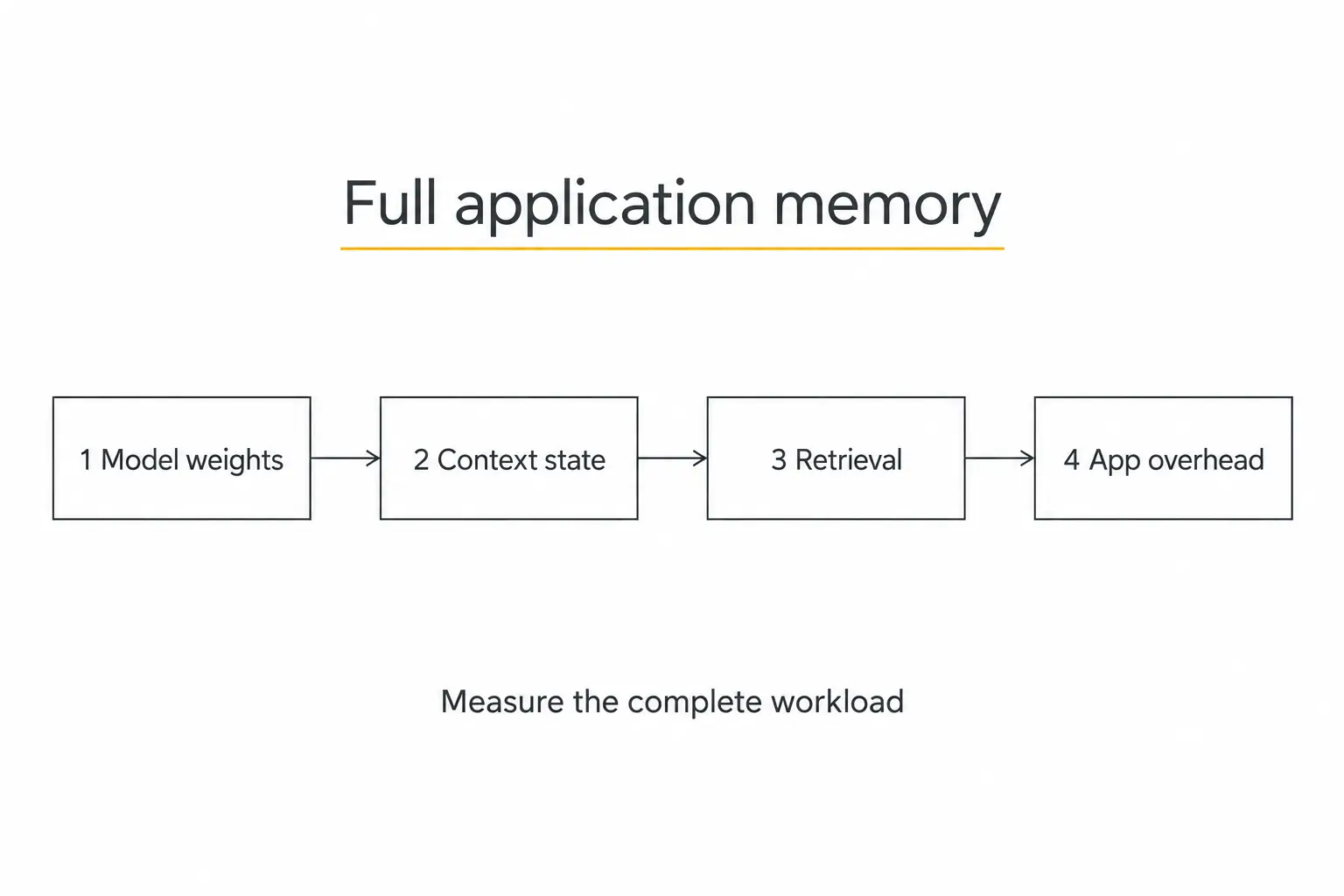
2. Measure full memory at the context you will use
The model card's approximately 1 GB figure at four-bit precision is useful for understanding the small checkpoint. It is not a guarantee that your complete assistant needs only that much memory.
Your application also needs working memory for inference, context state, retrieval, the interface, and everything else running on the device. The relevant measurement is peak application and system pressure during the intended workload.
Liquid's launch post separately reports 1.6 GB of KV cache at a 128K-token context. Treat that as a vendor-reported configuration result, not a portable total-memory requirement or a number to add blindly to every deployment.
For the service-manual pilot, I would avoid starting at the advertised maximum context. First define the largest realistic user request, retrieved passage bundle, tool response, and retained conversation history.
Use that representative workload for the main run, then add a deliberately oversized input to verify a controlled refusal or truncation policy. An application that silently drops the safety instructions has failed even if it avoids crashing.
Test while the technician's ordinary applications remain open. A clean machine with nothing but the inference server running can hide the resource contention that appears during an actual shift.
Keep these measurements distinct:
- Artifact size: bytes occupied by the downloaded model files.
- Loaded model footprint: memory after loading, before a realistic conversation.
- Peak workload memory: the high point while retrieving, processing, and generating.
- Device headroom: what remains for the OS and the user's other applications.
Run the same representative request at the chosen quantization and at another quality setting you can support. Do not assume the smallest file preserves the exact extraction and tool behavior you need.
Evidence to keep: peak memory, context settings, concurrent applications, and a graceful response to an oversized request. A screenshot of a downloaded file size is insufficient.
3. Test decisions and arguments, not just valid output
A syntactically valid tool call can still request the wrong manual, use the wrong equipment identifier, or perform a step the user did not authorize. Score those failures separately.
The LFM3 model card reports BFCL V4 at 71.39 and MCP-Atlas at 32.57. These are Liquid's benchmark results on different evaluations, not percentages you can transfer to your own task or combine into a production success rate.
I would create a compact fixture set for the actual assistant. The point is to reveal failure modes early, then expand the set as the pilot finds new ones.
- Known document: the user supplies an exact equipment identifier and a supported question.
- Ambiguous identifier: similar equipment names require a clarifying question.
- Missing source: the relevant service manual is absent.
- Tool failure: document retrieval returns an error or empty result.
- Untrusted instruction: retrieved text tells the assistant to ignore its operating rules.
- Unauthorized action: the user asks it to order a replacement component.
For each case, write the expected behavior before running the model. Otherwise a plausible answer can move the goalposts while you are grading it.
In the ambiguous case, the expected output should be a question. In the missing-source case, it should say it cannot establish the answer from the approved materials.
Validate arguments in application code against an allowlist of document IDs and permitted operations. Do not let generated strings become arbitrary filesystem paths or shell commands.
If the assistant outputs a structured checklist, verify required fields, allowed values, source references, and the relationship between them. A source field pointing to an unrelated paragraph is still an incorrect answer.
Our AI agent evals guide shows how to turn expected outcomes into a regression set. Keep the same cases when changing runtime, quantization, prompt, or model revision.
Evidence to keep: case-level results with inputs, tool calls, returned sources, and final answers. Label every unsafe or unsupported outcome explicitly instead of hiding it inside an average.
4. Prove retrieval and privacy with the network unavailable
Local inference only tells you where the model runs. It does not establish where embeddings are computed, where documents are indexed, or which services receive tool calls and diagnostic logs.
Draw the data path for the proposed application. Include document ingestion, text extraction, embeddings, the retrieval store, model inference, logging, backups, update checks, and any fallback.
For the field-service example, I would require the approved manuals, search index, and retrieval model to be available on the device before the technician leaves connectivity. Otherwise the offline promise fails before generation starts.
Test the complete application after disabling its network access in the approved test environment. Check that it can still retrieve the right passage, disclose missing information, and produce the same kind of source reference.
A useful negative test is a manual that was never synchronized. The assistant should identify the absence, rather than guessing a procedure from general knowledge or pretending a cloud lookup succeeded.
The knowledge-base design guide explains why source preparation and retrieval quality deserve their own evaluation. Moving inference onto a laptop does not repair an outdated or poorly organized document collection.
I would also test a revoked document. Remove it from the approved collection, refresh the local index, and confirm that future responses no longer retrieve it.
That test forces an ownership question: who updates each device, and how do you know the update arrived? A copy of a manual that remains offline indefinitely can become a maintenance liability.
Keep tools narrow. A document-search tool should return approved passages with stable identifiers, not unrestricted access to every file a technician can open.
For diagnosis, capture enough information to explain failures without unnecessarily retaining customer material. Define retention and access before the pilot creates a collection of sensitive transcripts.
Evidence to keep: a data-flow inventory, an offline transcript, an absent-source result, and a removed-source result. Check observed network behavior as well as the application's settings.
5. Measure useful latency, energy, and completed work
A fast stream of tokens is encouraging, but the client experiences the time from submitting a request to receiving a usable result. That includes retrieval, prompt processing, tool round trips, validation, and retries.
I would time both a cold start and a warmed-up application. If technicians open the assistant occasionally between jobs, the cold path may matter more than the headline generation rate.
Record time to the first visible response separately from time to the final checked answer. An immediate “Working on it” message should not make the actual task look faster.
Use the same representative document bundle for comparisons. Shortening the prompt for one runtime and leaving a long history in another changes the workload.
For the proposed pilot, log device power state, battery change over a repeated workload, and whether performance changes as the device warms. Compare runs under similar brightness, background activity, and charging conditions.
Those are proposed measurements, not a prediction about LFM3's battery consumption. I would not infer energy use from parameter count or tokens per second alone.
Also count work the human must redo. A quick checklist that requires a technician to verify every sentence from scratch can be less useful than a slower answer with precise supporting passages.
One hypothetical workload might contain twenty requests. If four need retries and two need manual completion, record those events and the total elapsed human and device time; do not report only the sixteen clean first attempts.
To compare costs, use completed acceptable tasks as the denominator. Include device allocation, deployment work, updates, support, retrieval, and approved fallback charges rather than calling local inference free.
Our model routing guide covers sending suitable jobs to different models. A local route only earns its place when it improves the full workflow under the client's constraints.
Evidence to keep: end-to-end timings, cold-start behavior, retry counts, human correction time, and device conditions. Set the acceptable experience with the people doing the work.
6. Check commercial eligibility before quoting the rollout
LFM3 is open-weight under the LFM Open License v1.0. Download availability does not establish unrestricted commercial permission.
The license defines its Threshold as annual revenue of $10 million or more, while Section 5 phrases the commercial condition in terms of not exceeding that Threshold. The Legal Entity definition also includes controlled and commonly controlled entities.
I would ask Liquid to confirm eligibility in writing when revenue is at or near the boundary, when a parent company is involved, or when the deployment is for a client. Do not treat the agency's own revenue as the only relevant fact.
Above-threshold commercial use is not licensed by that agreement. Obtain appropriate commercial terms before promising a production rollout.
Redistribution also has requirements, including providing the license and retaining applicable notices. Keep the exact license version with the chosen checkpoint and have the responsible reviewer evaluate your distribution arrangement.
This is a procurement checkpoint, not a legal opinion. The practical deliverable is written confirmation of who is authorized to use and distribute the model for this particular project.
Then separate license cost from operating cost. A no-charge right to use model weights does not pay for device management, support coverage, or a fallback service.
I would put those responsibilities directly into the project scope: who supplies hardware, who installs updates, what happens when a device fails, and which changes require revalidation.
Evidence to keep: the applicable license, entity and deployment scope, written clarification where needed, and an owner for ongoing compliance.
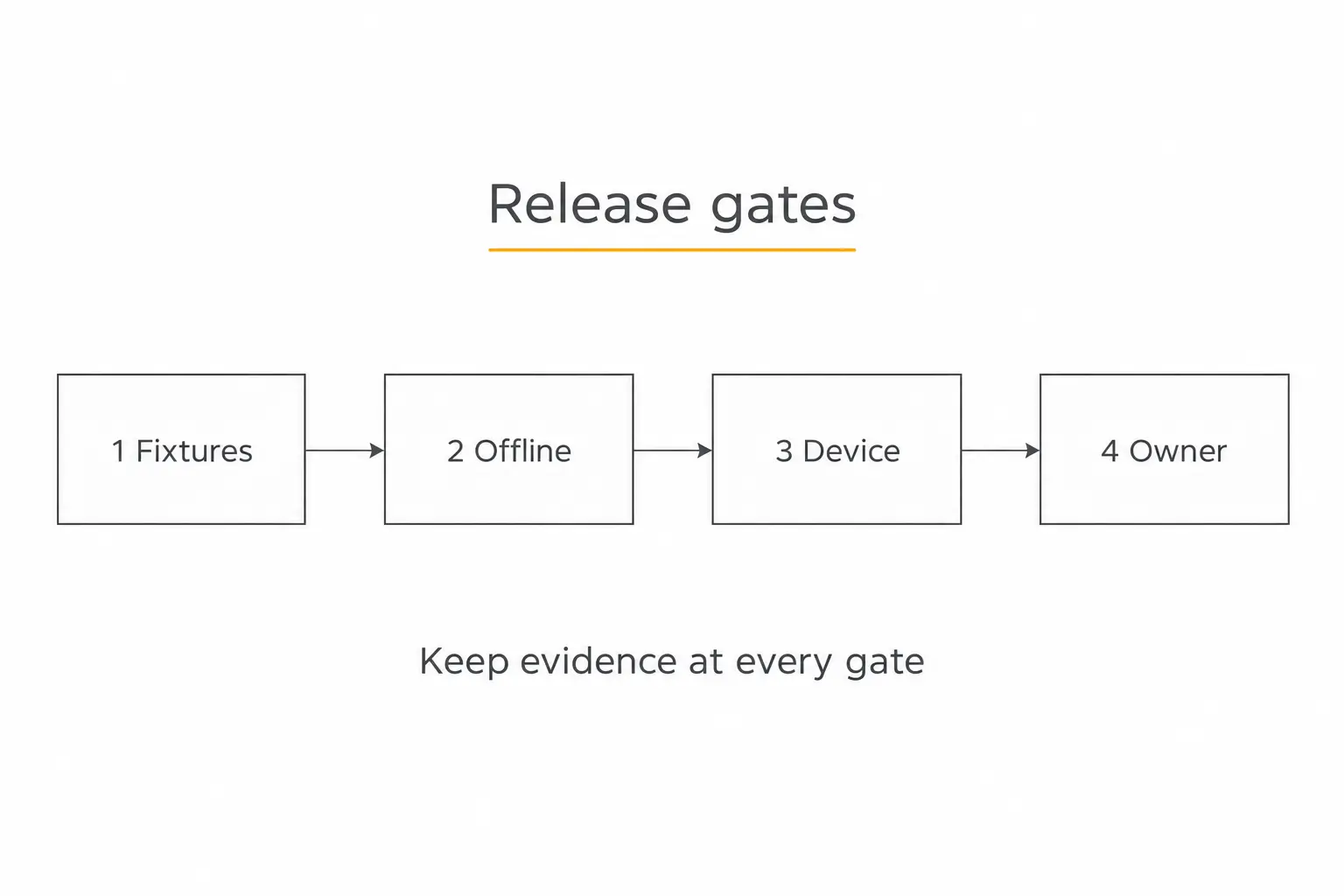
7. Define fallback, updates, and a person who owns recovery
A failed local request needs a deliberate destination. For a draft-only assistant, the safest fallback may simply be the original manual and a clear explanation of what the assistant could not establish.
If the client permits a cloud fallback, define exactly which data can leave the device, which provider receives it, and what happens when connectivity is unavailable. Make that route visible to the user.
For our proposed service assistant, a missing source should open a manual-review path. It should not silently upload the entire document collection to a different model.
Use an explicit retry limit and an overall task deadline. If retrieval has already failed with the same inputs, another generated attempt is unlikely to create the missing manual.
Keep external side effects out of the initial pilot. If later versions create service tickets or order parts, put authorization and duplicate prevention in the application before enabling those operations.
Liquid's local agent harness guide describes connecting LFMs to agent frameworks. Treat that as integration guidance, not a substitute for your own access controls and recovery policy.
I would assign separate owners for the model package, local documents, tool credentials, and incident response. One person can hold several roles, but the handoff should name them.
Pin the known-good configuration and retain a rollback package. Re-run the fixture set after a runtime update, a new quantization, a changed prompt, or a document ingestion change.
The testing and debugging guide is useful here: preserve the failing input and the configuration that produced it. “It was wrong yesterday” is hard to repair without a reproducible case.
Evidence to keep: a tested stop path, an approved fallback policy, a rollback procedure, and a named owner who can restore service.
Clarify the client workflow first
Explore a hosted agent prototype in Pickaxe before committing to a device deployment.
A practical pilot for LFM3 local AI agents
Here is the pilot I would propose before quoting the complete deployment. These are suggested stages and acceptance criteria, not measured LFM3 outcomes.
| Gate | Evidence | Hold the rollout when |
|---|---|---|
| Fixture evaluation | Expected behavior and case-level transcripts | Unsupported instructions appear or identifiers are confused |
| Offline rehearsal | Approved sources retrieve with networking unavailable | Hidden cloud dependencies or stale documents appear |
| Device rehearsal | Memory, latency, and repeated-use observations | The user's normal workload becomes unusable |
| Owned pilot | License review, fallback, rollback, and support owner | No one can recover a failed deployment |
Agree on the task contract first: draft a checklist from approved manuals, cite the source, and ask when the equipment identifier is unclear. Explicitly prohibit unsupported procedures and unapproved external actions.
Start with synthetic inputs and non-sensitive example documents. Only introduce client material after the data path, access restrictions, and logging behavior have been reviewed.
Have a domain expert grade the answers. A technically valid response can still omit a prerequisite that makes the procedure inappropriate.
Keep factual correctness, source support, action restraint, usability, and recovery as separate outcomes. Do not let a high average hide a failure that the client considers disqualifying.
For acceptance, I would require every release-blocking case to behave as agreed, no prohibited action, and an experience the actual users accept on their normal hardware. Passing that finite set authorizes a bounded pilot; it does not prove universal reliability.
Expand only after reviewing pilot failures and adding them to the regression set. If the local route cannot meet the task contract, narrow the job or keep it on a suitable hosted system.
What I would decide before building
I would shortlist LFM3 for a constrained local assistant when offline availability or control over inference location has clear value. I would keep complex reasoning and broad autonomous work outside the initial commitment.
If the main job is delivering a branded client agent with a knowledge base and controlled access, I would compare the device deployment burden with a hosted product such as Pickaxe. That is a different delivery choice; this article does not establish Pickaxe support for on-device LFM3 inference.
For a hosted prototype, review the available models at Pickaxe's model catalog and the current plan details on the pricing page. Validate the same task contract before deciding where production should run.
The launch is a good reason to begin a careful pilot. The decision to ship should come from the evidence you collect across these seven checks.