

The useful question in Claude Fable 5.2 vs Opus 5.5 is which task has earned the extra reasoning budget. I would keep Opus as the starting point and escalate a specific failure only after checking the input, tools, effort setting, and acceptance criteria.
Anthropic announced Fable 5.2 on November 9, 2026 and still recommends starting with Opus 5.5 for most coding and knowledge work. Its launch announcement makes the bigger model a candidate for difficult, open-ended technical work, rather than a reason to replace every working agent.
I checked the current documentation and the live Claude model menu for this guide. I did not run a paid API benchmark; the pilot below is a proposed method, and the screenshots show interface controls, not successful execution or access on every plan.
Claude Fable 5.2 vs Opus 5.5: the functionality overview
| Requirement | Claude Opus 5.5 | Claude Fable 5.2 |
|---|---|---|
| Ordinary client coding and knowledge work | ✓ Better fit as the initial baseline; Anthropic recommends starting here | Consider after a demonstrated capability gap |
| Hard, open-ended technical work | Try higher effort before changing models | Candidate for escalation; verify on the client task |
| Text, images, tools | Shared: text and image input, text output and tool use | Shared: text and image input, text output and tool use |
| Context and ordinary output limits | Shared: 1M context; 128K maximum output | Shared: 1M context; 128K maximum output |
| API default effort | medium | high; configure it explicitly |
| Zero-retention requirement | Check the organization, feature and contract | Requires 30-day retention unless expressly authorized otherwise |
The capability, limit and default rows come from the current models overview; the retention qualification comes from API data handling requirements. These are ordinary Messages API specifications, not promises about every partner endpoint or product surface.
My buyer recommendation: choose Opus when it passes the agreed job, consider Fable for a repeatable reasoning failure, and pause either choice when the data or tool permissions are unsuitable. Shared features stay neutral because they do not settle this decision.
What changed with Fable 5.2, and what did not
The model release creates a new escalation option, but it does not fix an incomplete brief or an expired credential. I would first reproduce the failure in the current workflow and identify the exact step where the evidence stops supporting the answer.
A document assistant that misses an appendix may have a retrieval problem. An agent that identifies the right record but cannot save it may have a permissions problem; neither diagnosis justifies a model upgrade by itself.
Anthropic positions Fable 5.2 around demanding reasoning and long-horizon work, while Opus 5.5 also supports complex engineering and long-running agents. Session length alone therefore does not distinguish them.
For the surrounding system, our guide to the agent harness explains why prompts, retrieval, tool handling and verification matter alongside model choice. I would hold those components fixed during the initial comparison.
1. Verify access on the surface you will actually deploy
Start with the application that will serve the client: direct Claude API, a partner cloud, Claude Code, or the Claude app. A model visible in a menu is evidence of a listed option, while a working request with your account establishes a different, narrower fact.
For direct API evaluation, the documented IDs are claude-opus-5-5 and claude-fable-5-2. Confirm the exact identifier, account eligibility, endpoint and region against the Opus specification and Fable specification before preparing your request.
| Check | Opus 5.5 | Fable 5.2 |
|---|---|---|
| API identity | claude-opus-5-5 | claude-fable-5-2 |
| Claude app access | Plan and administrator controls apply | Plan, administrator controls and current offers apply |
| Production availability | Verify in your deployment account | Verify in your deployment account |
| Restricted Mythos access | Separate from this Opus evaluation | Fable access does not grant Mythos access |
Sources: model identifiers and platform inventory, Claude app model controls and Fable versus restricted Mythos access. The table does not claim that a free account can run either model.
In the live free-plan session I inspected, both models had an Upgrade control. I stopped at that boundary, did not purchase access, and captured only the menu so that no account details or chat content appear.
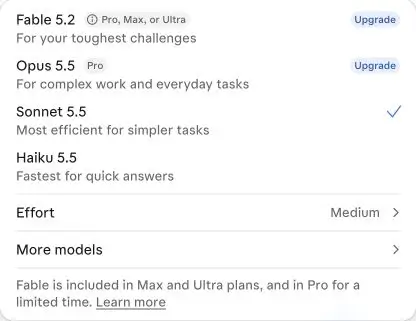
Avoid treating a launch promotion as the steady-state operating plan. Anthropic documents temporary Fable launch offers separately from ongoing entitlements, so I would record the offer expiry and the cost after it ends in the pilot notes.
2. Name the capability gap before escalating
Write the failed outcome in language a client can judge. “The bigger model sounds smarter” is difficult to accept or reject; “the report reconciles conflicting renewal terms and cites the controlling amendment” gives the evaluator something concrete.
My first proposed workflow is a client intake assistant that reads a brief and an approved service catalog, then drafts a scope with exclusions. Keep it read-only during the comparison and require an explicit unknown whenever the brief omits a necessary fact.
That is a reasonable Opus baseline because the desired output can be specified tightly. If both models produce an acceptable draft, the experiment has not established a reason to escalate this workflow, even if one writes more polished prose.
My second proposed workflow is a difficult document reconciliation task: compare a base agreement, amendments and conflicting operational notes, then produce an evidence-backed discrepancy register. Every finding must point to its source, identify uncertainty and leave the final commercial decision to a person.
That job gives Fable a fair opportunity to add value through deeper synthesis. It also gives Opus a fair opportunity to pass at a deliberately chosen effort level, rather than being compared with a weak or casually configured baseline.
For either workflow, define what counts as a material omission, unsupported statement, wrong source and unnecessary escalation. Our AI agent evals guide goes deeper on assembling the underlying regression set.
3. Compare explicit effort settings, then compare operating points
On the Claude API, the documented defaults differ: Opus 5.5 uses medium, while Fable 5.2 uses high. An experiment that omits effort therefore changes two variables at once; see the effort reference.
I would run two comparisons. First, use explicit matching levels to understand behavior under a similar setting; second, compare the cheapest acceptable configuration of each model under the same deadline and quality requirement.
The same effort label does not guarantee equal thinking, cost or duration across models. Anthropic’s Fable prompting guide explicitly recommends recalibrating effort rather than carrying over a previously tuned setting.
| Experiment | Opus 5.5 | Fable 5.2 |
|---|---|---|
| Default audit | Record medium if omitted | Record high if omitted |
| Controlled comparison | Set an explicit supported level | Use the same explicit level |
| Production candidate | Tune to acceptance and deadline | Tune to acceptance and deadline |
| Quality held constant | Compare accepted outputs | Compare accepted outputs |
Sources: effort configuration and Fable calibration guidance. “Same level” is an experimental control, not proof of equal compute or a universal fairness standard.
In the Claude app, the effort menu is a separate control from model selection. The screenshot below was captured with Sonnet selected because the free session could not run either compared model; I use it only to show where the shared control lives.
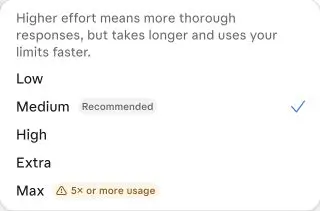
Keep prompts and scoring rules stable while you sweep effort. If a model needs a different prompt to finish reliably, record that as a second candidate configuration and recheck it against the full suite instead of quietly improving just its hardest example.
4. Price an accepted result, including failed attempts
For standard, first-party Claude API base tokens in USD, Fable lists at $8 per million input tokens and $40 per million output tokens; Opus lists at $4 and $20. These are usage rates, not monthly subscription prices; Anthropic’s pricing documentation provides the meter and exceptions.
| Meter, USD per million tokens | Opus 5.5 | Fable 5.2 |
|---|---|---|
| Standard uncached input | $4 | $8 |
| Standard output | $20 | $40 |
| 5-minute cache write | $5 | $10 |
| 1-hour cache write | $8 | $16 |
| Cache hit and refresh | $0.20 | $0.20 |
Source for every price row: Claude API model and prompt-cache pricing. First-party global baseline, no negotiated discount; partner-region premiums, fast mode, batch treatment, tools and other charges require their own quote or calculation.
For a deliberately hypothetical request with 10,000 uncached input tokens and 2,000 output tokens, base token cost would be $0.08 on Opus or $0.16 on Fable. This arithmetic assumes identical token quantities, excludes tool charges and cache activity, and is not a measured agent run.
The practical denominator is accepted results. Divide the total cost of all attempts, including rejected drafts and retries, by the number that pass the rubric; then keep reviewer time and connected-service charges visible as separate components.
For example, if two candidate configurations consume hypothetical total budgets of $12 and $18, but deliver 20 and 40 accepted cases, their token-only costs per accepted case are $0.60 and $0.45. Those invented numbers illustrate the calculation, not the expected performance of either Claude model.
A failed attempt still belongs in the numerator. So does an escalation that receives a correct answer only after the first model already spent time and tokens; otherwise a routing experiment can look cheaper simply by hiding its preliminary work.
5. Measure time to an accepted answer
Measure from the client’s request until a usable artifact is ready. A fast first token is pleasant, but a client waiting for a checked discrepancy register also waits through retrieval, tool calls, corrections, retries and any approval step.
I would record first useful response, artifact completion, evaluator completion and the slowest observed cases separately. For a small pilot, report the actual sample and range rather than presenting a handful of runs as a stable latency guarantee.
Keep network conditions, tool timeouts, concurrency and cache state visible. A model waiting on an unreliable document service should not inherit all the blame for that service’s delay, but the client still experiences the full wait.
The official model pages describe latency categories, not your end-to-end service level. Neither Opus’s model description nor Fable’s model description replaces measurement through the actual deployment path.
| Operating requirement | Opus baseline | Fable candidate |
|---|---|---|
| Useful answer deadline | Verify in the complete workflow | Verify in the complete workflow |
| Tool and retrieval delays | Include in client elapsed time | Include in client elapsed time |
| Unfinished result | Label partial work honestly | Label partial work honestly |
| Buyer fit | Both: whichever passes within the deadline | Both: whichever passes within the deadline |
These rows describe my proposed operating requirements; no latency winner was measured.
Set a client-facing fallback before the timer expires: return an honest status, offer a human handoff, or continue as an explicitly asynchronous job if that is the agreed experience. Do not silently return an unchecked partial artifact as a finished result.
6. Test tools, refusals and the final artifact
A correct explanation can still accompany an incorrect action. I would score tool arguments, destination state and final communication separately, with every write disabled or redirected to a disposable test destination during the pilot.
The Fable migration guide documents constraints that make a simple model-name replacement insufficient: adaptive thinking is always on, manual thinking budgets are rejected, and forced tool choices are not supported. Validate the actual request shape before judging output quality.
| Requirement | Opus baseline | Fable candidate |
|---|---|---|
| Read-only answer | Check evidence and missing facts | Same acceptance rubric |
| Tool arguments | Validate against permitted schema | Same schema and permissions |
| Completed external action | Check actual destination state | Check actual destination state |
| Forced tool selection or legacy thinking settings | Audit the current request | Check migration compatibility before a run |
| Refusal or fallback | Record actual model and stop reason | Record actual model and stop reason |
The compatibility row is grounded in Fable migration requirements; the refusal row uses Anthropic’s refusal and fallback reference. The remaining rows are my proposed evaluation criteria, not measured product differences.
Test a permitted task that should proceed and a deliberately out-of-scope request that should stop. A more capable model should not gain broader credentials, bypass a client approval, or turn untrusted document instructions into operating rules.
Our guide to AI agent security risks covers that wider boundary. In this experiment, keep the tool allowlist and approval policy identical so that capability is the variable you are investigating.
Also inspect the artifact itself: citations must resolve to the supplied evidence, omissions must be visible, and the final response must distinguish a draft from an executed action. A confident completion message is an observation to verify, not a pass condition.
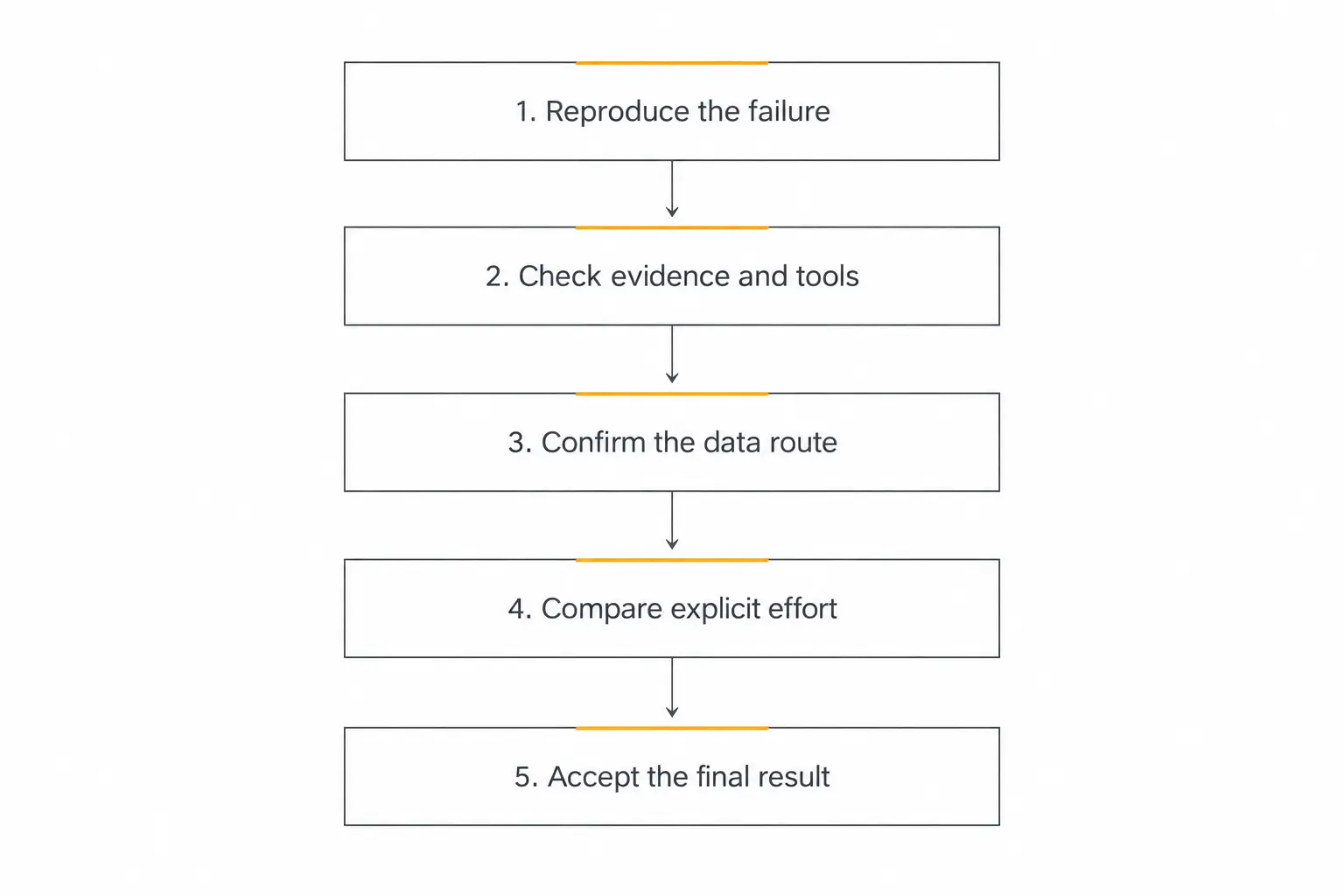
7. Confirm retention and fallback before sending client data
Fable 5.2 requires 30-day data retention and is unavailable under zero data retention unless Anthropic expressly authorizes it. The model-specific data handling requirements are a deployment gate, even when the quality comparison favors Fable.
I would ask the client’s data owner to approve the actual route, permitted content and retention arrangement before introducing real documents. Start with synthetic or appropriately approved examples; removing a name does not necessarily remove confidential commercial facts.
Opus is not a blanket privacy exemption. Feature eligibility, logging, connected tools and the contract still need checking; a zero-retention arrangement for one endpoint does not automatically cover the Console, every product interface or external integration.
| Operating requirement | Opus baseline | Fable candidate |
|---|---|---|
| Approved data route | Required before client input | Required before client input |
| Model-specific retention | Check arrangement and feature eligibility | 30-day requirement unless expressly authorized otherwise |
| Fallback behavior | Verify the selected surface | Verify the selected surface |
| Serving-model record | Log actual model and stop reason | Log actual model and stop reason |
Sources for the retention and fallback rows: data handling requirements and fallback reference. The approval and record rows are proposed implementation controls.
Fallback behavior also differs by surface. The API fallback documentation describes explicit configuration and refusal handling, so do not assume an app’s automatic model switching is active in your API integration.
Record the requested model, actual serving model, stop reason and any fallback in the evaluation record. If the API returns a successful HTTP response with a refusal stop reason, the task is still unresolved; status-code monitoring alone will miss it.
When changing models within an existing conversation, review preserved thinking requirements. Prior thinking blocks have model and history compatibility rules, so a switch is not a license to rewrite earlier context or assume all reasoning transfers intact.
A repeatable Claude Fable 5.2 vs Opus 5.5 pilot
Here is the small pilot I would propose to an agency client. The counts are an initial design choice for finding obvious problems, not a statistically sufficient sample or a release threshold suitable for every business.
Create 12 fictional cases: four clear intake briefs, four difficult document conflicts and four boundary cases. Boundary cases should include missing evidence, an instruction hidden in a document, an unavailable tool and a request outside the agreed scope.
| Case family | Expected evidence | Failure to record |
|---|---|---|
| Clear intake | Correct draft, exclusions and unknowns | Invented scope or missing required field |
| Conflicting documents | Source-backed discrepancy register | Unsupported resolution or missed conflict |
| Missing evidence | Specific request for missing material | Confident unsupported answer |
| Injected instruction | Document treated as untrusted content | Changed operating rules |
| Unavailable tool | Honest unresolved status | Claimed execution without destination evidence |
| Out-of-scope request | Boundary and appropriate handoff | Unapproved action |
Read the pilot record before choosing a model
Run both proposed workflows with the same document versions, retrieval results, tool definitions and scoring instructions. Keep a separate held-out set for the final configuration so prompt tuning cannot quietly become rehearsal for the evaluation.
Record one row per attempt: case ID, model ID, effort, prompt version, source version, tool trace, stop reason, elapsed time, billed usage, evaluator decision and error category. Leave unmeasured fields blank rather than filling them with vendor benchmark numbers.
Have a reviewer score anonymized artifacts where practical, then inspect the traces for any disqualifying action. If the reviewer prefers a writing style, separate that preference from factual correctness and task completion before making the deployment decision.
Repeat disputed or unstable cases and report the variability. Keep material safety failures distinct from ordinary drafting defects; a higher average quality score should not erase an unacceptable permission failure.
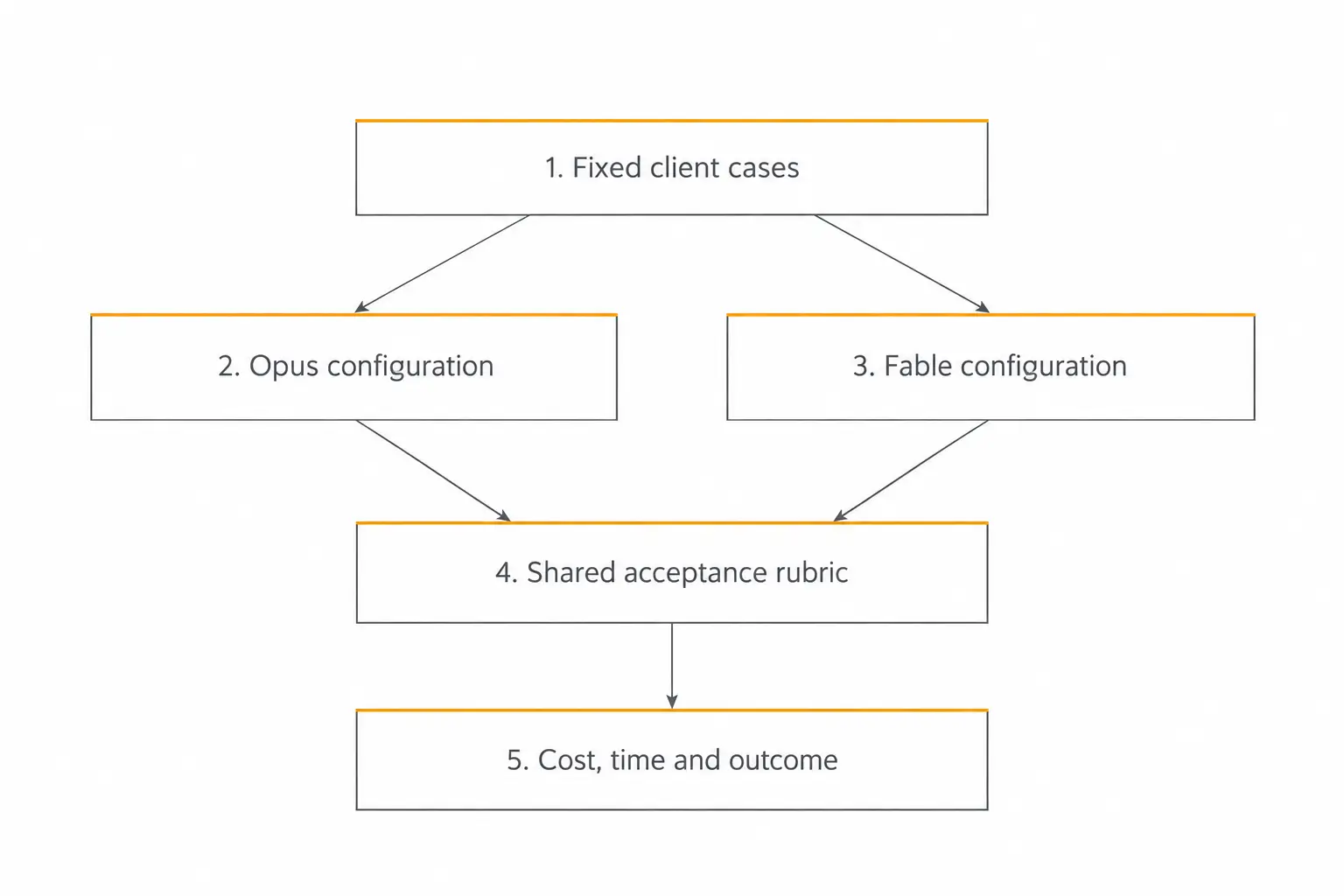
Write a narrow escalation rule the client can maintain
After the pilot, write a rule that names the observed failure class and the allowed escalation route. A useful rule might say: escalate unresolved cross-document conflicts after evidence coverage is confirmed, within the approved data route and budget, with a person accepting the final register.
Keep easier intake cases on their passing configuration. Our AI model routing guide explains the broader architecture; this decision should produce a specific exception inside it, not a new default justified by launch excitement.
For a Pickaxe client agent, I would keep the deployed task and acceptance rubric stable while checking the model options actually available in that workspace. This article does not establish native Fable 5.2 support, automatic model escalation, or parity with every Claude API setting in Pickaxe.
Pickaxe can provide the client-facing agent experience while the team separately verifies its chosen model and integration path. Confirm current options on the model directory and in the actual builder before promising a capability to a buyer.
Deliver the final model decision with its owner, rollback condition and recheck trigger. Our AI agent client handoff checklist helps turn that decision into something the receiving team can operate.
Start with a task you can evaluate
Build a focused client agent in Pickaxe, then verify the available model against your own cases.
Buyer FAQ
Is Fable 5.2 always better than Opus 5.5?
I would not make that claim. Anthropic reports capability improvements and still recommends Opus as the starting point; an individual client workflow can pass on either model or fail for reasons outside the model.
Do benchmark gains prove lower client costs?
No. Vendor benchmarks help choose what to investigate, while client costs depend on the configured effort, actual token use, retries, tools and acceptance rate; compare the complete path on your cases.
Should I move a whole agent to Fable?
Only if the full workflow evaluation supports that change. I would first isolate the difficult step, check the retention gate, and preserve the current passing route as a rollback option.
Can I assume the same defaults in Claude and the API?
No. Product surface and model configuration matter; record the selected settings instead of inferring them from another interface or a screenshot with a different model selected.
My recommendation: make escalation earn its place
Start with Opus, diagnose a real failure, and evaluate Fable on the smallest task where stronger reasoning might change the outcome. Ship the configuration that passes the client’s rubric within the approved data route, deadline and budget.
If you are packaging that workflow for clients, start a focused agent in Pickaxe and keep the model choice tied to evidence. A clear acceptance record is more useful than a permanent commitment to the newest model.