
If you've been paying attention to the AI agent space in 2026, you've probably seen two acronyms popping up everywhere: MCP and A2A.
And if you're like most people I talk to, you're not entirely sure what either one does — or why you should care.
Fair enough. The MCP vs A2A protocol debate has generated a lot of noise. Hot takes on X. Breathless blog posts about "protocol wars." Enterprise vendors slapping both logos on their marketing pages.
But here's the thing most of that content gets wrong: MCP and A2A aren't competitors. They solve completely different problems. And understanding the difference matters if you're building anything with AI agents right now.
I spent the last few weeks digging into both protocols — reading the specs, looking at real implementations, and talking to builders who are actually shipping with them. Here's what I found.
The One-Sentence Version
MCP gives your agent hands. A2A gives your agents colleagues.
That's the core distinction, and it's worth sitting with for a second.
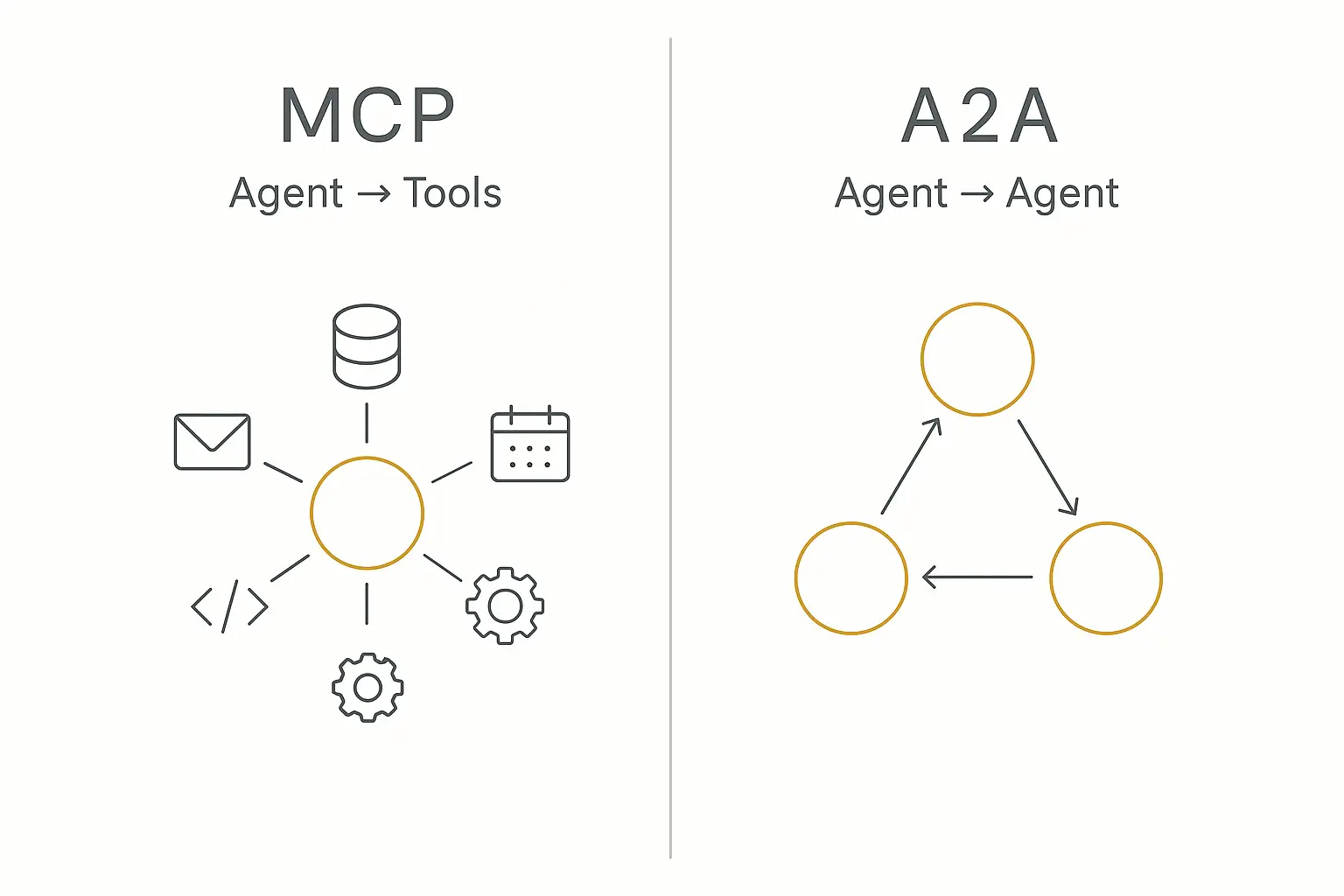
The Model Context Protocol (MCP) standardizes how a single AI agent connects to external tools and data sources. Think of it as the USB-C port for AI — one universal interface that lets any agent plug into any tool.
The Agent-to-Agent (A2A) protocol standardizes how multiple AI agents communicate with each other. It's the coordination layer — how agents discover each other, delegate tasks, and pass work back and forth.
One handles agent-to-tool communication. The other handles agent-to-agent communication. Different layers, different jobs.
What Is MCP (Model Context Protocol)?
MCP was created by Anthropic and released in November 2024. The problem it solves is deceptively simple.
Before MCP, if you wanted an AI agent to talk to, say, your Slack workspace, your PostgreSQL database, and your GitHub repos, you needed three separate custom integrations. Every AI platform had to build its own connectors. Every tool vendor had to support every AI platform.
This is the classic M×N integration problem. With M AI platforms and N tools, you need M × N integrations. MCP reduces that to M + N.
Every AI platform implements MCP once. Every tool implements an MCP server once. Then everything connects to everything.
How MCP Works Under the Hood
MCP uses a client-server architecture built on JSON-RPC 2.0. There are three key components:
- Hosts — The AI applications users interact with (Claude Desktop, ChatGPT, Cursor, any number of AI platforms)
- Clients — The connectors within the host that communicate with servers
- Servers — Lightweight services that expose specific capabilities (a GitHub server, a Slack server, a database server)
Each MCP server can expose four types of capabilities:
- Resources — Read-only data the agent can access (like files, database records, or API responses)
- Tools — Executable actions the agent can take (like sending a message, creating a file, or running a query)
- Prompts — Reusable template instructions for common tasks
- Sampling — The ability for a server to request LLM completions back from the host (reverse calls)
MCP supports three transport options:
- stdio — For local tools and CLI integrations
- SSE (Server-Sent Events) — For remote servers
- Streamable HTTP — For production cloud deployments
MCP Adoption: The Numbers Tell the Story
The adoption curve for MCP has been unlike anything I've seen in developer tooling.
In 16 months, MCP went from 100,000 to 97 million monthly SDK downloads — a 970x increase. The public server registry grew from about 1,200 servers in Q1 2025 to over 9,400 by April 2026. An independent audit by Zuplo indexed over 17,000 MCP servers across all registries.
But the adoption stat that really matters: 78% of enterprise AI teams now report at least one MCP-backed agent in production.
Every major AI lab and IDE now ships MCP support. Claude (native from day one), OpenAI's ChatGPT and Agents SDK, Google's Gemini API and Vertex AI, Cursor, Windsurf, JetBrains, and the Vercel AI SDK. Even platforms like Pickaxe now support MCP integrations for connecting agents to external automation tools like Make, Zapier, and n8n.
MCP won. Not in the sense of beating A2A (again, different layers) — but in the sense that it's become the de facto standard for agent-to-tool connectivity. The protocol war at this layer is over.
What Is A2A (Agent-to-Agent Protocol)?
A2A was created by Google and launched in April 2025 — about five months after MCP. While MCP asks "how does an agent talk to tools?", A2A asks a different question entirely: "how do agents talk to each other?"
This matters more than it sounds like at first. Most AI deployments today run a single agent. But as systems get more complex, you start needing specialized agents that collaborate.
Picture a customer service system. You might have a triage agent that classifies incoming requests, a billing agent that handles payment questions, a technical support agent that troubleshoots issues, and an escalation agent that loops in humans when needed.
Each agent is good at one thing. But they need to find each other, hand off tasks, and share results. That's what A2A solves.
How A2A Works Under the Hood
A2A uses a client-remote architecture (not client-server — the distinction is intentional, since both sides are autonomous agents). It also runs on JSON-RPC 2.0 over HTTP, with support for Server-Sent Events and webhooks.
The key concepts in A2A:
Agent Cards are the discovery mechanism. Every A2A agent publishes a JSON document at /.well-known/agent-card.json describing what it can do. Think of it as a business card — it lists the agent's name, capabilities, supported input/output types, and authentication requirements.
Tasks are the core unit of work. When one agent asks another to do something, it creates a task. Tasks flow through a lifecycle: submitted → working → completed (or failed, or canceled). There's also an input-required state for when the remote agent needs more information.
Messages and Artifacts carry the actual data. Messages are the back-and-forth conversation between agents during a task. Artifacts are the deliverables — the final outputs the remote agent produces.
A2A Adoption: Still Early, But Real
A2A is about a year younger than MCP, and the adoption numbers reflect that.
As of May 2026, over 150 organizations support the A2A protocol, according to the Linux Foundation's latest numbers. Supporters include Google, Microsoft, AWS, Salesforce, SAP, ServiceNow, Workday, and IBM.
There are real production deployments happening. Salesforce's Agentforce exposes custom agents as A2A endpoints. SAP's Joule orchestrator delegates tasks to partner A2A agents across S/4HANA. ServiceNow's Now Assist registers A2A agents as skills for incident triage.
But let's be honest: most A2A implementations in the wild are still proofs of concept. The protocol hit v1.0 in early 2026, and production multi-agent systems using A2A for cross-vendor communication are still uncommon outside of enterprise environments.
That doesn't mean it's not important. It means it's early. And early is exactly when builders should be paying attention.
MCP vs A2A Protocol: Head-to-Head Comparison
Here's the side-by-side breakdown of MCP vs A2A protocol across the dimensions that actually matter:
| Dimension | MCP (Model Context Protocol) | A2A (Agent-to-Agent) |
|---|---|---|
| Created by | Anthropic (Nov 2024) | Google (Apr 2025) |
| Primary purpose | Agent ↔ Tool integration | Agent ↔ Agent communication |
| Architecture | Client-Server | Client-Remote (peer-to-peer) |
| Wire format | JSON-RPC 2.0 | JSON-RPC 2.0 over HTTP |
| Discovery | Configuration-based | Automatic via Agent Cards |
| Core unit of work | Tool call / Resource read | Task lifecycle |
| State management | Session-based | Task-based state machine |
| Transport options | stdio, SSE, Streamable HTTP | HTTP, SSE, webhooks, gRPC |
| Auth model | Protocol-agnostic (implementer's choice) | Built-in OAuth 2.0, API keys, mTLS |
| Maturity (May 2026) | Production-ready, universal adoption | v1.0, growing adoption, mostly enterprise |
| Best analogy | USB-C port (connect to anything) | Phone line (coordinate with colleagues) |
The table makes it clear: these protocols operate at different layers. Comparing them head-to-head is a bit like comparing HTTP and SMTP — technically both are communication protocols, but they solve fundamentally different problems.
How MCP and A2A Work Together
The real insight is that MCP and A2A form a complementary protocol stack. Here's how it actually works in practice.
Imagine you're building an AI-powered consulting workflow. You have three specialized agents:
- A research agent that gathers market data
- An analysis agent that processes numbers and creates visualizations
- A writing agent that drafts the final report
Each agent uses MCP to connect to its tools. The research agent has MCP servers for web search, document access, and database queries. The analysis agent connects to spreadsheet tools and charting libraries. The writing agent has access to templates and document generators.
The agents use A2A to coordinate with each other. The research agent discovers the analysis agent via its Agent Card, sends a task with the raw data, and gets back processed insights. The analysis agent then delegates to the writing agent with the visualizations and key findings.
MCP handles the vertical connections (agent to tools). A2A handles the horizontal connections (agent to agent). Together, they form the complete interoperability stack.
The Emerging Three-Layer Model
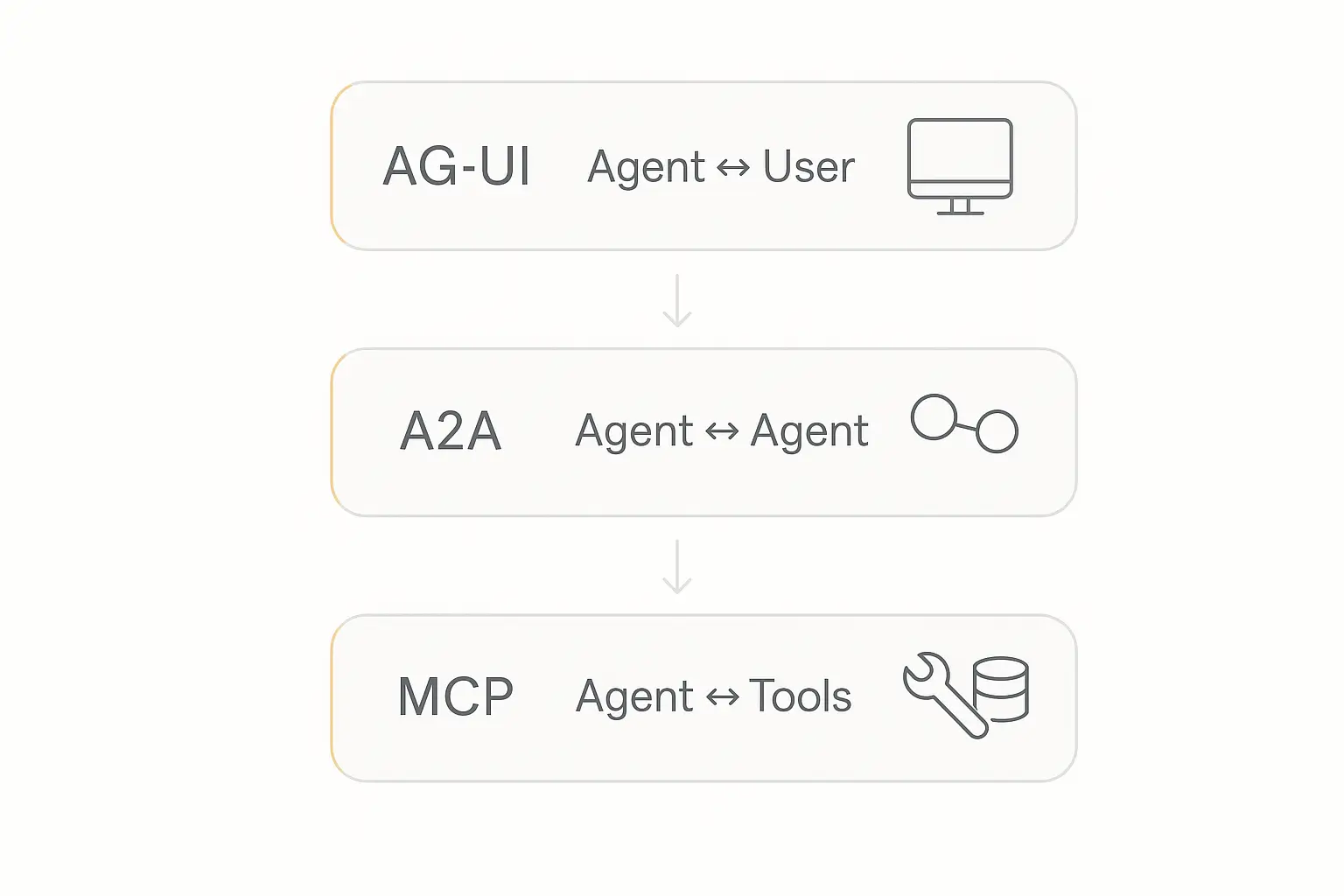
Some builders are also looking at a third layer: AG-UI (Agent-User Interface protocol), which standardizes how agents talk to frontends. AG-UI handles streaming UI updates, state synchronization, and human-in-the-loop workflows.
The full stack looks like:
- AG-UI — Agent ↔ User interface (the presentation layer)
- A2A — Agent ↔ Agent communication (the coordination layer)
- MCP — Agent ↔ Tool integration (the capability layer)
We're still in the early days of this three-layer model, but it's the direction the industry is heading.
When to Use MCP (And When You Don't Need A2A)
Here's the practical decision framework. Start with MCP. Add A2A only when you genuinely need it.
Use MCP when:
- You have an AI agent that needs to access external tools or data
- You want tool interoperability across multiple AI frameworks
- You're building a single agent that needs to do many things (search, send emails, query databases)
- You're building on a platform that supports MCP (which at this point is basically all of them)
For the majority of builders, MCP alone is enough. One agent with well-configured MCP servers can handle surprisingly complex workflows.
This is especially true if you're using a no-code platform like Pickaxe, where Actions already abstract the tool-integration layer. You don't need to think about protocols at all — the platform handles the connectivity behind the scenes. For most no-code agent builders, the MCP layer is invisible.
When to Add A2A to the Mix
Add A2A when:
- You're building a multi-agent system where specialized agents need to collaborate
- You need agents from different vendors or organizations to communicate
- Your workflow requires autonomous task delegation — agents deciding which other agent should handle which part of a request
- You need dynamic discovery — agents finding and evaluating other agents' capabilities at runtime
A Cornell University benchmark found that coordinated multi-agent systems showed 70% higher goal success rates compared to single-agent setups for complex tasks. But — and this is key — that's for genuinely complex tasks that benefit from specialization.
Don't over-engineer. If a single agent with good tools can handle your use case, adding A2A coordination is unnecessary complexity. The protocol exists for when you truly need multiple autonomous agents working together.
Build agents that connect to anything
Pickaxe agents support Actions that integrate with your tools — no protocol debates required.
Real-World Implementation Patterns
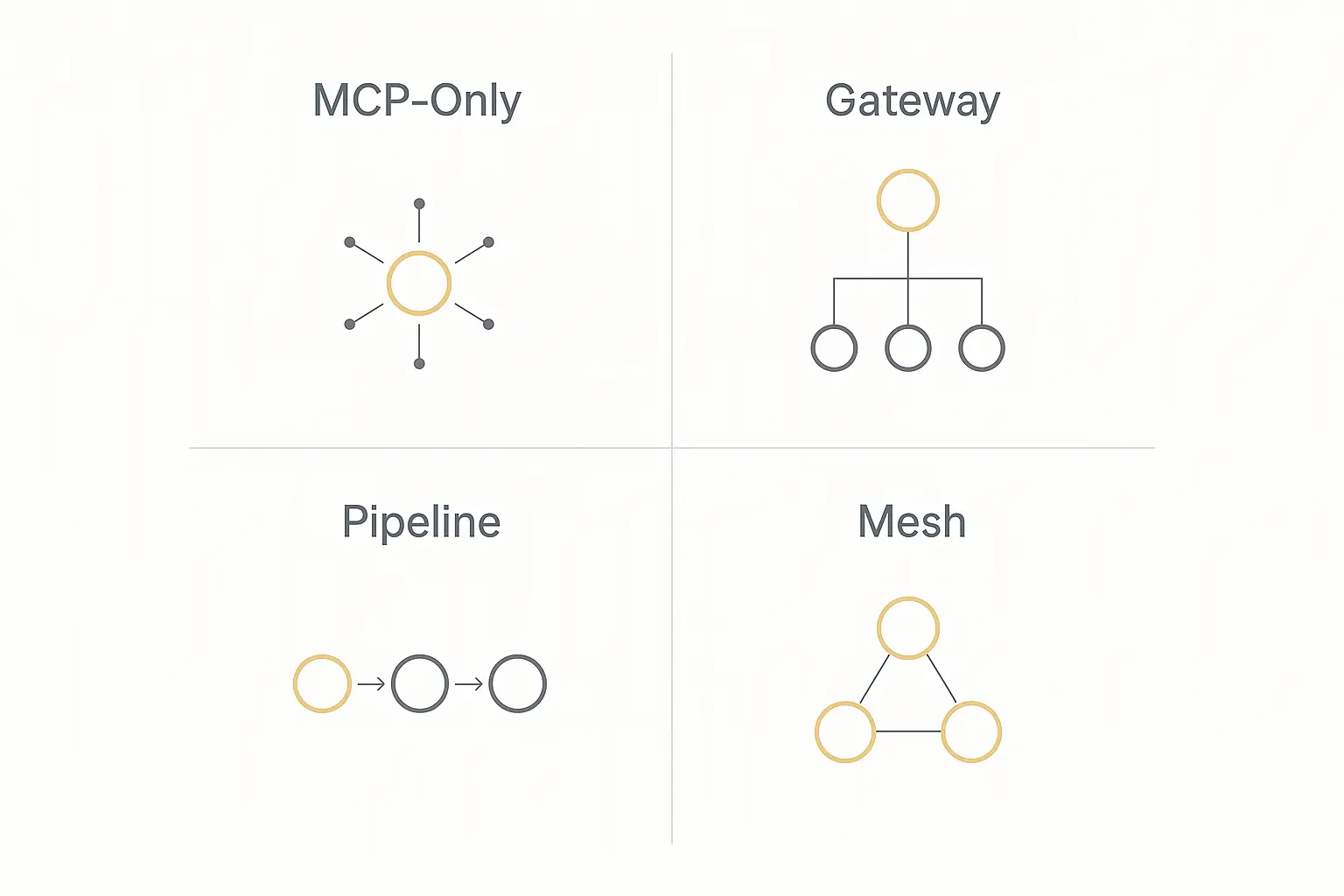
Here are the four most common architecture patterns I'm seeing builders use in 2026:
Pattern 1: MCP-Only (Most Common)
A single agent connected to multiple MCP servers. This is what 80%+ of production AI deployments look like right now.
Example: A consulting firm builds one AI assistant that connects to their CRM (via MCP), their document store (via MCP), and their calendar (via MCP). One agent, multiple tools. No A2A needed.
If you're running an AI agent agency or building tools for clients, this is probably your architecture for the foreseeable future.
Pattern 2: Gateway Agent
One user-facing agent that delegates to specialized backend agents via A2A.
Example: A customer service system where a front-door agent triages requests and routes them to billing, technical support, or returns agents. The front-door agent discovers specialists via their Agent Cards and creates tasks for the appropriate one.
Pattern 3: Pipeline
Agents arranged in sequence, each processing and enriching data before passing it along via A2A.
Example: A content workflow where a research agent gathers data, an analysis agent extracts insights, a writing agent drafts the content, and a review agent checks quality. Each stage is its own agent, and the output flows forward.
Pattern 4: Mesh
Fully peer-to-peer, where any agent can communicate with any other agent. The most complex pattern.
Example: A research team of agents where a literature agent, a data agent, and a hypothesis agent all exchange findings dynamically based on what they discover. This requires sophisticated A2A coordination and is still rare in production.
The Governance Story: Why Both Protocols Are Here to Stay
One thing that gives me confidence about both MCP and A2A is the governance structure.
In December 2025, the Agentic AI Foundation (AAIF) was formed under the Linux Foundation. Both MCP and A2A are now governed by this neutral body, with co-founding members including Anthropic, Google, OpenAI, Microsoft, AWS, and Block.
As of May 2026, AAIF has 190 member organizations — making it one of the fastest-growing projects in Linux Foundation history. They're running MCP Dev Summits in cities worldwide throughout 2026.
This matters for builders because it means:
- No single company controls either protocol. Anthropic can't lock down MCP. Google can't gatekeep A2A.
- Enterprise adoption accelerates when governance is neutral. Companies that wouldn't bet on a competitor's proprietary protocol will bet on a Linux Foundation standard.
- Both protocols will evolve in coordination rather than fragmenting. The AAIF is explicitly working on making MCP and A2A interoperate cleanly.
Google also recently announced the Agent Payments Protocol (AP2), an extension of A2A for handling secure transactions between agents. The protocol stack keeps growing.
Security Considerations: What Each Protocol Gets Right (and Wrong)
Security is where these protocols show their different design philosophies.
MCP Security
MCP is auth-agnostic by design. The protocol itself doesn't mandate how authentication works — that's left to the implementer. This is both a strength (flexibility) and a weakness (inconsistency).
The main risks with MCP:
- Tool poisoning — A malicious MCP server could return manipulated data to influence agent behavior
- Prompt injection via tools — External data returned through MCP could contain instructions that override the agent's behavior
- Over-permissioned access — MCP servers that expose more capabilities than the agent needs
Best practice: apply least-privilege access to every MCP server connection and validate all data returned from external sources.
A2A Security
A2A takes a more opinionated approach to security. The protocol has built-in support for OAuth 2.0, OpenID Connect, API keys, HTTP auth, and mutual TLS. Agent Cards declare their authentication requirements upfront.
The main risks with A2A:
- Agent impersonation — A malicious agent publishing a fake Agent Card to intercept tasks
- Cascade attacks — A compromised agent in a multi-agent chain that poisons downstream results
- Data leakage — Sensitive information flowing between agents without proper access controls
Best practice: use mutual TLS for agent-to-agent communication, implement audit logging at every delegation point, and rate-limit task creation.
Five Mistakes I Keep Seeing Builders Make
After looking at dozens of implementations, here are the patterns that keep going wrong:
1. Using A2A When MCP Is Enough
If your workflow is deterministic — if you know exactly which tools need to be called in which order — you don't need agent-to-agent communication. You need one agent with well-orchestrated tool calls. A2A adds overhead (discovery, task lifecycle, message passing) that's only worth it when you genuinely need autonomous delegation.
2. Ignoring MCP Server Security
Every MCP server is a potential attack surface. I've seen builders connect to community MCP servers without reviewing the code, grant servers unrestricted filesystem access, or skip input validation. Treat every MCP server like an API dependency — audit it, scope its permissions, and monitor its behavior.
3. Building Custom Protocols Instead of Using Standards
Some teams are still building custom agent-to-tool or agent-to-agent communication layers. In 2024, that made sense — the standards didn't exist yet. In 2026, you're creating technical debt. MCP and A2A have the ecosystem, the tooling, and the momentum. Use them.
4. Confusing Tool Orchestration With Agent Orchestration
Calling three APIs in sequence isn't multi-agent coordination. It's a workflow. The distinction matters because multi-agent systems introduce autonomous decision-making — agents choosing what to do, not just executing a predefined script. If your "agents" are just running scripted tool calls, you have a pipeline, not a multi-agent system.
5. Over-Engineering With Multi-Agent Architecture
This is the biggest one. Building a mesh of six specialized agents when a single well-prompted agent with good tools would do the job. Multi-agent systems are harder to debug, harder to monitor, and harder to explain to clients. Start with the simplest architecture that works, and add complexity only when you have evidence it's needed.
This is especially relevant if you're building agents for clients. A consultant who deploys a monetized AI agent on Pickaxe doesn't need to think about agent protocols — the platform handles tool connections through Actions, and the agent just works. Don't introduce protocol-level complexity when the problem doesn't demand it.
What This Means for No-Code Agent Builders
If you're building AI agents on no-code platforms, the MCP vs A2A protocol question is mostly academic — for now.
Platforms like Pickaxe abstract the tool-integration layer entirely. When you add an Action to connect your agent to Google Sheets or HubSpot or Zapier, you're benefiting from MCP-style standardization without touching a protocol spec. The platform does the heavy lifting.
A2A will matter more to no-code builders once platforms start supporting multi-agent orchestration natively. Imagine setting up a portal where a lead qualification agent automatically hands off to an onboarding agent, which delegates to a CRM-update agent. That's the A2A pattern, packaged in a no-code interface.
We're not quite there yet in the no-code world, but it's coming. And when it arrives, understanding the underlying architecture will help you build a better agency and design smarter workflows for your clients.
What's Coming Next for Both Protocols
Both MCP and A2A have active roadmaps for the rest of 2026 and beyond.
MCP Roadmap Highlights
- Enhanced authentication — Moving from auth-agnostic to providing standard auth patterns
- Registry improvements — Better server discovery, verification, and trust scoring
- Performance optimizations — Reducing latency for real-time tool calls
- Elicitation — Standardized patterns for servers to request additional context from users
A2A Roadmap Highlights
- Agent Payments Protocol (AP2) — Secure transactions between agents, already announced
- Enhanced streaming — Better support for long-running tasks with real-time updates
- Compliance metadata — Agent Cards that declare regulatory compliance capabilities
- Cross-organization trust — Standardized trust frameworks for agents communicating across company boundaries
Frequently Asked Questions
Is MCP better than A2A?
Neither is "better." They solve different problems. MCP handles agent-to-tool connections; A2A handles agent-to-agent communication. Most production systems will eventually use both. If you're building a single agent that needs tool access, MCP is what you want. If you're building multiple agents that need to coordinate, you'll want A2A too.
Do I need to learn both protocols to build AI agents?
Not necessarily. If you're using a no-code platform, both protocols are abstracted away from you. If you're coding agents from scratch, start with MCP — it's more mature, has better tooling, and covers 80%+ of use cases. Add A2A when you have a genuine multi-agent coordination need.
Can I use MCP and A2A together?
Yes, and that's the intended design. Each agent uses MCP to connect to its tools, and agents use A2A to communicate with each other. The Agentic AI Foundation is actively working to ensure both protocols interoperate cleanly.
Who governs these protocols?
Both are open-source projects under the Agentic AI Foundation (AAIF), part of the Linux Foundation. The AAIF has 190 member organizations including Anthropic, Google, OpenAI, Microsoft, and AWS. No single company controls either protocol.
What about ACP (Agent Communication Protocol)?
ACP, created by IBM, is sometimes mentioned alongside MCP and A2A. It focuses on agent communication within a single runtime environment — more like an internal message bus than an inter-organizational protocol. It's less widely adopted than MCP or A2A and serves a more specialized use case.
Is MCP only for Anthropic/Claude?
No. While Anthropic created MCP, it's now an open standard governed by the Linux Foundation. OpenAI, Google, Microsoft, and virtually every major AI tool supports it. MCP is model-agnostic and vendor-neutral.
When will A2A be production-ready for most builders?
A2A is already production-ready at the protocol level (v1.0 shipped in early 2026). The tooling and ecosystem around it are catching up. For enterprise teams building custom multi-agent systems, it's ready now. For no-code builders, expect platform-level support to roll out through late 2026 and into 2027.
The Bottom Line
The MCP vs A2A protocol question isn't really a versus at all. It's a "both, in the right order" situation.
Start with MCP. It's mature, universally supported, and covers the agent-to-tool layer that every AI deployment needs. Connect your agents to the tools and data they need to be useful.
Add A2A when the problem demands it. When you're building genuinely complex multi-agent systems — where specialized agents need to discover, delegate to, and coordinate with each other autonomously — A2A provides the standardized coordination layer.
And if you're building on a no-code platform, you probably don't need to think about either protocol directly. The platforms handle the plumbing. Focus on building agents that solve real problems for real people.
That's what matters. The protocols are just the infrastructure that makes it possible.