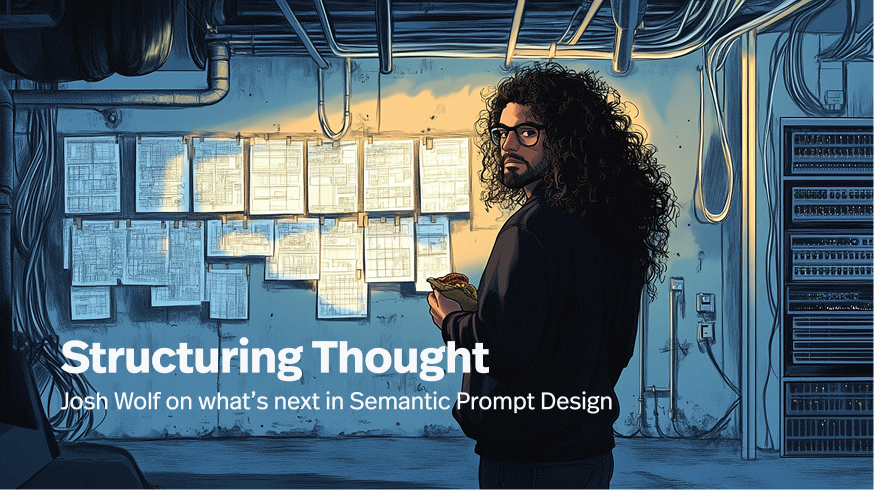
This is a historical companion to Josh Wolf's comprehensive semantic prompt design guide. I would use that guide for the practical framework and this page for its context in Pickaxe's publishing.
The original guide and its ideas
Wolf's guide describes organizing an AI conversation around its purpose, audience, opening, information gathering, and response. It makes the intended interaction explicit rather than treating a prompt as an isolated question.
Those ideas are useful when an agent needs to collect information or help a user navigate a defined task. A modular structure also makes it easier to change one part of the interaction without rewriting everything.
What the history does not establish
The publication of a named framework does not prove that it became an industry standard or caused a specific improvement in legal, medical, or robotics systems. This page does not attribute quantitative performance gains to the framework.
I would evaluate an implementation on its own task and evidence. Clear instructions can help, but source quality, model behavior, permissions, and testing still matter.
How I would use the ideas today
- Define a small job and a concrete completion rule.
- Separate the conversation structure from approved business facts.
- Give the agent an explicit response to missing information.
- Test the routine path and the cases that require escalation.
- Repeat the tests after changing a prompt, model, source, or integration.
The comprehensive guide includes a reusable template. Our prompting, RAG, and fine-tuning comparison explains which intervention fits different failures, and the onboarding example applies a structured workflow to a specific task.
Related provider guidance
For current implementation details, I would also consult Anthropic's prompt engineering overview and OpenAI's prompt engineering guide. They are separate provider resources, not evidence of adoption of Pickaxe's named framework.