

What our latest launch revealed about who gets seen and whose votes count
Product Hunt's leaderboard is not a level playing field. The team chooses which launches get the homepage. Votes carry different weights. And the products we compared began around 50 points while we began at zero. Those are the displayed starting balances in our screenshots; the dashboard does not establish how they were assigned.
On November 10, we launched Sell Personal Agents with Pickaxe. We estimate that around 150 people upvoted us. We finished with 42 points, in position #52. The starting balance of the top three launches in our dashboard was larger than everything we earned all day.
We also gained more points after launch than four products in our dashboard comparison, yet stayed buried below page one. A final ranking leaves out a lot when it puts editorial selection, unequal starting positions, and weighted votes behind a single number.
Product Hunt chooses who gets seen
Product Hunt hand-picks the launches that appear on its homepage leaderboard. Its own explanation of how the platform works says that featured launches compete for the day's ranking, including Product of the Day. Editorial selection determines who enters that competition.
The AMA with Gabe Perez, who leads leaderboard curation, states it directly in the title: “I decide what's featured on the leaderboard.”
If you aren't selected, your launch still goes live, but it sits outside the default homepage feed. People can find it through your direct link or by opening the list of all launches. Your community can show up and support you without your product ever getting the same exposure as the featured launches.
We brought people to Product Hunt. Our launch stayed outside its featured feed. That is the exchange founders need to understand: bringing your audience to the platform does not mean the platform will bring its audience to you.
The 50 point head start is visible in the dashboard
Look at the starting positions of Alsona, Maxma, and TK by Medium in our launch dashboard. All three begin around 50 points. Pickaxe begins at zero.
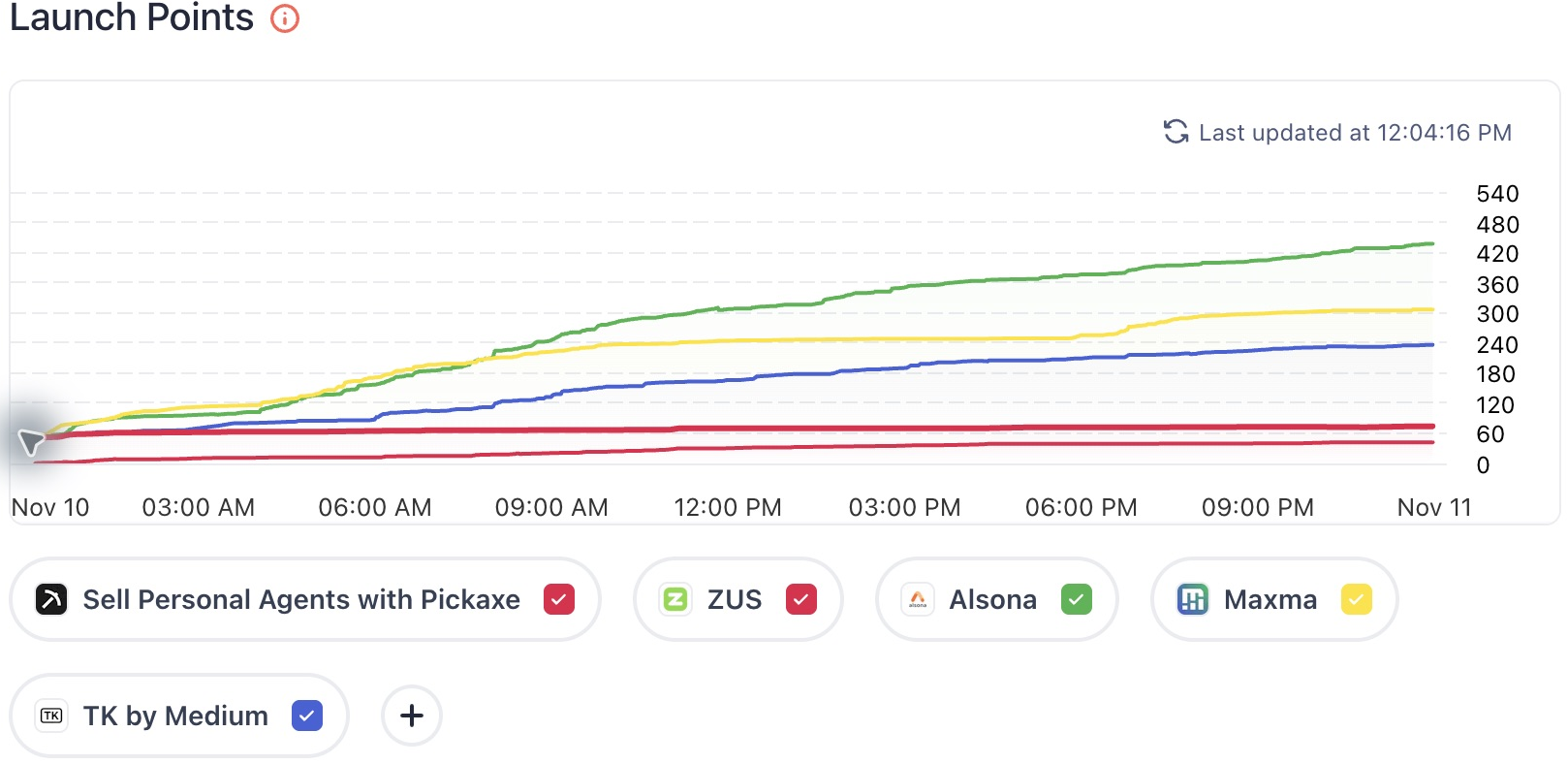
Fifty points at the starting line is a real advantage, whatever the platform calls it. The gap is visible in Product Hunt's own dashboard. The launches in that screenshot did not begin on equal terms.
We earned 42 points all day. Those products began around 50. Their head start alone was enough to stay above our final score, even before adding any further support.
The head start came with homepage placement. Featured launches could collect support from people browsing the feed. We had to bring people directly to our page. The products that began ahead also had better access to the audience that could help them pull further ahead.
We may have missed the editorial review window
Product Hunt's featuring guidance emphasizes originality, a clear difference from alternatives, plain language, a working product people can try, and a meaningful new release. The AMA also stresses actual product screenshots or video. Those are reasonable criteria for an editorial review.
We kept our launch in draft until roughly 12 hours before it went live, then scheduled it.
In the AMA, Gabe recommends allowing at least 24 hours for moderation. He says he reviews launches in advance and monitors them while they're live.
We suspect that short notice hurt our chances of being reviewed before launch.
Without a feature, we entered the day outside the homepage feed. Gaining points later did not get us into it. A decision made around the launch shaped our access to the audience for the rest of the day.
A real supporter can vote and count for zero
An upvote does not necessarily add a point. A real person can support your product and contribute nothing to its score.
Product Hunt says this explicitly in its forum post on vote selling. An account with a recently created Gmail address and no contribution history can count for zero points, even when the user is well intentioned. An established account with stronger identity and participation signals can carry much more weight.
Its homepage ranking explanation also lists featured status itself among the factors affecting points, alongside community engagement and vote authenticity. Being featured matters beyond simply getting seen.
Our estimate is around 150 upvoters. Our dashboard recorded 42 points. That score can include comments and other engagement, so it cannot be read as a raw vote total. The people who showed up and the public number are different measures.

Product Hunt has to fight vote sellers and fraud. That does not make every consequence of its scoring system fair. The platform's own explanation acknowledges that a well-intentioned person's vote can count for zero. Real support can be discounted alongside the activity the system is designed to stop.
A customer can know your product well and still be a newcomer to Product Hunt. Being new to the platform does not make that person's judgment about your product worthless. Yet the leaderboard can give that support little or no weight.
We beat featured launches after 12:01 and still got shoved below page one
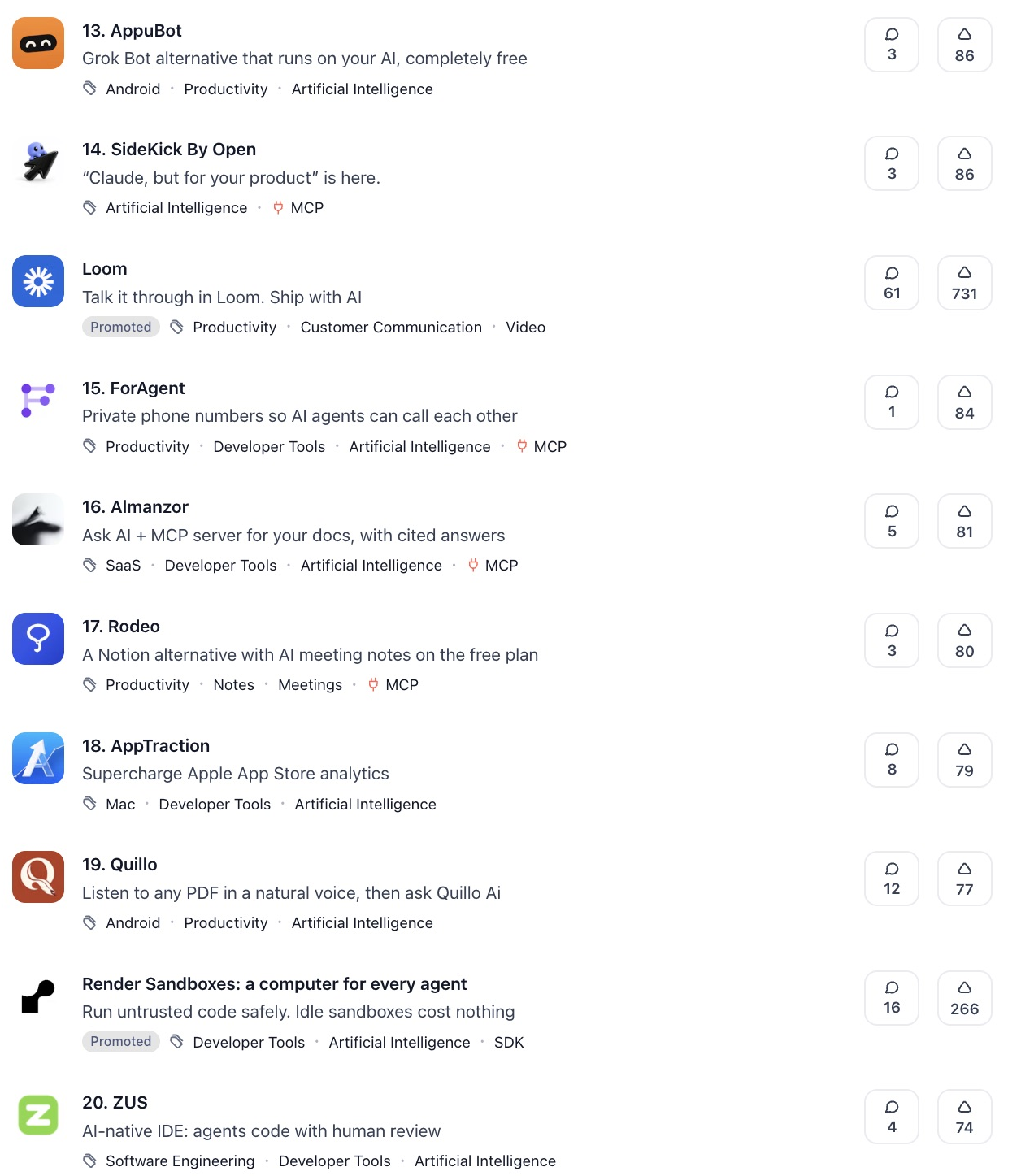
After 12:01 a.m. Pacific, we put more points on the board than AppuBot, SideKick By Open, ForAgent, and ZUS. We still finished #52, shoved below page one.
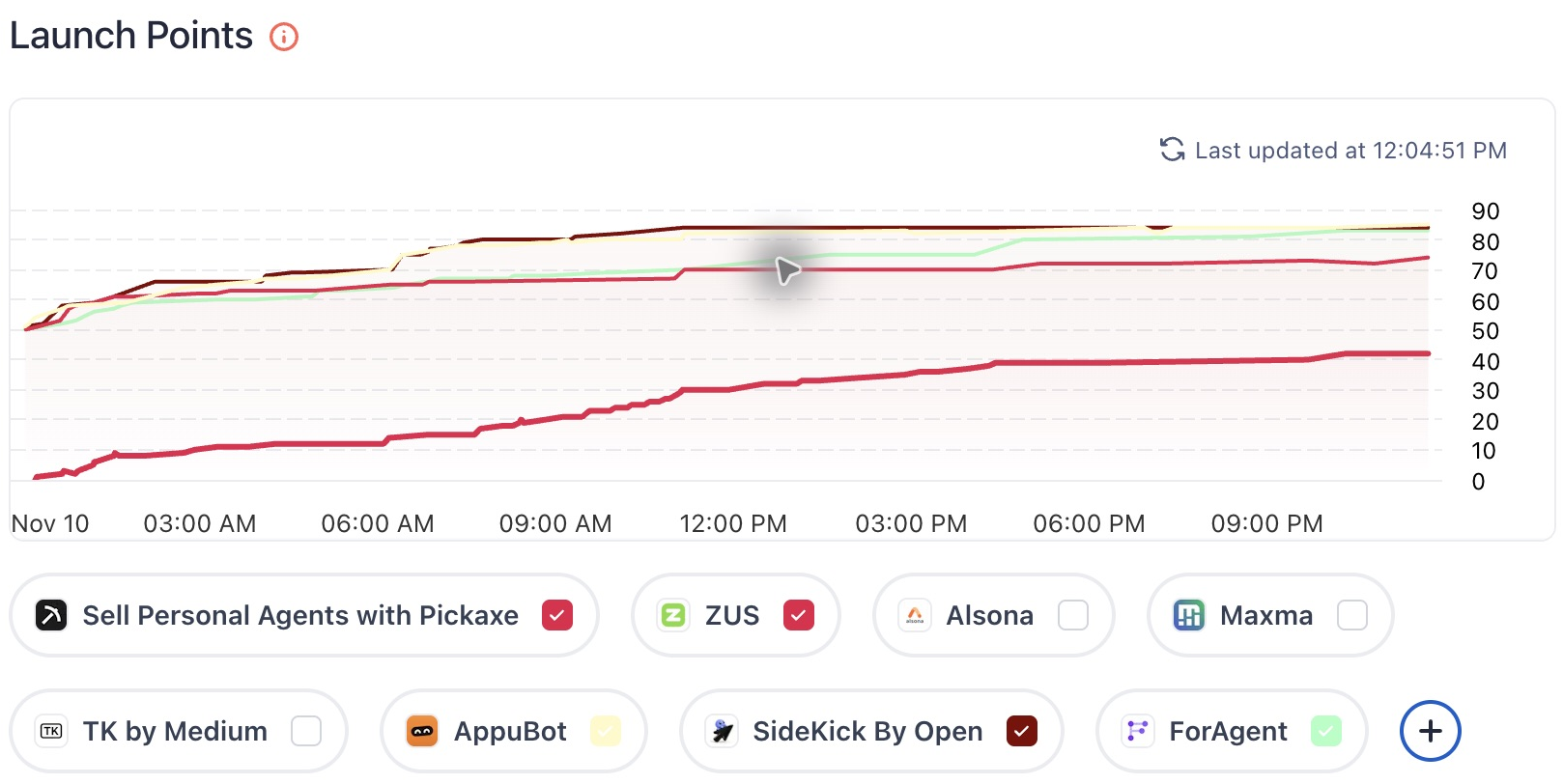
Our dashboard shows Pickaxe climbing from zero to 42. ZUS starts around 50 and ends around 74. AppuBot and SideKick By Open end in the mid-80s after starting around 50. ForAgent ends around 84.
| Launch | Starting points | Points at end of chart | Points gained |
|---|---|---|---|
| Pickaxe | 0 | 42 | 42 |
| ZUS | 50 | 74 | 24 |
| AppuBot | 50 | 85 | 35 |
| SideKick By Open | 50 | 85 | 35 |
| ForAgent | 50 | 84 | 34 |
We outgrew all four after the clock started, while buried outside the featured feed. The featured launches had homepage exposure helping them collect organic support. We were working our way up from zero without that placement.
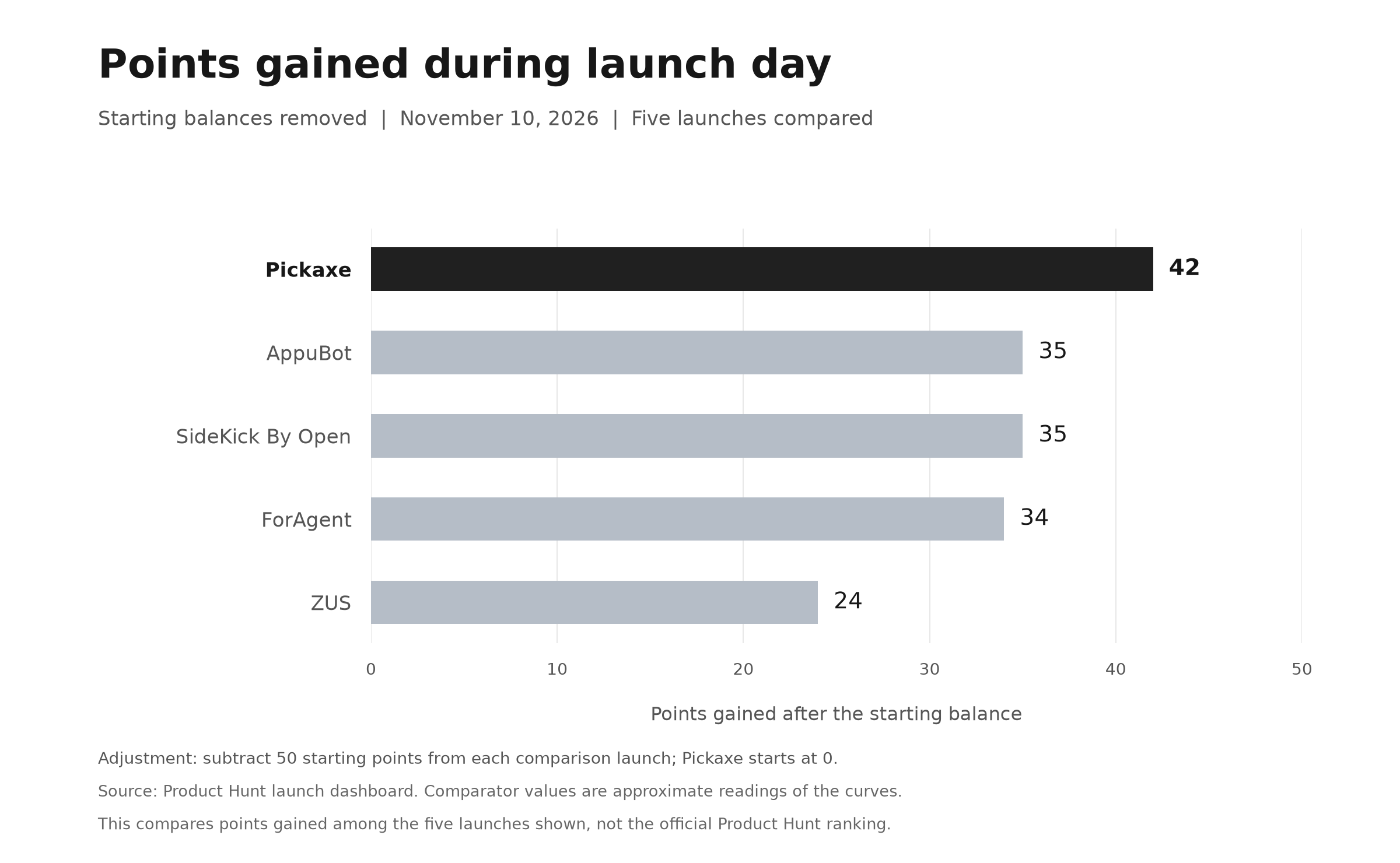
Subtract the 50-point starting balances and we finish first in this five-product comparison. That is a comparison of points gained during the day. The official result still left us at #52. Gaining more points after launch did not get us onto page one.
The starting advantage outweighed our entire day's points. In these comparisons, beginning ahead mattered more to the final total than gaining more points once the launch was live. Read the ranking without that context and you miss what actually happened.
Product Hunt needs to show founders the actual rules
This is how a contest gets stacked. The platform selects who gets the audience. Some launches begin with a 50-point lead. People you bring in can have their support heavily discounted. Each disadvantage makes the next one harder to overcome.
A #52 finish hides the fact that our launch-day point growth beat all four comparison products. Our community showed up. The dashboard shows how little the final rank tells you about that effort.
Product Hunt should show the starting balance separately from points gained. It should show raw voter totals alongside the weighted score, give makers a clear review status before launch, and explain the visibility consequences of not being featured. Makers should be able to understand their results without reverse-engineering a dashboard.
Founders spend their time on these launches, and they spend their customers' goodwill too. People create accounts, try products, leave comments, and lend their names to something they care about. They deserve to know how that effort will be treated before being asked to show up.
Founders should schedule early and make their products easy to test. But no founder should mistake a low rank for proof that customers didn't care. In our case, people showed up and we outgrew products that remained ahead.
Makers deserve to know which part of the result reflects the community and which part reflects Product Hunt's own choices. Today, those influences sit behind the same ranking. Until the platform makes that distinction clear, its leaderboard does not deserve to be treated as a verdict on your product.